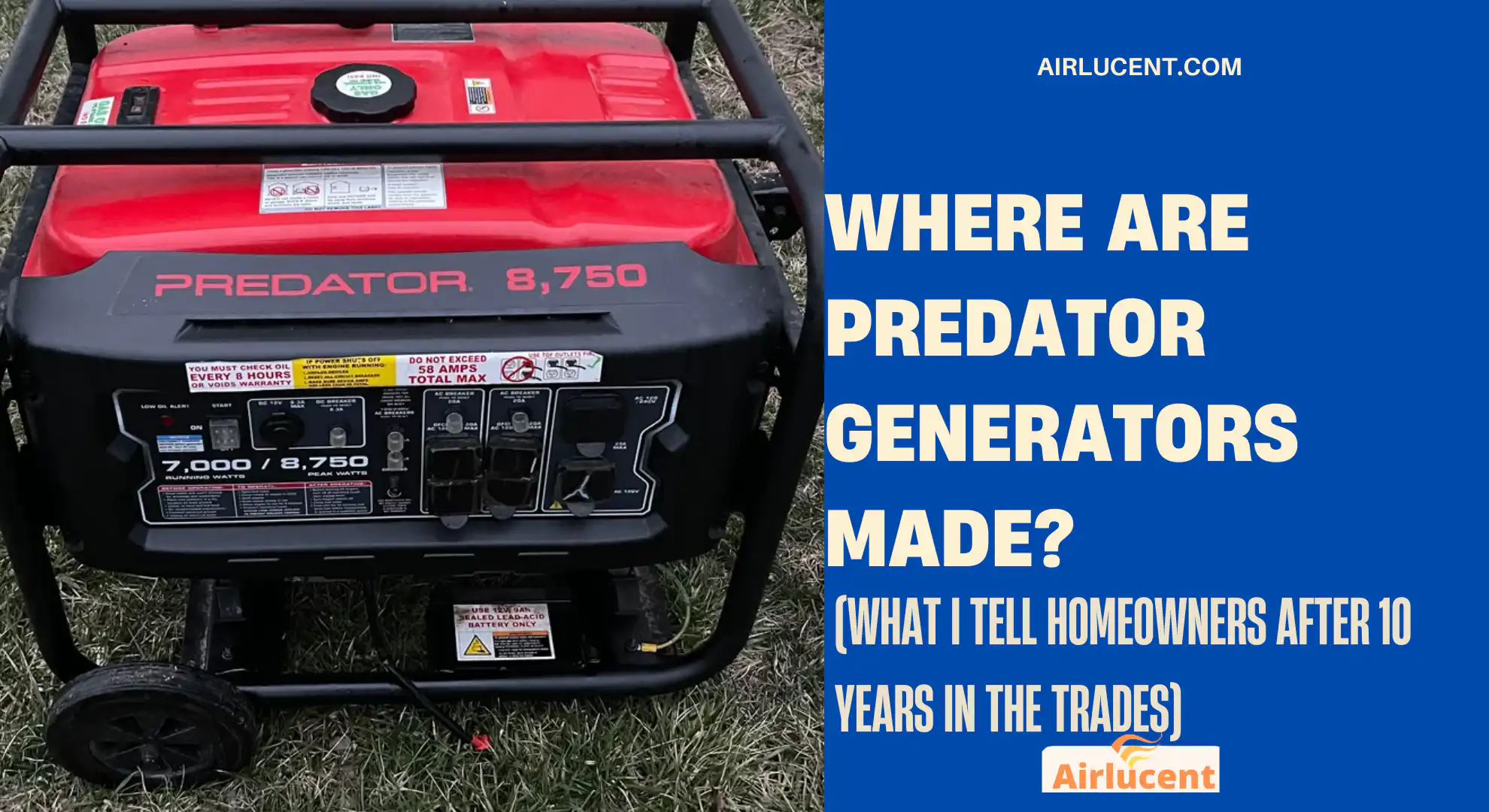
If you are trying to figure out where Predator generators are made, here’s the straight answer:
Predator generators are manufactured and assembled in China, then imported and sold in the United States by Harbor Freight Tools. Any U.S. work is typically limited to distribution, retail, and quality checks after import, not factory production.
I’m Nathan. I’ve worked as an HVAC technician for 10 plus years, and I’ve seen a lot of “backup power panic” during heat waves, ice storms, and surprise outages. When someone asks me about a generator, they usually think they’re asking about watts. What they’re really asking is:
Will this thing start when I need it, and can I trust it?
Country of origin is part of that conversation, so let’s break it down clearly.
Quick Overview: Predator Generators and Harbor Freight
Predator is Harbor Freight’s in-house power equipment brand (private label). Harbor Freight is an American retailer, but Predator units are produced overseas.
Harbor Freight at a glance
| Company | Harbor Freight Tools |
| Headquarters | Calabasas, California, USA |
| Founded | 1977 |
| CEO | Eric Smidt |
| Store count | 1,350 plus stores (often reported as 1,400 to 1,500 plus depending on year) |
| Employees | 40,000 plus |
| Business model | Retail, e-commerce, mail order |
| What they sell | Tools, automotive, equipment, home improvement, power equipment |
So, Where Are Predator Generators Made?
The short version
Predator generators are made in China. That includes manufacturing, assembly, and boxing, and then they are shipped to the U.S. for sale through Harbor Freight.
The slightly longer version (the part most people miss)
Predator is not usually a “single factory, single maker” story like a boutique brand. Predator is a private label, which typically means:
- Harbor Freight controls the product positioning, specs, feature set, and pricing targets
- One or more overseas OEM manufacturers build the generator to those specs
- The units are imported, distributed, and supported under the Predator name
This is extremely common in power equipment.
Who Actually Manufactures Predator Generators?
You’ll see a lot of talk online about Loncin (a major Chinese engine manufacturer) being involved with Predator engines or production.
Here’s the most accurate way I can say it without guessing:
- Many sources attribute Predator engine manufacturing to Loncin, which is a well-known Chinese producer of small engines and power equipment components.
- Predator units are made in Chinese manufacturing facilities as part of the private label supply chain.
- Depending on model and production run, OEM relationships can vary in private label manufacturing.
If you want certainty for your exact unit, I’ll show you how to confirm it (step by step) a little later.
Are Predator Generators Made in the USA or Assembled in the USA?
No. Predator generators are not made in the USA and are not assembled in the USA.
Harbor Freight is U.S.-based, but the physical generator production is overseas. In real-world terms, that usually means:
- Manufacturing and assembly happen in China
- The U.S. side focuses on import logistics, warehousing, retail, warranty handling, and support
Why Are Predator Generators Made in China?
When homeowners ask me this, I’m blunt: it’s mostly about cost and scale.
China has:
- massive small-engine manufacturing capacity
- mature supply chains for alternators, inverter boards, frames, plastics, wiring harnesses
- the ability to hit a price point that’s hard to match with U.S. labor and overhead
That is a big reason Predator can often sell for significantly less than brands like Honda or Yamaha in similar watt classes.
Does “Made in China” Automatically Mean Lower Quality?
Not automatically.
I’ve seen cheap, flimsy equipment from every corner of the world. I’ve also seen Chinese-built equipment run for years because the owner maintained it and didn’t overload it.
What matters more than the country name on the sticker is:
- quality control consistency
- parts availability
- warranty process
- design choices (cooling, inverter quality, windings, connectors, breaker protection)
- how you use it (load type matters a lot)
In my HVAC world, the biggest generator failures I see are not “bad factories.” They’re:
- stale fuel
- carburetor varnish
- overloaded circuits
- no oil changes
- trying to start a big compressor with no soft start
Popular Predator Generator Models (Typical Specs You Should Know)
Predator’s lineup changes over time, but most homeowners end up comparing inverters (quiet, electronics-friendly) vs open-frame (louder, more watt per dollar).
Here’s a practical snapshot of commonly discussed Predator models and what they’re generally known for. Always verify exact specs on the model tag or Harbor Freight listing.
| 2000W class inverter | Camping, fridge, small loads | Quiet, portable, clean power | Not enough surge for big HVAC loads |
| 3500W class inverter | Home essentials, RV, small AC | Great balance of noise, runtime, output | Still limited for large central AC without a soft start |
| 5000W to 6500W open frame | Jobsite, heavier home loads | Strong surge watts for the money | Louder, dirtier power on some non-inverter models |
| 8000W plus open frame | Larger backup needs | Can handle more circuits | Fuel use, noise, safe connection becomes critical |
Features Predator is known for (and why they matter)
These features show up on many Predator models, especially inverter units:
- CO shutdown safety (CO SECURE or similar)
Helps reduce carbon monoxide risk by shutting down when CO reaches dangerous levels. - Parallel capability
Lets you connect two inverter generators for more power (helpful if one unit can’t handle your surge). - Inverter clean power with low THD
Many inverter models target under 5 percent THD, which is generally considered safe for sensitive electronics. - Decent runtime for tank size
For example, the Predator 3500 inverter is commonly advertised around 11 hours at 25 percent load (varies by conditions and fuel).
Certifications and Compliance: What Predator Generators Typically Meet
For homeowners, the two labels I care about most are emissions compliance and basic electrical safety markings.
Predator generators commonly advertise compliance such as:
- EPA compliant (federal emissions requirements)
- CARB compliant (California Air Resources Board standards)
Some models may also carry third-party testing marks (varies by unit and year). The right move is to check your specific generator’s data plate, because compliance can differ by model.
How to Confirm Where Your Specific Predator Generator Was Made (3 Fast Checks)
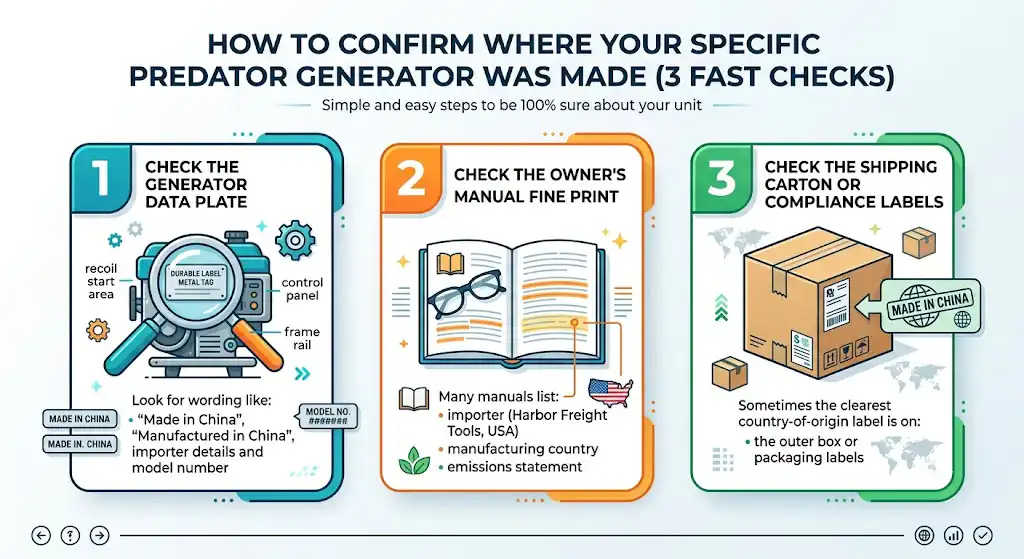
If you want to be 100 percent sure about your unit, do this:
1) Check the generator data plate
Look for a metal or durable sticker panel near:
- recoil start area
- control panel
- frame rail
You’re looking for wording like:
- “Made in China”
- “Manufactured in China”
- importer details and model number
2) Check the owner’s manual fine print
Many manuals list:
- importer (Harbor Freight Tools, USA)
- manufacturing country
- emissions statement
3) Check the shipping carton or compliance labels
Sometimes the clearest country-of-origin label is on the box or packaging labels, especially for retail logistics.
What “Made in China” Means for Reliability (My Real-World Take)
Here’s what I tell you as a homeowner, based on what I see in service calls:
A Predator generator can be a solid buy if you:
- size it correctly
- maintain it like a machine (not like a flashlight)
- use clean fuel and stabilize it
- test-run it monthly
- connect loads safely
Where people get burned is expecting a budget generator to behave like:
- a permanently installed standby unit
- a commercial-grade Honda
- a whole-house solution without a transfer switch
It can still be a great tool. You just have to treat it like a generator, not a miracle.
Predator vs Other Brands: What You’re Really Comparing
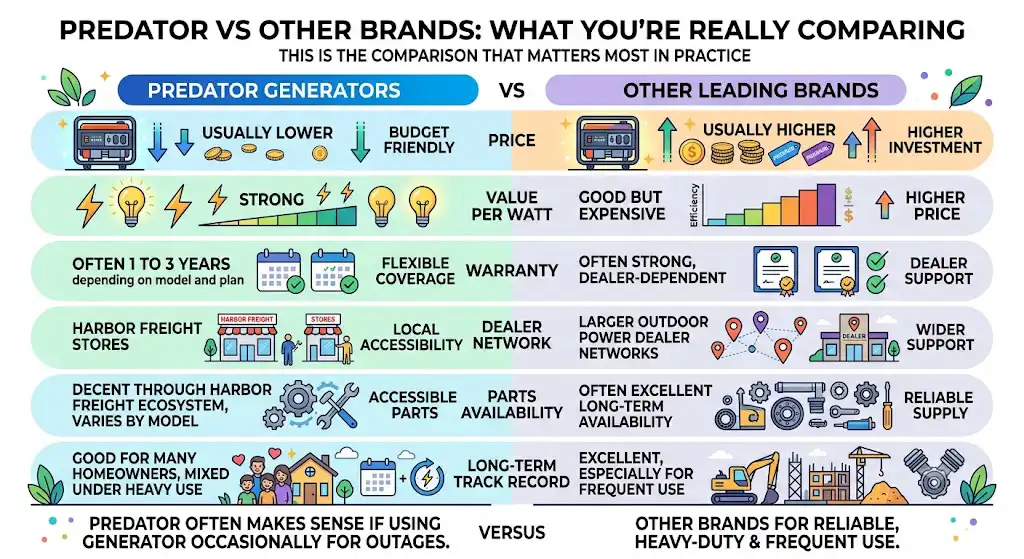
This is the comparison that matters most in practice.
| Price | Usually lower | Usually higher |
| Value per watt | Strong | Good but expensive |
| Warranty | Often 1 to 3 years depending on model and plan | Often strong, dealer-dependent |
| Dealer network | Harbor Freight stores | Larger outdoor power dealer networks |
| Parts availability | Decent through Harbor Freight ecosystem, varies by model | Often excellent long-term availability |
| Long-term track record | Good for many homeowners, mixed under heavy use | Excellent, especially for frequent use |
If you’re using a generator occasionally for outages, Predator often makes sense. If you’re running it daily or for critical business loads, that’s where premium brands start to justify the cost.
Buying Tip From an HVAC Tech: Don’t Guess Your Starting Watts
If your goal is to run anything with a motor, especially HVAC equipment, you have to think about surge.
Common household loads that surge
- refrigerator and freezer compressors
- well pumps
- sump pumps
- portable AC units
- central AC compressors (big surge)
If you tell me “I want to power my AC,” my next question is always:
Is it a window unit, portable unit, mini-split, or central air?
Because central air often needs either:
- a much larger generator, or
- a soft starter on the condenser, or
- both
Safe Connection Matters More Than Brand
I have to say this clearly because I’ve seen the damage in real homes:
- Do not backfeed through a dryer outlet.
- Use a properly installed transfer switch or interlock.
- Keep the generator outside, far from doors and windows.
CO shutdown features help, but they do not give permission to run it near the garage.
FAQ: Predator Generator Manufacturing and Quality
Are Predator generators made by Harbor Freight?
Harbor Freight owns the Predator brand and sells it, but the units are manufactured by overseas factories (China) under private label arrangements.
Are Predator generators made in China from start to finish?
In general, yes. Manufacturing and assembly are done in China, and then the units are imported to the U.S. for distribution and retail.
Is Loncin the manufacturer?
Loncin is frequently mentioned as a major engine manufacturer associated with many small-engine products in this category, and many sources link it to Predator engines. Private label sourcing can vary by model, so confirm via your unit’s data plate.
Bottom Line
Predator generators are made in China and imported to the United States by Harbor Freight Tools. They’re popular because they hit a strong price-to-performance sweet spot, and in my experience they can serve homeowners well if you size them correctly and maintain them.