
I’m Nathan. I’ve worked in HVAC and combustion safety for over 10 years, and I’ve been on service calls where carbon monoxide wasn’t a “maybe” problem. It was the problem.
So I’m going to be very direct with you:
I can’t walk you through step-by-step instructions to bypass or defeat a generator’s CO (carbon monoxide) sensor. Disabling a life-safety shutdown can turn a nuisance shutdown into a lethal situation in minutes, especially around homes, RVs, garages, crawlspaces, or open windows.
What I can do (and what will help you more long-term) is:
- Show you why CO sensors “trip” even when you think the generator is outside and safe
- Walk you through a detailed troubleshooting process that fixes most false shutdowns
- Explain how the CO shutdown circuit works so you can diagnose the right part
- Share the safe repair path: cleaning, airflow changes, reset procedures, and sensor module replacement
- Give you practical safety rules and real-world distances that reduce nuisance trips and protect your family
If your generator is shutting down with a CO warning, this guide will help you get reliable power again without removing the safety system that was designed to keep you alive.
- Quick safety reality check (please read)
- What a CO sensor on a generator actually does
- Why your generator’s CO sensor might trip even outdoors
- Symptoms checklist: CO sensor issue vs. actual CO condition
- The safest “first fix”: placement and airflow (this solves a lot)
- Tools I actually use for troubleshooting (no fancy gear required)
- Step-by-step: safe troubleshooting when the CO sensor keeps shutting your generator down
- 1) Confirm you’re not operating in a CO trap
- 2) Check wind direction and exhaust direction
- 3) Inspect and clean the CO sensor intake area
- 4) Look for exhaust leaks near the engine area
- 5) Reset procedure (model-dependent)
- 6) Verify with a portable CO detector
- 7) If it still trips in wide-open air, suspect module failure
- How the CO shutdown circuit works (so you can diagnose intelligently)
- The correct long-term fix: replace the CO sensor/module
- If you’re in an emergency and need power today (safe emergency checklist)
- Do whole-house standby generators produce carbon monoxide too?
- Is it legal to bypass a generator CO sensor?
- What I recommend instead of bypassing (best-to-worst options)
- Frequently asked questions
- My final advice (from one homeowner-helper to another)
Quick safety reality check (please read)
Carbon monoxide is colorless and odorless. You don’t “smell it getting bad.” You just get sleepy, confused, and then you don’t wake up.
CDC data (U.S.) is commonly cited as:
- 400+ accidental CO deaths per year
- tens of thousands of ER visits annually (often cited around 50,000+)
What a CO sensor on a generator actually does
A generator CO sensor is a built-in detector that monitors carbon monoxide accumulating around the generator. When it detects CO above a set threshold, it triggers a warning and often an automatic engine shutdown.
On many modern portable units, the CO module is designed as a fail-safe:
- If it senses dangerous CO, it shuts the engine down
- If the module fails electrically, some designs also shut the engine down (so you can’t unknowingly run without protection)
This is similar in concept to low-oil shutdown logic: annoying when it malfunctions, but there for a reason.
Why your generator’s CO sensor might trip even outdoors
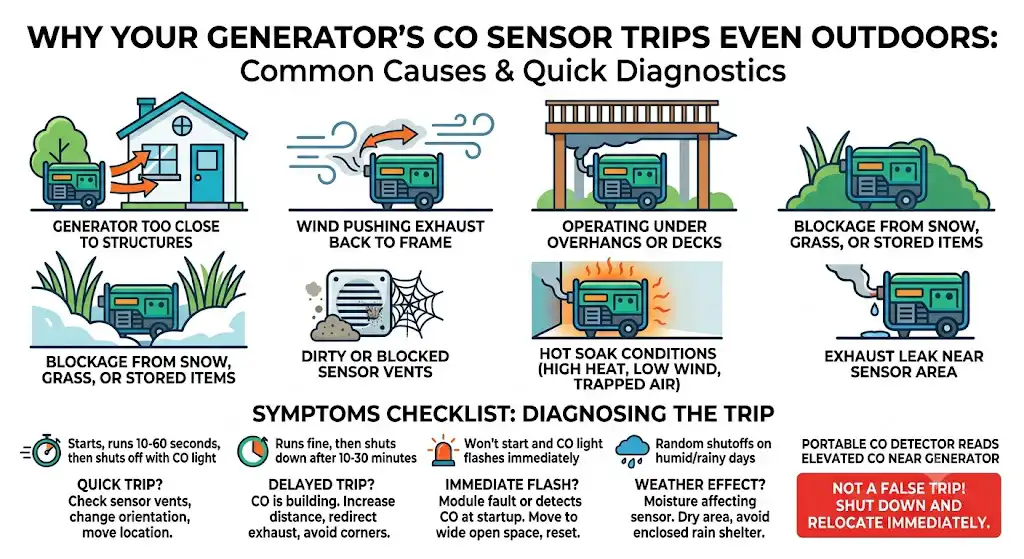
Here’s what I see in the field. Many “false trips” are not actually false. They’re CO recirculation problems.
Common real-world causes
- Generator too close to the house (exhaust gets pulled toward doors, soffits, windows, dryer vents, or fresh air intakes)
- Wind pushing exhaust back into the generator frame
- Operating under a deck, awning, porch roof, carport, or near a wall
- Snowbanks, tall grass, or stored items blocking airflow
- Dirty sensor vents (dust, spider webs, insect nests, moisture)
- Hot soak conditions (high heat, low wind, running in a corner)
- Exhaust leak near the sensor area (muffler gasket, loose fasteners)
Symptoms checklist: CO sensor issue vs. actual CO condition
| Starts, runs 10 to 60 seconds, then shuts off with CO light | CO module is tripping quickly or failing self-check | Move location + change orientation + inspect/clean sensor vents |
| Runs fine, then shuts down after 10 to 30 minutes | CO is building around the unit (recirculation) | Increase distance, redirect exhaust, avoid corners/overhangs |
| Won’t start and CO light flashes immediately | Module fault or wiring issue, or it detects high CO at startup | Move it to wide open space, reset, check vent blockage |
| Random shutoffs on humid/rainy days | Moisture affecting sensor housing or airflow | Dry area, avoid running in enclosed “rain shelter” |
| Portable CO detector reads elevated CO near generator | Not a false trip | Shut down and relocate immediately |
The safest “first fix”: placement and airflow (this solves a lot)
If you do nothing else, do this.
My placement rules (practical, not theoretical)
- At least 20 feet away from the home, doors, windows, soffit vents, crawl vents
(You’ll see 15 feet quoted often. I prefer 20 feet when possible.) - Point the exhaust away from the home and away from any “wind trap” (fences, walls)
- Never run under decks, porches, carports, open garages, or near open windows
- Do not “box it in” for rain protection. That’s how CO pools and sensors trip
Quick reposition test (takes 2 minutes)
- Move generator into the most open area you have (driveway center or yard open zone)
- Rotate the generator 90 degrees so exhaust faces a new direction
- Restart and let it run 5 to 10 minutes
If nuisance tripping disappears after that change, you likely had recirculation, not a “bad sensor.”
Tools I actually use for troubleshooting (no fancy gear required)
- A portable CO detector (battery-powered, UL-listed if possible)
- Flashlight
- Soft brush and/or compressed air (for vent cleaning)
- Screwdriver set (for covers, depending on model)
- Multimeter (optional, for checking harness power/grounds if you know what you’re doing)
If you only buy one thing: buy the portable CO detector. It gives you real data immediately.
Step-by-step: safe troubleshooting when the CO sensor keeps shutting your generator down

1) Confirm you’re not operating in a CO trap
Walk around and look for these “CO bowls” that hold exhaust:
- Corners between fences/walls
- Alcoves next to the house
- Under stairs/decks
- Near shrub lines
- Near stacked materials or garbage cans
If you see one, relocate.
2) Check wind direction and exhaust direction
This matters more than people realize.
If wind is pushing exhaust back toward the generator body, CO can concentrate around the sensor intake even outdoors.
What I do:
- Rotate the unit so exhaust points downwind
- Increase distance from reflective surfaces (walls, siding, brick)
3) Inspect and clean the CO sensor intake area
Most CO modules have a small vented housing.
- Turn generator OFF and let it cool
- Use a soft brush or compressed air gently
- Look for dust caking, spider webs, mud dauber nests, moisture residue
Do not spray cleaners into it. If it’s wet, let it dry fully before re-testing.
4) Look for exhaust leaks near the engine area
A small leak can blow CO right where the sensor “breathes.”
Check:
- Muffler bolts tight
- Muffler gasket area
- Spark arrestor screen condition (if equipped)
- Any soot trails around the exhaust path (a clue of leakage)
If you see soot where it shouldn’t be, fix that first.
5) Reset procedure (model-dependent)
Some generators allow a CO reset (button, key cycle, or restart sequence). Use your manual for your exact model.
If you don’t have the manual:
- Search your model number + “CO reset”
- Or go to the manufacturer support page (Champion, Firman, Honda, Generac, etc.)
6) Verify with a portable CO detector
Place your portable CO detector:
- 3 to 5 feet from generator
- Around the same height as the generator’s control panel
- Not directly in the exhaust stream
If the detector climbs fast, you have a real accumulation problem. Shut down and relocate.
7) If it still trips in wide-open air, suspect module failure
When a generator trips repeatedly in an open field setup (seriously open air), the likely causes are:
- Failing CO module
- Harness corrosion or loose connector
- Power/ground issue feeding the CO module
- Control board logic interpreting the sensor incorrectly (less common)
At that point, the right repair is replacement, not bypassing.
How the CO shutdown circuit works (so you can diagnose intelligently)
Most portable generators use a “kill” strategy similar to low-oil protection:
- The CO module sends a shutdown signal that kills spark (grounding ignition) or tells the controller to stop ignition/fuel.
- Many are designed so that unplugging the module doesn’t make the generator run. It makes it fail-safe and shut down or not start.
That’s why “just disconnect it” often doesn’t work on newer models.
The correct long-term fix: replace the CO sensor/module
If your CO module is faulty, replacement is typically straightforward for a small engine shop or an authorized service center. For homeowners, it depends on brand and access, but the core idea is the same: replace the module, don’t defeat it.
Typical replacement cost (realistic range)
| CO module part | $50 to $200 (varies widely by brand/model) |
| Shop labor | $75 to $150+ depending on region |
| Warranty coverage | Often covered if within warranty and not tampered with |
Tip from experience: if the unit is under warranty, don’t modify wiring. It can void coverage fast.
If you’re in an emergency and need power today (safe emergency checklist)

I get it. Storm hits, freezer full of food, medical device, no parts available.
If your generator is tripping CO shutdown and you’re trying to keep essentials going, do this instead of bypassing:
- Move generator to the most open outdoor area you have (20 feet or more)
- Aim exhaust away from buildings
- Use two CO detectors if possible:
- One near the generator area (outdoors, not in exhaust blast)
- One inside the home near sleeping areas
- Only run what you must (reduce runtime and load where possible)
- If CO alarms inside the house, shut it down and relocate immediately
This keeps the safety system intact while you stabilize your setup.
Do whole-house standby generators produce carbon monoxide too?
Yes. Anything burning fuel can produce CO:
- Natural gas standby generators
- Propane standby generators
- Diesel generators
- Portable gasoline generators
Standby units are safer mainly because they’re permanently installed outdoors with proper clearances and exhaust routing, not because they “don’t make CO.
Is it legal to bypass a generator CO sensor?
I’m not your attorney, and laws vary by region. But here’s the practical reality:
- Bypassing safety systems can expose you to liability if someone gets hurt
- It may violate rental, workplace, or jobsite safety rules
- It can void your warranty and sometimes create insurance issues after an incident
Even when people “get away with it,” the risk-to-reward trade is terrible.
What I recommend instead of bypassing (best-to-worst options)
| Fix placement/airflow | High | High | First thing I do on calls |
| Clean sensor vents + dry housing | High | Medium to high | Surprisingly effective |
| Replace CO module with OEM part | High | High | The real fix |
| Authorized service diagnosis | High | High | Best if warranty applies |
| Defeat/bypass sensor | Very low | Unpredictable | Not recommended |
Frequently asked questions
Can a bad CO sensor prevent a generator from starting?
Yes. Many models are designed to fail safe, meaning a fault can cause no-start or immediate shutdown.
Can I just cover the CO sensor with tape?
No. That’s unsafe and unreliable, and it can trap heat/moisture or worsen readings depending on the design.
How fast can CO build up from a generator?
In enclosed or semi-enclosed spaces, CO can build in minutes. That’s why generators should never run in garages, sheds, or under decks even if doors are open.
Why does my generator shut off when it rains or snows?
Often because people move the generator into a “protected” area that is actually a CO trap (carport, porch, near walls). Moisture can also affect the sensor housing or airflow.
My final advice (from one homeowner-helper to another)
If you came here searching “how to bypass CO sensor on generator,” you’re probably dealing with a generator that won’t stay running when you need it most.
I’m telling you honestly: you’ll get a better outcome fixing the cause of the shutdown than trying to defeat the safety system.
Start with placement and airflow. Clean the sensor vents. Verify with a portable CO detector. If it still trips in open air, replace the CO module or have a small engine shop do it. That’s the path that keeps your power on and keeps you and your family safe.