I’m Nathan. I’ve worked as an HVAC technician for over 10 years, and a big part of my job has been helping homeowners keep equipment running safely during outages. When the power goes out in a storm, your sump pump is one of the few devices that can prevent thousands of dollars in water damage.
Here’s the straight answer, then I’ll show you how to size it correctly for your exact pump.
Quick answer (most homes)
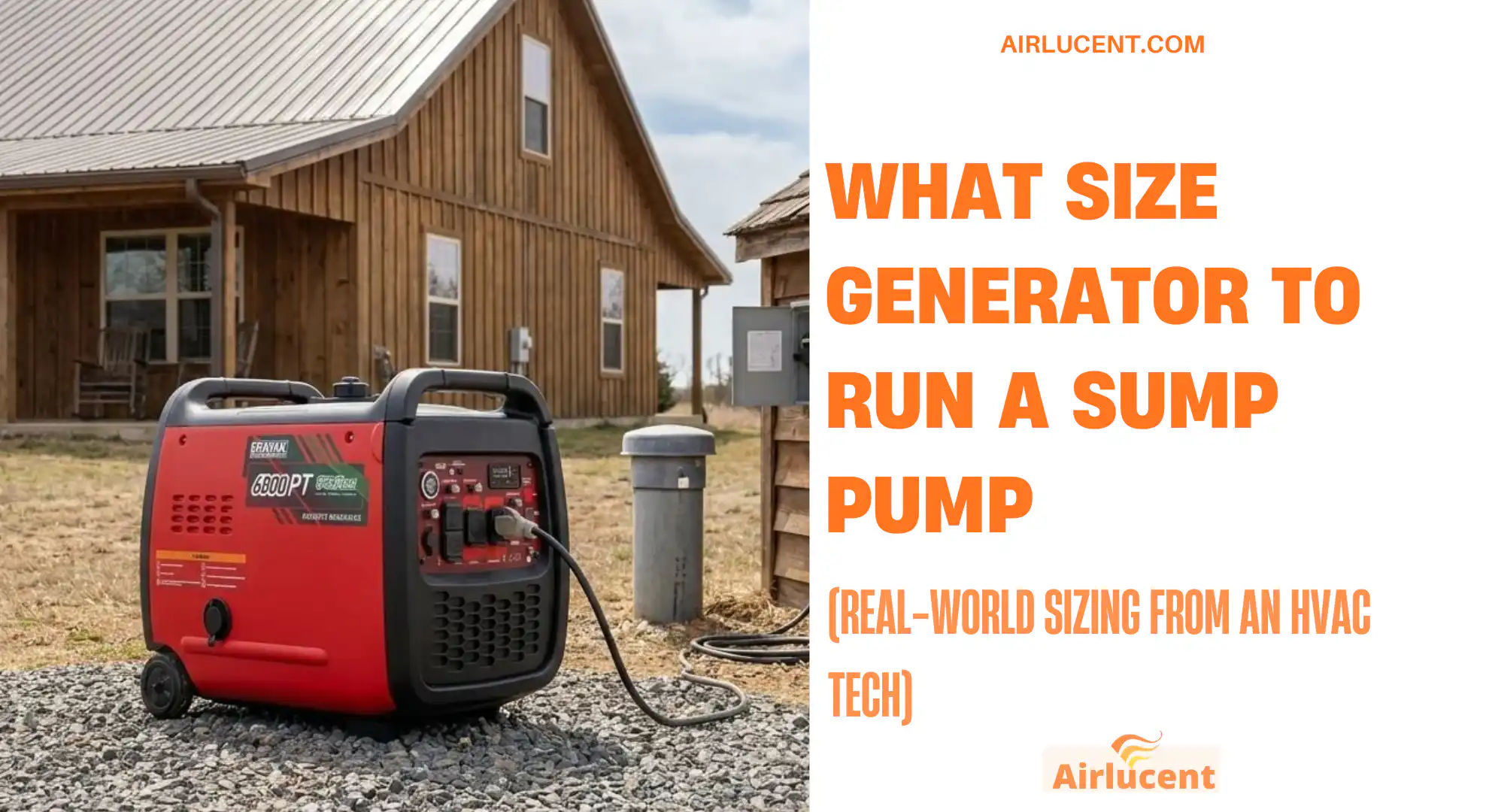
To run a typical residential sump pump, I recommend a generator in the 3,000 to 4,000 watt range.
- Many sump pumps only need 800 to 1,500 running watts
- But they often need 2 to 3 times that for a split second at startup (surge watts)
- A generator that’s too small will bog down, trip, or fail right when you need it most
Minimum: You can sometimes get by with a 2,000 watt generator for a smaller 1/4 HP to 1/3 HP pump, but it’s tight once you factor in startup surge, extension cord voltage drop, and real-world conditions.
Why a generator matters for a sump pump
A sump pump is your last line of defense against basement flooding during heavy rain, snow melt, or rising groundwater. The problem is that storms that bring flooding also commonly bring outages.
A widely cited FEMA estimate is that just 1 inch of water in a home can cause up to $25,000 in damage. If you’ve ever torn out wet carpet, baseboards, and drywall, you already know that number is believable.
So when you ask, “What size generator do I need to run my sump pump?” what you’re really asking is:
How do I keep water out of my house when the grid fails?
The two numbers that matter: running watts and starting watts
Sump pumps use electric motors. And motors are different than things like lamps or phone chargers.
Running watts
This is the power your pump uses once it’s already spinning and moving water.
Starting watts (surge watts)
This is the brief spike when the motor starts from a dead stop. In the field, this surge is where most generator problems happen.
If your generator cannot handle the surge, you’ll see symptoms like:
- The generator engine bogs down
- Lights flicker hard when the pump kicks on
- Breakers trip
- The pump hums but doesn’t start (bad situation, and hard on the motor)
Step-by-step: How to calculate the generator size you need

You can size this accurately in 5–10 minutes.
Step 1: Find your sump pump’s electrical label
Look on the pump itself (or the manual). You’re hunting for:
- Voltage (often 120V, sometimes 240V)
- Amps (running amps, and sometimes starting amps)
- Horsepower (HP)
If you only have horsepower and not amps, don’t worry. I’ll give you a solid sizing table below.
Step 2: Calculate running watts
Formula:
Running watts = Volts × Running amps
Example (very common):
- 120V pump
- 9 amps running
Running watts = 120 × 9 = 1,080 watts
Step 3: Estimate starting watts
If the label lists starting amps, use it:
Starting watts = Volts × Starting amps
If it does not list starting amps, a good rule for sump pump motors is:
- Starting watts ≈ running watts × 2 to 3
Example:
- Running watts: 1,080
- Starting watts estimate: 1,080 × 2.5 ≈ 2,700 watts
Step 4: Add a safety margin (this is where DIY sizing goes wrong)
I like adding 20 to 30 percent for real conditions:
- Extension cord voltage drop
- Cold starts
- Older motors that draw more
- Generator output that isn’t perfectly steady
So in the example above, I’d target:
2,700 surge watts × 1.25 ≈ 3,375 watts
That lands you right in the 3,000–4,000 watt sweet spot.
Sump pump generator sizing chart (HP to watts)
This table is a practical guide based on typical residential pumps. Always verify your specific model’s label.
| 1/4 HP | 600 to 800 | 1,200 to 2,000 | 2,000W minimum, 3,000W better |
| 1/3 HP | 800 to 1,050 | 1,600 to 2,600 | 3,000W |
| 1/2 HP | 1,050 to 1,500 | 2,200 to 3,500 | 3,500 to 4,500W |
| 3/4 HP | 1,500 to 1,800 | 3,000 to 4,500 | 5,000W |
| 1 HP | 2,000 to 2,400 | 4,000 to 6,000 | 6,000W+ |
How many amps does a sump pump use?
Homeowners ask me this all the time because generators, cords, and breakers are all amp-related.
Here’s a common, simplified view (ranges vary by brand and efficiency):
| 1/4 HP | 120V | 4 to 7A |
| 1/3 HP | 120V | 5 to 9A |
| 1/2 HP | 120V | 8 to 12A |
| 3/4 HP | 120V or 240V | 10 to 13A (at 120V) |
| 1 HP | 120V or 240V | 12 to 16A (at 120V) |
Tip from the field: 240V pumps can be easier on generators at the same horsepower because amperage is lower, but you need a generator with a 240V outlet and the proper connection method.
Don’t forget these 4 factors (they change the generator size fast)
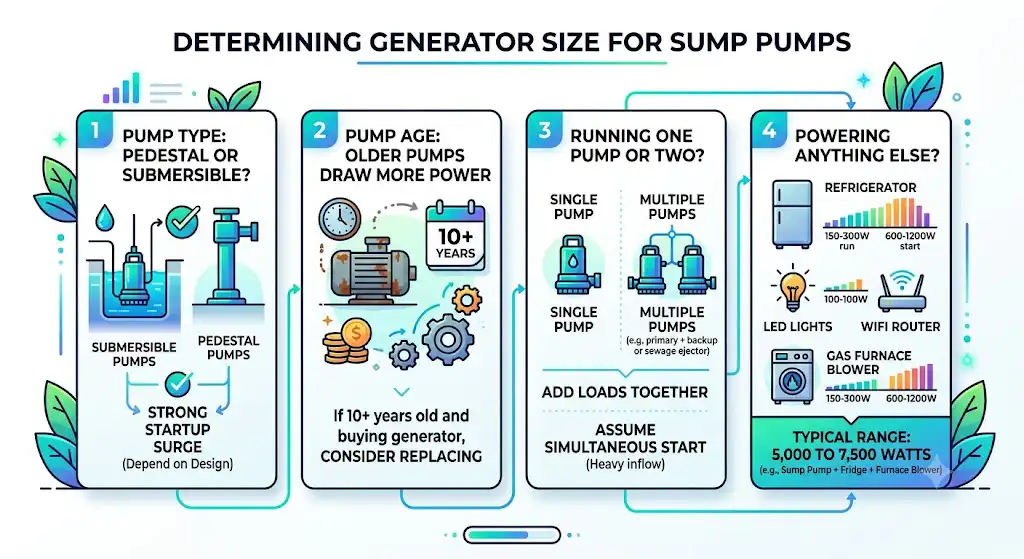
1) Is your pump pedestal or submersible?
Submersible pumps are common and reliable, but depending on design they can have a stronger startup surge than some pedestal setups.
2) How old is the pump?
Older pumps often draw more power for the same work. If your pump is 10+ years old and you’re already buying a generator, I’d seriously consider replacing the pump too.
3) Are you running one pump or two?
If you have:
- A primary sump pump plus a backup sump pump
- Or a sump pump plus a sewage ejector pump
You need to add the loads together (and assume they might start at the same time during heavy inflow).
4) Are you powering anything else?
Most people also want at least a few basics:
- Refrigerator
- Some lights
- Router/phone chargers
- Furnace blower (if it’s a gas furnace)
Here’s a helpful reference.
Common appliance wattage add-ons (rough planning numbers)
| Refrigerator | 150 to 300 | 600 to 1,200 |
| WiFi router | 10 to 20 | same |
| A few LED lights | 30 to 100 | same |
| Gas furnace blower | 400 to 800 | 1,200 to 2,000 |
| Freezer | 150 to 300 | 600 to 1,200 |
If you want your sump pump plus fridge plus furnace blower, you’re often in the 5,000 to 7,500 watt generator conversation.
My recommended generator sizes by situation
If you only care about the sump pump
- Small pump (1/4 HP): 2,000 to 3,000W
- Most homes (1/3 to 1/2 HP): 3,000 to 4,500W
If you want sump pump plus basics (fridge, lights, router)
- 4,500 to 6,500W is a comfortable range
If you want sump pump plus furnace blower too
- 6,500 to 9,000W is common depending on furnace and how much else you run
Portable vs standby generator for a sump pump
Portable generator
Best for most homeowners because:
- Lower upfront cost
- Flexible
- Plenty of wattage choices
Tradeoffs:
- You have to roll it out, start it, refuel it
- You need a safe way to connect the sump pump (more on that below)
Standby generator
Best if you:
- Travel often
- Have frequent outages
- Cannot risk manual setup during storms
Standby units start automatically and can run on natural gas or propane. They cost more, but they’re the “it just works” solution.
Inverter generator vs conventional (this matters more than people think)
A sump pump motor doesn’t require “clean power” the way sensitive electronics do, but inverter generators still have advantages:
Inverter generator
- Often quieter
- Often more fuel-efficient at partial load
- Usually produces steadier voltage
Conventional generator
- Often cheaper per watt
- Many are excellent for motor loads, but quality varies
My take after years around motors and equipment: either can run a sump pump, but I prefer a stable, reputable generator with strong surge capacity and good voltage regulation.
Runtime and fuel planning (what to expect)
Your sump pump does not run continuously in most cases. It cycles.
Generator fuel use depends heavily on:
- Generator size
- Load percentage
- Fuel type
- Ambient temperature
Safe connection methods (this is important)

I need to be blunt here because I’ve seen dangerous setups.
Never backfeed your panel
Do not plug a generator into a wall outlet. It can energize utility lines and can kill a lineman or start a fire.
The safest options
Option 1: Battery backup sump pump
This is not a generator, but it’s one of the best protections you can buy. Even with a generator, I like battery backup as redundancy.
Option 2: Generator + dedicated extension cord to the sump pump
If your sump pump is plug-in, you can run a heavy-duty cord from the generator to the pump.
Important: undersized cords cause voltage drop, which increases motor strain and starting problems.
Extension cord gauge guidance (practical rule)
| Up to 25 ft | 12 gauge (12 AWG) |
| 25 to 50 ft | 10 gauge (10 AWG) |
| 50 to 100 ft | 8 gauge (8 AWG) if you must, but shorter is better |
Option 3: Transfer switch or interlock kit (best long-term)
If you want to power the sump pump circuit through your panel safely, hire a licensed electrician to install:
- A manual transfer switch, or
- A panel interlock (where allowed by code)
This is the cleanest setup for storms because you’re not dragging cords through a wet basement.
My quick sizing checklist (use this before you buy)
- Identify pump voltage: 120V or 240V
- Find running amps (or HP)
- Calculate running watts
- Estimate starting watts (or use label)
- Add 20 to 30 percent margin
- Add any other loads you truly need
- Confirm generator has the right outlets (especially if 240V)
- Plan safe connection method (transfer switch or proper cord)
- Plan fuel storage safely and legally for your area
Example sizing (realistic homeowner scenario)
You have:
- 1/2 HP sump pump
- You want to also run a fridge and a few LED lights
Typical planning watts:
- Pump: 1,200 running, 3,000 starting
- Fridge: 250 running, 1,000 surge
- Lights: 80 running
Running total: 1,200 + 250 + 80 = 1,530 watts
Worst-case surge (pump + fridge start close together): 3,000 + 1,000 = 4,000 surge watts
Add 25 percent buffer: 4,000 × 1.25 = 5,000 watts
In this case, I’d point you toward a 5,000 to 6,500 watt generator for stress-free operation.
FAQs
Can a 2000-watt generator run a sump pump?
Sometimes, yes, especially for a smaller 1/4 HP pump. In the real world, 2,000W is often borderline once you account for startup surge and voltage drop. If you can swing it, 3,000W is a much safer purchase.
What if my sump pump is hardwired?
Then you typically need a transfer switch/interlock (installed correctly) or you’ll need an electrician to convert it to a plug connection in a code-compliant way. Don’t jury-rig a hardwired motor.
Do I need a pure sine wave inverter generator?
Not specifically for a sump pump. The bigger issue is surge capacity and stable voltage.
Should I size the generator to starting watts or running watts?
Both, but you must cover starting watts or the pump may not start when water is rising. I size around the surge first, then confirm the generator can comfortably handle the running load.
Bottom line: the generator size I’d choose for most sump pumps
If you want one simple recommendation that works for most homes:
- Minimum that often works: 2,000W (small pumps only)
- Best all-around choice for one sump pump: 3,000 to 4,000W
- If you want sump pump plus fridge or furnace blower: 5,000 to 7,500W