Hi, I’m Nathan. I’ve worked as an HVAC technician for over 10 years, and I’ve lost count of how many winter service calls start with the same sentence.
My emergency heat is on but it’s blowing cold air.
If your heat pump emergency heat is not working, don’t panic. In a lot of homes, the fix is something simple like a tripped breaker, a thermostat wiring issue, or a safety limit that opened up because airflow is restricted.
This guide walks you through the exact checks I do in the field, in the safest order, so you can pinpoint what’s wrong before you spend money on a service call.
- Quick safety note (please read)
- What emergency heat is (and what it isn’t)
- At a glance: Emergency heat not working causes and fixes
- How emergency heat should feel when it’s working
- Step-by-step troubleshooting (the same order I use on calls)
- The most common component failures (and how they’re diagnosed)
- Why emergency heat is so expensive (and what the data says)
- Common “it’s not broken” situations I see
- How to test emergency heat (simple homeowner test)
- When to stop troubleshooting and call a technician
- Preventive maintenance that keeps EM heat reliable
- FAQ
Quick safety note (please read)
Emergency heat is usually electric resistance heat strips inside the air handler. That means high voltage and high amperage. If you’re not comfortable around electrical panels, breakers, or a multimeter, stop at the thermostat and breaker checks and call a pro.
What emergency heat is (and what it isn’t)
Emergency heat is your backup heat source. In most all electric heat pump systems, that backup is electric heat strips.
Two important points I always explain to homeowners:
- Emergency heat is typically manual. You switch the thermostat to EM HEAT.
- Auxiliary heat is typically automatic. AUX kicks on when the heat pump needs help (during defrost, or when it’s too cold outside).
At a glance: Emergency heat not working causes and fixes
| EM heat is on but air is cold | Heat strips not energized (breaker, fuse, sequencer, wiring) | Check air handler breakers and thermostat config |
| EM heat starts warm then goes cold | High limit opening from overheating | Check filter, vents, blower, coil cleanliness |
| EM heat works sometimes | Loose wire, weak sequencer, failing strip | Inspect wiring, test sequencer and strip resistance |
| Thermostat shows EM but nothing changes | Miswired thermostat or incorrect setup (O/B, AUX, W2) | Verify wiring and thermostat equipment settings |
| Breaker trips when EM is used | Shorted heat strip or wiring issue | Stop, call a pro or electrician |
How emergency heat should feel when it’s working
A lot of people assume emergency heat should feel like a furnace instantly. In reality, there’s usually a short delay.
What I tell homeowners to expect:
- Warm air may take 2 to 5 minutes to feel noticeably warmer at the vents.
- You might smell a burning dust smell the first time each season. That’s normal if it goes away quickly.
- The air coming out of the vents will typically feel warmer than heat pump-only air.
If it’s still cool after 5 minutes, use the steps below.
Step-by-step troubleshooting (the same order I use on calls)
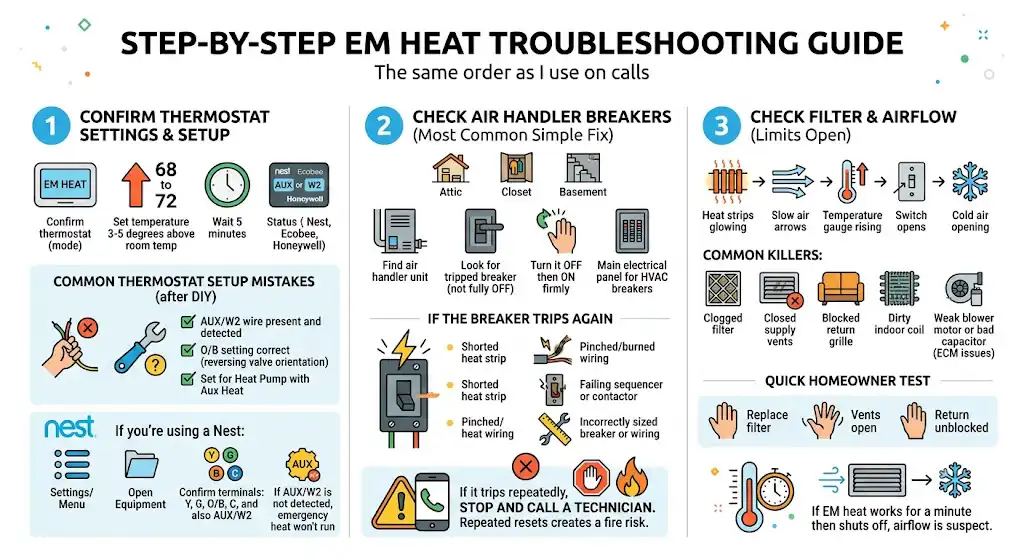
Step 1: Make sure you’re actually in EM heat and set correctly
On the thermostat:
- Set mode to EM HEAT (or Emergency Heat).
- Set the temperature 3 to 5 degrees above room temperature.
- Wait 5 minutes.
Common thermostat setup mistakes (very common after DIY installs)
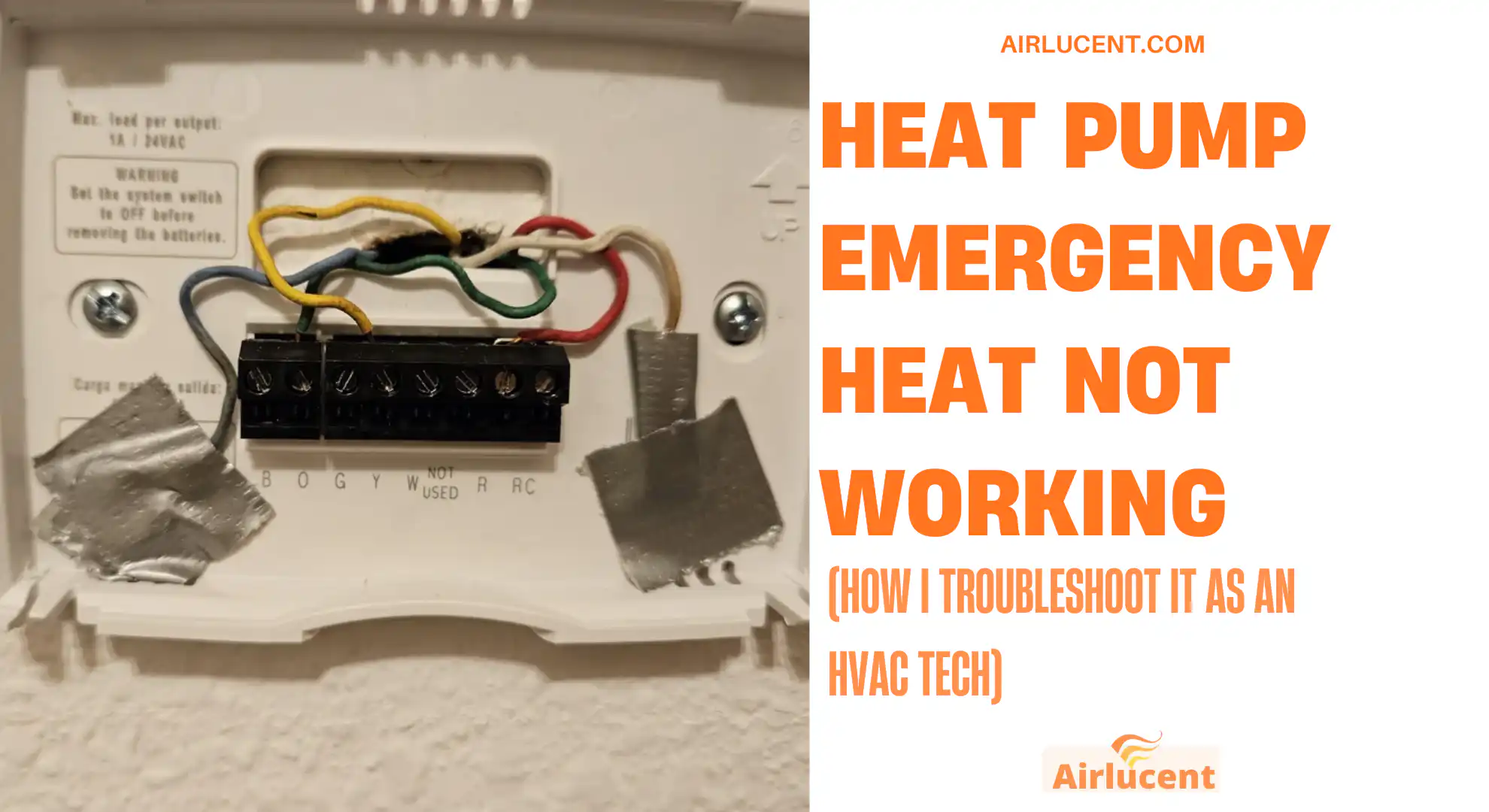
If the thermostat is misconfigured, it may never energize the heat strips.
Things I double-check:
- AUX/W2 wire present and detected
- O/B setting correct (reversing valve orientation)
- Thermostat is set for Heat Pump with Aux Heat, not “Conventional”
If you’re using a Nest:
- Go to Settings or Menu
- Open Equipment
- Confirm it detects common heat pump terminals like Y, G, O/B, C and also AUX/W2
If AUX/W2 is not detected, emergency heat won’t run no matter what you select.
Step 2: Check the air handler breakers (most common simple fix)
Many air handlers have one or two breakers mounted on or inside the unit, often 30 to 60 amps (sometimes two 40s).
What to do:
- Find the air handler (attic, closet, basement)
- Look for a breaker handle that’s tripped (often not fully OFF)
- Turn it OFF then ON firmly
Also check your main electrical panel for any HVAC-related breakers.
If the breaker trips again
That usually points to:
- A shorted heat strip
- Pinched/burned wiring
- A failing sequencer or contactor
- Incorrectly sized breaker or wiring
If it trips repeatedly, I recommend stopping and calling a technician. Repeated resets can damage components and creates a fire risk.
Step 3: Check your filter and airflow (this causes limits to open)
Emergency heat strips get hot fast. If airflow is low, the system overheats and a safety switch opens, and then you get cold air.
Airflow killers I see constantly:
- Clogged filter
- Closed supply vents
- Blocked return grille
- Dirty indoor coil
- Weak blower motor or bad capacitor (ECM issues too)
Quick homeowner test:
- Replace the filter with the correct size and airflow rating
- Make sure supply vents are open
- Make sure nothing is blocking the return
If your EM heat works for a minute then shuts off, airflow is one of the first things I suspect.
The most common component failures (and how they’re diagnosed)
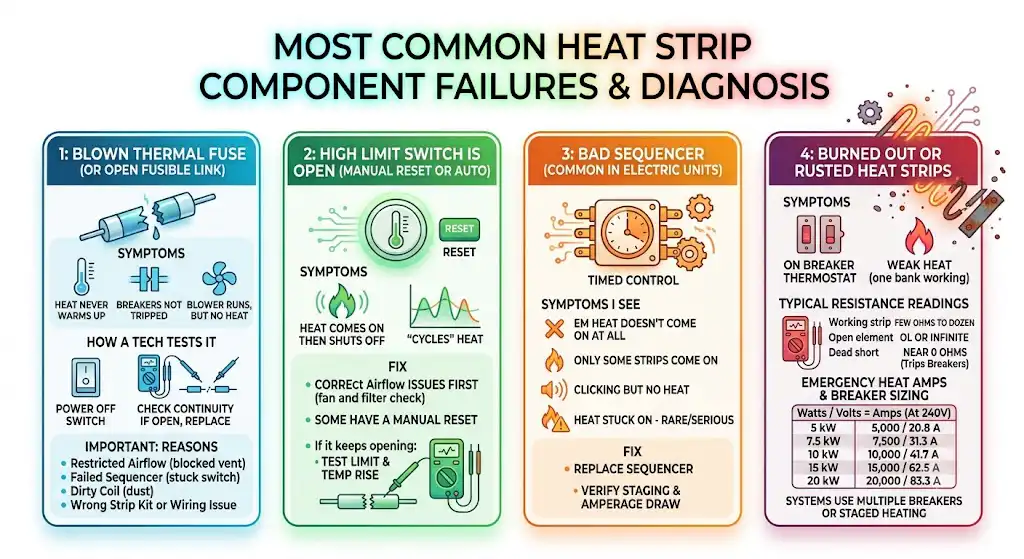
1: Blown thermal fuse (or open fusible link)
Many heat strip kits use a thermal fuse that opens if things overheat.
Symptoms:
- EM heat never warms up
- Breakers are not tripped
- Blower runs, but no heat
How a tech tests it:
- Power off
- Check continuity with a multimeter
- If open, replace with the same rating
Important: If the fuse blew, I always look for the reason:
- restricted airflow
- failed sequencer stuck on
- dirty coil
- wrong strip kit or wiring issue
2: High limit switch is open (manual reset or auto)
Heat strips typically have a limit switch that opens if the heat gets too hot.
Symptoms:
- Heat comes on then shuts off
- Sometimes it “cycles” heat on and off
Fix:
- Correct airflow issues first
- Some have a manual reset button (not all)
- If it keeps opening, a tech needs to test the limit and temperature rise
3: Bad sequencer (very common in electric air handlers)
A sequencer is basically a timed switch that:
- turns heat strips on in stages
- keeps blower timing correct
Symptoms I see:
- EM heat doesn’t come on at all
- Only some strips come on (weak heat)
- Clicking but no heat
- Heat stuck on (rare but serious)
Fix:
- Replace sequencer
- Verify staging and amperage draw
4: Burned out or rusted heat strips
Heat strips can fail like a toaster element. Rust, debris, or a hotspot can break the element.
Symptoms:
- Breakers on, thermostat correct, but no heat
- Or heat is weak because only one bank of strips is working
Typical resistance readings (rule of thumb)
In the field, I check resistance across each element and compare to what it should be.
A rough idea:
- A working strip circuit often reads a few ohms to a few dozen ohms, depending on kW
- An “open” element reads OL or infinite resistance
- A dead short reads near 0 ohms (and usually trips breakers)
Because strip sizing varies, it’s better to compare to expected amps.
Emergency heat amps and breaker sizing (helpful reference)
Electric heat strips pull serious power. Here’s the math I use:
Amps = Watts ÷ Volts
At 240V, common strip loads look like this:
| 5 kW | 5,000 | 20.8 A |
| 7.5 kW | 7,500 | 31.3 A |
| 10 kW | 10,000 | 41.7 A |
| 15 kW | 15,000 | 62.5 A |
| 20 kW | 20,000 | 83.3 A |
That’s why many units use multiple breakers or staged heating. If your system should have 10 kW of heat but it’s only drawing half the amps, you likely have a failed strip bank or control issue.
Why emergency heat is so expensive (and what the data says)
Here’s the honest truth I tell homeowners: emergency heat is a lifesaver, but it’s not meant to be your everyday heat source.
- Heat pump efficiency is measured as COP (Coefficient of Performance).
- In mild weather, many heat pumps run around COP 2 to 4, meaning you can get 2 to 4 units of heat for every 1 unit of electricity.
- Electric resistance heat is COP 1 (1 unit in, 1 unit out).
That’s why running on emergency heat can easily double or triple heating costs, depending on outdoor temperature, your home’s insulation, and your electricity rate.
Sources you can verify:
- U.S. Department of Energy: Heat pump efficiency basics and COP concept
- ENERGY STAR: Heat pump performance and heating season guidance
Common “it’s not broken” situations I see
EM heat blowing cold for the first few minutes
Normal. Give it up to 5 minutes.
Outdoor unit not running in EM heat
Often normal. Many systems lock out the compressor in Emergency Heat mode and heat only with strips.
Burning smell
If it’s the first run of the season and the smell fades quickly, it’s usually dust burning off. If it smells like hot plastic or electrical, shut it off and call a pro.
How to test emergency heat (simple homeowner test)
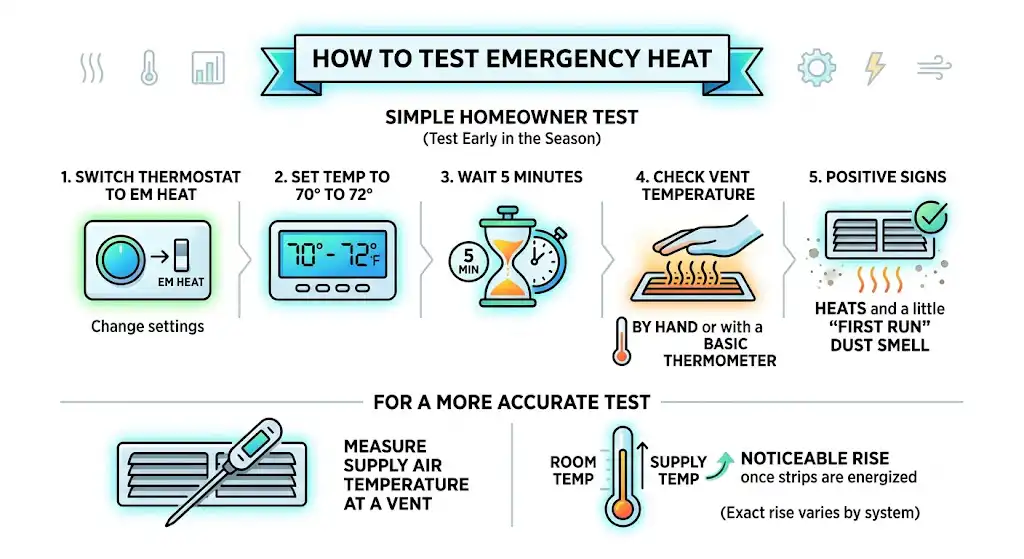
I recommend testing emergency heat early in the season.
- Switch thermostat to EM Heat
- Set temp to 70 to 72
- Wait 5 minutes
- Check vent temperature by hand, or with a basic thermometer
If it heats and you smell a little “first run” dust, that’s usually a good sign.
If you want a more accurate test:
- Measure supply air temperature at a vent
When to stop troubleshooting and call a technician
Call a pro if you notice any of the following:
- Breaker trips repeatedly when EM heat turns on
- You smell strong electrical burning
- You see melted wiring, scorched components, or water in the air handler
- You’re not getting heat and outdoor temps are dangerously low
- You’re uncomfortable using a multimeter around high voltage
In my experience, the most expensive calls come from “I kept resetting it” situations.
Preventive maintenance that keeps EM heat reliable
If you want emergency heat to work when you need it most, here’s what actually helps:
- Replace filters regularly (don’t wait until they look dirty)
- Keep returns and vents open
- Schedule a heating checkup before winter
- Make sure the thermostat is configured correctly after any replacement
- Clear the outdoor unit so the heat pump can do its job (less AUX and EM runtime)
FAQ
What is the difference between AUX heat and EM heat?
Aux heat is automatic assistance while the heat pump still runs. Emergency heat is typically a manual mode that often locks out the compressor and heats using strips only.
When should a heat pump switch to emergency heat?
Most systems switch to auxiliary heat automatically, not emergency heat. Emergency heat is usually manual. Some setups and thermostats may behave differently depending on wiring and controls, but as a general homeowner rule, you choose EM heat when the heat pump is failing or you need to lock it out.
What’s the biggest drawback of emergency heat?
Cost. Electric resistance heat is much less efficient than heat pump operation, so your power bill can jump quickly if you run EM heat for long periods.
Final thoughts from me
If your heat pump emergency heat isn’t working, start with the easy wins: thermostat setup, breakers, and airflow. Those three alone solve a huge percentage of the no heat calls I get.