Hi, I’m Nathan. I’ve worked as an HVAC technician for over 10 years, and one of the fastest, most reliable ways I troubleshoot a no-heat or no-AC call is to temporarily bypass the thermostat at the thermostat wiring.
If your system won’t turn on, bypassing the thermostat helps answer a simple question:
Is the thermostat the problem, or is the HVAC equipment the problem?
This guide walks you through the same basic process I use in the field, with clear steps for cooling, heating, and the fan. I’ll also show you what the results mean, what not to do, and when you should stop and call a pro.
- How a thermostat actually works (in plain English)
- When bypassing a thermostat makes sense
- Tools and supplies I recommend
- Step 1: Shut off power the right way
- Step 2: Remove the thermostat and document the wiring
- How to bypass a thermostat for cooling (AC test)
- How to bypass a thermostat for heating (furnace or boiler test)
- How to bypass a thermostat to run the fan only
- Heat pumps: a quick note before you bypass
- What your bypass results mean (quick diagnosis table)
- How long can you run HVAC without a thermostat?
- Common mistakes I see (and how to avoid them)
- How to restore everything back to normal
- When you should call a professional (I mean it)
- My bottom-line advice (from the field)
How a thermostat actually works (in plain English)
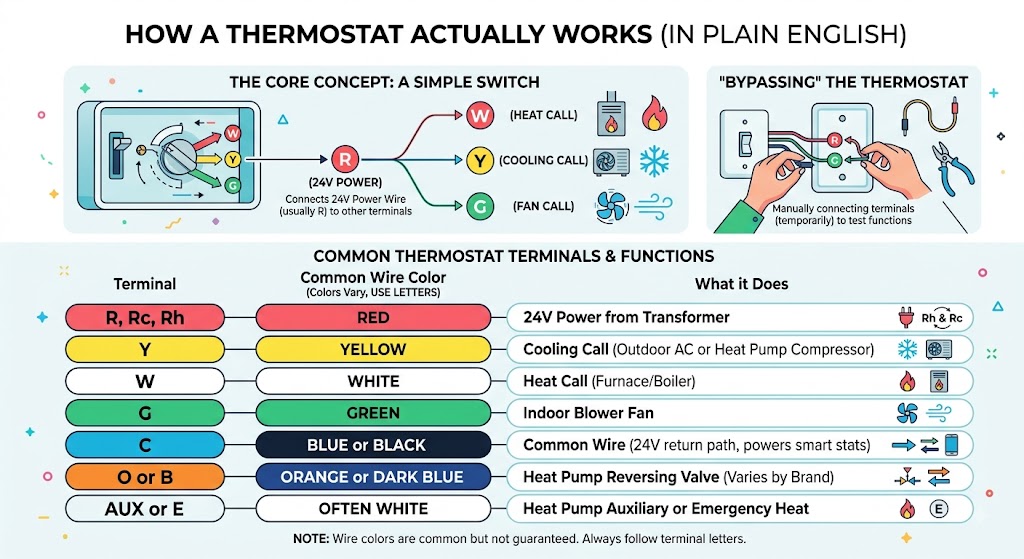
On most systems, the thermostat is basically a switch. When it wants heating or cooling, it connects the 24V power wire (usually R) to another terminal:
- R to W calls for heat
- R to Y calls for cooling
- R to G calls for the fan
So “bypassing the thermostat” usually means removing the thermostat from the equation and temporarily connecting the same terminals yourself using a small jumper wire.
Common thermostat terminals and what they do
Wire colors are common but not guaranteed. Always go by the terminal letters.
| R, Rc, Rh | Red | 24V power from transformer |
| Y | Yellow | Cooling call (outdoor AC or heat pump compressor) |
| W | White | Heat call (furnace/boiler) |
| G | Green | Indoor blower fan |
| C | Blue or Black | Common wire (24V return path, powers smart stats) |
| O or B | Orange or Dark Blue | Heat pump reversing valve (varies by brand) |
| AUX or E | Often White | Heat pump auxiliary or emergency heat |
In many homes Rc and Rh are jumped together (either by a factory jumper or an internal design). If you only see R, that’s normal too.
When bypassing a thermostat makes sense
Here are the most common real-world reasons I tell homeowners to use a bypass test:
- Your thermostat screen is blank or unresponsive and you need to confirm if the HVAC can still run.
- The system won’t heat or cool, and you want to confirm whether the thermostat is the failure point.
- You replaced a thermostat and want to prove the equipment runs before you spend more money.
- You suspect a wiring or thermostat base issue (loose terminals, broken conductor, etc.).
Tools and supplies I recommend
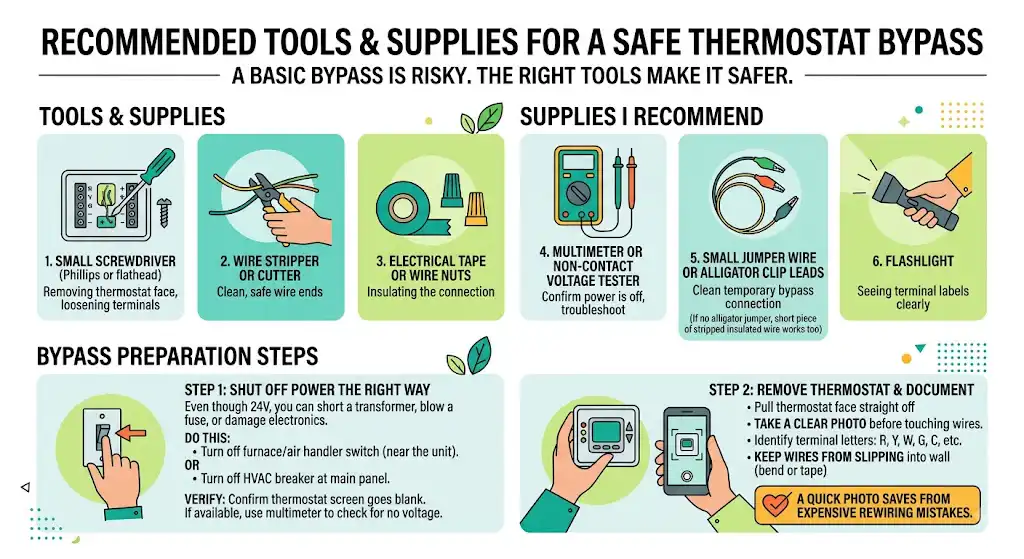
You can do a basic bypass with almost nothing, but the right tools make it safer.
| Small screwdriver (Phillips or flathead) | Removing thermostat face or loosening terminals |
| Wire stripper or cutter | Clean, safe wire ends if needed |
| Electrical tape or wire nuts | Insulating the connection |
| Multimeter or non-contact voltage tester | Confirm power is off and troubleshoot properly |
| Small jumper wire or alligator clip leads | Clean temporary bypass connection |
| Flashlight | Seeing terminal labels clearly |
If you don’t have an alligator jumper, a short piece of insulated wire with both ends stripped works well.
Step 1: Shut off power the right way
Even though thermostat wiring is usually 24V, you can still short a transformer, blow a fuse on the control board, or damage electronics.
Do this:
- Turn off the furnace or air handler switch (it often looks like a light switch near the unit).
- Turn off the HVAC breaker at the main panel if you’re not 100 percent sure.
- Confirm the thermostat screen goes blank (if it was on).
- If you have a multimeter, verify you do not have 24V between R and C.
Step 2: Remove the thermostat and document the wiring
- Pull the thermostat face straight off (some have clips, some have screws).
- Take a clear photo of the wiring before you touch anything.
- Look at the terminal letters on the base: R, Y, W, G, C, etc.
- Make sure the wires don’t slip back into the wall. If they’re loose, gently bend them or tape them in place so you can reattach later.
That quick photo has saved a lot of homeowners from expensive rewiring mistakes.
How to bypass a thermostat for cooling (AC test)
This is the most common bypass I do to test a no-cool complaint.
What you’re doing
You’re temporarily connecting R (power) to Y (cooling call). On many systems, the indoor fan comes on automatically with a cooling call. On some setups, you may also need G for the blower.
Steps
- Confirm power is off.
- Find the R terminal and the Y terminal.
- Remove the R wire and Y wire from their terminals if needed (or leave them in place if you can safely jumper at the terminal screws).
- Connect R to Y using a jumper wire or alligator leads.
- Insulate the connection with electrical tape if it’s exposed.
- Restore power.
What to expect (and the 5-minute delay)
- Many outdoor units have an anti-short-cycle delay. Even if your bypass is correct, the compressor may wait about 5 minutes before starting.
- You may hear the indoor blower start first, then the outdoor unit.
If nothing happens after the delay, the thermostat may not be the issue.
How to bypass a thermostat for heating (furnace or boiler test)
What you’re doing
You’re temporarily connecting R (power) to W (heat call).
Steps
- Confirm power is off.
- Locate R and W at the thermostat base.
- Connect R to W with your jumper.
- Insulate the connection.
- Restore power.
- Wait and listen.
What to expect
- Most furnaces do not start blowing heat immediately.
- A typical sequence is inducer motor, ignition, flame, then blower after a warm-up delay.
If the furnace runs with R to W connected, your thermostat or thermostat wiring is very likely the issue.
If your thermostat has Rh and Rc
Some systems show Rh (heating power) and Rc (cooling power).
- To call for heat, jumper Rh to W.
- If you only have one red wire on R, treat it as the power feed and jumper R to W.
How to bypass a thermostat to run the fan only
This is useful if you’re troubleshooting airflow, a bad fan relay, or you just want circulation.
What you’re doing
You’re connecting R to G.
Steps
- Confirm power is off.
- Connect R to G with a jumper.
- Restore power.
- The indoor blower should run.
Heat pumps: a quick note before you bypass
Heat pumps can be wired differently depending on brand and whether you’re calling for auxiliary heat. In many heat pump systems:
- Y energizes the compressor (heating or cooling)
- O or B controls the reversing valve
- AUX/E controls backup heat
What your bypass results mean (quick diagnosis table)
This is the part homeowners find most helpful, because it tells you what to do next.
| R to Y | AC runs (after delay) | Thermostat or thermostat wiring problem is likely |
| R to Y | Nothing happens | Problem likely in equipment (fuse, control board, float switch, contactor, low pressure switch, disconnect, etc.) |
| R to W | Heat runs | Thermostat or wiring issue likely |
| R to W | Nothing happens | Furnace/boiler issue likely (safety switch, ignition, limit, board, gas supply, etc.) |
| R to G | Fan runs | Fan circuit and blower are likely OK |
| R to G | Fan does not run | Blower/control problem likely |
In my experience, if the system runs during bypass but not with the thermostat, the next steps are usually:
- Check thermostat batteries (if applicable)
- Check loose wire at the thermostat base
- Check broken wire behind the wall
- Replace the thermostat (often the quickest fix)
How long can you run HVAC without a thermostat?
I only recommend bypassing long enough to test operation, or to get temporary relief while you’re actively monitoring the system.
Here’s why: without a thermostat, the system does not know when to stop. It will keep running until you shut it off.
Realistic energy cost examples (why “temporary” matters)
Actual power draw varies by system size and efficiency, but these ballparks are common:
| Furnace blower only | 400 to 800 watts | $0.06 to $0.13 | $0.51 to $1.02 |
| Central AC (2.5 to 4 tons) | 2,500 to 5,000 watts | $0.40 to $0.80 | $3.20 to $6.40 |
| Electric heat strips | 5,000 to 15,000 watts | $0.80 to $2.40 | $6.40 to $19.20 |
Equipment risk
- AC can freeze the indoor coil if airflow is weak or the system runs too long in poor conditions.
- Furnaces can hit high-limit safety cutoffs if airflow is restricted.
- Continuous operation increases wear on motors, contactors, and control boards.
Common mistakes I see (and how to avoid them)
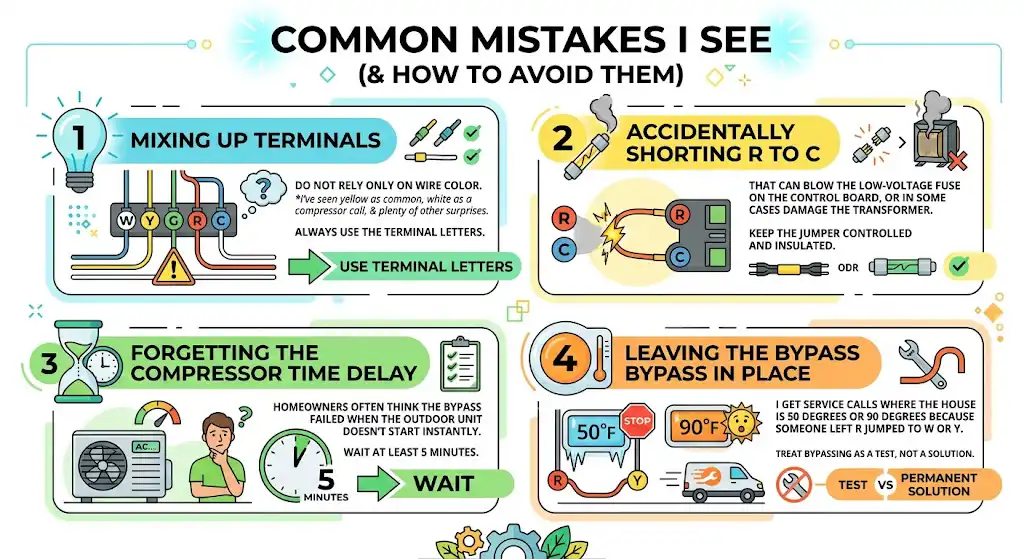
Mixing up terminals
Do not rely only on wire color. I’ve seen yellow used as a common, white used as a compressor call, and plenty of other surprises.
Always use the terminal letters.
Accidentally shorting R to C
That can blow the low-voltage fuse on the control board, or in some cases damage the transformer.
Keep the jumper controlled and insulated.
Forgetting the compressor time delay
Homeowners often think the bypass failed when the outdoor unit doesn’t start instantly. Wait at least 5 minutes.
Leaving the bypass in place
I get service calls where the house is 50 degrees or 90 degrees because someone left R jumped to W or Y. Treat bypassing as a test, not a solution.
How to restore everything back to normal
- Turn power off again.
- Remove the jumper.
- Reconnect each wire to the correct terminal (use your photo).
- Make sure each terminal screw is snug and no copper is exposed outside the clamp.
- Reattach the thermostat face.
- Restore power and test normally.
If your system works normally after reassembly, you likely had a loose connection at the thermostat.
When you should call a professional (I mean it)
Call an HVAC technician if:
- The bypass test does not start the system.
- You blow a fuse or lose thermostat power after attempting a jumper.
- The outdoor unit hums but does not run (possible capacitor or compressor issue).
- The furnace starts then shuts down with flashing error codes.
- You suspect refrigerant issues, icing, or water in the emergency drain pan.
- You have a heat pump and are not confident about O/B and AUX wiring.
A good tech can diagnose these safely and quickly, and you avoid turning a small repair into a bigger one.
My bottom-line advice (from the field)
If you’re trying to get heat or AC back in a pinch, bypassing the thermostat can be a very effective diagnostic move and a short-term workaround. Just do it safely, keep it temporary, and use the result to make the next decision: thermostat repair or an equipment repair.