I’m Nathan. I’ve worked as an HVAC technician for over 10 years, and I’ve spent a big chunk of that time troubleshooting comfort problems that boil down to two things: systems running longer than they need to, and homes holding onto humidity.
Nest Airwave is one of those features that sounds like marketing until you understand what it’s actually doing inside your air conditioner. When it’s set up right, it can shave real runtime off your compressor without you feeling like the house is getting warmer.
In this guide, I will tell you all about it.
- What is Nest Airwave?
- Why Airwave can save energy (the compressor vs the fan)
- How Nest Airwave works step by step
- The big catch: Humidity (and why Nest cares)
- Key benefits of Nest Airwave
- Which Nest thermostats have Airwave?
- How to turn Nest Airwave on (and confirm it’s enabled)
- Nest Airwave vs just running the fan
- How much money can Nest Airwave save? (simple example)
- When I recommend using Airwave (and when I don’t)
- Pro tips from my 10 years in HVAC service (to make Airwave work better)
- Troubleshooting: Airwave is on, but I never see the swirl
- FAQs
- Bottom line: What Nest Airwave really is
What is Nest Airwave?
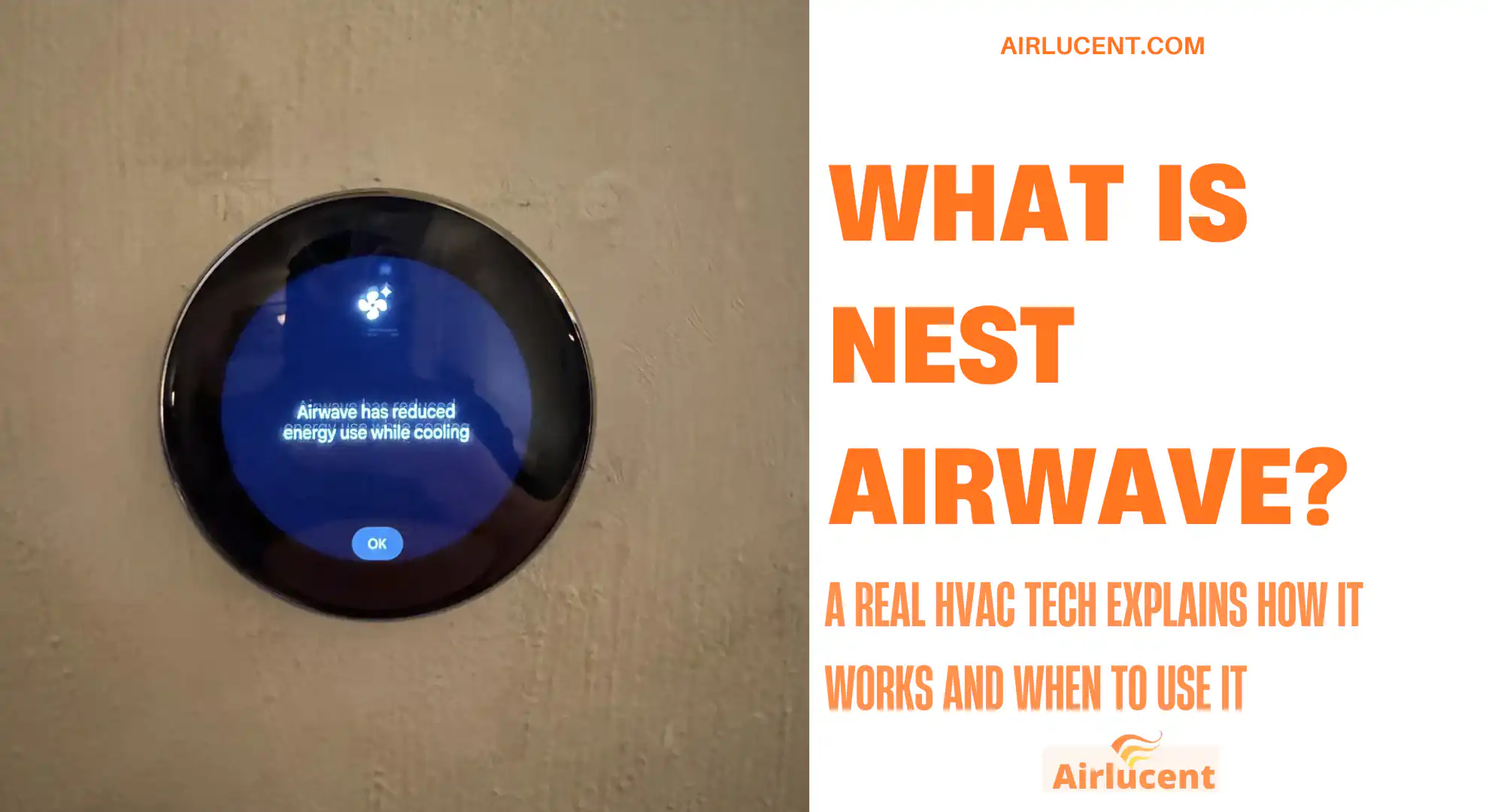
Nest Airwave is a cooling efficiency feature on certain Nest thermostats that turns the AC compressor off a little early, then keeps the blower fan running to use the leftover cold in the evaporator coil.
In plain English: your AC coil stays cold for a few minutes after the compressor stops. Airwave tries to “coast” on that stored cooling, so you get more comfort while using less power.
Why Airwave can save energy (the compressor vs the fan)
Here’s the HVAC reality I explain to homeowners all the time:
- The compressor is the power-hungry part of your AC.
- The indoor blower fan uses electricity too, but usually a lot less than the compressor.
Typical power draw comparison (what I see in the field)
Actual numbers vary by system size and blower type, but these are common ranges for many homes:
| Outdoor compressor (central AC) | 2,000 to 5,000 watts | This is the big cost |
| Indoor blower fan (PSC/ECM) | 300 to 900 watts | Noticeably cheaper than the compressor |
That difference is the whole idea behind Airwave.
How Nest Airwave works step by step
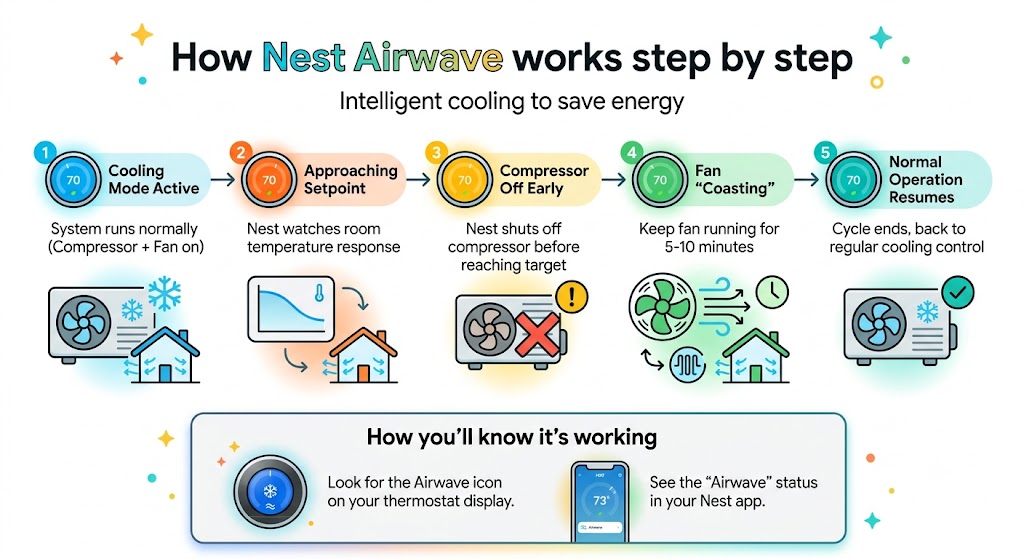
When you’re running your system in Cool mode, Nest watches how your home is responding and then, under the right conditions, it does this:
- AC runs normally (compressor + indoor fan)
- As the room temperature approaches your setpoint, Nest shuts the compressor off early
- Nest keeps the indoor fan running for a short “coast” period (often around 5 to 10 minutes)
- Air continues moving across the still-cold evaporator coil, pushing leftover cooling into your rooms.
- Nest ends the Airwave cycle and returns to normal operation.
How you’ll know it’s working
When Airwave is actively running, you’ll typically see the Airwave swirl icon on the thermostat display.
The big catch: Humidity (and why Nest cares)
This is the part that many competitor articles mention but don’t really explain.
Your AC does two jobs:
- Lowers temperature
- Removes humidity (by condensing moisture on the evaporator coil)
That’s why Airwave works best when indoor humidity is moderate to low. Many guides cite effectiveness when humidity is under roughly the mid-40 percent range, and in my experience, that’s a good rule of thumb.
When Airwave usually feels great
- Dry climates
- Mild humidity days
- Homes that already manage humidity well (tight ducts, proper sizing, good airflow)
When you may want to watch it closely
- Very humid climates (long cooling seasons, lots of moisture)
- Homes that already feel “cool but sticky”
- Oversized AC systems that short-cycle (poor dehumidification)
Key benefits of Nest Airwave
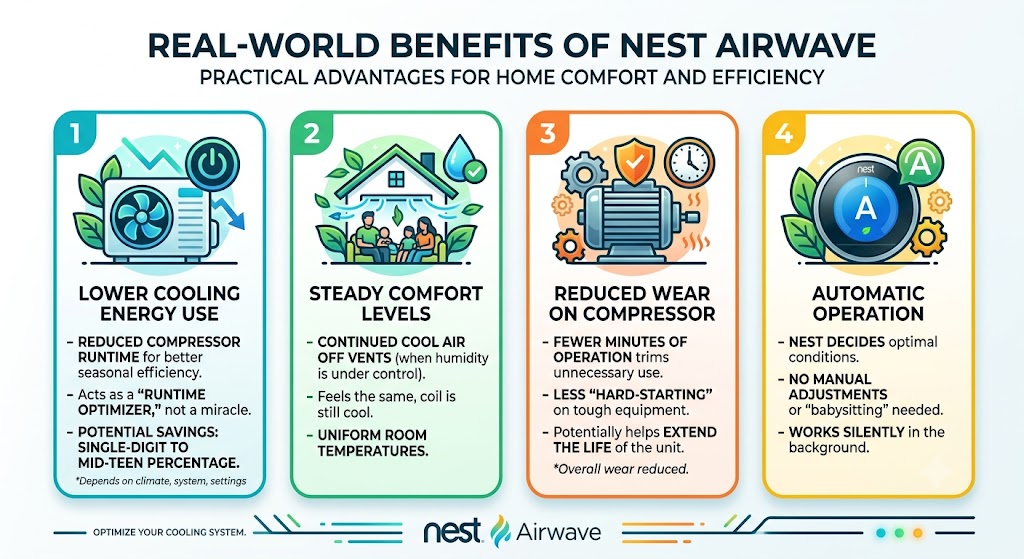
1. Lower cooling energy use
By reducing compressor runtime, Airwave can reduce cooling energy use over the season.
How much can you save?
It depends on climate, system efficiency, and your settings, but smart thermostat optimization is often associated with single-digit to mid-teen percentage savings in real homes. I always tell homeowners to think of Airwave as a “runtime optimizer,” not a miracle button.
2. Comfort stays steady (when humidity is under control)
When Airwave conditions are right, you typically don’t feel the change at all. You still get cool air off the vents because the coil hasn’t warmed up yet.
3. Reduced wear on the compressor
Compressors are expensive and hard-starting is tough on equipment. Anything that trims unnecessary compressor runtime can help reduce overall wear. It won’t “double the life” of your unit, but fewer compressor minutes is generally a good thing.
4. It’s automatic
You don’t have to babysit it. If Airwave is enabled, Nest decides when conditions make sense.
Which Nest thermostats have Airwave?
Airwave is commonly available on:
- Nest Learning Thermostat (notably 3rd gen models)
- Nest Thermostat E
Availability can vary by model and region, and features can change with app/platform updates (Nest app vs Google Home app). If you don’t see Airwave in settings, it may be a thermostat model limitation, software limitation, or wiring/system limitation.
System requirements (important)
In most homes, Airwave is intended for forced-air cooling, where the thermostat can control:
- Cooling (Y)
- Fan (G)
If your system setup doesn’t allow independent fan control, Airwave may not operate as expected.
How to turn Nest Airwave on (and confirm it’s enabled)
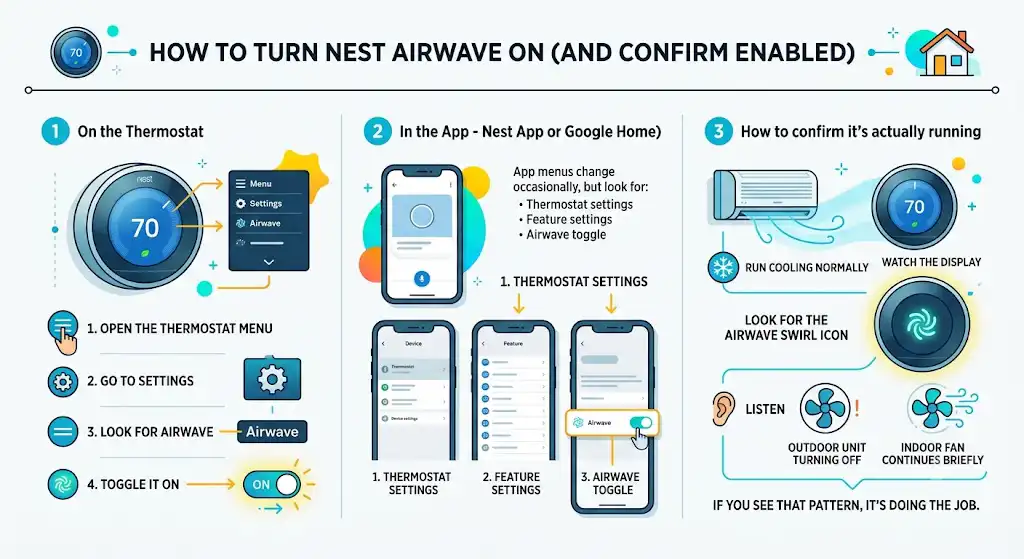
On the thermostat
- Open the thermostat menu.
- Go to Settings
- Look for Airwave
- Toggle it On
In the app (Nest app or Google Home)
App menus change occasionally, but you’re generally looking for:
- Thermostat settings
- Feature settings
- Airwave toggle
How to confirm it’s actually running
- Run cooling normally
- Watch the display at the end of a cooling cycle.
- Look for the Airwave swirl icon.
- Listen for the outdoor unit turning off while the indoor fan continues briefly.
If you see that pattern, it’s doing the job.
Nest Airwave vs just running the fan
A lot of homeowners ask me: “Can’t I just set the fan to ON and do the same thing?”
Not quite.
| Fan set to ON | Fan runs constantly | Can increase humidity, adds fan energy use all day |
| Fan set to AUTO | Fan runs only with heating/cooling | Normal operation |
| Nest Airwave | Fan runs briefly after compressor shuts off | Targets leftover coil cooling without running fan all day |
Airwave is basically a smarter, shorter version of a fan overrun cycle.
How much money can Nest Airwave save? (simple example)
Let’s do a realistic back-of-the-napkin estimate.
Assumptions (example only):
- Your compressor averages 3,500 watts (3.5 kW) while running.
- Your blower averages 600 watts (0.6 kW) during Airwave.
- Airwave trims 10 minutes of compressor runtime per day during the cooling season.
- Electricity cost: $0.16 per kWh (a common ballpark in many U.S. areas)
Compressor energy avoided:
3.5 kW × (10/60 hr) = 0.58 kWh/day
Extra fan energy used:
0.6 kW × (10/60 hr) = 0.10 kWh/day
Net savings:
0.48 kWh/day × $0.16 = $0.08/day
Over a 120-day cooling season:
$0.08 × 120 = about $10 per season in this conservative scenario.
Now here’s the honest HVAC-tech takeaway:
- If your system runs a lot (hot climate, long summers), savings can be higher.
- If your system barely runs, savings will be small.
- Airwave is more about trimming waste than creating huge dollar savings overnight.
When I recommend using Airwave (and when I don’t)
I recommend Airwave if:
- Your home cools well but you want better efficiency.
- Indoor humidity usually stays reasonable.
- You have a properly sized AC that runs steady cycles (not constant short bursts)
I’m cautious about Airwave if:
- Your home often feels clammy in summer.
- Indoor RH is regularly high.
- You’re already fighting moldy smells, condensation, or comfort complaints.
If you’re in a humid region and your AC already struggles with moisture, you may get better results by improving dehumidification first (system sizing, airflow, blower settings, dedicated dehumidifier, duct sealing).
Pro tips from my 10 years in HVAC service (to make Airwave work better)
1. Keep your filter clean
A clogged filter reduces airflow. Poor airflow can reduce coil performance and make humidity problems worse. Check it monthly during peak season.
2. Don’t set extreme temperature drops
If you set the thermostat way down (like 78 to 70), the system runs hard and long. Airwave can still help, but you’ll get better efficiency by using smaller adjustments.
3. Watch humidity, not just temperature
If you have a separate hygrometer, use it. Comfort is usually best around 40 to 55 percent RH for many homes.
4. Make sure your fan setting is correct
Run the fan on AUTO unless you have a specific reason not to. A constant fan can reintroduce moisture and reduce comfort in humid weather.
Troubleshooting: Airwave is on, but I never see the swirl
Here’s a practical checklist I use before blaming the thermostat.
| No swirl icon ever | Indoor humidity too high or conditions not met | Check RH, improve dehumidification, try on drier days |
| Fan stops with compressor | Wiring or system doesn’t allow fan overrun | Confirm G wire and HVAC control compatibility |
| Cooling feels weaker at end of cycle | Airwave running too long for your humidity | Monitor comfort, consider disabling during humid spells |
| Airwave option missing | Thermostat model/app limitation | Check model support and software updates |
If you’re not comfortable checking wiring or control boards, that’s a good point to call a technician. A quick service call can prevent accidental equipment issues.
FAQs
Is Nest Airwave compatible with all AC systems?
No. It’s designed for systems where Nest can control both cooling and the indoor fan properly. Most standard central forced-air setups work, but some older or unusual configurations may not.
Does Airwave work with heat pumps?
Airwave is a cooling optimization feature. If your heat pump is running in cooling mode and your thermostat/system supports the needed controls, Airwave may function similarly.
Can Airwave make humidity worse?
It can, especially if indoor humidity is already high. That’s why Nest tends to run Airwave only when conditions make sense, but every home is different.
Do I need professional installation to use Airwave?
Not always, but correct wiring and setup matter. If your system is acting odd or the fan control isn’t behaving correctly, a pro check is worth it.
Bottom line: What Nest Airwave really is
Nest Airwave is a smart, practical way to squeeze extra cooling out of the cold your AC already produced. It reduces compressor runtime by letting the blower “coast” on the cold evaporator coil after the compressor shuts off.
If your home’s humidity is under control, you’ll usually get the best of both worlds:
- similar comfort
- less compressor runtime
- modest seasonal savings that add up over time