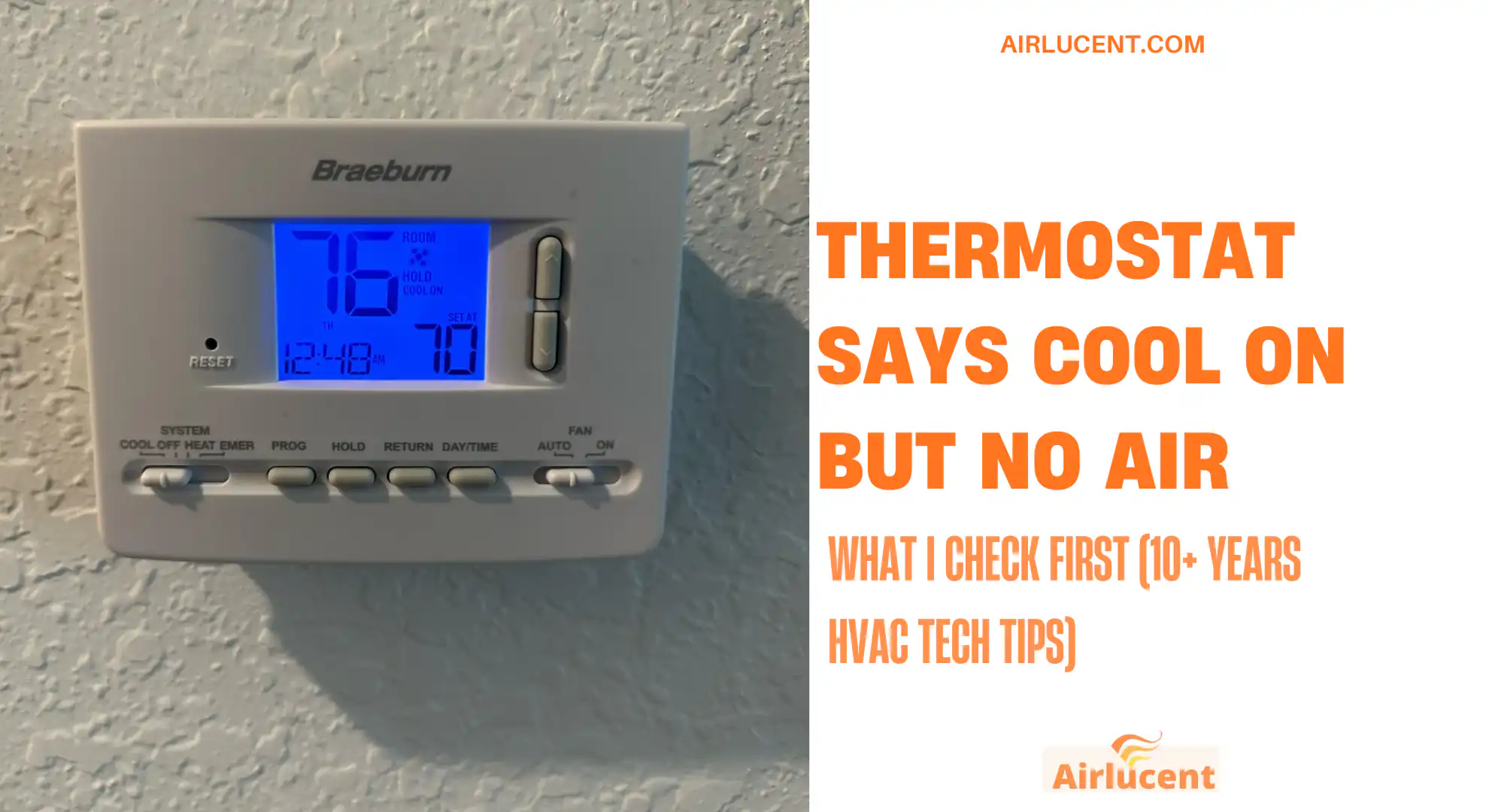
Hi, I’m Nathan. I’ve worked as an HVAC technician for over 10 years, and this is one of the most common summer calls I get: your thermostat says Cool On (sometimes it even blinks), but you’re getting no air or almost no air from the vents.
The good news is you can safely rule out a lot of causes in 10 to 20 minutes before you pay for a service call. I’m going to walk you through the exact order I use in the field, what each symptom usually means, and when it’s time to stop and call a licensed pro.
- Quick Answer: Why Your Thermostat Says Cool On But No Air Is Coming Out
- Quick Diagnostic Table (Match Your Symptom)
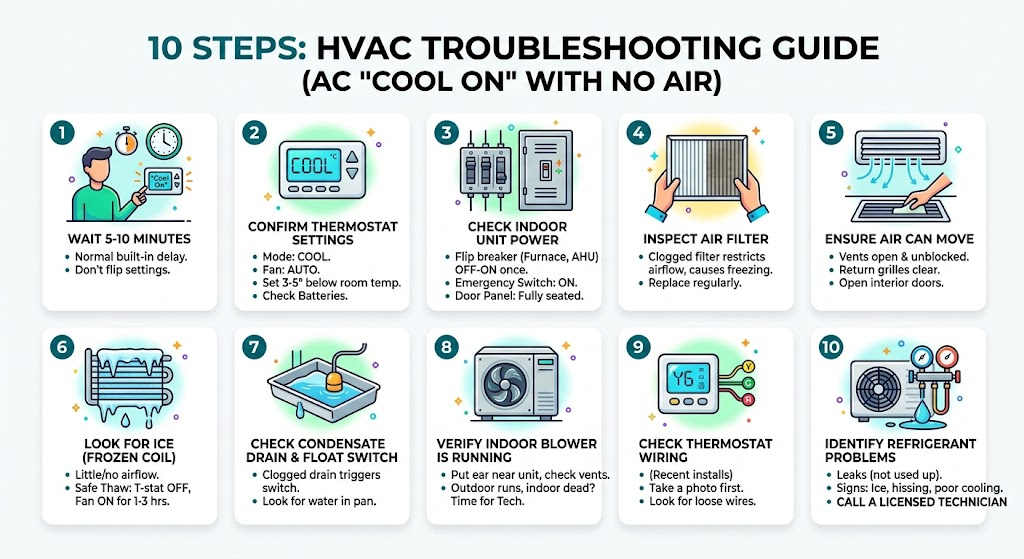
- Step 1: If “Cool On” Is Blinking, Wait 5 to 10 Minutes
- Step 2: Confirm Thermostat Settings (It’s Simple, But It Matters)
- Step 3: Check Power to the Indoor Unit (This Causes “No Air” All the Time)
- Step 4: Check the Air Filter (And Don’t Ignore MERV)
- Step 5: Make Sure Air Can Actually Move (Registers, Returns, and Duct Issues)
- Step 6: Look for Ice (Frozen Evaporator Coil = “Cool On, No Air” Classic)
- Step 7: Check the Condensate Drain and Float Switch (Especially in Humid Weather)
- Step 8: Verify the Indoor Blower Is Actually Running
- Step 9: Thermostat Wiring Problems (Less Common, But Real)
- Step 10: Refrigerant Problems (When “Cool On” Is True, But Cooling Can’t Happen)
- When to Call a Professional (My Honest Line in the Sand)
- What Repairs Usually Cost (Realistic Ranges)
- How Central AC Moves Air (So the Problem Makes Sense)
- Prevent This From Happening Again (What I Recommend to Homeowners)
- FAQ: Thermostat Says Cool On But No Air
Quick Answer: Why Your Thermostat Says Cool On But No Air Is Coming Out
If the thermostat displays Cool On, it’s usually sending the cooling signal correctly. When you get no airflow, the problem is typically one of these:
- A safety delay is active (normal)
- The indoor unit lost power (breaker, switch, door interlock)
- A clogged air filter or frozen coil is blocking airflow
- The condensate drain safety switch shut the system down
- The blower motor, capacitor, or control board failed
- Ductwork is blocked, collapsed, or a damper is closed
Let’s pinpoint which one you’re dealing with.
Quick Diagnostic Table (Match Your Symptom)
| Thermostat says Cool On and blinks | Built-in compressor delay after power loss or short cycle protection | Wait 5 to 10 minutes | DIY |
| Outdoor unit runs, but vents are silent | Indoor blower not running (capacitor, motor, door switch, power) | Check filter, door panel, switch, breaker | DIY then Pro |
| Air barely trickles from vents | Clogged filter, blocked return, frozen evaporator coil | Replace filter, open returns, check for ice | DIY |
| Airflow stopped suddenly after heavy rain/humidity | Clogged condensate drain tripped float switch | Check drain pan and wet safety switch | DIY basic, Pro if needed |
| You see ice on copper lines or indoor coil | Airflow restriction or refrigerant leak | Turn cooling off, thaw on Fan Only | DIY thaw, Pro if it returns |
| Breaker trips when AC starts | Electrical fault (capacitor, motor, compressor) | Stop resetting it repeatedly | Pro |
Step 1: If “Cool On” Is Blinking, Wait 5 to 10 Minutes
A blinking Cool On (or a blinking snowflake) often means your thermostat is in a built-in delay mode. This is normal on many thermostats.
Why the delay happens
- Compressor protection: prevents rapid restarts that damage the compressor
- Restart delay after power loss: protects against voltage spikes after an outage or breaker reset
What I tell homeowners
If it’s blinking, don’t keep flipping settings back and forth. Set it to Cool, lower the temperature a few degrees, and wait. If nothing changes after 10 minutes, move on
Step 2: Confirm Thermostat Settings (It’s Simple, But It Matters)
Here’s my quick thermostat checklist:
- Mode: Set to Cool
- Set temperature: At least 3 to 5 degrees below room temperature
- Fan: Set to Auto for troubleshooting
- Fan On can run the blower even when cooling isn’t happening, which confuses the diagnosis.
- Batteries: If your thermostat uses batteries, replace them if the screen is dim or acting weird.
- Schedule/Hold: Make sure a schedule isn’t overriding your setpoint.
If the thermostat looks normal but nothing changes at the vents, the issue is usually power, airflow restriction, or the blower system.
Step 3: Check Power to the Indoor Unit (This Causes “No Air” All the Time)
When homeowners say “the AC is on,” they often mean the thermostat is on. But the indoor air handler or furnace (the part that actually moves air) may have no power.
3A. Check the breaker correctly
Go to your main panel and look for breakers labeled:
- Furnace
- Air Handler
- HVAC
- AC
If a breaker looks tripped or halfway:
- Flip it all the way off
- Then flip it back on
If it trips again soon, stop. Repeated resets can damage equipment and create a safety hazard.
3B. Check the emergency switch near the indoor unit
Most systems have a wall switch near the furnace/air handler that looks like a light switch. It can get bumped off by accident.
Make sure it’s On.
3C. Check the furnace/air-handler door panel (very common)
This one gets people. Many indoor units have a door safety switch. If the panel isn’t fully seated, the switch opens and the blower won’t run.
What to do:
- Turn system off
- Remove the panel and reinstall it firmly so it latches tight
I’ve fixed plenty of “no air” calls with nothing more than clicking that door back into place.
Step 4: Check the Air Filter (And Don’t Ignore MERV)
If I could only check one thing first at most homes, it would be the filter.
A clogged filter can:
- Reduce airflow to nearly zero
- Freeze the evaporator coil into a block of ice
- Overheat blower components
- Make the system seem like it has a refrigerant problem
My real-world rule on MERV
In most standard residential systems, MERV 13 is the practical ceiling unless the ductwork and blower were designed for it.
Higher MERV means higher resistance. If airflow is already borderline (undersized returns are common), a high-MERV filter can make the system act “sick.”
Fast filter test
Hold the filter up to a light.
- If you can barely see light through it, replace it.
Filter replacement schedule (practical)
| Typical home, no pets | 60 to 90 days |
| AC runs daily in summer | 30 to 60 days |
| Pets or allergies | 30 days |
| Smoke, renovations, dusty area | 2 to 4 weeks |
Useful stat: The U.S. Department of Energy estimates replacing a dirty filter can reduce HVAC energy use by 5 to 15 percent in many systems, because the blower doesn’t have to fight restriction as hard.
Step 5: Make Sure Air Can Actually Move (Registers, Returns, and Duct Issues)
Before you assume a motor failed, do these quick airflow checks:
Check supply vents
- Make sure vents aren’t closed
- Make sure rugs/furniture aren’t blocking them
Check return air grilles (huge)
Your system needs air coming back in. If return grilles are blocked, airflow collapses.
- Open interior doors (especially bedrooms)
- Check for filters at return grilles (some homes have multiple filters)
- Make sure nothing is suctioned to the return
Quick “one-room vs whole-house” clue
- No airflow anywhere: likely blower/power/coil freeze
- Some rooms fine, others dead: duct damper closed, duct collapse, or a disconnected duct
Step 6: Look for Ice (Frozen Evaporator Coil = “Cool On, No Air” Classic)
A frozen coil can block air so completely it feels like the blower died.
Signs of a frozen coil
- Little to no airflow
- Ice on the larger copper line near the indoor unit
- Water around the furnace/air handler as it thaws
- You recently installed a more restrictive filter, or vents/returns were closed
What to do safely (my recommended thaw method)
- Set thermostat to Off
- Set fan to On (or Fan Only)
- Let it thaw for 1 to 3 hours (sometimes longer)
- Replace the filter
- After thawing, try cooling again
Do not chip ice off, and do not use a heat gun. You can damage the coil.
If it freezes again
If it ices up again within an hour or two, you likely have:
- An airflow restriction you didn’t fix (filter, return, blower weakness)
- Or a refrigerant issue (often a leak)
Refrigerant work is professional-only.
Step 7: Check the Condensate Drain and Float Switch (Especially in Humid Weather)
Many modern installs include a float safety switch in the drain pan or drain line. If the condensate drain clogs (algae and sludge are common), the float switch shuts the system down to prevent water damage.
Clues this is your issue
- It worked earlier, then suddenly stopped
- You’ve had very humid weather
- You see water in the drain pan
- The indoor unit looks “off” even though the thermostat calls for cooling
What you can do
- Turn power off to the indoor unit
- Look for standing water in the auxiliary pan
- If you see a clear clog in the drain line near the trap, you can sometimes clear it with a wet/dry vacuum (from the outside drain termination)
If you’re unsure, call a tech. I’ve seen homeowners cause ceiling leaks by “clearing” the wrong pipe.
Step 8: Verify the Indoor Blower Is Actually Running
When you call for cooling, the indoor blower should usually start within a short period.
Quick checks you can do
- Put your ear near the indoor unit: do you hear the blower ramping up?
- Check airflow at the closest vent to the air handler
- If you have a smart thermostat, check if it’s reporting the fan running
What it means if the outdoor unit runs but indoor blower doesn’t
This is one of the most common combos I see:
- Outdoor condenser is humming/running
- Thermostat says Cool On
- Indoor vents are dead quiet
Likely causes:
- Blower capacitor failed
- Blower motor failed
- Control board issue
- Door switch open
- Drain float switch open
- No power to indoor unit
At this stage, if your filter is clean and power/switches/panels are correct, it’s usually time for a technician.
Step 9: Thermostat Wiring Problems (Less Common, But Real)
If someone recently replaced the thermostat, miswiring can cause strange behavior.
Common issues:
- Y (cooling call) not connected properly
- G (fan) not connected properly
- Missing jumper between R and Rc on some setups
- Loose wire not fully clamped into the terminal
If you remove the thermostat faceplate:
- Take a photo before touching anything
- Look for loose copper or a wire that slipped out
If you’re not confident, stop here. Low-voltage wiring is safer than line voltage, but miswiring can still blow a fuse on the control board.
Step 10: Refrigerant Problems (When “Cool On” Is True, But Cooling Can’t Happen)
Refrigerant doesn’t get “used up.” If it’s low, there’s usually a leak.
Common signs of low refrigerant
- Ice on the evaporator coil or suction line (even with good airflow)
- Hissing near the coil or refrigerant lines
- AC runs long cycles and never cools properly
What you should do
Call a licensed HVAC technician. Refrigerant handling is regulated and requires proper leak testing, repair, evacuation, and charging procedures.
If someone only “tops it off” without addressing the leak, the problem returns and can lead to compressor damage.
When to Call a Professional (My Honest Line in the Sand)
You can usually DIY:
- Replacing the filter
- Opening vents and returns
- Resetting a breaker once (only once)
- Confirming thermostat settings
- Rinsing the outdoor coil lightly with a garden hose (power off first)
- Thawing a frozen coil safely
Call a pro when:
- The breaker trips more than once
- The indoor blower won’t run after you confirmed power, door, and filter
- Ice returns after thawing and filter replacement
- You suspect a refrigerant leak
- You smell burning or see melted wires
- The outdoor unit hums loudly but won’t start (possible capacitor/contactor/compressor)
What Repairs Usually Cost (Realistic Ranges)
Prices vary by region and system, but here are common ballparks homeowners ask me about:
| Clogged filter | Replace filter | 10 to 40 |
| Clogged drain line | Clear line, flush, test float switch | 150 to 400 |
| Failed capacitor (blower or condenser) | Replace capacitor | 150 to 350 |
| Failed contactor | Replace contactor | 150 to 400 |
| Blower motor failure | Replace motor (sometimes module) | 500 to 1,500+ |
| Refrigerant leak | Leak search, repair, recharge | 300 to 1,500+ |
| Compressor failure | Major repair or system replacement | 1,500 to 4,000+ (or more) |
If a company jumps straight to “you need a whole new system” without showing you test results (amps, capacitor readings, static pressure, refrigerant measurements), get a second opinion.
How Central AC Moves Air (So the Problem Makes Sense)
Here’s the simple version I explain on service calls:
- The thermostat calls for cooling.
- The indoor blower pulls warm air through the return and filter.
- Air passes over the cold evaporator coil and gets cooled.
- The blower pushes cooled air through ducts to your rooms.
- The outdoor unit dumps the heat outside.
So if you have no air, the failure is usually:
- the blower didn’t run
- airflow is blocked (filter/ice/duct)
- power or safety switches stopped the indoor unit
Prevent This From Happening Again (What I Recommend to Homeowners)
1) Change filters on a schedule you’ll actually follow
Put a reminder on your phone. In peak summer, filters load faster.
2) Keep at least 2 feet of clearance around the outdoor unit
Airflow through that coil matters. Trim plants back.
3) Rinse the outdoor coil at the start of cooling season
Power off first. Gentle water is fine. No pressure washer.
4) Annual maintenance is worth it
ENERGY STAR notes that proper maintenance can improve HVAC efficiency and comfort, and many manufacturers expect regular service to maintain performance. A good maintenance visit includes:
- coil inspection/cleaning
- electrical testing (capacitors and connections)
- drain line flush
- blower and temperature split checks
FAQ: Thermostat Says Cool On But No Air
Why does my thermostat say Cool On but nothing is blowing?
Most often the thermostat is calling correctly, but the indoor unit isn’t moving air due to a tripped breaker, loose door panel, clogged filter, frozen coil, clogged drain triggering a float switch, or a blower/capacitor failure.
What does blinking Cool On mean?
Usually it’s a compressor protection delay. Wait 5 to 10 minutes. If it never starts, troubleshoot power, filter, drain safety switch, and blower operation.
Can a dirty filter really stop airflow completely?
Yes. I’ve pulled filters so clogged they caused the coil to freeze solid, and airflow dropped to almost nothing.
My outdoor unit is running but there’s no air inside. What’s wrong?
That points to the indoor side: blower motor, capacitor, door switch, float switch, or power problem. Start with the filter and door panel, then check the breaker and emergency switch.
Is it safe to keep running the AC if there’s no air?
No. Turn cooling off. Running without airflow can freeze the coil or overheat components and lead to expensive damage.
Can I fix refrigerant issues myself?
No. Refrigerant work requires licensing, proper recovery equipment, leak repair, evacuation, and charging by measured method, not guessing.