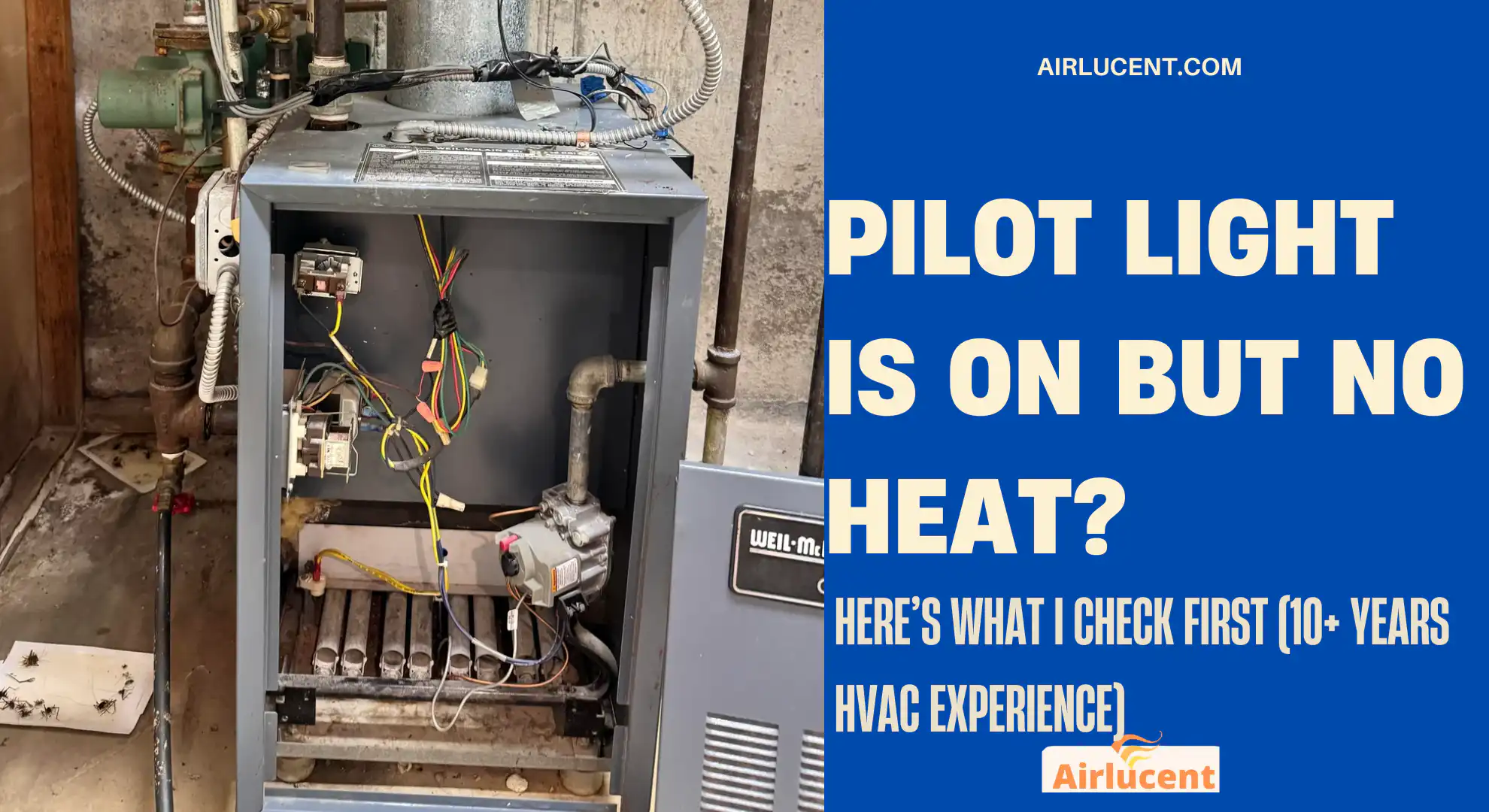
Hi, I’m Nathan. I’ve worked as an HVAC technician for over 10 years, and I’ve been on a lot of “no heat” calls where the homeowner tells me, “The pilot light is on, but the furnace won’t heat.”
The good news is this issue is usually caused by a handful of common problems. Some are quick DIY fixes like a dirty flame sensor or a clogged filter. Others involve safety devices and gas controls where you should slow down and, if needed, call a pro.
This guide walks you through exactly how I troubleshoot it in the field, step by step, with safety in mind.
- Safety first (read this before you touch anything)
- First, confirm what you actually have (standing pilot vs electronic ignition)
- Troubleshooting at a glance (cause and fix table)
- Step-by-step: what I want you to check (in order)
- If your furnace is modern: clean the flame sensor (most common fix)
- If you have a standing pilot: check the thermocouple (or thermopile)
- Open limit switch (overheating shutdown)
- Blower motor or capacitor problems (heat may exist, but it’s not getting to you)
- A few extra causes competitors often skip (but I see in real homes)
- Simple diagnostic flow you can follow (my “basement checklist”)
- When I recommend calling an HVAC professional
- Prevention tips (so you do not get stuck without heat again)
- FAQ
- Final thoughts from Natha
Safety first (read this before you touch anything)
If you notice any of the following, stop and get help:
- You smell gas (rotten egg smell). Turn the furnace off, leave the area, and call your gas provider or emergency services.
- You feel dizzy, nauseous, or have headaches. That can be a carbon monoxide warning sign. Get outside and call for help.
- Your furnace area has soot, scorch marks, or you’ve seen flame rollout (flames where they shouldn’t be).
Also, before doing any checks inside the furnace:
- Turn off power at the furnace switch or breaker.
- For gas furnaces, don’t force the gas valve knob. If it won’t turn easily, stop.
First, confirm what you actually have (standing pilot vs electronic ignition)
Not every furnace has a true “pilot light.”
Standing pilot furnace (older)
- You will see a small constant flame burning all the time.
- Common culprits: thermocouple, gas valve issues, pilot flame not hitting the sensor properly.
Electronic ignition furnace (more common today)
- No always-on pilot. It uses a hot surface igniter or spark.
- Homeowners often call the burner flame a “pilot,” but the key safety part is the flame sensor.
- Common culprits: dirty flame sensor, pressure switch/inducer issues, limit switch, control board, thermostat.
If you’re not sure, don’t worry. The troubleshooting steps below still work.
Troubleshooting at a glance (cause and fix table)
Here’s the same “checklist logic” I use on service calls, starting with the easiest wins.
| Pilot flame is on, burners never light | Thermocouple weak or mispositioned (standing pilot) | Reposition, clean, or replace thermocouple | Medium |
| Burners light briefly then shut off | Dirty flame sensor (electronic ignition) | Clean flame sensor | Easy |
| Furnace runs but air is cold or barely warm | Thermostat setting, fan set to ON, duct/vent issues | Fix thermostat and airflow | Easy |
| Furnace tries to run then stops, repeats | Limit switch open from overheating | Replace filter, open vents, check blower | Easy to Medium |
| No heat and blower is not moving air | Blower motor or capacitor issue | Check if motor runs, call pro if not | Medium to Pro |
| Heat works sometimes, fails randomly | Failing sensor, control board, loose connections | Basic checks, then pro diagnosis | Pro |
Step-by-step: what I want you to check (in order)
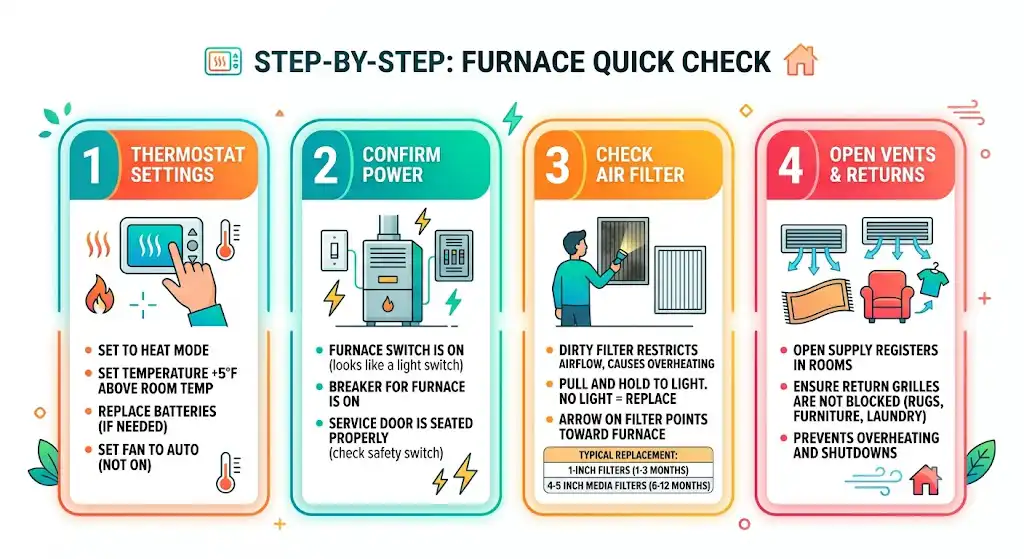
1. Thermostat settings (simple, but it gets people all the time)
Before touching the furnace, check:
- Set thermostat to HEAT
- Set temperature at least 5 degrees above room temperature
- If your thermostat has batteries, replace them
- If the FAN is set to ON, switch it to AUTO (ON can make air feel cool between heat cycles)
2. Confirm the furnace has power
I see this a lot after someone flips a switch by accident.
Check:
- Furnace switch (looks like a light switch) is ON
- Breaker for furnace is ON
- If there’s a service door, make sure it’s seated properly (some furnaces have a door safety switch)
3. Check the air filter (this causes more “no heat” than most people realize)
A dirty filter restricts airflow. Restricted airflow can overheat the heat exchanger area, and the furnace will shut the burners off via the high limit switch.
What I see in the field: a severely clogged filter can drop airflow enough that the furnace heats up fast, trips the limit, shuts burners off, then tries again. Homeowners often describe it as “pilot on, no heat” or “it runs but never warms up.”
What to do:
- Pull the filter and hold it up to a light
- If you can’t see light through it, replace it
- Make sure the arrow on the filter points toward the furnace (airflow direction)
Typical replacement schedule (real-world rule):
- 1 inch filters: every 1 to 3 months
- 4 to 5 inch media filters: every 6 to 12 months (varies by home)
4. Make sure your vents are open and returns are not blocked
Closed supply vents can raise static pressure and reduce airflow. Blocked returns starve the system for air.
Do this:
- Open supply registers in rooms
- Make sure return grilles are not blocked by rugs, furniture, or piles of laundry
This one is easy, but it absolutely can trigger overheating and limit switch shutdowns.
If your furnace is modern: clean the flame sensor (most common fix)
What the flame sensor does (in plain language)
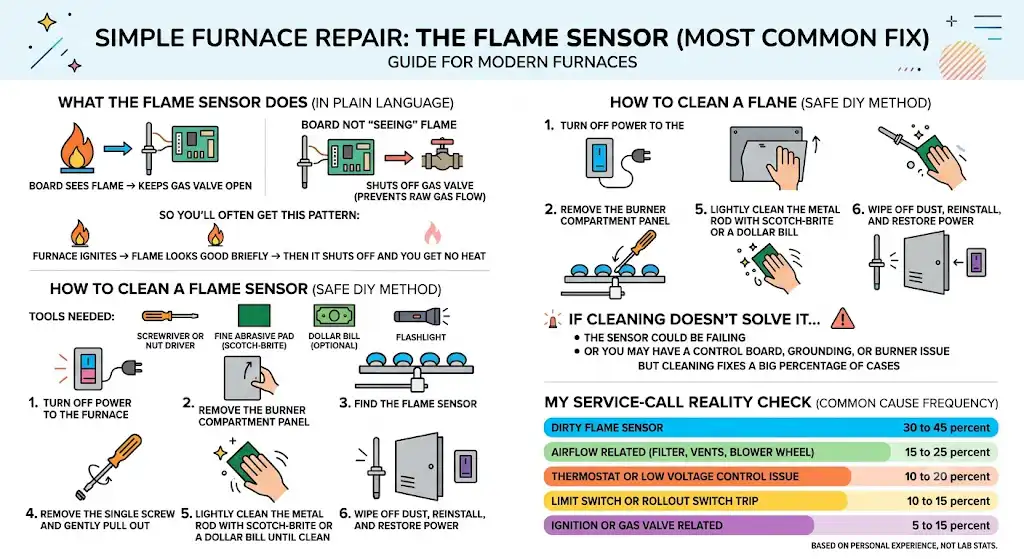
The flame sensor proves to the control board that flame is present. If the board does not “see” flame within a few seconds, it shuts the gas valve to prevent raw gas from flowing.
So you’ll often get this pattern:
- Furnace ignites
- Flame looks good briefly
- Then it shuts off and you get no heat
How to clean a flame sensor (safe DIY method)
Tools I typically use:
- Screwdriver or nut driver
- Fine abrasive pad (Scotch-Brite) or a clean dollar bill
- Optional: flashlight
Steps:
- Turn off power to the furnace.
- Remove the burner compartment panel.
- Find the flame sensor. It is usually a thin metal rod with a white porcelain base, mounted near the burners.
- Remove the single screw holding it in and gently pull it out.
- Lightly clean the metal rod with Scotch-Brite or a dollar bill until it looks clean.
- Wipe off dust, reinstall, and restore power.
If cleaning doesn’t solve it, the sensor could be failing or you may have a control board, grounding, or burner issue. But cleaning fixes a big percentage of cases.
My service-call reality check (common cause frequency)
This varies by brand and home, but across a lot of “no heat” calls, I see something like this:
| Dirty flame sensor | 30 to 45 percent |
| Airflow related (filter, vents, blower wheel) | 15 to 25 percent |
| Thermostat or low voltage control issue | 10 to 20 percent |
| Limit switch or rollout switch trip | 10 to 15 percent |
| Ignition or gas valve related | 5 to 15 percent |
These aren’t lab stats, just what I’ve personally run into repeatedly over the years.
If you have a standing pilot: check the thermocouple (or thermopile)
What the thermocouple does
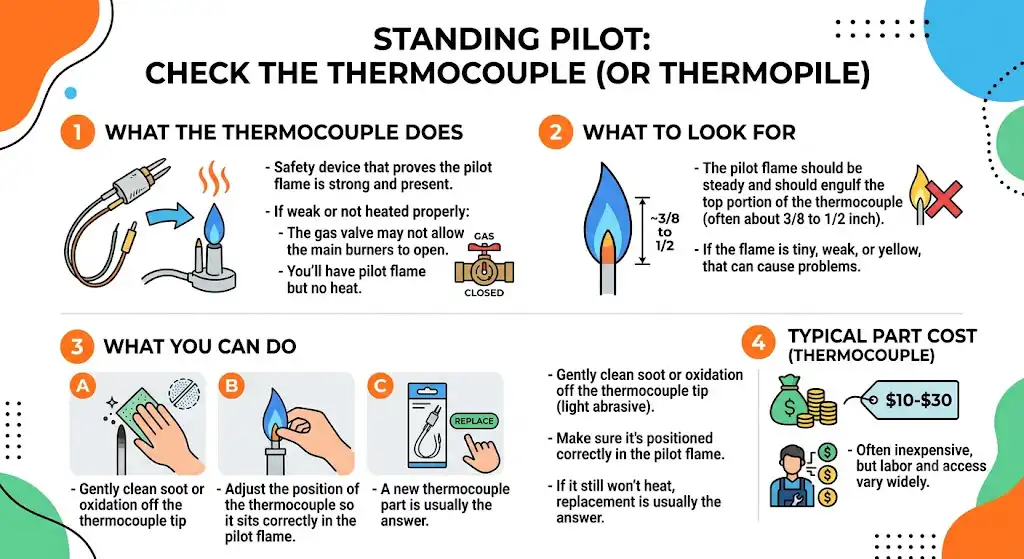
On standing pilot systems, the thermocouple (or thermopile on some systems) is a safety device that proves the pilot flame is strong and present.
If it’s weak or not being heated properly:
- The gas valve may not allow the main burners to open
- You’ll have pilot flame but no heat
What to look for
- The pilot flame should be steady and should engulf the top portion of the thermocouple (often about 3/8 to 1/2 inch)
- If the flame is tiny, weak, or yellow, that can cause problems
What you can do
- Gently clean soot or oxidation off the thermocouple tip (light abrasive)
- Make sure it’s positioned correctly in the pilot flame
If it still won’t heat, replacement is usually the answer.
Typical part cost (thermocouple): often inexpensive, but labor and access vary widely.
Open limit switch (overheating shutdown)
What the limit switch does
The high limit switch opens when the furnace gets too hot, shutting the burners off to protect the system.
If it opens:
- You may get burner ignition briefly, then shutdown
- Or the furnace may refuse to fire until it cools
Why it opens (most common reasons)
- Dirty filter
- Closed vents or blocked returns
- Blower motor not moving enough air
- Dirty blower wheel or plugged evaporator coil (on combined heating and cooling systems)
Can the limit switch be bad?
Yes. It can stick open or fail. Testing usually requires a meter and system knowledge. If you suspect a bad limit switch, I recommend calling a technician because repeated overheating can damage the furnace.
Blower motor or capacitor problems (heat may exist, but it’s not getting to you)
The blower motor’s job is to move air across the heat exchanger and through your ducts.
If the blower isn’t running correctly:
- The furnace may overheat and shut down on limit
- Or you may feel little to no warm air from vents
What you can check:
- Call for heat at the thermostat
- Listen for the blower to start after the burners fire (timing varies by system)
- If you hear humming but the fan doesn’t spin, that often points to a capacitor or motor issue
This is one of those areas where I suggest caution. Capacitors can hold a charge, and blower compartments can have sharp edges and exposed wiring.
A few extra causes competitors often skip (but I see in real homes)
Pressure switch or inducer issues (modern furnaces)
On many furnaces, the inducer motor starts first and the pressure switch proves venting is safe.
If the pressure switch does not close, the furnace may not allow a heating cycle to continue. You might still see an igniter glow or some initial activity, but no sustained heat.
Rollout switch tripped
If a rollout switch trips, it’s serious. It can indicate flame rollout or venting issues. Some reset manually, but I do not recommend resetting without knowing why it tripped.
Simple diagnostic flow you can follow (my “basement checklist”)
- Thermostat on HEAT, temp raised 5 degrees
- Furnace has power, door switch engaged
- Filter clean, vents open, returns clear
- Watch a heat cycle
- Does the burner light then shut off quickly? Clean flame sensor
- Pilot is steady but main burners never light on old furnace? Check thermocouple position and condition
- Blower never comes on or airflow is weak? Possible blower/capacitor or airflow restriction
- Check LED error code (if your furnace has one)
- If you smell gas, see soot, or get repeated lockouts, stop and call a pro
When I recommend calling an HVAC professional
Call a technician if:
- You’ve cleaned the flame sensor and replaced the filter and it still fails
- The limit switch keeps tripping (overheating needs real diagnosis)
- You suspect a gas valve, control board, or venting issue
- You see error codes you can’t interpret
- Any sign of gas smell, soot, or rollout
Prevention tips (so you do not get stuck without heat again)
- Change filters on schedule and use the correct size and MERV rating for your system
- Keep vents open and returns unobstructed
- Have a yearly maintenance visit if you rely heavily on gas heat
- Install CO detectors near sleeping areas and near the furnace area
FAQ
Why is my pilot light on but the furnace won’t kick on?
Most commonly it’s a safety device preventing the main gas valve from opening, such as:
Dirty flame sensor (modern furnaces)
Weak thermocouple (standing pilot)
Limit switch open due to overheating (airflow problems)
Can a dirty air filter really cause no heat?
Yes. Restricted airflow can overheat the furnace and trigger the high limit switch, which shuts the burners down to protect the unit.
How long does flame sensor cleaning take?
If you can access it easily, usually 10 to 20 minutes including shutdown and restart.
Is it safe to clean a flame sensor myself?
For many homeowners, yes, as long as power is off and you’re comfortable removing one screw and reinstalling the part. If you’re unsure, it’s worth calling a pro.
Final thoughts from Natha
When you’ve got a pilot light on but no heat, don’t assume the furnace is “dead.” In a lot of homes I service, it’s something straightforward like a dirty flame sensor, a clogged filter, or a thermostat setting.