Hi, I’m Nathan. I’ve been an HVAC technician for over 10 years, and I’ve worked on a lot of Bryant furnaces (Bryant and Carrier share many of the same designs). If you’re seeing Bryant furnace code 31, you’re not alone. I get this call every heating season, especially after the first cold snap or after a snowstorm.
In this guide, I’ll explain what Code 31 means in plain English, what usually causes it, and the exact troubleshooting order I use in the field so you can fix the simple stuff safely and know when it’s time to call a pro.
- Quick takeaway
- What does Bryant furnace Code 31 mean?
- Most common causes of Bryant Code 31 (ranked by what I see in homes)
- Before you touch anything: safety and what you should not do
- Tools that help (most are optional)
- Step-by-step troubleshooting for Bryant furnace Code 31 (my real-world order)
- Step 1: Confirm the code and do a simple reset
- Step 2: Check and replace the air filter (quick win)
- Step 3: If you have a high efficiency Bryant (PVC venting), check the condensate drain first
- Step 4: Inspect the intake and exhaust vent terminations outside
- Step 5: Check the pressure switch tubing and ports (this fixes a lot of Code 31 calls)
- Step 6: Listen to the inducer motor
- Step 7: Pressure switch testing (when everything else checks out)
- Step 8: Control board (rare, but possible)
- A simple decision guide (so you don’t chase your tail)
- How much does it usually cost to fix Code 31?
- Prevent Code 31 from coming back (my maintenance routine for homeowners)
- When you should stop troubleshooting and call a pro
- FAQ
- Final thoughts from the field
Quick takeaway
Bryant furnace code 31 almost always points to a pressure switch problem. The pressure switch is a safety device that proves the inducer motor is venting properly. If the furnace cannot prove draft or it loses draft while running, it shuts down and flashes Code 31.
What does Bryant furnace Code 31 mean?
On most Bryant furnaces, Code 31 means the pressure switch did not close, or it reopened during a heat cycle.
In normal operation, your furnace does this:
- The thermostat calls for heat.
- Inducer motor starts (draft fan)
- Pressure switch closes (proves venting is safe)
- The ignition sequence starts
- Burner runs
- The blower comes on and heats your home.
Code 31 occurs when the furnace fails at step 3 or later loses that proof. The control board shuts things down to prevent unsafe combustion or flue gas issues.
Why this matters
The pressure switch isn’t “the problem” every time. It’s often the messenger. In my experience, the real cause is usually one of these:
- A vent or intake restriction
- Water backed up in a condensate drain (high efficiency furnaces)
- A cracked, loose, or waterlogged pressure switch tube
- A weak or failing inducer motor
- Less common: a bad control board or a truly failed pressure switch
Most common causes of Bryant Code 31 (ranked by what I see in homes)
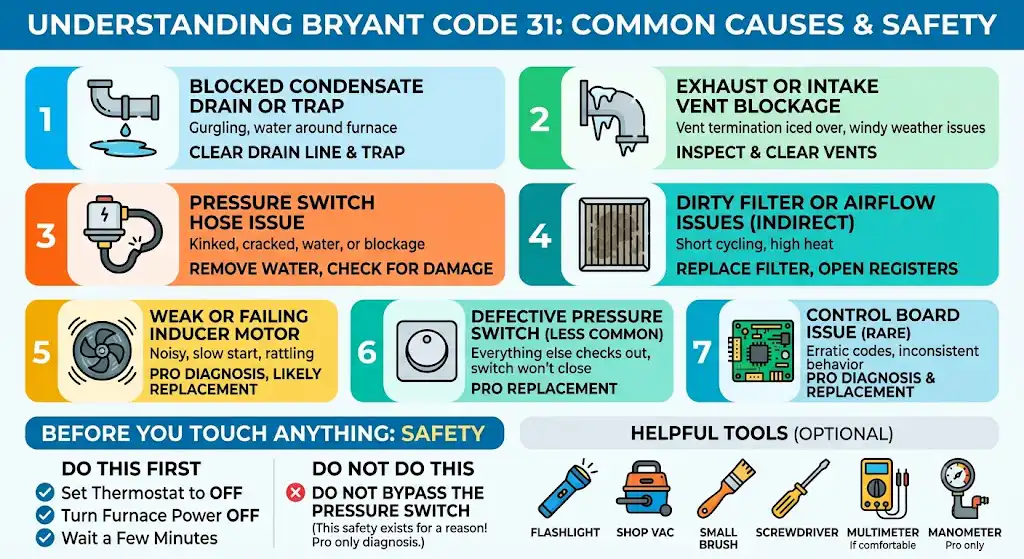
Below is a practical table based on what I run into most often in the field.
Code 31 causes and fixes (fast reference)
| Blocked condensate drain or trap (90+ AFUE) | Gurgling, water around furnace, error happens more in cold weather | Water backs up into inducer/hoses and pressure switch can’t read correctly | Clear drain line and trap |
| Exhaust or intake vent blockage | Furnace fails more in windy/snowy weather, vent termination iced over | Inducer can’t move air, draft pressure is wrong | Inspect and clear vent termination |
| Pressure switch hose issue (kink, crack, water, blockage) | Code comes and goes, especially after long run times | Switch can’t sense proper draft | Remove hose and clear water, check for cracks |
| Dirty filter or airflow issues (indirect cause) | High heat, short cycling, other codes may appear too | Overheating can cause safety trips and unstable operation | Replace filter, open registers |
| Weak or failing inducer motor | Inducer noisy, slow start, rattling | Not enough draft to close switch | Pro diagnosis, likely inducer replacement |
| Defective pressure switch (less common than people think) | Everything else checks out, switch won’t close at correct pressure | Switch fails mechanically/electrically | Pro replacement and verification |
| Control board issue (rare) | Erratic codes, inconsistent behavior | Board misreads the switch circuit | Pro diagnosis and board replacement |
Before you touch anything: safety and what you should not do
I’m all for homeowners doing basic checks, but I’m also serious about safety.
Do this first
- Set thermostat to Off.
- Turn furnace power off at the switch or breaker.
- Wait a few minutes
Do not do this
- Do not bypass the pressure switch and leave it bypassed
(That safety exists for a reason. If you temporarily jump something for diagnosis, it should only be done by someone trained, and only long enough to test.)
Tools that help (most are optional)
Here’s what I typically use. You can still do several checks with just a flashlight and common sense.
| Flashlight | Vent termination, tubing, water leaks | Yes |
| Shop vac or wet vac | Clearing drain lines | Yes |
| Small brush or pipe cleaner | Drain trap and tubing cleanup | Yes |
| Screwdriver / nut driver | Removing panels | Yes |
| Multimeter | Checking switch continuity | If you’re comfortable |
| Manometer | Measuring inducer draft pressure | Usually pro-only |
Step-by-step troubleshooting for Bryant furnace Code 31 (my real-world order)
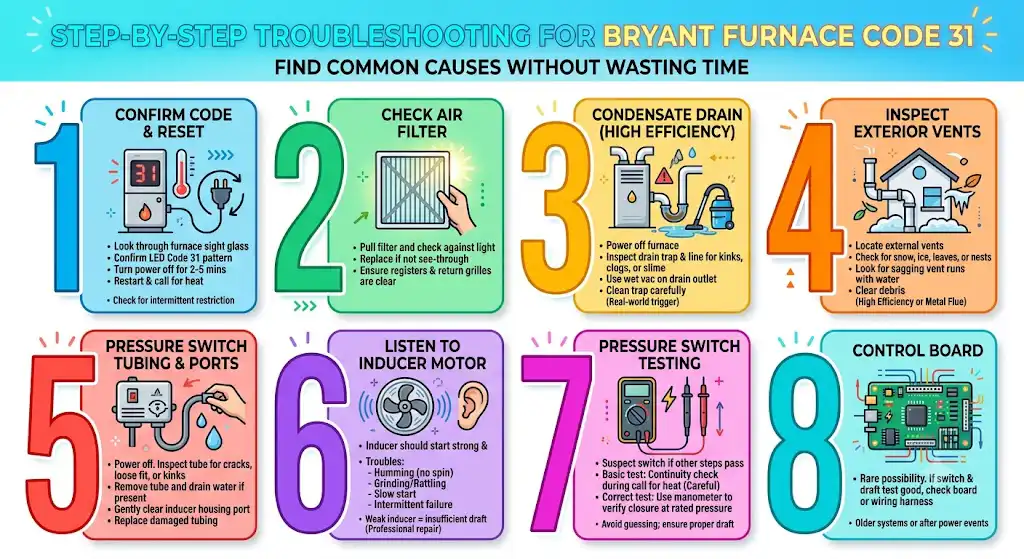
If you do these in order, you’ll fix the most common causes first without wasting time.
Step 1: Confirm the code and do a simple reset
- Look through the furnace sight glass and confirm the LED pattern matches Code 31.
- Turn the power off to the furnace for 2 to 5 minutes.
- Turn it back on and call for heat.
If it fires and stays running, you may have an intermittent restriction (like water sloshing in a tube or a vent termination that’s icing over). Keep going anyway, because it will likely come back.
Step 2: Check and replace the air filter (quick win)
Even though Code 31 is pressure switch related, I still check filters early because a badly neglected system often has multiple problems.
- Pull the filter and hold it to a light.
- If you can’t see light through most of it, replace it.
Also make sure:
- Supply registers are open.
- Return grilles are not blocked.
Step 3: If you have a high efficiency Bryant (PVC venting), check the condensate drain first
This is one of the biggest real-life triggers for Code 31 on condensing furnaces.
Look for:
- Water in the bottom of the cabinet
- A clogged drain trap
- A kinked drain tube
- Slime buildup in the drain
What I do:
- Power off the furnace
- Locate the condensate trap and drain line.
- Make sure the tubing isn’t kinked or pinched.
- Use a wet vac on the drain outlet if accessible.
- Clean the trap if you can remove it (take a picture first, so you put it back correctly)
Why it matters:
When condensate backs up, it can fill the pressure switch hose or inducer port. Then the switch cannot “see” the right draft pressure and Code 31 pops up.
Step 4: Inspect the intake and exhaust vent terminations outside
If your Bryant is a 90+ model, you typically have two PVC pipes outside:
- Intake (brings combustion air in)
- Exhaust (pushes flue gas out)
Check for:
- Snow or ice blockage
- Leaves or debris
- Bird nests (yes, it happens)
- A sagging vent run that can hold water
Clear any blockage you find. If you see water pooling in a sagging horizontal run, that’s a bigger venting issue and may need a pro to correct slope and support.
If your furnace is an 80% model, you may have a metal flue. Check the termination and make sure it’s not blocked.
Step 5: Check the pressure switch tubing and ports (this fixes a lot of Code 31 calls)
This is the small rubber or vinyl tube running between the inducer housing and the pressure switch.
What to look for:
- Cracks
- Loose connections
- Kinks
- Water sitting in the tube
What you can do:
- Power off.
- Remove the tube carefully.
- If water drains out, that’s a big clue. Dry it out and figure out why water is getting there (often condensate backup or venting slope).
- Gently clear the port on the inducer where the tube connects. Sometimes it gets clogged with debris.
If the tubing is brittle or cracked, replace it with the correct size and material rated for the application.
Step 6: Listen to the inducer motor
When the thermostat calls for heat, the inducer should start strong and sound smooth.
Common signs of inducer trouble:
- Humming but not spinning
- Grinding or rattling
- Starts slow, then the furnace faults out.
- Works sometimes, fails other times.
If the inducer is weak, it may not pull enough draft to close the pressure switch consistently, especially on colder days when the system is under more strain.
This is typically a professional repair because it may involve:
- Inducer replacement
- Checking venting and condensate routing
- Confirming draft pressure with a manometer
Step 7: Pressure switch testing (when everything else checks out)
If you’ve verified:
- Venting is clear
- Condensate drains properly
- Tubes and ports are clear.
- Inducer is running properly.
Then the pressure switch becomes more suspect.
A basic test (if you’re comfortable):
- With power off, remove wires and test continuity across the switch terminals during a heat call (procedure varies by model and should be done carefully)
- The real correct test is verifying the switch closes at the rated pressure using a manometer.
Important:
In the field, I don’t like guessing on pressure switches. If the draft is marginal and you replace the switch, the furnace may run for a while but you haven’t fixed the actual cause.
Step 8: Control board (rare, but possible)
If the switch and draft test good but Code 31 persists, the control board or wiring harness can be the issue. This is not a common first cause, but I do see it occasionally, especially on older systems or after power events.
A simple decision guide (so you don’t chase your tail)
| Code 31 happens after heavy snow or freezing rain | Check exhaust and intake terminations for ice |
| Code 31 shows up after the furnace runs a while | Check condensate drain and pressure switch tube for water |
| Inducer is loud, shaky, or slow | Inducer diagnosis |
| You recently changed nothing and it suddenly started | Vent restriction, condensate clog, or tubing issue are most likely |
How much does it usually cost to fix Code 31?
Prices vary by region, furnace model, and accessibility, but here are realistic ballparks I see:
| Air filter replacement | Low cost DIY |
| Clearing condensate drain or trap | Service call to moderate |
| Clearing vent termination | DIY to service call |
| Pressure switch replacement | Moderate |
| Inducer motor replacement | Higher (often the most expensive common fix) |
| Control board replacement | Higher |
Prevent Code 31 from coming back (my maintenance routine for homeowners)
Heating is a major part of home energy use in many households, so keeping your furnace running correctly matters for both comfort and cost. Here’s the simple routine I recommend to homeowners I work with.
Maintenance checklist
| Replace or clean air filter | Every 1 to 3 months | Prevents airflow problems and stress on the system |
| Check outdoor vent terminations | Monthly during winter | Prevents ice, snow, and debris blockages |
| Flush or inspect condensate drain (90+ units) | Once per season | Prevents backups that trigger pressure switch faults |
| Professional furnace tune-up | Yearly | Catches weak inducer motors, draft issues, and venting problems early |
When you should stop troubleshooting and call a pro
Call a qualified HVAC technician if:
- You’ve cleared vents and drains and Code 31 keeps returning
- The inducer motor is noisy, intermittent, or not starting
- You suspect a venting design issue (improper slope, sagging PVC, incorrect termination)
- You smell gas or suspect flue gas issues
- You’re not comfortable testing electrical components
A pro will typically verify:
- Draft pressure with a manometer
- Pressure switch rating and operation
- Venting and condensate routing compliance
- Inducer performance under load
FAQ
Is Code 31 dangerous?
It can be if the underlying cause is blocked venting or flue gas handling. The good news is Code 31 is the furnace protecting you by shutting down.
Can a dirty filter cause Code 31?
Not directly in most cases, but poor airflow can contribute to unstable operation and other trips. I still replace it early because it’s fast and it eliminates one variable.
Why does Code 31 come and go?
Intermittent problems are commonly caused by:
Water shifting in the pressure tube
A vent termination that freezes over only under certain conditions
An inducer motor that’s getting weak and fails when cold
Final thoughts from the field
When I get a Bryant Code 31 call, I start with condensate and venting, then I move to pressure tubing and inducer performance, and only after that do I condemn the pressure switch itself. That order solves the majority of Code 31 problems without wasting money on parts that weren’t actually bad.