I’m Nathan. I’ve worked as an HVAC technician for over 10 years, and I can tell you this problem is one of the most common winter calls I run: the furnace kicks on, runs for about 30 seconds, then shuts off. Sometimes it tries again. Sometimes it locks out and you get no heat at all.
The good news is this usually is not a “your furnace is dead” situation. Most of the time, it’s a safety shutdown caused by a handful of fixable issues like restricted airflow, a dirty flame sensor, or venting problems.
This guide walks you through what’s really happening and what you can safely check yourself, step by step.
- Quick safety first (do this before troubleshooting)
- What it’s called when a furnace shuts off after 30 seconds
- What’s happening inside your furnace during those 30 seconds
- Most common causes (and the fastest ways to identify them)
- Step-by-step: How to fix a furnace that shuts off after 30 seconds
- Step 1: Replace the air filter (yes, even if it “looks fine”)
- Step 2: Make sure vents and returns are not choking the system
- Step 3: Check thermostat settings and power
- Step 4: Clean the flame sensor (most common true cause when it lights then dies)
- Step 5: Check intake and exhaust venting outside (blocked vent can cause fast shutdown)
- Step 6: If you have a high-efficiency furnace, check the condensate drain line
- If it still shuts off: likely causes that usually require a technician
- Typical repair costs (realistic ranges)
- How to prevent this from happening again (my maintenance checklist)
- FAQ: Furnace turns on then off after 30 seconds
- My bottom-line advice as a tech
Quick safety first (do this before troubleshooting)
If any of these are true, stop and call a pro right away:
- You smell gas (rotten egg smell)
- Your carbon monoxide alarm is going off
- You see soot around the furnace or vent pipe
- You see flames “rolling out” or hear a loud boom at ignition
- You feel dizzy or nauseous when the furnace runs
What it’s called when a furnace shuts off after 30 seconds
In the HVAC world, this is usually short cycling or a safety shutdown.
A modern furnace has multiple safety switches. If the furnace starts, then shuts down quickly, it’s often because one of these safety checks failed, such as:
- Flame was not proven (flame sensor issue)
- Furnace overheated (limit switch issue, often airflow-related)
- Draft/venting was not proven (pressure switch issue)
- Condensate safety opened (high-efficiency furnaces)
Your furnace is basically saying: “I tried to run, but something didn’t look safe.”
What’s happening inside your furnace during those 30 seconds
This timeline helps you pinpoint the failure:
- Thermostat calls for heat
- Inducer motor starts (you’ll hear a small motor/whirring)
- Pressure switch proves draft (confirms venting is moving air)
- Ignitor heats up (hot surface ignitor glows or spark ignites)
- Gas valve opens, burners light
- Flame sensor proves flame
- Blower motor starts (after a short delay)
Key clue:
If your furnace lights, then shuts off around 5 to 30 seconds later, I immediately suspect the flame sensor (or flame signal issue).
Most common causes (and the fastest ways to identify them)
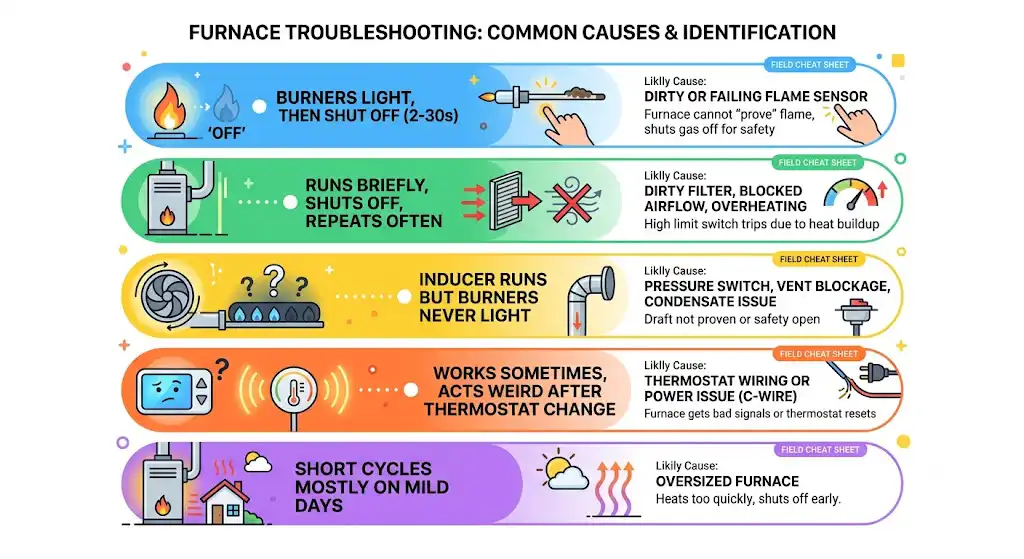
Here’s a field-style cheat sheet I use.
Table: Symptoms and likely causes
| Burners light, then shut off in 2 to 30 seconds | Dirty or failing flame sensor | Furnace cannot “prove” flame, shuts gas off for safety |
| Furnace runs briefly, then shuts off, repeats often | Dirty filter, blocked airflow, overheating | High limit switch trips due to heat buildup |
| Inducer runs but burners never light | Pressure switch, vent blockage, condensate issue | Draft not proven or safety open |
| Furnace works sometimes, acts weird after thermostat change | Thermostat wiring or power issue (C-wire) | Furnace gets bad signals or thermostat resets |
| Short cycles mostly on mild days | Oversized furnace | Heats too quickly, shuts off early |
Step-by-step: How to fix a furnace that shuts off after 30 seconds
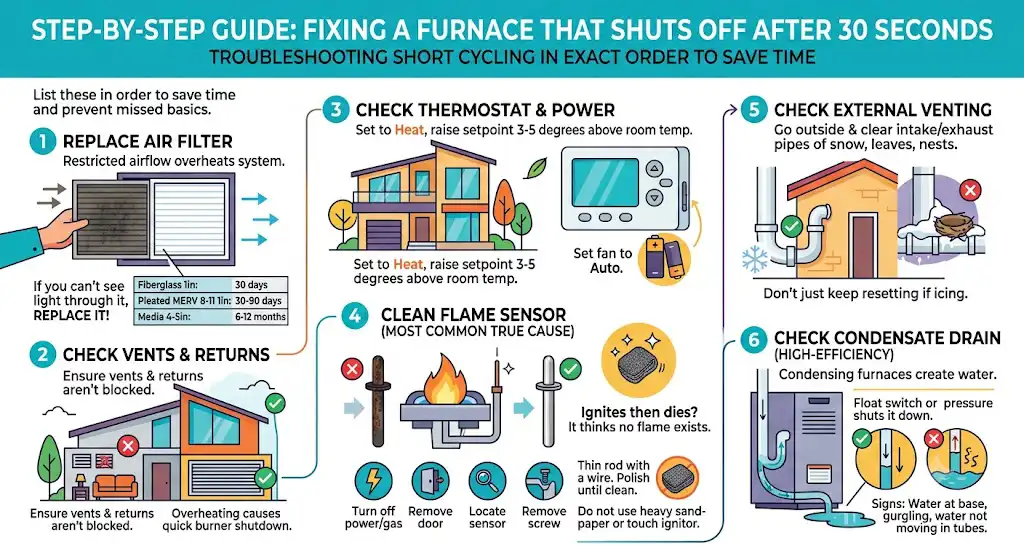
I’m going to list these in the exact order I’d troubleshoot in a home, because it saves time and prevents missed basics.
Step 1: Replace the air filter (yes, even if it “looks fine”)
Restricted airflow is one of the biggest triggers for short cycling because it overheats the heat exchanger.
What I tell homeowners: If you can’t clearly see light through the filter, replace it.
Typical replacement schedule (real world):
- Every 1 month: pets, dusty home, renovations, heavy furnace use
- Every 2 to 3 months: average homes with standard 1 inch filters
- Every 6 to 12 months: thicker 4 to 5 inch media filters (depends on use)
Table: Filter type, pros, and change interval
| Fiberglass basic | 1 inch | Budget, equipment protection only | 30 days |
| Pleated MERV 8 to 11 | 1 inch | Most homes | 30 to 90 days |
| Media filter | 4 to 5 inch | Better airflow and filtration | 6 to 12 months |
What you do:
- Turn the furnace off at the thermostat.
- Pull the filter and match the size exactly.
- Install with the airflow arrow pointing toward the furnace.
Step 2: Make sure vents and returns are not choking the system
This one surprises people.
Check:
- Supply vents not covered by rugs or furniture
- Return grille not blocked
- Too many registers not closed (closing lots of vents can raise static pressure and cause overheating)
If your furnace is overheating, it will shut the burners off quickly and try again later. That looks like “it runs for 30 seconds and quits.”
Step 3: Check thermostat settings and power
Before you open the furnace:
- Set thermostat to Heat
- Raise setpoint 3 to 5 degrees above room temp
- Set fan to Auto
- Replace thermostat batteries (if it uses them)
If you recently installed a smart thermostat and this started afterward, it could be a wiring or C-wire issue. I’ve seen smart thermostats “power steal,” causing strange cycling and control problems.
Step 4: Clean the flame sensor (most common true cause when it lights then dies)
If your burners ignite and then shut off quickly, this is where I’d put my money.
What the flame sensor does
It’s a small metal rod that sits in the burner flame. It sends a tiny electrical signal back to the control board to prove flame is present. If it’s dirty, the furnace thinks there is no flame and shuts the gas off.
How to clean it safely
Tools:
- 1/4 inch nut driver or screwdriver (varies)
- Fine steel wool or a very fine abrasive pad
- Clean dry cloth
Steps:
- Turn off power to the furnace at the switch or breaker.
- Shut off gas if you want an extra layer of safety.
- Remove the burner compartment door.
- Find the flame sensor (thin rod with a single wire, usually near the burners).
- Remove the screw holding it and pull it out gently.
- Lightly polish the rod until it’s clean and shiny.
- Wipe it clean and reinstall.
Important:
- Do not use heavy sandpaper or aggressively grind it down.
- Do not touch the ignitor (it’s fragile).
If cleaning fixes it, great. If it works for a day and fails again, the sensor may be weak or you may have grounding or control-board flame signal issues.
Step 5: Check intake and exhaust venting outside (blocked vent can cause fast shutdown)
Especially on high-efficiency furnaces with PVC pipes, I’ve seen these blocked by:
- Snow and ice
- Leaves
- Wasp nests
- Bird nests
What you do:
- Go outside and make sure the pipes are clear.
- Make sure nothing is packed into the openings.
- If you see ice buildup, don’t keep resetting the furnace. Find out why it’s icing (pitch, drainage, termination location, wind issues).
Step 6: If you have a high-efficiency furnace, check the condensate drain line
Condensing furnaces create water. If the drain line backs up, a float switch or pressure issue can shut the furnace down fast.
Signs:
- Water around the furnace base
- Gurgling sounds
- Clear tubing holding water with no movement
If it still shuts off: likely causes that usually require a technician
At this point, I’m being straight with you: you’re getting into areas where guessing gets expensive and can become unsafe.
Common pro-level causes
- High limit switch problems (bad switch or real overheating from deeper airflow issues like a failing blower motor or plugged coil)
- Pressure switch failure (or venting/inducer problems)
- Control board issues (misreading flame signal or dropping power)
- Gas pressure problems (low pressure or improper regulation)
- Cracked heat exchanger (serious safety issue)
When I tell a homeowner to shut it off immediately
- Repeated lockouts
- Burning smell that doesn’t go away quickly
- Any signs of rollout
- CO concerns
- You keep resetting it and it keeps failing
Typical repair costs (realistic ranges)
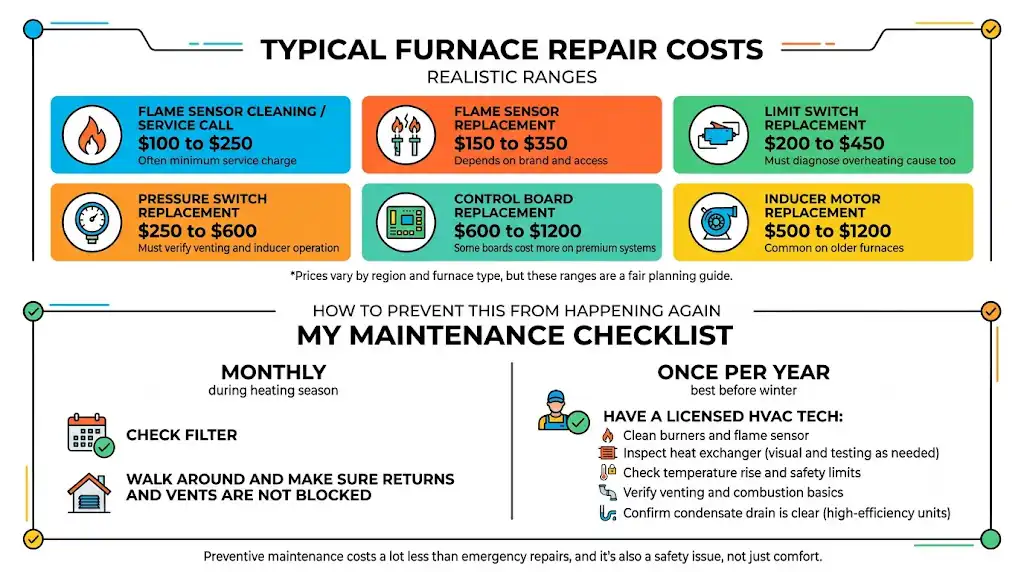
Prices vary by region and furnace type, but these ranges are a fair planning guide.
| Flame sensor cleaning/service call | 100 to 250 | Often minimum service charge |
| Flame sensor replacement | 150 to 350 | Depends on brand and access |
| Limit switch replacement | 200 to 450 | Must diagnose overheating cause too |
| Pressure switch replacement | 250 to 600 | Must verify venting and inducer operation |
| Control board replacement | 600 to 1200 | Some boards cost more on premium systems |
| Inducer motor replacement | 500 to 1200 | Common on older furnaces |
How to prevent this from happening again (my maintenance checklist)
If you want fewer breakdowns, this is the simple routine I recommend to homeowners.
Monthly during heating season
- Check filter
- Walk around and make sure returns and vents are not blocked
Once per year (best before winter)
Have a licensed HVAC tech:
- Clean burners and flame sensor
- Inspect heat exchanger (visual and testing as needed)
- Check temperature rise and safety limits
- Verify venting and combustion basics
- Confirm condensate drain is clear (high-efficiency units)
Preventive maintenance costs a lot less than emergency repairs, and it’s also a safety issue, not just comfort.
FAQ: Furnace turns on then off after 30 seconds
Why does my furnace keep shutting off after a few seconds?
Most commonly it’s either:
A dirty air filter causing overheating and tripping the limit switch, or
A dirty flame sensor failing to prove flame so the board shuts off the gas
Why does my furnace run for a little then shut off?
That’s classic short cycling. The furnace is hitting a safety condition (overheating, flame not proven, venting not proven) and shutting itself down to prevent damage or danger.
How do I fix a short cycling furnace?
Start with safe, high-success steps:
Replace the air filter
Open vents and unblock returns
Check thermostat settings and batteries
Clean the flame sensor
Check intake and exhaust vent terminations outside
If it persists, call a pro to test limits, pressure switch, draft, and flame signal.
Why does my furnace shut off before reaching the set temperature?
If it’s shutting off early, it’s usually:
Overheating due to airflow restriction
Flame sensor problems causing burner shutdown
Thermostat issues (bad location, miswiring, smart thermostat power issues)
Oversized furnace short cycling on mild days
My bottom-line advice as a tech
When a furnace shuts off after 30 seconds, it’s usually a safety shutdown, not a mystery. Start with the filter and airflow, then move to the flame sensor. Those two fixes alone solve a huge percentage of these calls in the real world.