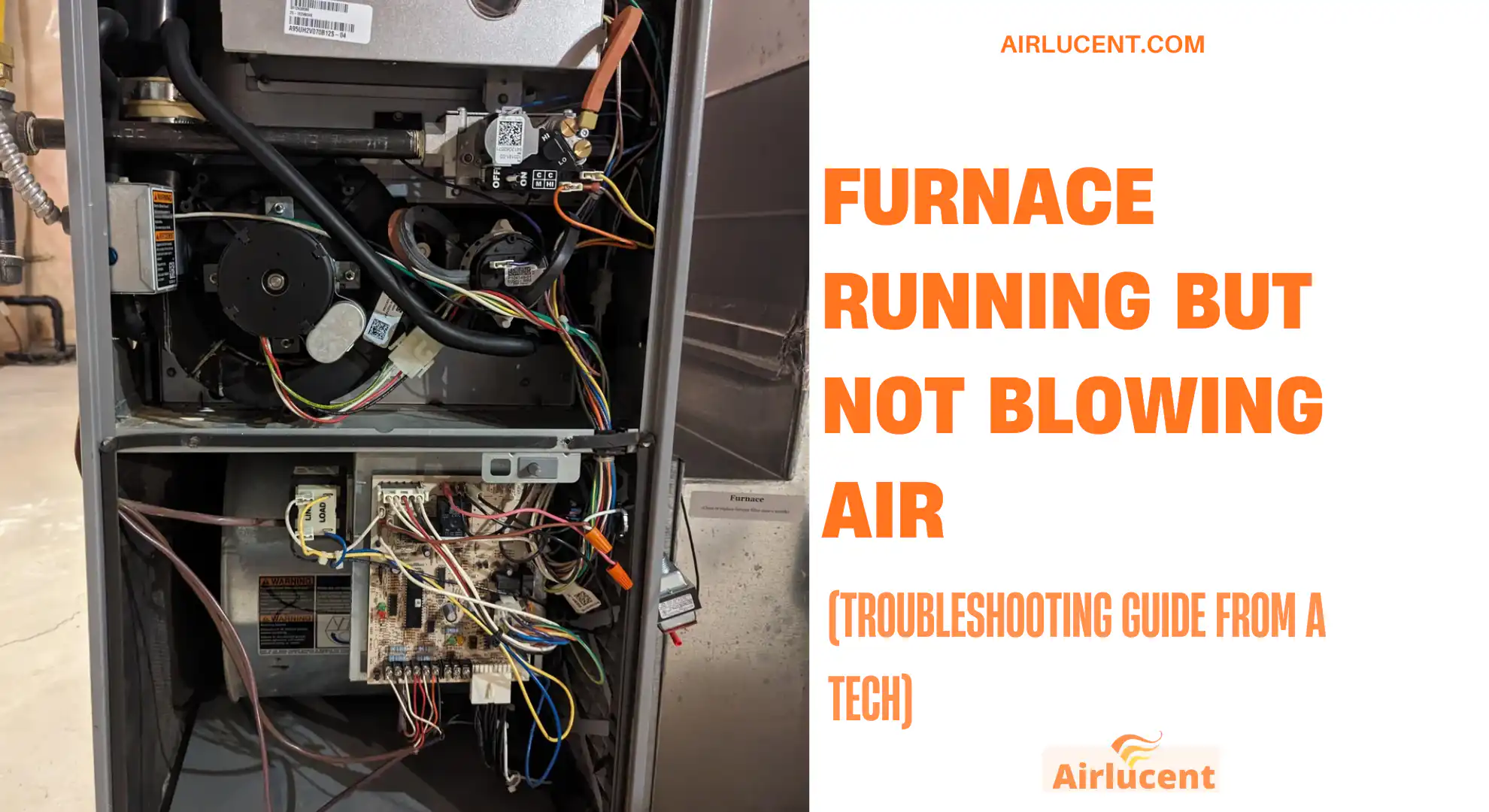
If your furnace is running but not blowing air, it usually means the heat is being created (or at least the system is trying to run) but the air-moving side of the furnace is failing or airflow is blocked somewhere.
I’ve worked on this exact complaint for years, and in most homes it comes down to a handful of root causes:
- A plugged air filter
- A blower motor or capacitor issue
- A safety limit switch shutoff from overheating
- A thermostat or fan setting problem
- A blocked return, supply vents, or duct problem
In this guide, i will tell you all.
- Quick diagnosis: what “running” actually means
- Step-by-step troubleshooting (in the order I’d do it)
- If the easy stuff didn’t fix it: common mechanical and electrical causes
- A practical troubleshooting checklist you can follow today
- When you should call a technician (and what to tell them)
- Prevent this from happening again (what I recommend after 10 years in HVAC)
- Frequently asked questions
- Final thoughts
Quick diagnosis: what “running” actually means
When homeowners tell me “it’s running,” they might mean different things. Use this quick table to narrow it down.
Quick Symptom-to-Cause Table
| Furnace is humming, burners may be on, but no air from vents | Blower motor not running, bad capacitor, control board not sending blower signal | Filter, blower access panel switch, blower motor start |
| Airflow is very weak | Clogged filter, dirty blower wheel, blocked return, closed registers | Filter and returns, vent/register positions |
| Works for a bit then stops blowing, furnace seems hot | Overheating and limit switch tripping (often from restricted airflow) | Filter, blocked vents/returns, blower wheel buildup |
| Thermostat says “heat,” furnace runs, but fan never comes on | Thermostat wiring/setting, fan control issue, blower motor failure | Thermostat fan settings, furnace error code, blower |
| Breaker trips when it tries to blow | Shorted motor, failing capacitor, wiring problem | Stop and call a technician |
Step-by-step troubleshooting (in the order I’d do it)
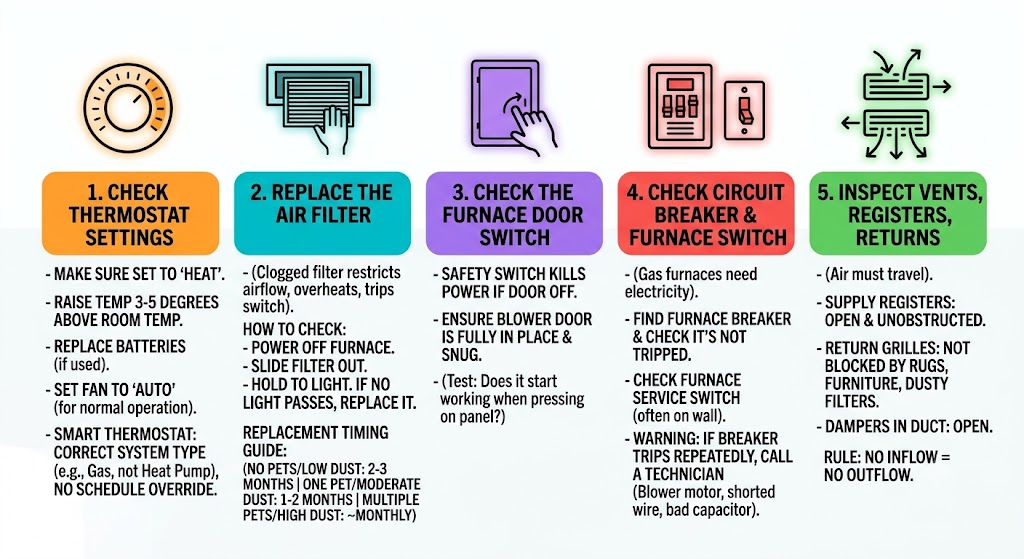
1. Check thermostat settings (simple but common)
I’ve seen plenty of “no airflow” calls that were really a thermostat issue.
What to do:
- Make sure it’s set to Heat
- Raise the set temperature 3 to 5 degrees above room temp
- If your thermostat uses batteries, replace them
- Set Fan to Auto (not On) for normal operation
- Fan On can actually confuse troubleshooting because it tries to run the blower constantly
If you have a smart thermostat and recently changed it or lost Wi‑Fi/power, double-check:
- Correct system type selected (gas furnace, not heat pump)
- No schedule override keeping it down
2. Replace the air filter (this is the number one cause I see)
A clogged filter can restrict airflow so badly that:
- The furnace overheats
- A safety limit switch trips
- The burners shut down
- The blower may stop or run weakly
How to check it correctly
- Power off the furnace
- Slide the filter out (usually in the return duct slot or blower compartment)
- Hold it up to a light
- If you can’t see light through it, replace it
Filter replacement timing (real-world guidance)
Most manufacturers and service manuals commonly recommend changing filters about every 1 to 3 months, but your home matters:
- Pets, construction dust, allergies, or lots of carpet usually means closer to monthly
- A very clean home may stretch longer, but I rarely advise pushing it
Quick filter guide
| No pets, low dust | Every 2 to 3 months |
| One pet or moderate dust | Every 1 to 2 months |
| Multiple pets, high dust, allergies | About monthly |
If replacing the filter restores airflow, you likely solved the main problem. If it happens again quickly, your system may be:
- Using too restrictive a filter (overly high MERV for the duct system)
- Pulling dust from leaky return ducts or an old filter rack
3. Check the furnace door switch (easy to miss)
Many furnaces have a safety switch that cuts power when the blower door is off. If the panel isn’t seated perfectly, the furnace can behave strangely.
What to do:
- Make sure the blower door is fully in place and snug
- If the furnace starts working when you press on the panel, that’s a clue
4. Check your circuit breaker and furnace switch
Even gas furnaces need electricity for the control board and blower.
What to do:
- Find the furnace breaker and ensure it’s not tripped
- Check the furnace service switch (often on a wall near the unit)
If the breaker trips repeatedly, stop. That often indicates:
- A failing blower motor
- A shorted wire
- A bad capacitor pulling high amperage
That’s technician territory.
5. Inspect vents, registers, and returns (air has to travel)
This one is more common than people think, especially after moving furniture or doing renovations.
Check:
- Supply registers: open and unobstructed
- Return grilles: not blocked by rugs, furniture, or filters that are packed with dust
- Dampers in the duct (if accessible): open
A quick rule I tell homeowners: Your furnace can’t blow air out if it can’t pull air in. A blocked return can mimic a blower failure.
If the easy stuff didn’t fix it: common mechanical and electrical causes
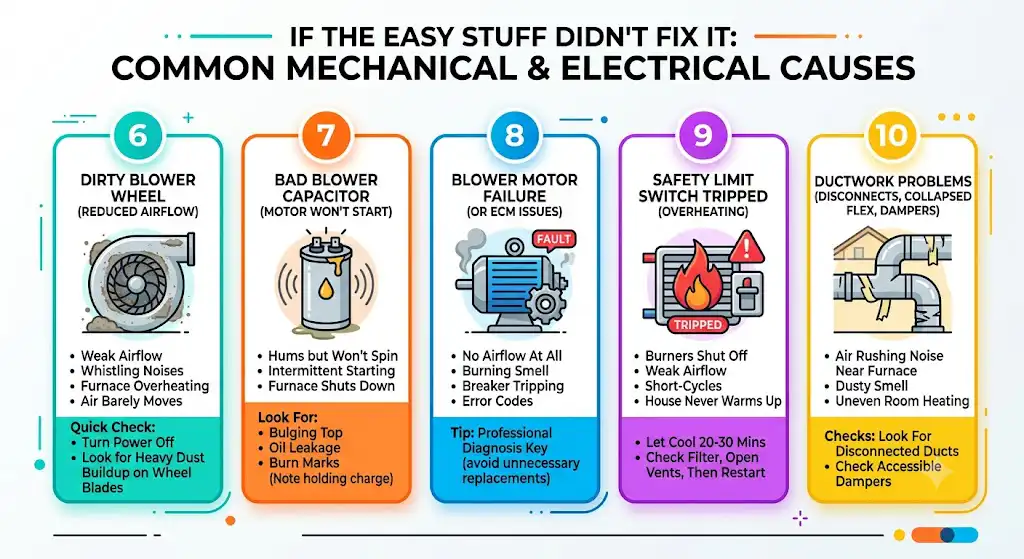
6. Dirty blower wheel (reduced airflow even if motor runs)
A blower wheel (often called a squirrel cage) can get caked with dust, especially if filters were neglected.
Symptoms:
- Weak airflow
- Whistling at returns
- Furnace overheating
- Blower runs, but air barely moves
What you can do:
- Turn off power
- Open blower compartment (if you’re comfortable)
- Look for heavy dust buildup on the wheel blades
Light dust can sometimes be vacuumed carefully, but a proper cleaning often requires removing the assembly. If you’re not experienced, this is a good point to call a tech because you can damage the wheel or wiring.
7. Bad blower capacitor (motor hums but won’t start)
On many PSC blower motors, the capacitor provides the “kick” to start spinning.
Common signs:
- You hear a hum, but the fan doesn’t spin
- The blower may start sometimes and fail other times
- The furnace may shut down on limit due to no airflow
What I look for:
- Bulging top on the capacitor
- Oil leakage
- Burn marks
Testing requires a meter with capacitance. Replacement is inexpensive compared to a motor, but capacitors can hold a charge. If you’re not trained, don’t mess with it.
8. Blower motor failure (or ECM motor issues)
If the motor is seized, shorted, or failing, the furnace may “run” but never move air.
Symptoms:
- No airflow at all
- Burning smell
- Breaker tripping
- Error code on control board (varies by brand)
Modern variable-speed ECM motors fail differently than older motors. Sometimes they’ll run at the wrong speed or not at all due to a failed module.
This is typically a professional repair because correct diagnosis matters. I’ve seen homeowners replace a motor when the real problem was the control board or wiring harness.
9. Safety limit switch tripped from overheating
If airflow is restricted, the furnace heat exchanger gets too hot and the high-limit switch shuts burners down to prevent damage.
What you may notice:
- Burners ignite, then shut off
- Blower may run but airflow is weak
- System short-cycles
- “Running” but house never warms up
What to do:
- Turn thermostat off
- Let the furnace cool 20 to 30 minutes
- Replace the filter and open vents
- Restart
If it repeats, don’t keep resetting it. Repeated overheating can damage the furnace.
10. Ductwork problems (disconnects, collapsed flex duct, closed dampers)
If the blower is running but air isn’t reaching rooms, ducts may be leaking or disconnected, especially in attics and crawlspaces.
Clues:
- Air rushing noise near the furnace
- Dusty basement or attic air smell
- Some rooms get air, others get nothing
Basic homeowner checks:
- Look for obvious disconnected ducts near the unit
- Check any accessible dampers
A practical troubleshooting checklist you can follow today
Homeowner checklist (10 to 20 minutes)
- Thermostat on Heat and set higher than room temp
- Fan set to Auto
- Replace filter
- Confirm all return grilles and supply vents are open
- Check breaker and furnace switch
- Ensure blower door panel is properly seated
- Listen: do you hear the blower try to start (hum) or nothing at all?
When you should call a technician (and what to tell them)
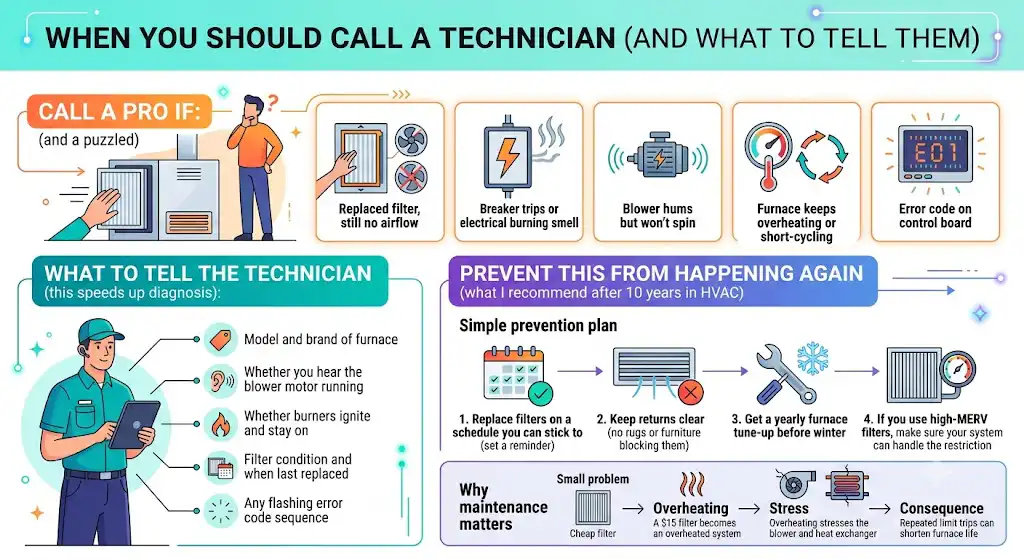
Call a pro if:
- You replaced the filter and still get no airflow
- The breaker trips or you smell electrical burning
- The blower hums but won’t spin
- The furnace keeps overheating or short-cycling
- You see an error code on the control board
What to tell the technician (this speeds up diagnosis):
- Model and brand of furnace
- Whether you hear the blower motor running
- Whether burners ignite and stay on
- Filter condition and when it was last replaced
- Any flashing error code sequence
Prevent this from happening again (what I recommend after 10 years in HVAC)
Simple prevention plan
- Replace filters on a schedule you can stick to (set a reminder)
- Keep returns clear (no rugs or furniture blocking them)
- Get a yearly furnace tune-up before winter
- If you use high-MERV filters, make sure your system can handle the restriction
Why maintenance matters
From experience, the expensive repairs I see most often start as small airflow issues:
- A $15 filter becomes an overheated system
- Overheating stresses the blower and heat exchanger
- Repeated limit trips can shorten furnace life
Frequently asked questions
Why is my furnace running but no air comes out?
Usually the blower isn’t moving air, or airflow is blocked by a clogged filter, dirty blower wheel, closed vents, or duct problems.
Can a dirty filter cause the furnace to stop blowing?
Yes. A clogged filter can restrict airflow enough to cause overheating and trigger safety shutdowns, which can look like “it’s running but not blowing.”
Should I keep resetting it and trying again?
No. If it overheats or keeps shutting down, repeated resets can lead to bigger damage. Fix airflow first, then test.
Is this an emergency?
If there’s no gas smell or smoke, it’s typically not an immediate emergency, but don’t ignore overheating signs, burning smells, or breaker trips.
Final thoughts
When a furnace is running but not blowing air, the issue is almost always on the airflow side: filter, blower, capacitor, limit switch, vents, or ducts. Start with the simplest checks, because the quick fix is often a filter or a blocked return. If you get into humming motors, repeated overheating, or electrical symptoms, that’s when a qualified HVAC tech should take over.