If your furnace ignitor is lighting (glowing orange or clicking to spark) but you are not getting any flame, the furnace is failing at the exact moment it should open the gas valve and light the burners. In my day to day service work, this usually comes down to one of four things:
- Gas is not reaching the burners (shutoff, low pressure, air in line, gas valve issue)
- The gas valve is not being energized (control board or a safety switch in the circuit)
- Burners or orifices are dirty or misaligned (gas flows poorly and will not light)
- The furnace lights briefly but shuts down (dirty flame sensor or grounding problem)
Below is the same step by step process I use in the field so you can pinpoint the cause without guessing or throwing parts at it.
- Safety first (please do this before anything else)
- Quick 60 second clarification: what type of ignitor do you have?
- How the ignition sequence works (so the troubleshooting makes sense)
- Fast diagnosis table (symptom to cause)
- Step by step: Furnace ignitor lights but no flame
- Step 1: Confirm you actually have a call for heat
- Step 2: Check the gas shutoff valves (two common locations)
- Step 3: Watch the burner area during the ignition trial
- Step 4: If you have a hot surface ignitor, check for gas valve voltage (best real test)
- Step 5: Common reasons gas is not reaching the burners
- Step 6: Clean and inspect burners (very common on older furnaces)
- Step 7: If the flame lights briefly then shuts off, clean the flame sensor
- Step 8: Check the easy safety switches (limits and rollouts)
- Step 9: Control board or wiring issues
- Special case: Older furnaces with a standing pilot
- What you can safely do yourself vs what I recommend hiring out
- Typical repair costs and part life (real world planning info)
- My “no flame” checklist you can follow in order
- When to stop troubleshooting and call a pro
- FAQ: Furnace ignitor lights but no flame
Safety first (please do this before anything else)
Gas and ignition systems are not forgiving. If at any point you smell gas, stop and shut off the furnace and gas supply, leave the area, and contact your gas utility or a licensed HVAC pro.
Before you open panels or touch wiring:
- Set thermostat to Off
- Turn furnace power off at the switch or breaker
- If you will be removing any gas components, close the gas shutoff valve
- Wait a few minutes for any unburned gas to clear
If you are not comfortable using a multimeter around live voltage, skip straight to the “When to call a pro” section.
Quick 60 second clarification: what type of ignitor do you have?
Most modern furnaces are one of these:
- Hot surface ignitor (HSI): a small ceramic element that glows bright orange
- Spark ignitor: you hear rapid clicking as it sparks
Either way, the sequence is similar: inducer motor starts, ignitor heats or sparks, then the gas valve opens and burners light.
How the ignition sequence works (so the troubleshooting makes sense)
When you call for heat, the furnace typically does this:
- Thermostat calls for heat
- Inducer motor starts (draft)
- Pressure switch proves venting
- Ignitor turns on (glow or spark)
- Gas valve opens
- Burners ignite
- Flame sensor proves flame
- Blower starts
Your symptom means the furnace is reaching step 4, but failing at step 5 or 6.
Fast diagnosis table (symptom to cause)
| Ignitor glows, no flame at all, then it retries | Gas not getting through, or gas valve not opening | Gas shutoff position, gas valve voltage during trial |
| Spark clicks, no flame, retries | Same as above, plus burner crossover issues | Gas supply, burner alignment and carryover ports |
| Flame lights for 1 to 5 seconds then shuts off | Dirty flame sensor or poor grounding | Clean flame sensor, check burner ground |
| Furnace locks out and shows an error code | Safety circuit opened or ignition failure | Read board flash code inside panel |
Step by step: Furnace ignitor lights but no flame
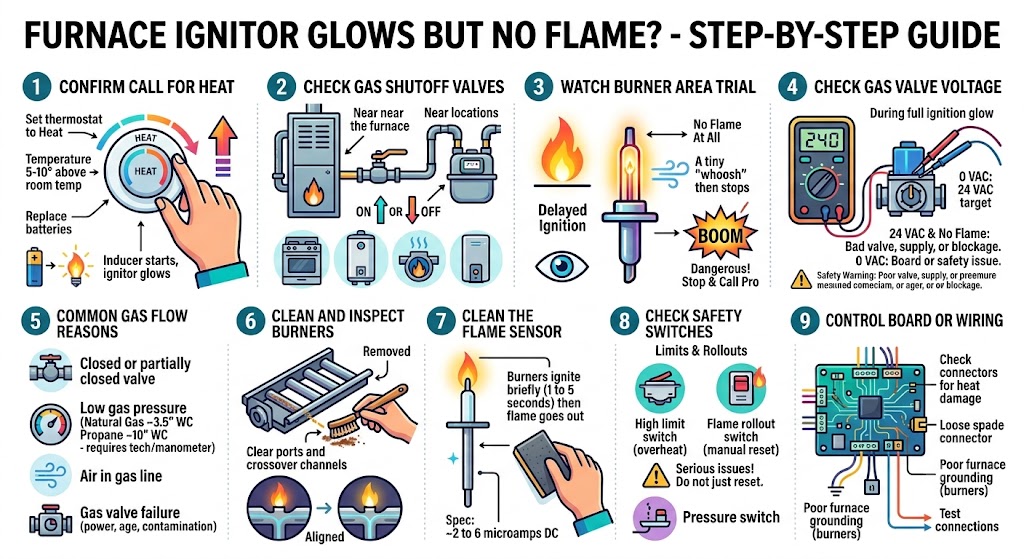
Step 1: Confirm you actually have a call for heat
This sounds basic, but I cannot tell you how often I walk into a “bad furnace” that is simply not being told to heat.
- Set thermostat to Heat
- Set temperature 5 to 10 degrees above room temp
- Replace thermostat batteries if applicable
If the inducer starts and the ignitor lights, you do have a call for heat. Move on.
Step 2: Check the gas shutoff valves (two common locations)
If the ignitor glows but there is zero flame, I always verify gas supply first because it is the fastest and safest check.
Look for:
- A shutoff valve near the furnace on the gas pipe
- Sometimes a second valve near the gas meter
Correct position:
- Handle parallel to the pipe = ON
- Handle perpendicular to the pipe = OFF
Also ask yourself:
- Did anyone recently do plumbing, appliance work, or move items near the furnace?
- Are other gas appliances working (stove, water heater, fireplace)?
If other gas appliances are also dead, this is likely a supply issue, not a furnace part.
Step 3: Watch the burner area during the ignition trial
Turn power back on and watch one full attempt.
You are looking for any sign of gas ignition:
- No flame at all
- A tiny “whoosh” that immediately stops
- Delayed ignition (a boom) which is dangerous and should be handled by a pro
If you get delayed ignition, stop running it and get it serviced. That can indicate dirty burners, wrong gas pressure, or venting issues.
Step 4: If you have a hot surface ignitor, check for gas valve voltage (best real test)
This is the most direct way to separate “gas valve not being told to open” from “gas valve is bad.”
What you need:
- A multimeter
- Access to the gas valve wiring terminals
During the ignition trial, when the ignitor is glowing at full brightness, measure voltage at the gas valve:
- Many furnaces use 24 VAC to energize the gas valve
Interpretation:
- You have 24 VAC at the valve but no flame:
Most likely a failed gas valve, gas supply issue, or blockage before the burners. - You have 0 VAC at the valve:
The control board is not sending power, or a safety switch is open in the circuit.
If you are not comfortable doing this live, do not. This is where I typically recommend calling a technician.
Step 5: Common reasons gas is not reaching the burners
Closed or partially closed gas valve
Even a valve that is only partly open can cause ignition failure, especially on cold starts.
Low gas pressure
Low inlet pressure can prevent ignition even though everything “sounds normal.”
Typical manifold pressure targets (varies by furnace and setup):
| Natural gas | about 3.5 inches water column |
| Propane | about 10.0 inches water column |
Checking gas pressure requires a manometer and should be done by a qualified tech.
Air in the gas line
This can happen after gas work or if propane tanks were empty. You may see repeated ignition attempts with no flame until air purges. If it does not light quickly, stop and have it checked.
Gas valve failure
Gas valves fail, especially after power events, age, or contamination. If the valve is getting the proper voltage but not opening, replacement is common.
Step 6: Clean and inspect burners (very common on older furnaces)
If you hear gas for a moment but it will not light, or you have a spark ignitor that cannot “carry” flame across burners, dirty burners are a real suspect.
What I do:
- Power off
- Remove burner assembly if accessible
- Brush rust and debris
- Clear burner ports and crossover channels
- Reinstall burners square and aligned
A small amount of rust can disrupt the carryover, so burner one might light but the rest do not, or nothing lights consistently.
Step 7: If the flame lights briefly then shuts off, clean the flame sensor
This is one of the most common service calls I run.
What happens:
- Burners ignite
- Within 1 to 5 seconds, flame goes out
- Furnace retries and may lock out
That is classic flame sensing failure.
How to clean it:
- Turn power off
- Remove the flame sensor (usually one screw)
- Gently clean the metal rod with fine abrasive pad or fine grit sandpaper
- Wipe clean and reinstall
Field note from my own work: many flame sensors look “fine” but still fail to read properly due to oxidation you can barely see.
Typical flame sensor readings (varies by brand):
- Many systems like to see about 2 to 6 microamps DC flame signal
A pro can test that with a meter in series.
Step 8: Check the easy safety switches (limits and rollouts)
If a safety is open, the control board may allow the ignitor to glow but never open the gas valve, depending on design.
Common switches:
- High limit switch (overheat protection)
- Flame rollout switch (manual reset on some models)
- Pressure switch (usually proves before ignitor, but can be intermittent)
If you find a rollout switch tripped, do not just reset it and walk away. Rollout is often caused by serious issues like blocked heat exchanger passages or venting problems.
Step 9: Control board or wiring issues
If:
- Ignitor glows normally
- Gas supply is confirmed on
- Safety circuit checks out
- No voltage is sent to the gas valve
Then the problem can be:
- Failing ignition control board
- Broken wire, loose spade connector
- Poor furnace grounding (yes, grounding matters for flame sensing and stable operation)
I always inspect connectors for heat damage and verify tight ground connections to the burner box.
Special case: Older furnaces with a standing pilot
Most furnaces today do not use a thermocouple, but some older standing pilot furnaces do. In those systems, you can see a pilot flame but still not get main burner flame if:
- The thermocouple is weak or mispositioned
- The pilot flame is too small (dirty pilot orifice)
- The gas valve is failing
A healthy pilot flame should strongly engulf the thermocouple tip. If it barely touches it, the valve may never open for the main burners.
What you can safely do yourself vs what I recommend hiring out
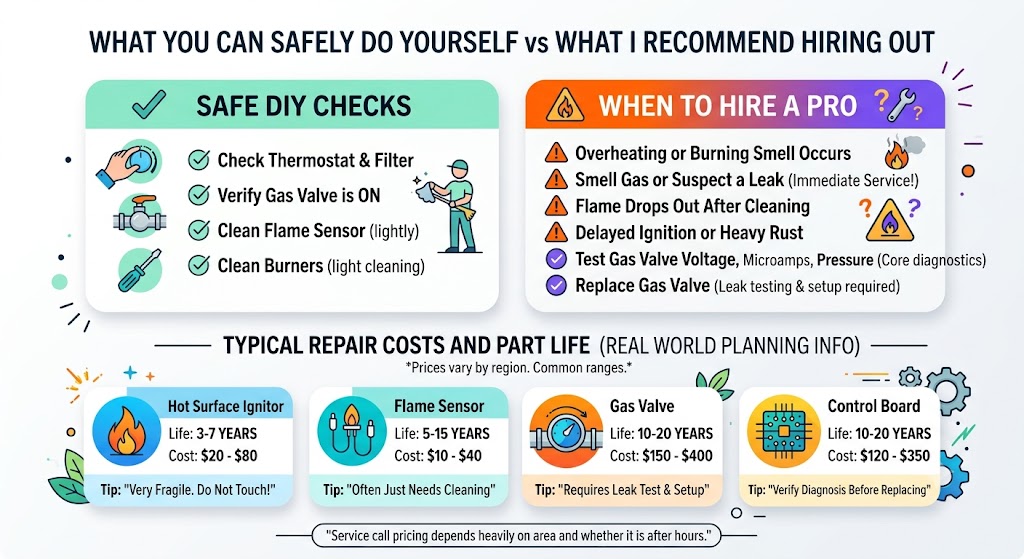
| Check thermostat settings and filter | Yes | If overheating or burning smell occurs |
| Verify gas shutoff valve is on | Yes | If you smell gas or suspect a leak |
| Clean flame sensor | Often yes | If flame still drops out after cleaning |
| Clean burners (light cleaning) | Sometimes | If delayed ignition happens or burners are heavily rusted |
| Test gas valve voltage, microamps, gas pressure | Not for most homeowners | Yes, this is core diagnostic territory |
| Replace gas valve | No for most | Yes, due to leak testing and setup |
Typical repair costs and part life (real world planning info)
Prices vary by region, but these ranges are common in the field.
| Hot surface ignitor | 3 to 7 years | 20 to 80 | Very fragile, do not touch the element |
| Flame sensor | 5 to 15 years | 10 to 40 | Often just needs cleaning |
| Gas valve | 10 to 20 years | 150 to 400 | Requires leak test and correct setup |
| Control board | 10 to 20 years | 120 to 350 | Verify diagnosis before replacing |
Service call pricing depends heavily on your area and whether it is after hours.
My “no flame” checklist you can follow in order
If you want the simplest path, do this:
- Thermostat calling for heat
- Furnace filter not completely plugged
- Gas shutoff valve fully on
- Other gas appliances working
- Watch ignition attempt: does flame appear at all
- If flame appears then drops: clean flame sensor
- If no flame ever: call a tech to test gas valve voltage and gas pressure
That order prevents wasted time and avoids the most common misdiagnoses.
When to stop troubleshooting and call a pro
Call for service if:
- You smell gas at any time
- You hear a boom or delayed ignition
- The furnace is repeatedly locking out
- You see soot, scorch marks, or signs of flame rollout
- You are not comfortable testing live voltage or gas pressure
FAQ: Furnace ignitor lights but no flame
Why does the ignitor glow but the burners never light?
Because the furnace is not opening the gas valve or gas is not reaching the burners. The most common culprits are a closed gas valve, failed gas valve, low gas pressure, or a control board or safety switch preventing gas valve power.
If the ignitor glows, does that mean the ignitor is good?
It means it is receiving power and heating, but it can still be weak or failing. That said, if you get a strong glow and still no flame, I look at gas delivery and gas valve control before blaming the ignitor.
The furnace lights for a second then shuts off. Is that the ignitor?
Almost always no. That is usually flame sensing. Clean the flame sensor and verify good grounding.
Can a dirty filter cause ignitor lights but no flame?
A severely dirty filter more commonly causes overheating and high limit trips, which can interrupt heating cycles. It is