
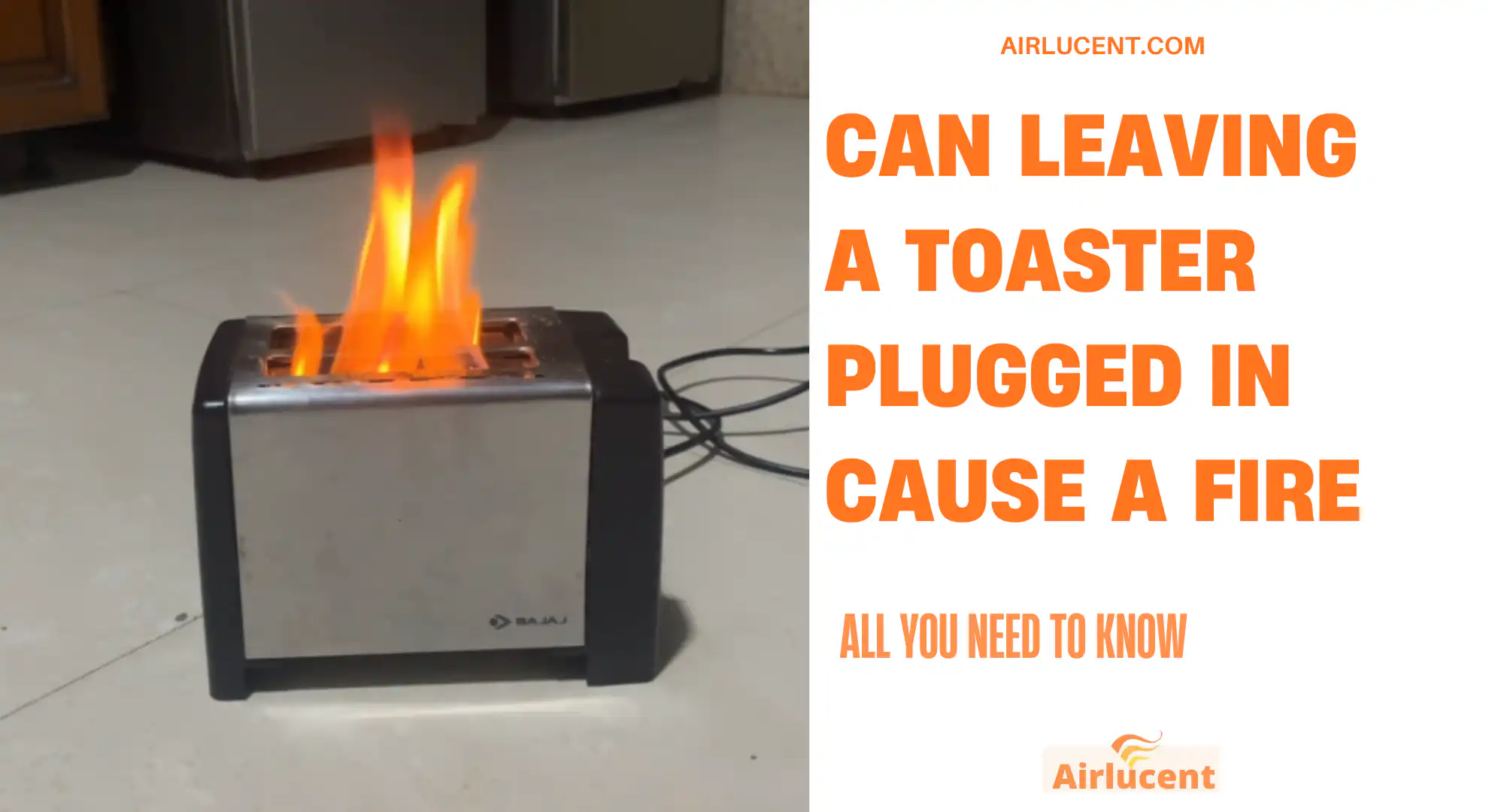
Yes, it can. Most of the time nothing happens, which is exactly why this hazard gets ignored. But a toaster is one of those small kitchen appliances that combines three things firefighters hate: high heat, combustible crumbs, and electrical parts that can fail.
I’m Nathan. I’ve worked as an HVAC technician for over 10 years, and while I’m not a fire investigator, I’ve spent a big chunk of my career walking through homes after “small” issues turned into expensive ones. Heat plus electricity is never something I treat casually. If you want the safest habit, it’s simple: unplug the toaster when you’re done and keep it clean.
In thi guide, I will tell you all you need to know.
- How Common Are Toaster Fires?
- Yes, A Toaster Can Start a Fire While Plugged In
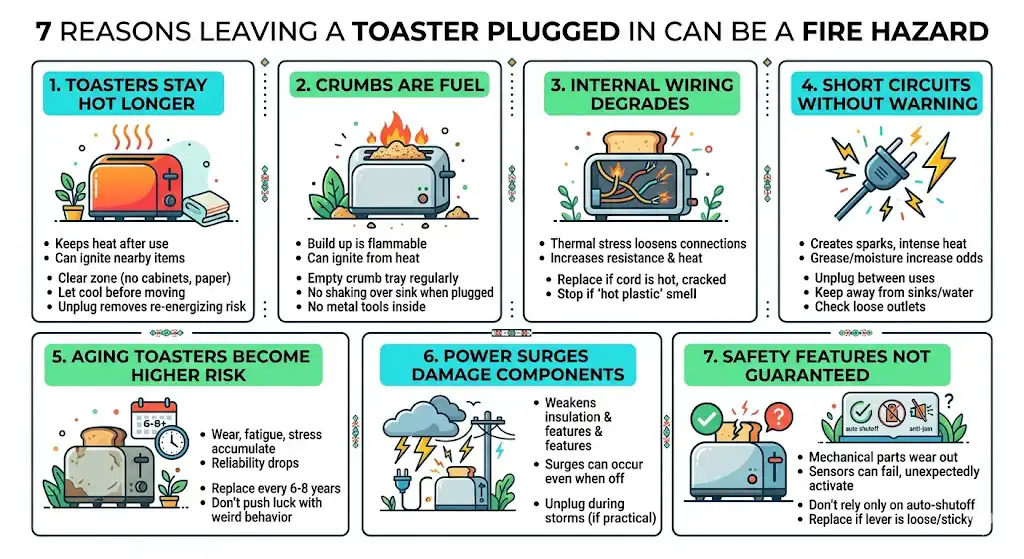
- 7 reasons leaving a toaster plugged in can be a fire hazard
- 1. Toasters stay hot longer than most people think
- 2. Crumbs are fuel, and toasters collect them by design
- 3. Internal wiring and connections can degrade over time
- 4. Short circuits can happen without warning
- 5. Aging toasters become higher risk
- 6. Power surges can damage internal components
- 7. Safety features help, but they’re not guaranteed
- Quick safety checklist (the habits that prevent most toaster fires)
- Toaster maintenance that actually reduces fire risk
- Warning signs your toaster is becoming dangerous
- Should you unplug your toaster after every use?
- Energy use: does leaving a toaster plugged in waste electricity?
- Extension cords and power strips: safe or not?
- What to do if a toaster catches fire
- FAQ
- My practical recommendation as a home-service tech
How Common Are Toaster Fires?
Let’s start with the data.
Toasters don’t cause most house fires, but they cause enough to be taken seriously.
According to national fire reports:
- from 2007 and 2011, toasters and toaster ovens caused nearly 3,000 documented fires in the United States.
- Those fires resulted in over 27 million dollars in property damage.
- Fire officials have repeatedly warned that plugged-in toasters have started apartment and residential fires.
- Globally, toaster-related incidents, including fires and electrical accidents, are linked to hundreds of injuries and fatalities annually.
Here’s a quick breakdown:
| Data point | What it means for homeowners |
|---|---|
| Nearly 3,000 toaster and toaster oven fires (U.S., 2007–2011) | That’s not rare. It’s a steady, repeatable problem pattern. |
| Over $27 million in property damage (U.S., 2007–2011) | Even “small” appliance fires can become major losses fast. |
| Local departments have documented fires starting from idle, plugged-in toasters | A toaster doesn’t always need to be in active use to be involved in ignition. |
Source summaries commonly referenced in consumer safety articles and fire loss discussions include statistics compiled from fire incident data in the 2007–2011 period.
Yes, A Toaster Can Start a Fire While Plugged In
Many people assume:
“If I’m not pushing the lever down, it’s not doing anything.”
That’s not completely true.
When a toaster is plugged in:
- Internal components remain energized.
- Wiring is still connected to live current.
- Mechanical parts can fail unexpectedly.
- Power surges can travel through the appliance.
I’ve personally seen small appliances activate due to internal switch failure. Heat plus electricity is never something you want operating unattended.
7 reasons leaving a toaster plugged in can be a fire hazard
1. Toasters stay hot longer than most people think
When you toast bread, the heating elements can reach temperatures commonly cited at 300°F (about 154°C) and higher during operation. After the cycle ends, heat doesn’t instantly disappear. The toaster body and internal metal parts can remain hot enough to ignite nearby combustibles if something goes wrong.
What I see in homes is people tucking a toaster under cabinets, beside paper towels, near wooden knife blocks, or right next to a dish towel. That setup is fine until it isn’t.
What you should do
- Keep the toaster in a clear zone, not wedged between items.
- Let it cool before you slide it back or cover it.
- Unplugging removes the “unexpected re-energizing” risk.
2. Crumbs are fuel, and toasters collect them by design
Crumbs aren’t just messy. They’re flammable. When crumbs build up in the crumb tray or along the bottom near heating elements, they become a ready-made ignition source.
Over time, old crumbs can dry further and char. If a heating element stays on too long or a cycle malfunctions, those crumbs can ignite.
What you should do
- Empty the crumb tray regularly (I’ll give you a simple schedule below).
- Never shake crumbs out over the sink while it’s plugged in.
- Never clean inside a toaster with metal tools.
3. Internal wiring and connections can degrade over time
Every heat cycle expands and contracts internal parts. Over years, that thermal stress can loosen connections, degrade insulation, and increase electrical resistance. Resistance creates heat. Heat damages parts further. That’s how “minor wear” turns into a failure.
And here’s the tricky part: you often won’t see it from the outside.
What you should do
- If the cord is warm, cracked, or stiff, replace the toaster.
- If you smell “hot plastic,” stop using it immediately.
4. Short circuits can happen without warning
A short circuit is electricity taking a path it wasn’t supposed to take. That can create sparks and intense localized heat. In kitchen environments, moisture, grease, and debris increase the odds of problems over time.
Leaving the toaster plugged in means a fault can occur when you’re not even in the room.
What you should do
- Unplug between uses.
- Keep the toaster away from the sink and splashing zones.
- If an outlet feels loose, stop using it and have it checked.
5. Aging toasters become higher risk
Many consumer safety writers and appliance guidance pieces recommend replacing toasters roughly every 6 to 8 years, especially if the unit is used frequently. That doesn’t mean it self-destructs at year 9, but it’s a realistic window where wear, heat stress, and mechanical fatigue start stacking up.
From a home-systems perspective, I treat older small appliances the same way I treat an older inducer motor or failing capacitor: it might “still run,” but reliability is dropping.
What you should do
- If your toaster is old and you’re seeing any weird behavior, don’t keep pushing your luck.
- Consider replacement if it’s approaching that age range and used daily.
6. Power surges can damage internal components
Storms and utility events can create voltage spikes. Even if the toaster isn’t running, delicate components or insulation can be weakened by surges. That damage might not show immediately, but it can raise the risk of overheating later.
One consumer safety angle that still holds up: unplugging small appliances before thunderstorms or when leaving for trips reduces exposure.
What you should do
- Unplug during storms if practical and safe (do it before the storm is on top of you).
- Consider a quality surge protector for countertop appliances, but understand that unplugging is the surest disconnect.
7. Safety features help, but they’re not guaranteed
Modern toasters often include features like:
- Auto shutoff
- Anti-jam mechanisms
- Better thermal controls
Those are improvements, but mechanical parts wear out and sensors can fail. Fire departments have specifically warned about worn lever mechanisms that can allow the heating element to activate unexpectedly.
What you should do
- Don’t rely on “it has auto shutoff.”
- If the lever feels loose, sticks, or doesn’t latch consistently, it’s time to replace the toaster.
Quick safety checklist (the habits that prevent most toaster fires)
If you only do five things, do these:
- Unplug it when you’re done.
- Keep it away from towels, paper, curtains, and upper cabinets.
- Empty crumbs often.
- Never use an extension cord.
- Replace it at the first sign of overheating, burning smell, or sticking controls.
Safe placement rules I recommend in real kitchens
Here’s a simple placement guide you can follow without overthinking it:
| Placement factor | Safer standard |
|---|---|
| Clearance around toaster | Keep open space on all sides so heat can dissipate |
| Overhead area | Avoid placing directly under cabinets or shelves |
| Nearby combustibles | Keep away from paper towels, bread bags, dish towels, curtains |
| Surface | Flat, stable, heat-resistant countertop |
| Location | Away from sink splash zone and grease-heavy stove zone |
If your toaster lives under a cabinet because it “looks cleaner,” I get it. But safety-wise, open air is your friend.
Toaster maintenance that actually reduces fire risk
How often should you clean it?
This is the schedule I tell homeowners because it’s realistic.
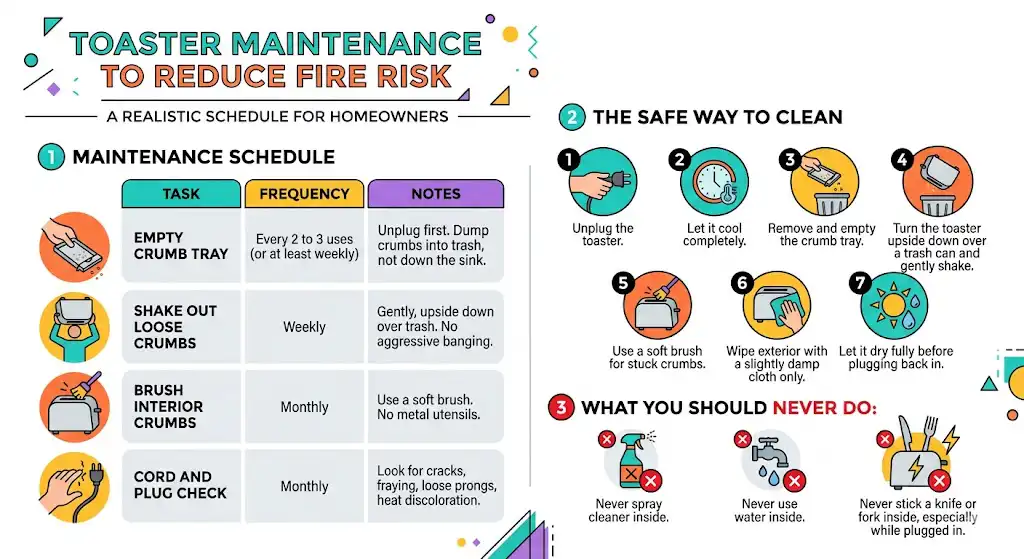
| Task | Frequency | Notes |
|---|---|---|
| Empty crumb tray | Every 2 to 3 uses (or at least weekly) | Unplug first. Dump crumbs into trash, not down the sink. |
| Shake out loose crumbs | Weekly | Gently, upside down over trash. No aggressive banging. |
| Brush interior crumbs | Monthly | Use a soft brush. No metal utensils. |
| Cord and plug check | Monthly | Look for cracks, fraying, loose prongs, heat discoloration. |
The safe way to clean a toaster
- Unplug the toaster.
- Let it cool completely.
- Remove and empty the crumb tray.
- Turn the toaster upside down over a trash can and gently shake.
- Use a soft brush for stuck crumbs.
- Wipe exterior with a slightly damp cloth only.
- Let it dry fully before plugging back in.
What you should never do:
- Never spray cleaner inside.
- Never use water inside.
- Never stick a knife or fork inside, especially while plugged in.
Warning signs your toaster is becoming dangerous
If you notice any of these, stop using the toaster and replace it.
| Warning sign | What it can indicate | What I’d do |
|---|---|---|
| Burning plastic smell | Insulation or wiring overheating | Unplug immediately, discontinue use |
| Lever sticks or doesn’t latch | Mechanical wear that can fail unpredictably | Replace the toaster |
| Toasting is inconsistent | Heating element or control issues | Replace if recurring |
| Sparks beyond normal heating glow | Electrical arcing | Unplug and replace |
| Cord is warm or cracked | Cord failure risk | Replace toaster (cord replacement isn’t worth it for most units) |
| Exterior gets unusually hot | Internal airflow restriction or fault | Stop using it |
Should you unplug your toaster after every use?
If you want the lowest risk, yes, unplug it after every use.
I know the pushback because I hear it all the time:
- “It’s annoying.”
- “Nothing has ever happened.”
- “My toaster is new.”
But here’s the reality: unplugging is a simple control that eliminates several failure scenarios when you’re not watching the appliance.
If you absolutely won’t unplug every time, at least do it:
- When you leave the house
- Before vacations
- During thunderstorms
- Overnight (especially in older homes or with older toasters)
Energy use: does leaving a toaster plugged in waste electricity?
Most basic toasters draw essentially nothing when idle because they don’t have clocks or displays. But some newer models with digital controls may use a small standby draw.
The bigger point isn’t the power bill. It’s risk management. Unplugging is about reducing fire exposure, not saving a fortune on electricity.
Extension cords and power strips: safe or not?
A toaster should be plugged directly into a wall outlet. Avoid extension cords. Many extension cords aren’t rated for the high wattage toasters pull, and heat buildup at the connection points is a real issue.
Power strips are also not ideal for high-heat appliances unless they are heavy-duty and specifically rated appropriately. Even then, direct-to-wall is the safest standard.
If your kitchen doesn’t have enough outlets, that’s a home electrical layout issue worth fixing, not something to work around with cheap cords.
What to do if a toaster catches fire
If there are flames or heavy smoke, treat it like a real emergency.
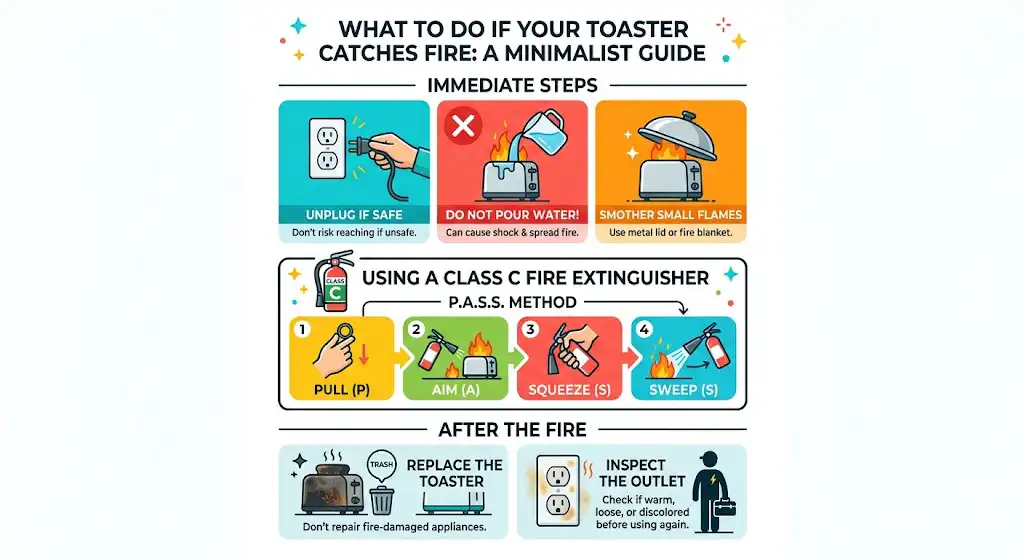
Immediate steps
- If it’s safe, unplug the toaster. If you can’t reach the plug safely, don’t risk it.
- Do not pour water on it. That can cause shock and spread the hazard.
- Smother small flames with a metal lid or fire blanket if you have one.
- Use a Class C-rated fire extinguisher for electrical fires.
Using an extinguisher (PASS method)
- Pull the pin
- Aim at the base of the fire
- Squeeze the handle
- Sweep side to side
After any fire event, even if it seems small:
- Replace the toaster. Don’t repair and reuse a fire-damaged appliance.
- If the outlet is discolored, warm, or loose, have an electrician inspect it before plugging anything back in.
FAQ
Can a toaster start a fire if it’s plugged in but not in use?
It can, especially if there’s a mechanical failure (like a worn latch), an internal electrical fault, or damage from a surge. Fire officials have publicly warned about plugged-in toasters contributing to fires even after days of not being used.
Can a toaster start a fire if it’s unplugged?
If it’s unplugged, it cannot energize its heating elements. The fire risk drops dramatically. The main remaining risk would be if it’s still hot from recent use and touching something combustible, which is why cool-down and clear space matter.
What type of fire extinguisher is best for toaster fires?
A Class C extinguisher (electrical fires). Many home extinguishers are ABC-rated, which is also suitable.
How long do toasters last before they become risky?
Many safety-oriented guides suggest replacing around 6 to 8 years depending on usage and condition. If you see warning signs, replace sooner.
My practical recommendation as a home-service tech
If you want a simple rule that covers almost every scenario:
Unplug your toaster when you’re done, keep it crumb-free, and replace it the moment it acts “weird.”
Most kitchen fire prevention is boring habits done consistently. The convenience of leaving it plugged in is real, but the upside is small and the downside can be huge.