I’m Nathan, and I’ve worked as an HVAC technician for over 10 years. When homeowners call me about an AC that “kind of cools” or a heat pump that’s acting unpredictable, a failing or restricted TXV is always on my shortlist. Not because it’s the most common part to fail, but because when it does fail, it can mimic a lot of other problems.
In plain English, a bad TXV can cause fluctuating refrigerant flow, uneven temperatures, icing on the evaporator coil, poor efficiency, odd noises, and compressor stress. If you catch it early, you can often prevent bigger damage.
Below I’ll walk you through what a TXV does, the most common symptoms I see, what readings usually confirm it, and how to avoid replacing parts you don’t need.
- Quick answer: the most common symptoms of a bad TXV
- What a TXV does (and why it matters so much)
- Bad TXV vs restricted TXV vs “not a TXV problem”
- Symptoms of a bad TXV in detail (what you’ll notice and what it usually means)
- 1. Inconsistent cooling or heating, trouble holding set temperature
- 2. Short cycling or erratic cycling
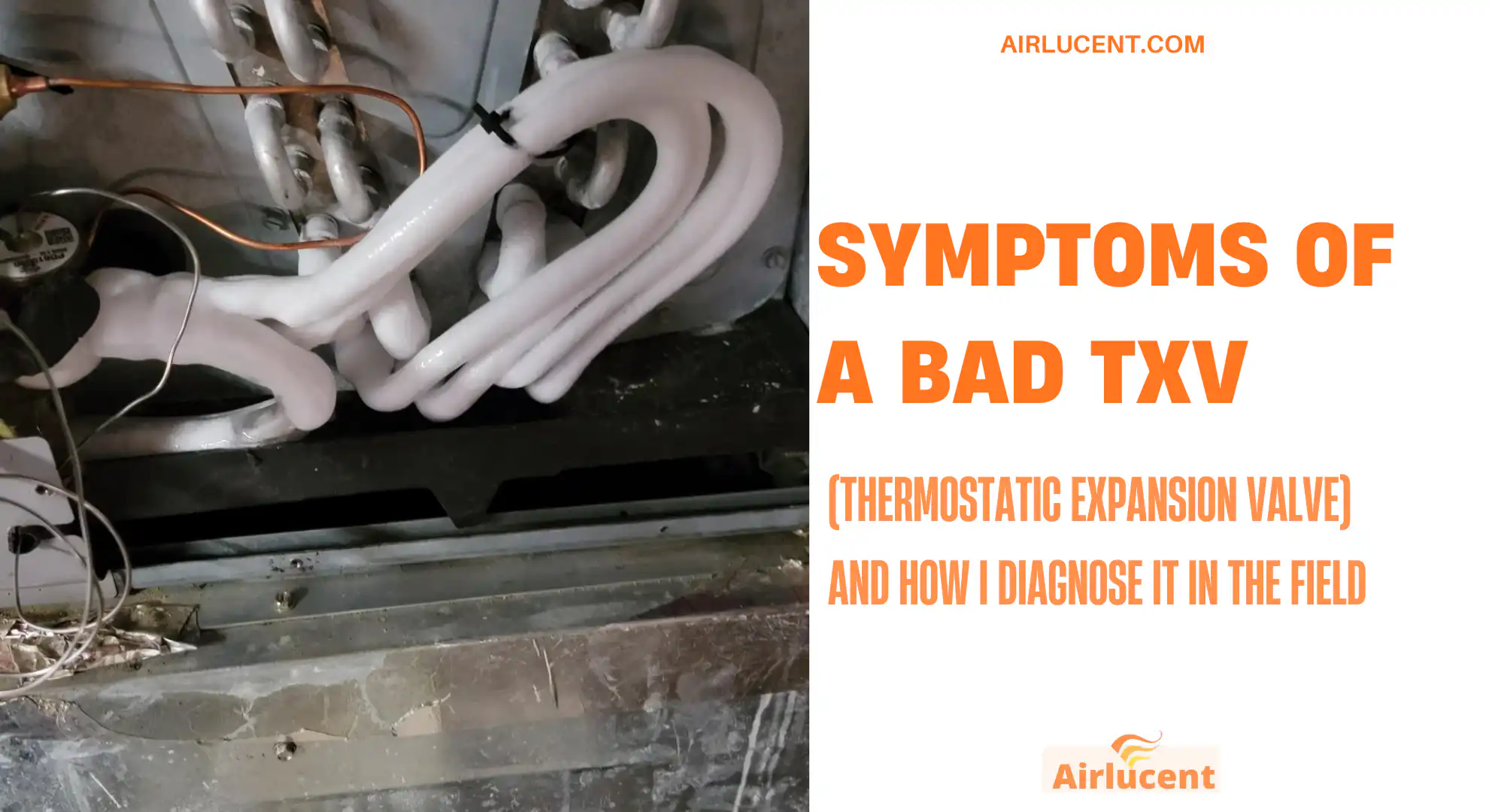
- 3. Ice buildup on the evaporator coil or suction line
- 4. High superheat (classic “restricted or underfeeding TXV” sign)
- 5. Very low superheat (overfeeding, floodback risk)
- 6. Low suction pressure (often paired with underfeeding)
- 7. High subcooling (often seen with restrictions)
- 8. Compressor overheating or thermal overload trips
- 9. Unusual noises like hissing, whistling, or “surging”
- At-a-glance table: symptoms and what I check next
- Common causes of TXV problems (what I see most often)
- How I diagnose a bad TXV (step-by-step, the same way I do on service calls)
- Tools I typically use
- Step 1: Rule out the simple stuff first
- Step 2: Confirm the system has a solid column of liquid to the TXV
- Step 3: Measure superheat at the evaporator outlet
- Step 4: Check for restrictions at the inlet screen or drier
- Step 5: Perform a controlled bulb response test (when appropriate)
- Diagnostic “pattern” table (helps avoid misdiagnosis)
- Preventive maintenance tips (what I recommend to homeowners)
- When replacement is the right call (and what it usually involves)
- Frequently asked questions
- My bottom line as a technician
- Helpful external resources I trust
Quick answer: the most common symptoms of a bad TXV
You may be dealing with a bad or restricted TXV if you notice:
- Weak or inconsistent cooling or heating
- Temperature swings from room to room
- Short cycling or erratic cycling
- Ice or heavy frost on the evaporator coil or suction line
- Higher energy bills with no clear reason
- Low suction pressure and often low head pressure (starved evaporator pattern)
- Abnormally high superheat or sometimes very low superheat (flooding pattern)
- Compressor running hot or tripping on overload
- Hissing, whistling, or “hunting” behavior (system seems to surge)
What a TXV does (and why it matters so much)
A TXV, or thermostatic expansion valve, is the metering device that controls how much refrigerant enters the evaporator coil. Its job is to maintain a target superheat at the evaporator outlet.
The simplest way I explain it to homeowners
Your evaporator coil is where heat is absorbed. The TXV is the “gatekeeper” that feeds the coil the right amount of refrigerant so:
- The coil absorbs as much heat as possible
- The refrigerant fully boils off before it leaves the evaporator
- The compressor mainly sees vapor, not liquid
When the TXV can’t feed properly, the entire system performance and efficiency take a hit.
Bad TXV vs restricted TXV vs “not a TXV problem”
In real service calls, people say “bad TXV” to mean a few different things:
- TXV stuck too closed (underfeeding, starving the evaporator)
- TXV stuck too open (overfeeding, flooding the evaporator)
- TXV hunting (unstable control, often due to load changes, bulb issues, airflow problems)
- Restriction before the TXV (plugged screen, moisture, plugged filter drier) that looks like a bad valve
That last one is big. I’ve seen plenty of “TXV failures” that were actually a restricted liquid line drier or contamination at the inlet screen.
Symptoms of a bad TXV in detail (what you’ll notice and what it usually means)
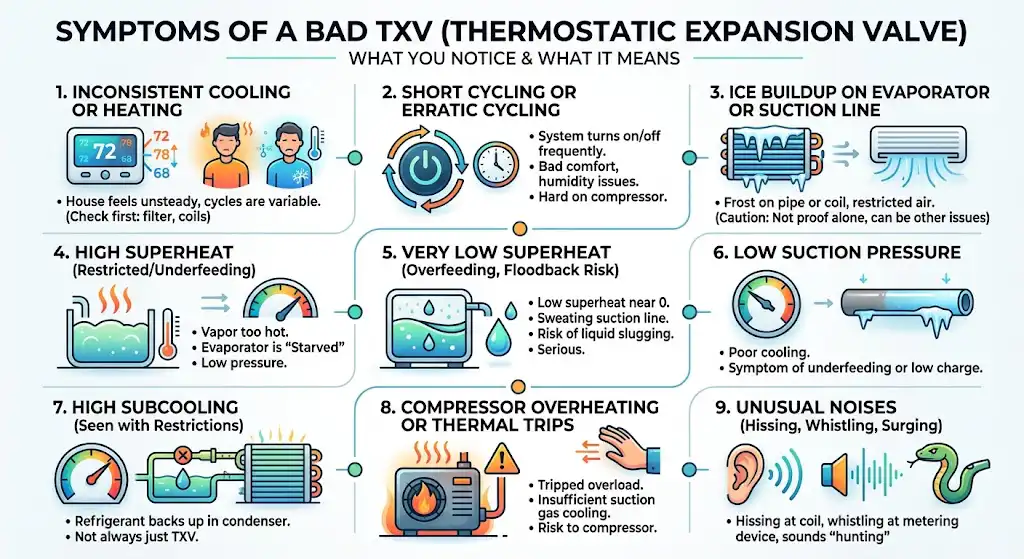
1. Inconsistent cooling or heating, trouble holding set temperature
What you feel:
- The system runs but the house never feels steady
- Some cycles feel strong, others feel weak
- On heat pumps, heating can feel “thin” or uneven too
What it often points to:
- Refrigerant feed is unstable or incorrect
- The evaporator is either starved (not enough refrigerant) or flooded (too much)
What I check first:
- Air filter and airflow
- Indoor coil cleanliness
- Supply temperature split
- Refrigerant charge indicators (subcooling and superheat)
2. Short cycling or erratic cycling
What you see:
- System turns on and off more frequently than normal
- Comfort is choppy, humidity may feel worse in cooling mode
Why it happens:
When the TXV cannot regulate properly, the system pressures and coil temps swing. That can trigger safeties, cause thermostat overshoot, or force the system into unstable run behavior.
Why you should care:
Short cycling is hard on compressors and contactors and typically raises operating cost.
3. Ice buildup on the evaporator coil or suction line
What you see:
- Frost on the bigger insulated copper line (suction line)
- Ice on the indoor coil
- Reduced airflow from vents as the coil blocks up
Common TXV-related cause:
- Underfeeding leads to low evaporator pressure, which can drop coil temperature below freezing and start icing.
But be careful:
The most common causes of icing I see are still:
- Low airflow (dirty filter, weak blower, dirty coil)
- Low refrigerant charge from a leak
So icing alone is not proof of a bad TXV.
4. High superheat (classic “restricted or underfeeding TXV” sign)
Superheat is the temperature of vapor refrigerant above its boiling point at a given pressure. In practical terms, it tells me whether the evaporator is being fed correctly.
What I commonly see with a restricted TXV:
- High superheat at the evaporator outlet
- Low suction pressure
- Often low capacity and longer run times
5. Very low superheat (overfeeding, floodback risk)
If a TXV sticks too open or loses control, it may feed too much refrigerant.
What I may find:
- Low superheat (approaching 0)
- Sweating suction line and possibly sweating compressor shell
- Risk of liquid refrigerant returning to the compressor
Why this is serious:
Compressors are designed to compress vapor. Liquid floodback can damage valves and cause mechanical failure.
6. Low suction pressure (often paired with underfeeding)
What you’ll notice:
- Poor cooling
- Coil may start to frost
- Suction line may be colder than normal
What it usually indicates:
- Starved evaporator from underfeeding
- Or low charge
- Or a restriction before the metering device
Low suction pressure is a symptom, not a diagnosis by itself.
7. High subcooling (often seen with restrictions)
Subcooling is how much the liquid refrigerant is cooled below its saturation temperature in the condenser.
A pattern I often see with restrictions:
- Higher than normal subcooling
- Refrigerant backed up in the condenser because it’s not feeding through the liquid line properly
But again, context matters:
High subcooling can also show up with overcharge or poor condenser airflow.
8. Compressor overheating or thermal overload trips
When a TXV underfeeds:
- The compressor may run hotter due to insufficient cooling from suction gas
- Superheat goes up
- Discharge temperatures can climb
When a TXV overfeeds:
- You can get floodback and slugging risk
- Oil return issues can show up over time
Either way, the compressor is the expensive part you’re trying to protect.
9. Unusual noises like hissing, whistling, or “surging”
What you might hear:
- Hissing at the indoor coil area
- Whistling around the metering device
- A repeated change in sound as the system “hunts”
What it can mean:
- Refrigerant flashing or pressure drop through a restriction
- TXV hunting due to bulb placement, missing insulation, equalizer issues, or unstable load/airflow
At-a-glance table: symptoms and what I check next
| Weak cooling, long run times | Underfeeding, low charge, airflow issue | Airflow, filter, indoor coil, superheat, subcooling |
| Ice on coil or suction line | Underfeeding, low airflow, low charge | Static pressure, blower speed, coil condition, charge indicators |
| Short cycling | Control instability, pressure issues | Pressures, temp splits, safeties, refrigerant feed stability |
| High superheat | Starved evaporator, restriction, low charge | Confirm solid liquid to TXV, check drier temp drop, verify charge |
| Very low superheat | Overfeeding, bulb issue, TXV stuck open | Bulb mount and insulation, equalizer line, floodback signs |
| Low suction pressure | Starved evaporator, low charge | Leak check, restrictions, airflow, TXV response |
| High subcooling | Restriction or overcharge | Condenser airflow, charge accuracy, liquid line restriction checks |
| Compressor overheating | Underfeeding or other system strain | Superheat, discharge temp, condenser condition, load conditions |
Common causes of TXV problems (what I see most often)
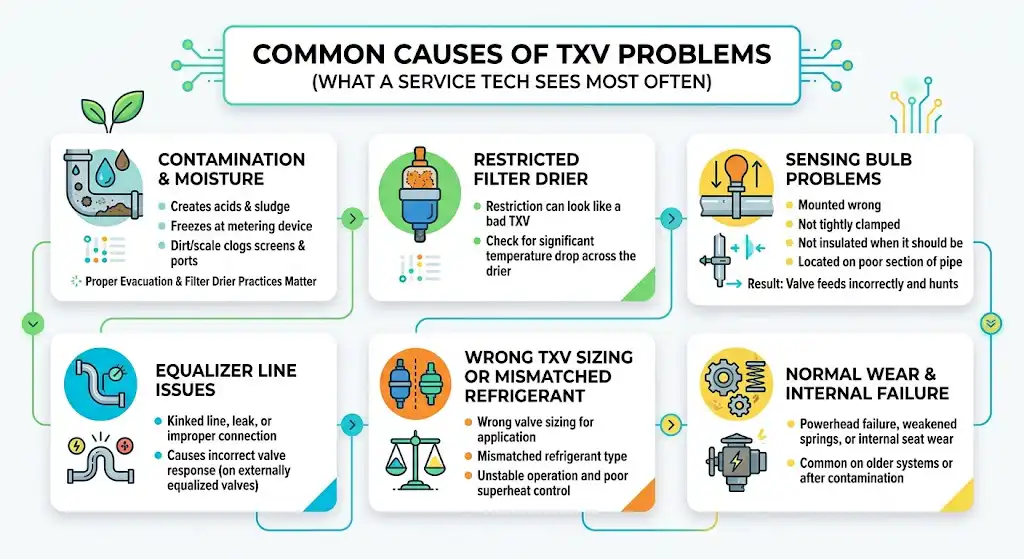
Contamination or moisture in the refrigerant circuit
Moisture can create acids and sludge, and it can freeze at the metering device. Dirt and copper oxide scale can also collect at screens and ports.
This is why proper evacuation and filter drier practices matter.
A restricted liquid line filter drier (looks like a bad TXV)
If I see a notable temperature drop across the drier, I suspect restriction. Many “bad TXV” calls end up being a drier or debris issue.
Sensing bulb problems
The bulb tells the TXV what the suction line temperature is. If the bulb is:
- Mounted wrong
- Not tightly clamped
- Not insulated when it should be
- Located on a poor section of pipe
the valve can feed incorrectly and hunt.
Equalizer line issues (on externally equalized valves)
A kinked equalizer line, a leak, or an improper connection can cause incorrect valve behavior.
Wrong TXV sizing or mismatched refrigerant/application
A mismatched valve can be unstable and never control superheat properly.
Normal wear and internal failure
Powerhead failure, spring issues, or internal seat wear can happen, especially on older systems or systems that have had contamination events.
How I diagnose a bad TXV (step-by-step, the same way I do on service calls)
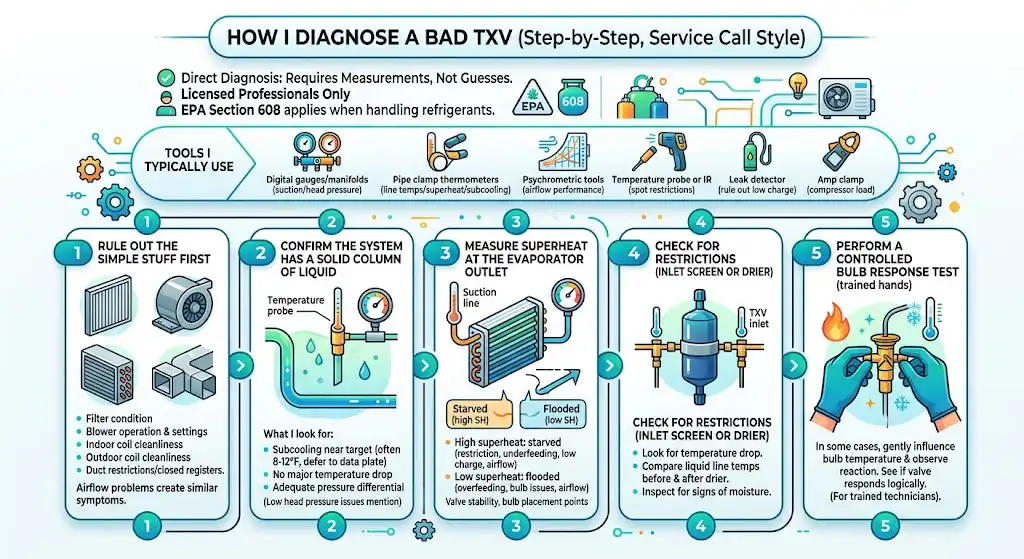
I’ll be direct here. A proper TXV diagnosis requires measurements, not guesses. And refrigerant work should be handled by a licensed professional. EPA Section 608 rules apply when handling refrigerants.
Tools I typically use
| Digital gauges or manifolds | Suction and head pressure behavior |
| Pipe clamp thermometers | Line temps for superheat and subcooling |
| Psychrometric tools (optional) | Load and airflow performance context |
| Temperature probe or IR (carefully) | Spot restrictions and temperature drops |
| Leak detector | Rule out low charge from leaks |
| Amp clamp | Compressor load and stress |
Step 1: Rule out the simple stuff first
Before I blame a TXV, I check:
- Filter condition
- Blower operation and speed settings
- Indoor coil cleanliness
- Outdoor coil cleanliness
- Obvious duct restrictions or closed registers
Airflow problems create TXV-like symptoms all the time.
Step 2: Confirm the system has a solid column of liquid to the TXV
If liquid is flashing before the TXV, the valve can’t control properly.
What I look for:
- Subcooling near manufacturer target (often around 8 to 12 F on many systems, but always defer to the data plate and charging chart)
- No major temperature drop across the liquid line that would suggest a restriction
- Adequate pressure differential between liquid line pressure and evaporator pressure
Low head pressure during low outdoor temperatures can also reduce pressure differential and make TXV control unstable.
Step 3: Measure superheat at the evaporator outlet
This is one of the biggest TXV indicators.
General interpretation:
- High superheat: evaporator is starved (restriction, underfeeding, low charge, airflow issues)
- Low superheat: evaporator is flooded (overfeeding, bulb issues, airflow/load issues)
A TXV is designed to control superheat. If superheat is wildly unstable under steady conditions, I start focusing on bulb placement, equalizer, contamination, and valve stability.
Step 4: Check for restrictions at the inlet screen or drier
Some TXVs have inlet screens that clog. If the system is clean, they can last a long time. If the system had burnout, moisture, or poor installation practices, that screen can plug up.
A common method:
- Look for a distinct temperature drop right at the restriction point
- Compare liquid line temps before and after the drier
- Inspect for signs of moisture contamination (history matters)
Step 5: Perform a controlled bulb response test (when appropriate)
In some cases, I’ll gently influence bulb temperature and observe valve reaction. The goal is to see if the valve responds logically.
This is not a homeowner DIY step, but it’s a useful diagnostic technique in trained hands.
Diagnostic “pattern” table (helps avoid misdiagnosis)
These patterns are general and can vary by system design and conditions, but they’re helpful when you’re trying to separate a TXV issue from a charge or airflow issue.
| TXV underfeeding or restriction | High | Often high | Low | Coil may frost, poor capacity |
| TXV overfeeding | Low | Varies | Often higher than starved case | Floodback risk, noisy, unstable |
| Low refrigerant charge | High | Low | Low | Low capacity, may frost, leak likely |
| Low airflow across evaporator | Often low | Normal | Often low | Coil icing, weak airflow, high humidity |
If you only take one thing from this article, take this:
You diagnose a TXV with a full set of readings and airflow context, not with one symptom.
Preventive maintenance tips (what I recommend to homeowners)
Even though you can’t “service” a TXV like a filter, you can reduce the conditions that kill them.
- Change filters on schedule
A dirty filter can lead to low airflow, icing, and messy diagnostics that stress the system. - Keep coils clean
Dirty evaporator and condenser coils push the system into abnormal pressures and temps. - Don’t ignore icing
If you see ice, shut the system off and call a pro. Running iced up can damage the compressor. - If refrigerant work is done, insist on proper practices
Proper evacuation, moisture control, correct brazing practices, and replacing filter driers when needed prevents contamination that can clog metering devices. - Fix refrigerant leaks correctly
Low charge conditions can create repeat issues and lead to compressor damage. EPA refrigerant management guidance is clear that leaks should be addressed properly, not ignored.
When replacement is the right call (and what it usually involves)
A TXV can sometimes be affected by a restriction that can be corrected. But if the valve itself is mechanically failing, unstable, or internally damaged, replacement is often the real fix.
What TXV replacement typically includes
- Recover refrigerant (legally and safely)
- Remove and replace the TXV
- Replace the filter drier (commonly recommended when opening the system)
- Evacuate to remove air and moisture
- Recharge to manufacturer specification
- Verify superheat and subcooling under stable conditions
This is licensed HVAC work.
How long a TXV lasts
In my experience, a TXV can last 10 years or more, but contamination, moisture, and poor installation practices can shorten that dramatically.
Cost considerations
Pricing varies heavily by region, accessibility, refrigerant type, and whether it’s a heat pump or straight AC. If you want, tell me your system type and location and I can give you a more realistic range, but in general TXV jobs can land anywhere from several hundred to over a thousand dollars when labor, refrigerant handling, and best-practice add-ons (like driers) are included.
Frequently asked questions
Can I keep running my AC with a bad TXV?
I don’t recommend it. A starved coil can drive high superheat and high compressor temps. An overfeeding valve can cause floodback. Either condition can shorten compressor life, and the compressor is the big-ticket item.
Does a bad TXV always cause icing?
No. Icing is common with underfeeding or airflow issues, but you can have a hunting TXV or unstable metering without visible ice.
How do I know it’s the TXV and not low refrigerant?
This is where subcooling, superheat, and a leak check come in. Low charge often shows high superheat and low subcooling. A restriction or underfeeding TXV often shows high superheat with normal to high subcooling.
Can a dirty filter mimic a bad TXV?
Yes, all the time. Low airflow can produce coil icing and odd pressure behavior that looks like metering trouble.
My bottom line as a technician
A TXV is a precision control device. When it starts underfeeding, overfeeding, or hunting, your comfort drops and the compressor takes the hit. The best move is to confirm airflow first, then confirm charge conditions, and only then condemn the valve based on stable, complete readings.
If you want, tell me:
- Your system type (AC or heat pump)
- Approximate tonnage
- Symptoms you see (ice, short cycling, weak airflow)
- Outdoor temperature when it happens
- Any gauge readings you already have (suction, liquid, superheat, subcooling)
And I’ll help you narrow down whether it truly looks like a TXV issue or something else.
Helpful external resources I trust
- U.S. Department of Energy, Heating and Cooling guidance: https://www.energy.gov/energysaver/heating-and-cooling
- ASHRAE (HVAC design and performance guidance): https://www.ashrae.org/
- AHRI (industry standards and performance ratings): https://www.ahrinet.org/
- EPA refrigerant management and technician requirements: https://www.epa.gov/section608
- ACHR News technical article on TXV diagnosis: https://www.achrnews.com/articles/142410-how-to-diagnose-a-thermostatic-expansion-valve-failure