I’m Nathan. I’ve worked as an HVAC technician for over 10 years, and I can tell you this combo is one of the most misunderstood readings I see in the field.
When someone hears “superheat is low,” they often assume the system is low on refrigerant. But when superheat is low and subcooling is high at the same time, that typically points the other direction.
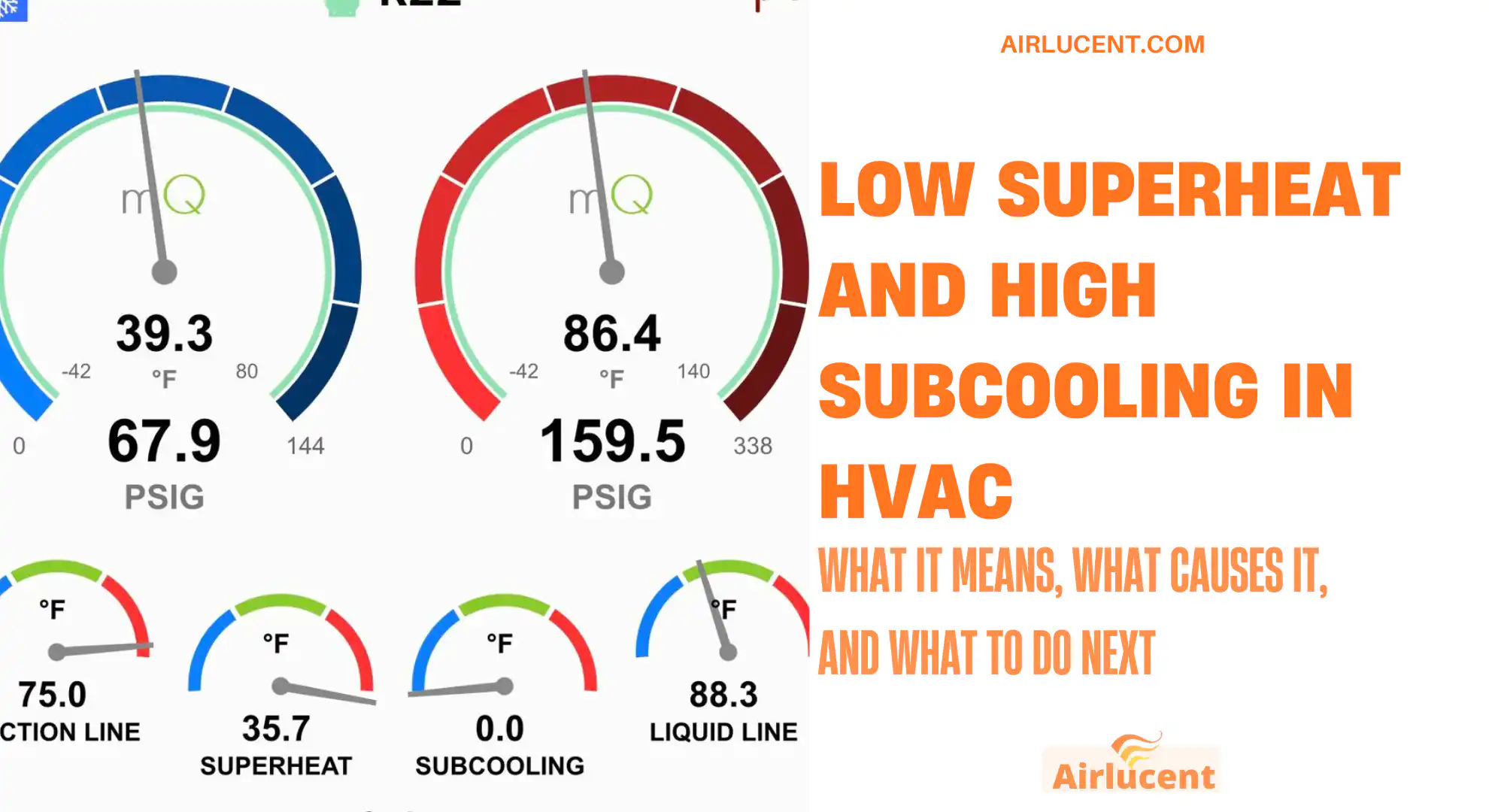
Low superheat + high subcooling usually indicates an overcharged system (too much refrigerant), not too little.
And yes, confirming and correcting it involves the sealed refrigerant circuit, which is not a DIY situation.
- TL;DR (the quick answer)
- What superheat and subcooling actually measure (and why both matter)
- Quick definitions table (simple and practical)
- What “low superheat + high subcooling” usually means
- The big confusion: Overcharge vs restriction (they are not the same)
- Diagnostic cheat sheet (how techs interpret patterns)
- What sets the “correct” superheat and subcooling numbers (there is no universal number)
- Why this is not a DIY fix (and what the law requires)
- What you can check yourself first (safe, no refrigerant work)
- Common causes of low superheat (by itself)
- Common causes of high subcooling (by itself)
- So what causes low superheat AND high subcooling together?
- How technicians actually calculate superheat and subcooling (conceptually)
- When you should stop troubleshooting and call a pro
- FAQ
TL;DR (the quick answer)
Low superheat + high subcooling most commonly means the AC is overcharged.
A tech confirms this using pressure and temperature readings and the unit’s charging specs, then corrects it by properly recovering refrigerant (never venting).
Before you call, you can check the basics that affect readings without touching refrigerant:
- Replace the air filter
- Make sure supply and return vents are open
- Gently rinse the outdoor coil (power off first)
What superheat and subcooling actually measure (and why both matter)
These two readings come from opposite sides of the refrigeration cycle. Looking at only one can mislead you. Looking at both together is where the diagnosis starts to get clear.
Superheat (measured on the low side)
Superheat is the number of degrees the refrigerant vapor is heated above its boiling (saturation) temperature at the evaporator pressure.
- Measured at the evaporator outlet / suction line
- Purpose: confirms the evaporator boiled off all liquid and only vapor is returning to the compressor
- Why it matters: liquid returning to the compressor can cause liquid slugging, which can destroy valves and bearings
Subcooling (measured on the high side)
Subcooling is the number of degrees the refrigerant liquid is cooled below its condensing (saturation) temperature at the condenser pressure.
- Measured at the condenser outlet / liquid line
- Purpose: confirms the metering device is receiving a solid column of liquid (not flash gas)
- Why it matters: flash gas at the metering device reduces capacity and can make the system unstable
Quick definitions table (simple and practical)
| Superheat | Suction line (low side) | Is refrigerant fully boiled into vapor before the compressor? | Protects compressor from liquid floodback |
| Subcooling | Liquid line (high side) | Is refrigerant fully condensed into liquid before the metering device? | Protects capacity and stable feeding |
What “low superheat + high subcooling” usually means
The most common cause: Overcharged system (too much refrigerant)
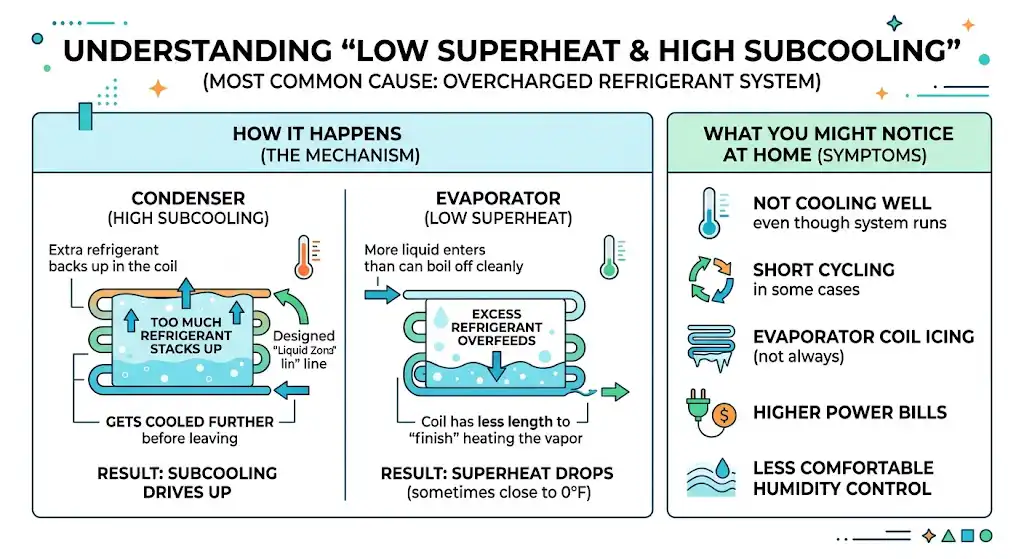
Here’s the mechanism, the same way I explain it to homeowners at the unit:
- Too much refrigerant stacks up in the condenser
- The condenser can only hold so much liquid in its designed “liquid zone.”
- Extra refrigerant causes more liquid to back up and sit in the coil.
- That extra liquid gets cooled further before leaving the condenser, which drives subcooling up.
- That excess refrigerant also tends to overfeed the evaporator
- More liquid enters the evaporator than it can boil off cleanly.
- The coil spends more length boiling liquid and has less length left to “finish” heating the vapor.
- Result: superheat drops (sometimes close to 0°F)
What you might notice at home
Low superheat and high subcooling can show up as:
- Not cooling well even though the system “runs”
- Short cycling in some cases
- Evaporator coil icing (not always)
- Higher power bills
- Less comfortable humidity control
The big confusion: Overcharge vs restriction (they are not the same)
A restriction on the liquid line side (like a clogged filter drier, kinked liquid line, plugged cap tube, or a TXV issue) can also drive subcooling high, which confuses people.
But here’s the separator:
- Overcharge: low superheat + high subcooling
- Restriction/underfeeding: high superheat + high subcooling
Why restrictions usually create HIGH superheat
When the metering device is underfeeding due to a restriction:
- The evaporator gets starved
- Suction pressure drops
- The refrigerant boils off early and the rest of the coil just superheats vapor
- Result: superheat rises, not fall
Diagnostic cheat sheet (how techs interpret patterns)
This is a simplified guide I use as a starting point. Real diagnosis still depends on airflow, indoor load, metering device type, and manufacturer targets.
| Low | High | Flooding or overcharge | Overcharged system, TXV overfeeding, very low indoor heat load |
| High | High | Liquid line restriction or underfeeding | Clogged filter drier, restricted TXV inlet screen, kinked line |
| High | Low | Undercharge / leak | Low refrigerant charge, leak, improper charge after repair |
| Low | Low | Low load or compressor/airflow problems | Low airflow, low heat load, compressor inefficiency (needs full diagnosis) |
What sets the “correct” superheat and subcooling numbers (there is no universal number)
One of the biggest mistakes online is people claiming one magic target like:
- “Superheat should always be 10°F”
- “Subcooling should always be 12°F”
That is not how real charging works.
What actually determines target readings
- Metering device type
- TXV/EEV systems are typically charged by subcooling
- Fixed orifice / piston / cap tube systems are typically charged by superheat using a charging chart based on indoor and outdoor temperatures
- The equipment design
- Coil size, refrigerant type, condenser volume, and efficiency rating all change “normal”
- Two different 3-ton systems can have different targets
- Airflow and heat load
- Dirty filters, blower issues, closed vents, wet coils, and low indoor load can all shift readings
Typical (not universal) ranges you may hear technicians mention
These are common ballpark ranges, but I want you to treat them as context only. Your unit’s data plate or install manual wins every time.
| TXV / EEV | Subcooling | Often around 8°F to 15°F (varies by brand/unit) |
| Fixed orifice | Superheat (by chart) | Often around 10°F to 20°F at the evaporator (depends on conditions) |
Why this is not a DIY fix (and what the law requires)
To verify low superheat and high subcooling correctly, a technician typically needs to:
- Connect pressure gauges to the system
- Measure line temperatures
- Convert pressure to saturation temperature for that refrigerant
- Compare against the manufacturer’s charging target
- Potentially recover refrigerant or troubleshoot a metering device issue
Safety side (what I’ve personally seen)
Refrigerant can cause:
- Frostbite on contact
- Eye injury
- Dangerous pressure release if a hose fails or a valve is opened incorrectly
What you can check yourself first (safe, no refrigerant work)
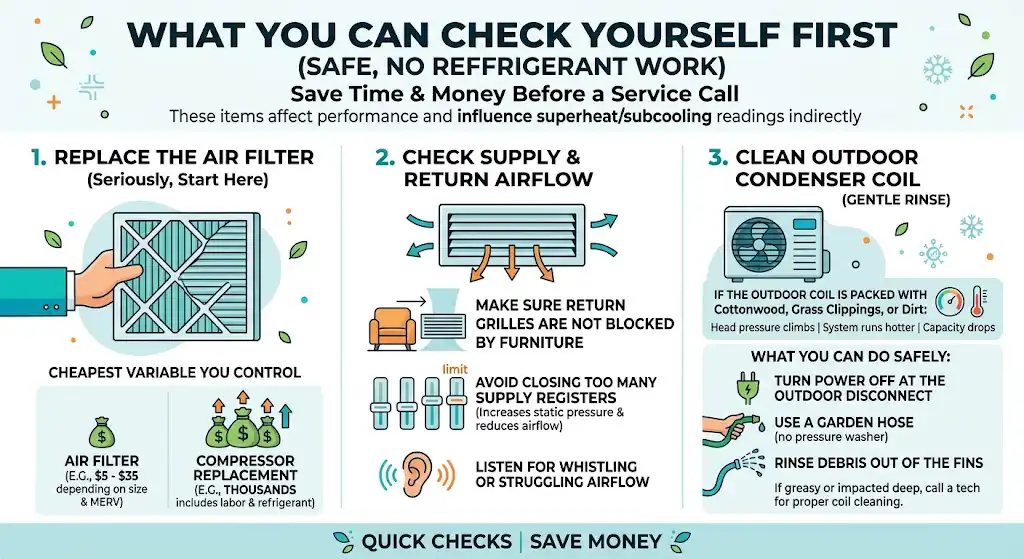
If you want to save time and possibly money on a service call, here’s what I recommend checking before you call a tech. These items affect performance and can influence superheat/subcooling readings indirectly.
1. Replace the air filter (seriously, start here)
This is the cheapest variable you control.
Typical real-world cost comparison:
- Air filter: often about $5 to $35 depending on size and MERV
- Compressor replacement: commonly runs into the thousands once labor and refrigerant work are included
2. Check supply and return airflow
- Make sure return grilles are not blocked by furniture
- Avoid closing too many supply registers (it can increase static pressure and reduce airflow)
- Listen for whistling or struggling airflow that suggests restriction
3. Clean the outdoor condenser coil (gentle rinse)
If the outdoor coil is packed with cottonwood, grass clippings, or dirt:
- Head pressure climbs
- The system runs hotter
- Capacity drops
What you can do safely:
- Turn power off at the outdoor disconnect
- Use a garden hose with gentle water (no pressure washer)
- Rinse debris out of the fins
If the coil is greasy or impacted deep, that’s when a proper coil cleaning is worth it.
Common causes of low superheat (by itself)
Low superheat means the suction vapor is not being heated much above saturation. In the field, I see these causes most:
| Overcharge | Too much refrigerant, evaporator tends to flood | Recover to spec (technician) |
| TXV overfeeding | TXV stuck open, bulb issue, wrong setting | Diagnose TXV/bulb, correct/replace (technician) |
| Low heat load | Cool indoor air, low fan speed, oversized system | Correct airflow/load issues |
| Airflow problems | Coil may not be absorbing heat normally | Filter, blower, coil cleaning, duct issues |
Common causes of high subcooling (by itself)
High subcooling means extra liquid is stacking in the condenser or liquid line.
| Overcharge | Excess refrigerant backs up in condenser | Recover to spec (technician) |
| Liquid line restriction | Liquid stacks up before restriction | Find restriction (drier, kink, TXV screen) and repair |
| Condenser flooding controls (some systems) | Controls keep head pressure up in low ambient | Verify design and operating conditions |
So what causes low superheat AND high subcooling together?
In most normal residential cooling situations, this combo points to:
1. Overcharge (most common)
- High subcooling from backed-up liquid in the condenser
- Low superheat from evaporator flooding
2. TXV/EEV overfeeding (less common, but real)
If the valve is stuck or misreading:
- It can flood the evaporator (low superheat)
- And still maintain higher subcooling depending on charge and condenser behavior
3. Very low indoor heat load (possible, but usually accompanied by other clues)
Examples:
- Oversized equipment short cycling
- Very low indoor airflow
- Unusual operating conditions
This is why a good tech checks the whole system: airflow, static pressure, blower speed, temperature split, coil condition, and manufacturer charging targets.
How technicians actually calculate superheat and subcooling (conceptually)
I’m not telling you to hook gauges up yourself, but I do want you to understand what a competent tech is doing so you can spot good work.
Superheat calculation
- Measure suction pressure
- Convert suction pressure to saturation temperature (using refrigerant PT data)
- Measure actual suction line temperature
- Superheat = actual suction line temp minus saturation temp
Subcooling calculation
- Measure liquid pressure
- Convert liquid pressure to saturation temperature
- Measure actual liquid line temperature
- Subcooling = saturation temp minus actual liquid line temp
A good technician will also:
- Compare results to the unit’s target
- Confirm airflow is correct before final charging
- Verify indoor/outdoor conditions are reasonable for charging
When you should stop troubleshooting and call a pro
Call a licensed HVAC technician if:
- The system is icing up repeatedly
- Cooling is weak and airflow checks out
- You suspect an overcharge (especially if refrigerant was recently added)
- There are signs of restriction (especially if a filter drier is suspected)
- You hear compressor noise changes, hard starting, or rapid cycling
Low superheat can become compressor damage if liquid refrigerant is returning to it. That’s one of those “pay now or pay a lot more later” situations.
FAQ
Can something other than overcharge cause low superheat and high subcooling?
Yes, but overcharge is the most common. A tech will also consider TXV overfeeding, low heat load, and unusual system conditions. The key is confirming readings against the unit’s charging data and verifying airflow.
Should I remove refrigerant myself if I think it’s overcharged?
No. Refrigerant recovery requires proper equipment and EPA Section 608 compliance. Venting refrigerant is illegal and unsafe.
What’s the simplest way to remember the difference between superheat and subcooling?
Superheat is on the suction side and helps protect the compressor from liquid.
Subcooling is on the liquid side and helps feed the metering device solid liquid.
Is high subcooling always overcharge?
No. High subcooling can also happen with liquid line restrictions. That’s why the superheat reading matters so much. Restrictions tend to push superheat high, while overcharge tends to push superheat low.