
Hi, I’m Nathan. I’ve worked as an HVAC technician for over 10 years, and while home HVAC and automotive AC aren’t identical, the fundamentals are the same: move heat, control airflow, and keep pressures and temperatures in the right range.
If your car AC is blowing about 50°F air, you’re probably thinking one of two things:
- That sounds kind of cool… but why am I still sweating
- My car used to blow colder than this
You’re not wrong. 50°F at the vent can be normal in some conditions, and a clear problem in others. In this guide I’ll help you figure out which one you’re dealing with, then walk you through the most likely fixes in the same order I would troubleshoot it.
- Quick Answer: Is 50°F Vent Air “Good” for a Car AC?
- What You Should Expect: Normal Car AC Vent Temps
- How to Measure Car AC Vent Temperature the Right Way
- Most Common Causes of a Car AC Blowing 50°F (and the Fix)
- 1) Replace the Cabin Air Filter (Fast, Cheap, Often Overlooked)
- 2) Check Condenser Airflow (This Is Huge for 50°F Problems)
- 3) Confirm the Radiator/Condenser Fan Is Actually Running
- 4) Low Refrigerant (Usually Caused by a Leak)
- 5) Compressor Problems (Clutch, Control Valve, or Internal Wear)
- 6) Blend Door or Temperature Control Issues (The Sneaky One)
- 7) Electrical Issues: Fuses, Relays, Pressure Switches, Sensors
- 8) If the Engine Runs Hot, the AC Often Suffers Too
- My Step-by-Step Troubleshooting Order (What I’d Tell You to Do)
- Cost Guide: What Repairs Usually Run (Realistic Ranges)
- When to Stop DIY and Call a Pro
- FAQ: Car AC Blowing 50°F
- Final Thoughts (From Someone Who Troubleshoots HVAC for a Living)
Quick Answer: Is 50°F Vent Air “Good” for a Car AC?
Sometimes yes, sometimes no. The key is context.
50°F can be normal when:
- It’s very hot outside (90–105°F+)
- You’re sitting idling in traffic
- Humidity is high
- The vehicle is heat-soaked from sitting in the sun
50°F is usually a problem when:
- It’s only 75–85°F outside
- You’re driving at road speed (good airflow)
- You’re on recirculation
- After 10 minutes, it still won’t drop below ~50°F
In many healthy systems, you’ll often see mid 40s°F at the vents, and sometimes even high 30s°F in ideal conditions (recirc on, shade, moderate humidity, steady RPM).
What You Should Expect: Normal Car AC Vent Temps
Here’s a realistic expectation chart I use when explaining this to customers.
Typical vent temperature targets (after 8–10 minutes)
| 75°F | 38–48°F | Many cars can hit low 40s easily |
| 85°F | 40–52°F | 50°F is borderline depending on humidity |
| 95°F | 42–55°F | At idle you may see higher temps |
| 105°F | 45–60°F | Heat-soak makes it harder; driving helps |
A more reliable way than chasing a perfect vent number is temperature drop (delta T).
A simple performance rule that works
Most systems should deliver roughly a 30–40°F drop from the air going into the system to the air coming out of the vents (varies by humidity and vehicle design).
So if it’s 95°F in the cabin and you’re getting 50°F out of the vents, that’s a 45°F drop which can actually be decent.
But if it’s 85°F and you’re stuck at 50°F, that’s only 35°F drop and may still be okay, but it’s often a sign you’re not getting peak performance.
How to Measure Car AC Vent Temperature the Right Way
Before you diagnose anything, measure correctly. I’ve seen people chase problems that weren’t real because the test was wrong.
Do this:
- Park in shade if possible (or just understand heat-soak will affect results)
- Start the engine
- AC on Max / LO
- Recirculation ON
- Fan speed on medium-high
- Windows up
- Put a thermometer in the center vent, not touching plastic
- Let it run 8–10 minutes
- For a more accurate check, hold engine speed around 1,500–2,000 RPM for 30–60 seconds
If you only test at idle on a 100°F day, many cars won’t impress you.
Most Common Causes of a Car AC Blowing 50°F (and the Fix)
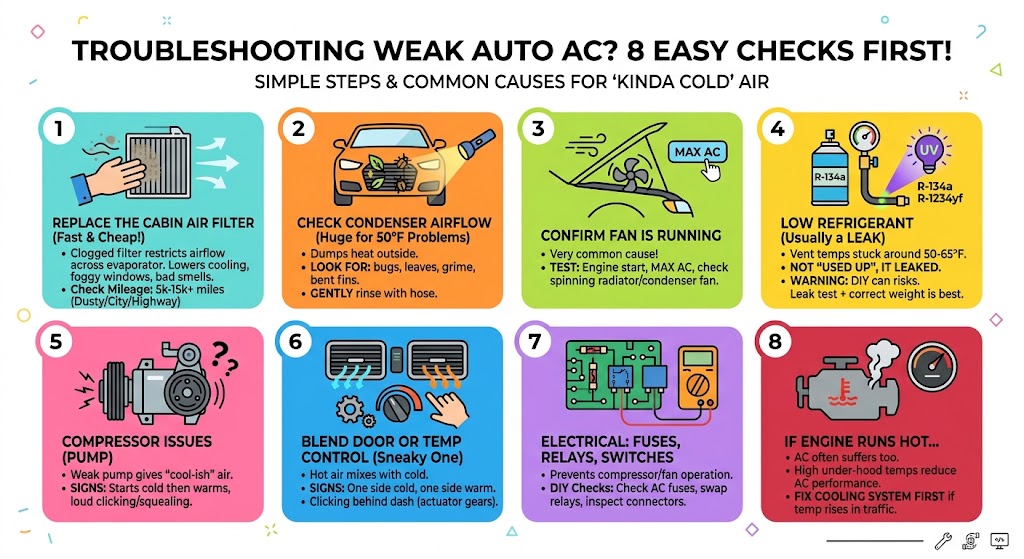
Here’s the troubleshooting table I’d start with.
Causes and fixes at a glance
| Dirty cabin air filter | Weak airflow, musty smell, takes forever to cool | Replace cabin filter |
| Condenser blocked (bugs, leaves, dirt) | Cool-ish at speed, warmer at idle | Clean condenser carefully |
| Radiator/condenser fan not working | AC warms up at idle or in traffic | Diagnose fan, relay, resistor, replace motor if needed |
| Low refrigerant from a leak | Works sometimes, worse over time, may cycle | Leak test then correct recharge |
| Compressor/clutch issue | Inconsistent cooling, clicking, or no change at all | Compressor/clutch diagnosis |
| Blend door or control issue | One side warm, temp won’t go full cold | Actuator/control module diagnosis |
| Overheating engine/cooling system issues | AC weak when engine temp rises | Fix cooling system first |
| Electrical (fuse/relay/sensor) | AC won’t engage reliably | Test power, fuses, relays |
Now let’s walk through these in the same order I’d do it in the real world.
1) Replace the Cabin Air Filter (Fast, Cheap, Often Overlooked)
If I could only check one thing first, it’s this.
A clogged cabin air filter restricts airflow across the evaporator. That can:
- reduce cooling at the vents
- make it feel like the AC is “kinda cold but not enough”
- cause foggy windows and funky smells
Typical replacement interval (real-world guidance)
Most manufacturers land around 12,000–15,000 miles under normal conditions, sooner in dusty areas.
| Mostly highway, clean air | 15,000 miles |
| City driving, pollen-heavy | 10,000–12,000 miles |
| Dusty roads, lots of construction | 5,000–10,000 miles |
If your airflow is weak, replace it before doing anything else.
2) Check Condenser Airflow (This Is Huge for 50°F Problems)
Your condenser sits at the front of the car and dumps heat to the outside air. If it can’t dump heat, your vent temps climb.
What to look for:
- bugs packed into the fins
- leaves and plastic bags
- mud, road grime, bent fins
What I do:
- Inspect with a flashlight
- Rinse gently with a hose from the back side if possible
- Avoid high-pressure spray directly into fins (it can fold fins over)
If the condenser is clogged, you’ll often get:
- “okay” cooling while driving
- noticeably warmer air at idle or stoplights
3) Confirm the Radiator/Condenser Fan Is Actually Running
This is one of the most common “AC stuck around 50°F” causes, especially on hot days.
Easy test:
- Start engine
- Turn AC to MAX
- Pop the hood
- Look for the condenser/radiator fan spinning
If it’s not running, the AC can’t reject heat properly, and pressures climb. Vent temps rise. Often you’ll see:
- cooling that falls off when stopped
- cooling that improves when you drive
Possible culprits:
- failed fan motor
- blown fuse
- bad relay
- wiring issue
- fan control module (common on some models)
4) Low Refrigerant (Usually Caused by a Leak)
Refrigerant doesn’t get “used up.” If it’s low, it leaked out somewhere.
When charge is low, you often get:
- vent temps stuck around 50–65°F
- cooling that comes and goes
- compressor cycling more than normal
What you might see:
Some leaks leave an oily residue around:
- hose connections
- condenser
- compressor
- service ports
On many systems, UV dye may be present from previous service, so leaks can glow under UV light.
Important: Recharge kits can be risky
Yes, you can DIY recharge on some cars, but here’s my honest take:
- If you recharge without finding the leak, you’re usually buying temporary comfort.
- Overcharging is common with DIY cans and can make cooling worse.
- Some newer vehicles use R-1234yf, which is not the same as R-134a. Using the wrong refrigerant is a serious problem.
Common refrigerants by era
| R-134a | Many vehicles ~1994 to mid/late 2010s | Widely available |
| R-1234yf | Many vehicles mid/late 2010s to present | More expensive; different service equipment |
If vent temps are stuck at 50°F and you suspect low charge, the best fix is leak test + correct recharge by weight.
5) Compressor Problems (Clutch, Control Valve, or Internal Wear)
Your compressor is the pump. If it’s weak, you can still get “cool-ish” air, but not cold.
Common signs:
- AC starts cold then warms
- loud clicking or squealing when AC engages
- vent temps don’t improve even when driving
- one day it’s fine, next day it’s not
Some modern compressors are variable displacement and may not use a traditional cycling clutch the same way older cars do, so diagnosis can require scan tool data and pressure readings.
6) Blend Door or Temperature Control Issues (The Sneaky One)
Sometimes the AC system is fine, but hot air is mixing in due to a blend door issue.
You’ll notice:
- one side cold, one side warm (dual-zone systems)
- temperature won’t go full cold even on LO
- clicking behind the dash (failed actuator gears)
This is very common on vehicles with electric actuators and digital climate control.
7) Electrical Issues: Fuses, Relays, Pressure Switches, Sensors
If something electrical prevents the compressor or fan from running correctly, you’ll often land in that frustrating “50°F zone.”
DIY checks you can do:
- Check AC fuse(s)
- Swap the AC relay with another identical relay (for testing)
- Confirm connectors at the fan and compressor are seated and not corroded
A cheap multimeter or 12V test light can go a long way here.
8) If the Engine Runs Hot, the AC Often Suffers Too
This is one I’ve seen a lot: the customer thinks the AC is failing, but the engine is creeping hot at idle.
If the cooling system isn’t doing its job (coolant level, thermostat, radiator airflow, fan issues), under-hood temps rise and AC performance drops.
If your temp gauge rises in traffic, fix that first.
My Step-by-Step Troubleshooting Order (What I’d Tell You to Do)
If you want the shortest path to an answer, follow this order:
- Measure vent temp correctly (recirc on, 8–10 minutes)
- Check airflow strength inside the cabin
- Replace cabin air filter
- Inspect/clean condenser
- Confirm radiator/condenser fan operation
- If still stuck: check for blend door issues
- If still stuck: get a professional AC performance check (pressures, leak test, recharge by weight)
Cost Guide: What Repairs Usually Run (Realistic Ranges)
Prices vary a lot by vehicle and region, but these ranges are common.
| Cabin air filter (DIY) | $15–$40 |
| Cabin air filter (shop) | $40–$120 |
| Condenser cleaning | $0–$75 |
| AC diagnostic (pressures + temp) | $100–$200 |
| Leak test + evac/recharge | $200–$450 |
| Radiator/condenser fan replacement | $250–$700 |
| Compressor replacement | $800–$2,000+ |
| Blend door actuator | $200–$700 (dash access varies) |
When to Stop DIY and Call a Pro
I’m all for homeowners and car owners learning to troubleshoot, but here’s where I recommend professional help:
- You suspect refrigerant is low (needs leak testing and correct charge by weight)
- You have R-1234yf (special equipment, higher cost, and stricter handling)
- The compressor is noisy or you suspect internal failure (debris can spread)
- You have dual-zone issues that point to blend door diagnostics
A proper shop will check:
- high-side and low-side pressure readings
- vent temps at idle and at RPM
- fan operation commands
- potential leaks (UV dye, nitrogen pressure test, electronic sniffer)
FAQ: Car AC Blowing 50°F
Is 50°F cold for car AC?
It’s cool, but not always “cold.” In many cars, 35–45°F at the vent is achievable under good conditions. 50°F can be normal in extreme heat or at idle, but if it never improves, something may be off.
Why is my car AC only slightly cool?
The most common reasons I see are:
dirty cabin air filter
weak condenser airflow (fan or blockage)
low refrigerant from a leak
blend door mixing warm air
How long should it take to get below 50°F?
In moderate conditions, many vehicles should get into the 40s within 5–10 minutes on recirc. In extreme heat, it may take longer, and the number may not drop much until you’re driving.
Final Thoughts (From Someone Who Troubleshoots HVAC for a Living)
If your car AC is blowing 50°F, don’t panic, but don’t ignore it either. Sometimes it’s completely normal based on outside temps and idle conditions. Other times it’s your first warning that airflow, refrigerant charge, or a fan/compressor issue is starting to slip.