Hi, I’m Nathan. I’ve worked as an HVAC technician for over 10 years, and I can tell you this: when a homeowner says, “My AC is blowing 70 degree air,” the system is usually running but not actually removing heat the way it should.
70°F air out of the vents can feel mildly cool on your hand, but it is not enough to bring your home down to a comfortable temperature unless your house is already close to 70°F.
Let’s walk through what 70°F supply air really means, how to test it correctly, and the most common causes I see in the field, from simple filter issues to refrigerant leaks.
- The Simple Test: Check Your Temperature Split (Delta T)
- Most Common Reasons Your AC Is Blowing 70 Degree Air
- 1. Dirty or Wrong Air Filter (Most Common and Cheapest Fix)
- 2. Low Refrigerant (Usually From a Leak)
- 3. Dirty Evaporator Coil (Indoor Coil)
- 4. Dirty Condenser Coil (Outdoor Unit)
- 5. Outdoor Fan or Capacitor Failure (AC Runs But Cannot Cool)
- 6. Duct Leaks or Disconnected Ductwork (You Make Cold Air, But You Lose It)
- When 70 Degree Air Might Be Normal (Temporarily)
- Typical Repair Costs (Ballpark)
- What I’d Do at Your House (My Professional Checklist)
- Frequently Asked Questions
- Conclusion: Fixing an AC Blowing 70 Degree Air
The Simple Test: Check Your Temperature Split (Delta T)
Before you replace parts or call anyone, do this quick test. It tells you more than guessing.
What you need
- A simple digital thermometer (even a cooking thermometer works)
- 10 minutes of runtime
How to measure it the right way
- Set thermostat to Cool and Fan = Auto
- Let the system run 10 to 15 minutes
- Measure the return air temperature
- Best spot is at the return grille, not near a window or kitchen
- Measure the supply air temperature
- Use a vent close to the air handler, not the farthest room
- Stick the probe into the airflow stream
What you should see
A normal system typically shows a 15°F to 20°F drop.
Normal AC temperature split guide
| 75 | 55 to 60 | Yes |
| 78 | 58 to 63 | Yes |
| 80 | 60 to 65 | Yes |
| 86 | 66 to 71 | Can be normal at startup, should improve |
| 78 | 68 to 72 | Usually a problem |
Important note from real service calls: if your indoor temp is extremely high (mid 80s or more), your AC may start around 70°F supply and improve as the house cools. The key is whether it drops toward the low 60s after it has been running.
Most Common Reasons Your AC Is Blowing 70 Degree Air
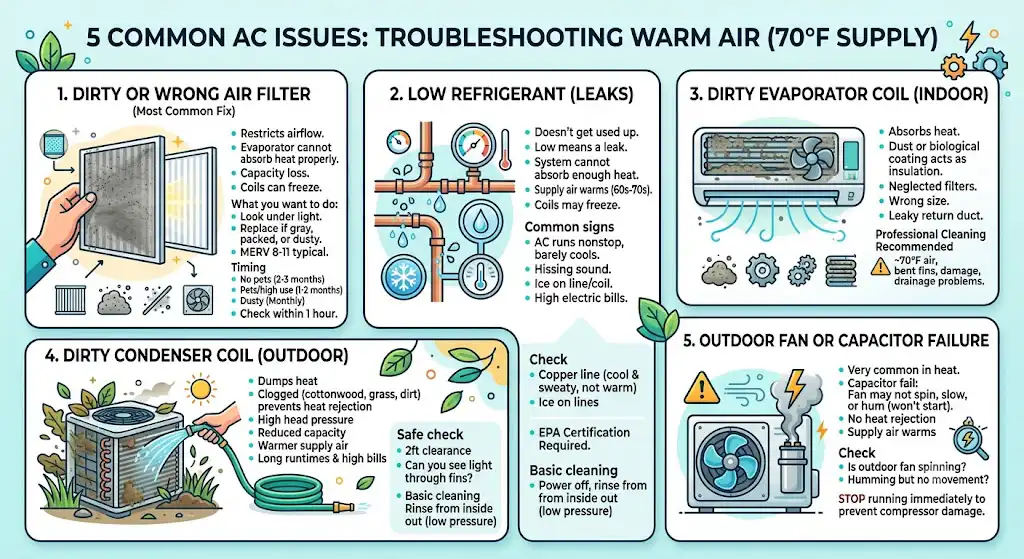
Here are the top causes I see again and again, plus what you can check safely.
Troubleshooting table (fast reference)
| Airflow weak, rooms not cooling | Dirty filter or airflow restriction | Check filter, vents, return grille | Replace filter, clear restrictions |
| Air is 70°F and airflow is normal | Low refrigerant, dirty coil, compressor issue | Look for ice, check outdoor unit running | Leak test and recharge, coil cleaning, repair |
| Outdoor fan not spinning | Bad capacitor, failed fan motor | Listen for humming, look for fan movement | Replace capacitor or motor |
| Copper line iced up | Low refrigerant or low airflow | Check filter, see visible ice | Fix airflow or leak and recharge |
| Some rooms warm, others ok | Duct leaks or disconnections | Look for loose ducts in attic/basement | Seal and reconnect ducts |
| AC runs constantly, high bill | Dirty coils, low refrigerant, undersized system | Inspect outdoor coil condition | Clean coil, service refrigerant, load calculation |
1. Dirty or Wrong Air Filter (Most Common and Cheapest Fix)
If I had to pick one issue that causes the most “70 degree air” complaints, it’s airflow problems, especially a clogged filter.
When airflow is restricted:
- The evaporator coil cannot absorb heat properly
- The system can start losing capacity
- In worse cases, the coil freezes and airflow drops even more
What I want you to do
- Pull the filter out and look at it under a light
- If it looks gray, packed, or dusty, replace it
Real-world filter guidance (based on what works in homes)
- Most homes do well with MERV 8 to MERV 11
- Very high MERV filters can restrict airflow if your system is not designed for them
Replacement timing (typical)
| No pets, light use | 2 to 3 months |
| Pets or high use | 1 to 2 months |
| Dusty area or remodeling | Monthly |
If you replace the filter and your supply air temp improves within an hour, you likely found the main issue.
2. Low Refrigerant (Usually From a Leak)
Refrigerant does not get “used up.” If it’s low, it is almost always leaking.
When refrigerant is low:
- The system cannot absorb enough heat indoors
- Supply air warms up (often hovering around the high 60s to low 70s)
- The coil may freeze due to low pressure and temperature
Common signs I see in the field
- AC runs nonstop but the home barely cools
- Hissing sound near the indoor coil or outdoor unit
- Ice on the copper line or indoor coil
- Higher electric bills due to long runtimes
What you can check (without tools)
- Look at the larger copper line near the outdoor unit
- It should feel cool and sweaty, not warm
- Look for ice on the refrigerant lines or indoor unit
- Check supply temperature split as described earlier
Important safety note
Handling refrigerant requires EPA certification in many places and the right tools. Also, “topping it off” without repairing the leak is a temporary band-aid and often costs you more long-term.
What a good technician should do:
- Confirm charge is low with pressure and temperature readings
- Find the leak (electronic detector, bubble test, nitrogen pressure test, etc.)
- Repair the leak when possible
- Evacuate and recharge to manufacturer specs
3. Dirty Evaporator Coil (Indoor Coil)
Your evaporator coil is where the heat is absorbed from the air. If it’s coated in dust or biological buildup, it becomes insulated and can’t transfer heat well.
A dirty coil commonly happens when:
- Filters were neglected
- Filter was the wrong size and air bypassed it
- Return duct has leaks pulling dusty attic air
Symptoms
- AC blows around 70°F
- Airflow may be normal or slightly reduced
- Musty smell in some cases
- Coil may start freezing in humid weather
What I recommend
If you can see the coil and it looks matted or dirty, this is usually a job for a professional cleaning. I’ve cleaned plenty of coils, and doing it wrong can bend fins, damage sensors, or create drainage problems.
4. Dirty Condenser Coil (Outdoor Unit)
The outdoor coil is where your system dumps heat. If it’s clogged with cottonwood, grass clippings, or dirt, your AC cannot reject heat efficiently.
The result can be:
- Higher head pressure
- Reduced cooling capacity
- Warmer supply air (like 70°F)
- Longer runtimes and higher bills
Safe homeowner check
- Make sure the outdoor unit has at least 2 feet of clearance
- Look through the fins
- If you cannot see light through them, it is likely clogged
Basic cleaning (safe method)
- Turn power off at the disconnect
- Gently rinse from the inside out with a garden hose
- Do not use high pressure (it bends fins)
If the coil is heavily impacted, a deeper cleaning may be needed.
5. Outdoor Fan or Capacitor Failure (AC Runs But Cannot Cool)
This one is very common during hot weather.
If the capacitor fails, the outdoor fan may:
- Not spin at all
- Spin slowly
- Hum but not start
If the fan is not moving enough air, the system cannot reject heat, so supply air warms up.
What you can check
- Is the outdoor fan spinning while the AC is on?
- Do you hear humming but no movement?
Stop running it if the fan is not working
Running the system in this condition can damage the compressor, which is a much bigger repair.
6. Duct Leaks or Disconnected Ductwork (You Make Cold Air, But You Lose It)
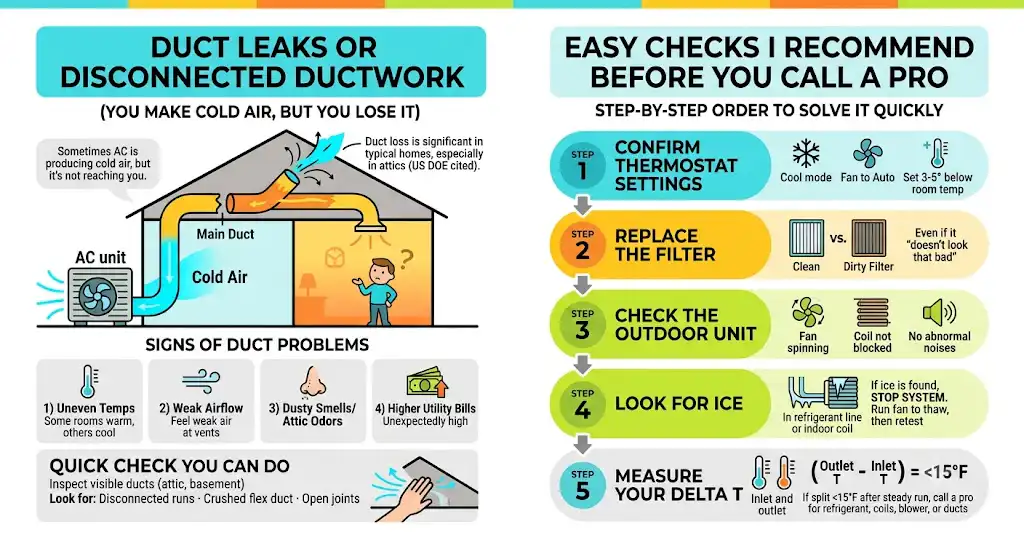
Sometimes the AC is actually producing cold air, but it is not reaching you.
In many homes, duct leakage is a real issue. The U.S. Department of Energy has cited duct losses that can be significant in typical homes, especially with ducts in attics.
Signs of duct problems
- Some rooms are much warmer than others
- You feel weak airflow at certain vents
- You notice dusty smells or attic odors
- Utility bills are higher than expected
Quick check you can do
- Inspect any visible ductwork in attic, basement, or crawlspace
- Look for disconnected runs, crushed flex duct, or open joints
- Check for air blowing into the attic (you may feel it with your hand)Easy Checks I Recommend Before You Call a Pro
Here is the exact order I use when I’m trying to solve this quickly.
Step 1: Confirm thermostat settings
- Cool mode
- Fan set to Auto (not On)
- Temperature set at least 3 to 5 degrees below room temp for testing
Step 2: Replace the filter
Even if it “doesn’t look that bad,” a new filter removes a big variable.
Step 3: Check the outdoor unit
- Fan spinning
- Coil not blocked
- No abnormal noises
Step 4: Look for ice
- Ice on refrigerant line or indoor coil area = stop the system
- Run fan only to thaw, replace filter, then retest
Step 5: Measure your Delta T
If the split is under 15°F after the system runs steadily, it is time to look deeper (refrigerant, coils, blower performance, ducts).
When 70 Degree Air Might Be Normal (Temporarily)
I do want to be fair here: there are a few cases where 70°F supply air is not instantly a disaster.
- Your house is extremely hot (mid to high 80s): supply temps may start higher and improve as indoor temp drops
- You measured incorrectly: measuring at a far vent, or right after startup, can mislead you
- High humidity: some systems prioritize latent removal; still, Delta T should generally land in range once stabilized
Typical Repair Costs (Ballpark)
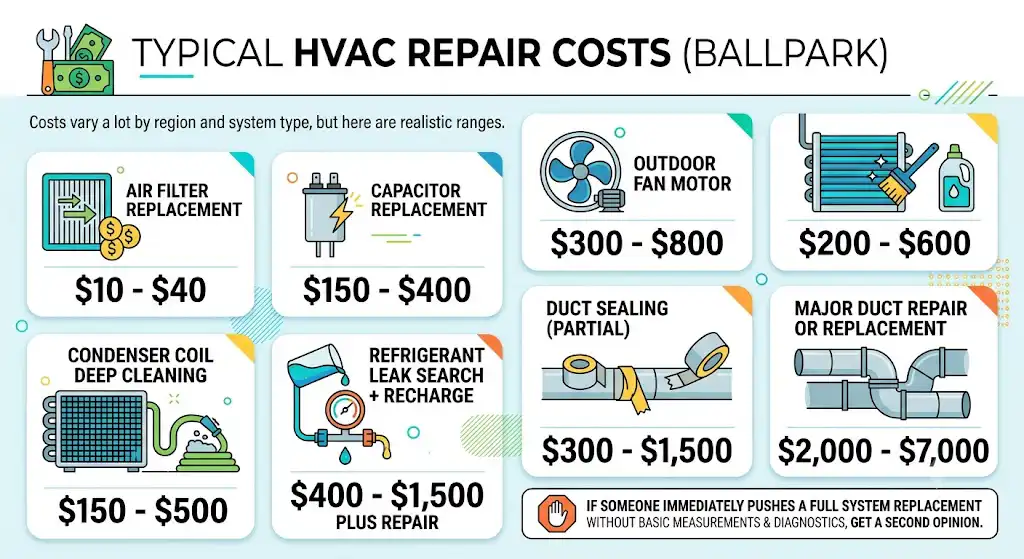
Costs vary a lot by region and system type, but here are realistic ranges I see.
| Air filter replacement | 10 to 40 |
| Capacitor replacement | 150 to 400 |
| Outdoor fan motor | 300 to 800 |
| Evaporator coil cleaning | 200 to 600 |
| Condenser coil deep cleaning | 150 to 500 |
| Refrigerant leak search + recharge | 400 to 1,500 plus repair |
| Duct sealing (partial) | 300 to 1,500 |
| Major duct repair or replacement | 2,000 to 7,000 |
If someone immediately pushes a full system replacement without basic measurements and diagnostics, get a second opinion.
What I’d Do at Your House (My Professional Checklist)
When I arrive on a “blowing 70 degrees” call, I typically:
- Verify thermostat operation and staging
- Measure return and supply temps and calculate Delta T
- Check filter, static pressure clues, and blower performance
- Inspect evaporator coil condition and drain
- Inspect outdoor coil and confirm fan and compressor operation
- If needed, check refrigerant charge properly and look for leak indicators
- Evaluate duct issues if temperatures look good at the unit but not at the rooms
That process prevents wasted money and fixes the actual cause.
Frequently Asked Questions
Should the big copper line outside feel cold?
Yes. The larger suction line should generally feel cool and often sweaty when running. If it feels warm while the system is on, that can point to refrigerant issues, compressor issues, or severe heat transfer problems.
Can I just add refrigerant myself?
In most cases, no. It requires proper tools, correct refrigerant type, and legal compliance. More importantly, if it is low, there is a leak that should be addressed.
Should I turn the AC off if I see ice?
Yes. Turn cooling off to prevent compressor damage. You can run the fan to help thaw the coil. Then check filter and airflow before restarting.
Conclusion: Fixing an AC Blowing 70 Degree Air
If your AC is blowing 70°F air and your home is still warm, the system is not cooling correctly. In my experience, the fastest wins usually come from:
- Replacing a clogged filter
- Cleaning a dirty outdoor coil
- Catching a failing capacitor or fan early
If your Delta T is low and you see ice or persistent poor cooling, you may be dealing with low refrigerant or coil issues, and that is where a qualified technician is worth it.