
I’m Nathan. I’ve worked as an HVAC technician for over 10 years, and I can tell you this is one of the most common “my thermostat is broken” moments I see in winter.
You look at your Google Nest Thermostat and suddenly it says AUX or EMER, the screen color changes, and your next thought is usually “Is my system failing?” or “Is my electric bill about to explode?”.
Let me walk you through it the same way I explain it to homeowners in the field.
- Quick answer (the difference in one sentence)
- First, a quick heat pump refresher (why these modes exist)
- Aux Heat on a Nest thermostat (Auxiliary Heat)
- Emergency Heat on a Nest thermostat (Em Heat)
- Aux Heat vs Emergency Heat (simple comparison table)
- Why can Aux Heat be normal but still expensive
- Nest-specific behavior: how Nest decides to use Aux Heat
- How to switch between Aux and Emergency on Nest (and when you should)
- What Aux Heat looks like when everything is working normally
- Cost reality check (simple numbers you can use)
- Troubleshooting: why your Nest is showing AUX a lot
- When to use Emergency Heat (decision guide)
- Dual fuel note (heat pump plus gas furnace)
- My rule of thumb after 10 years in HVAC
- FAQ
Quick answer (the difference in one sentence)
Aux Heat is automatic help that turns on with your heat pump when it’s struggling.
Emergency Heat is manual fallback that bypasses the heat pump and runs only the backup heat.
If your system is working normally, you almost never need to touch Emergency Heat.
First, a quick heat pump refresher (why these modes exist)
A heat pump does not “make” heat the same way a furnace does. Most of the time it moves heat from outside to inside. That works great in mild to moderately cold weather, but as outdoor temps drop, a heat pump’s capacity and efficiency drop too.
That’s why many heat pump systems include a backup heat source, usually:
- Electric heat strips (most common)
- A gas furnace (dual fuel)
- Hydronic coil in rare cases
Your Nest is basically deciding when to use:
- The heat pump (cheap-ish heat)
- Backup heat (more expensive)
- Both together (to catch up)
Aux Heat on a Nest thermostat (Auxiliary Heat)
What is Aux Heat
Aux Heat is supplemental heat. Your Nest turns it on automatically when the heat pump can’t keep up or when the system needs it for a special condition like defrost.
In most homes, Aux Heat means the system is running electric resistance heat strips along with the heat pump.
How Aux Heat works (real-world behavior)
Here’s what I see in the field:
- The heat pump is running, but the house temp is dropping or rising too slowly
- Nest decides it needs a boost
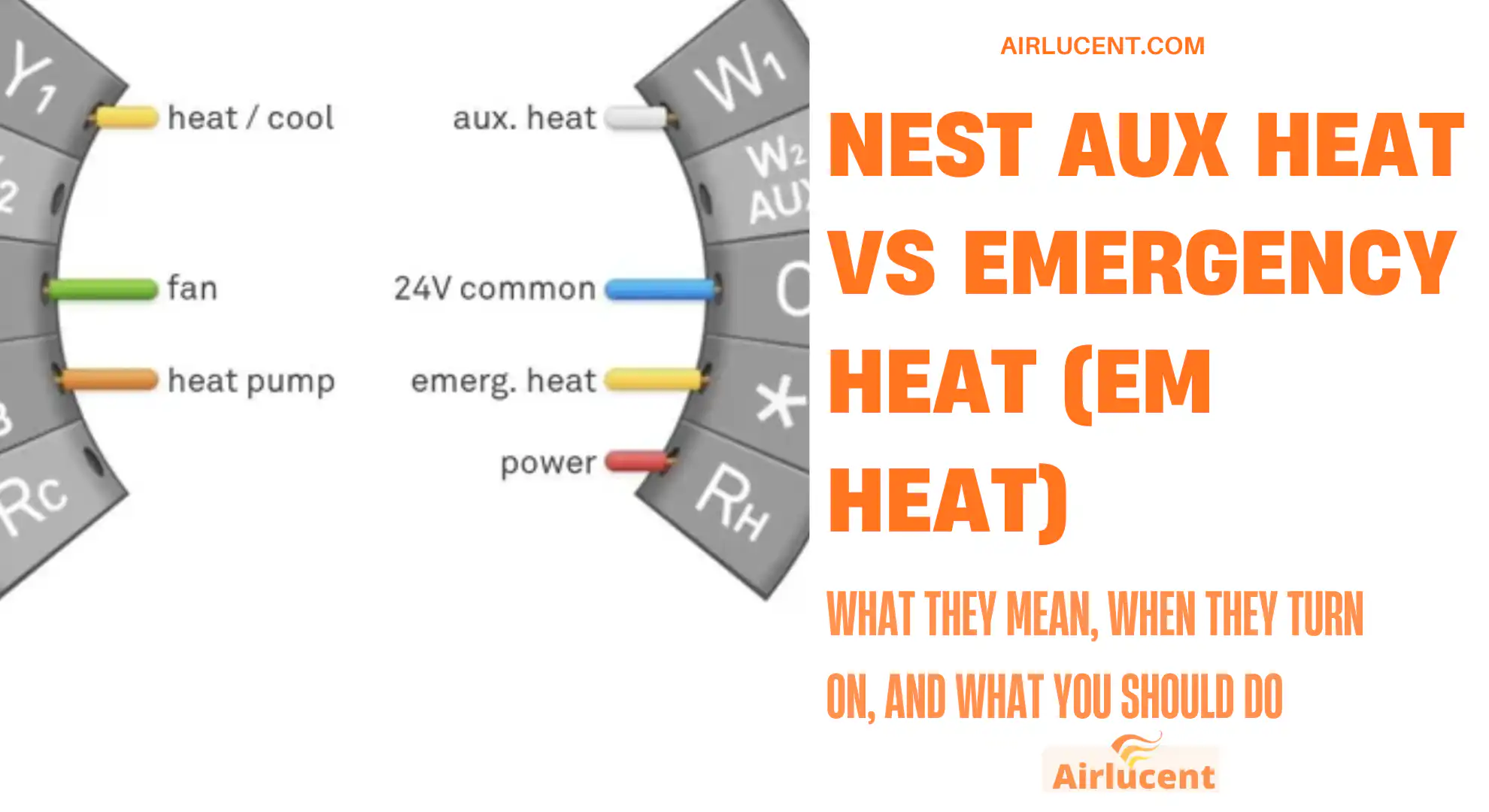
- Nest energizes the AUX stage (typically W2/AUX) while keeping the compressor running.
Common times Nest uses Aux Heat.
Aux Heat turning on is often normal during:
- Cold snaps
- Heat pumps lose capacity as outdoor temperatures drop.
- Big thermostat setpoint jumps.
- If you crank the thermostat up several degrees at once, many systems call for auxiliary heat to catch up faster.
- Defrost cycles
- When the outdoor coil frosts up, the heat pump periodically defrosts.
- During defrost, the system may rely on auxiliary heat so you don’t feel cold air indoors.
What you’ll see on the Nest
- Nest will display AUX.
- You may see the screen color shift based on model and mode, but the key indicator is the AUX label.
- In the Nest app, you can often confirm the equipment status or run history (depending on the model and settings)
Important note from the service truck
If Aux Heat comes on occasionally, that is normal.
If Aux Heat is on constantly when it is not that cold outside, that is when I start looking for problems.

Emergency Heat on a Nest thermostat (Em Heat)
What Emergency Heat is
Emergency Heat is a manual mode you turn on when you do not want the heat pump to run at all.
When you enable Emergency Heat:
- Nest locks out the heat pump.
- Nest runs only the backup heat.
This is exactly why it costs more in most all-electric homes. Electric heat strips are basically a giant toaster inside your air handler.
When you should use Emergency Heat (the only good reasons)
Turn on Emergency Heat if the outdoor heat pump unit is:
- Not running at all
- Making grinding or screaming noises
- Tripping the breaker repeatedly
- Frozen into a solid block of ice and not defrosting (not just light frost)
- Physically damaged
- Showing a confirmed compressor or control failure
What you’ll see on the Nest
- Nest will display EMER (or Emergency Heat)
- Many Nest models show an orange heating display when actively heating, but again, the label is the giveaway: EMER.
What not to do
Do not use Emergency Heat just because:
- It’s cold outside
- You want warmer air from vents.
- Aux Heat has been running.
Emergency Heat is not a comfort upgrade. It is a limp-home mode.
Aux Heat vs Emergency Heat (simple comparison table)
| Turns on automatically | Yes | No |
| Uses heat pump | Yes, usually runs with heat pump | No, heat pump is bypassed |
| Uses backup heat strips | Yes | Yes, only |
| Typical purpose | Help the heat pump keep up or cover defrost | Use backup heat when heat pump is broken |
| Cost to run (typical) | Higher than heat pump alone | Highest on most systems |
| What Nest displays | AUX | EMER |
Why can Aux Heat be normal but still expensive
Here’s the key money point I tell homeowners.
According to the U.S. Department of Energy, heat pumps can reduce electricity use for heating by about 50 percent compared with electric resistance heating (like heat strips). That’s the “why” behind these modes.
Efficiency snapshot (what happens as outdoor temps drop)
Actual numbers vary by model, but this is a practical rule of thumb:
| Around 45 to 55 F | High efficiency | Mostly heat pump only |
| Around 25 to 40 F | Moderate efficiency | Aux may kick on sometimes |
| Below about 20 to 30 F (system-dependent) | Lower capacity and lower efficiency | More frequent Aux, longer runtimes |
| Extreme cold | Heat pump may struggle hard | Aux a lot, or dual fuel changeover |
COP is “coefficient of performance”. Higher COP means more heat per unit of electricity.
Nest-specific behavior: how Nest decides to use Aux Heat
Nest thermostats can use logic that depends on:
- Indoor temperature vs setpoint (how many degrees behind you are)
- How fast the home is warming
- Runtime
- Outdoor temperature (from internet weather or a sensor, depending on setup)
- Your settings like Heat Pump Balance (on many Nest setups)
Heat Pump Balance (what it really does)
Heat Pump Balance is designed to reduce unnecessary Aux Heat.
Common options you may see (names can vary by model/app version):
- Max Savings: uses less Aux Heat, longer heat pump runtimes
- Balanced: middle ground
- Max Comfort: uses Aux Heat more readily to reach setpoint faster
In the field, I typically recommend starting with a balanced setting unless the homeowner is very cost-sensitive or has a borderline-sized heat pump.
How to switch between Aux and Emergency on Nest (and when you should)

Do you need to manually turn on Aux Heat
Almost never. Aux Heat is supposed to be automatic.
How to enable Emergency Heat (if your heat pump is down)
The exact taps differ by Nest model, but the path is usually:
- Open the Nest thermostat menu (or the Nest/Google Home app)
- Go to Heat mode settings.
- Select Emergency Heat
If you do not see Emergency Heat as an option, it may be because:
- Your system is not wired/configured for it
- Nest does not detect W2/AUX or the emergency heat stage
- You have a different equipment type (like furnace-only)
What Aux Heat looks like when everything is working normally
In a healthy system, Aux Heat often behaves like this:
- It turns on for 10 to 30 minutes during a recovery.
- It turns on during defrost.
- It turns off once the home closes the gap to the setpoint.
Normal
- AUX appears occasionally
- Home still reaches a temperature.
- The outdoor unit runs normally.
- No unusual noises
- No massive bill spike
Not normal (and I would investigate)
- AUX is on for hours every day in mild weather
- AUX is on, but the air feels cool, and the house does not warm up
- The outdoor unit is not running at all.
- The outdoor unit is a solid ice block.
- Your electric bill jumps sharply with no lifestyle change.
Cost reality check (simple numbers you can use)
Most electric air handlers have heat strips in the 5 kW to 15 kW range. A very common size is 10 kW.
Here’s a simple example using 10 kW strips:
| Electric heat strips (Aux or Emergency) | 10 kW | 10 kWh | $1.50 per hour |
| Heat pump (typical running draw varies a lot) | 2 to 5 kW | 2 to 5 kWh | $0.30 to $0.75 per hour |
These are general estimates, but the relationship is usually true:
Heat strips cost noticeably more per hour than the heat pump.
That’s why Emergency Heat can get expensive fast.
Troubleshooting: why your Nest is showing AUX a lot
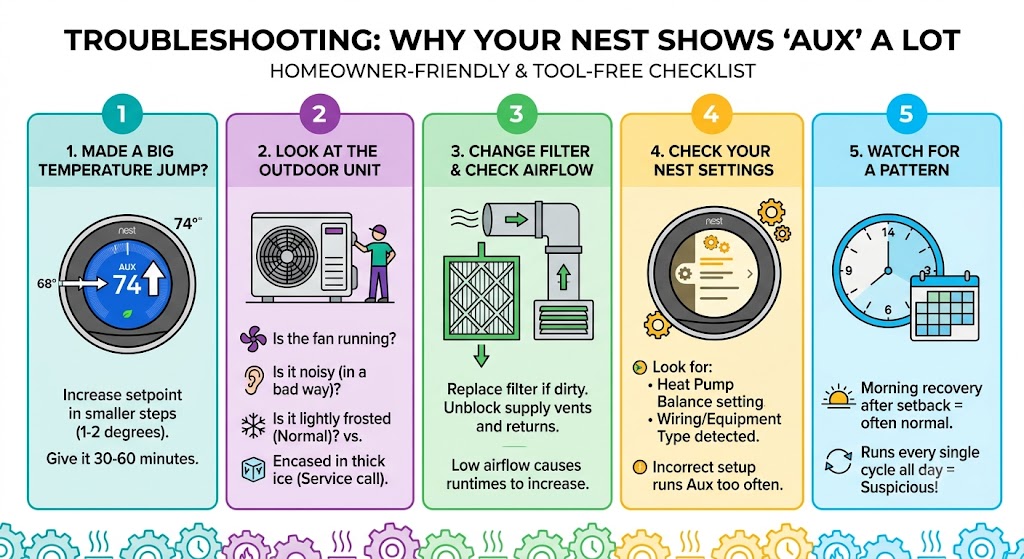
This is my homeowner-friendly checklist. You can do these safely without tools.
1. Check if you made a big temperature jump
If you went from 68 to 74, expect Aux.
What I recommend:
- Increase the setpoint in smaller steps, like 1 to 2 degrees
- Give it 30 to 60 minutes.
2. Look at the outdoor unit
Walk outside and check:
- Is the fan running
- Is the unit noisy in a bad way?
- Is it lightly frosted (often normal)
- Is it encased in thick ice (often not normal)
If it is a solid ice block and stays that way, that is a service call.
3. Change the filter and check airflow
Low airflow can cause longer runtimes and worse performance.
- Replace the filter if it is dirty.
- Make sure supply vents and returns are not blocked.
4. Check your Nest settings
Look for:
- Heat Pump Balance setting (if available)
- Wiring and equipment type detected
Incorrect setup can cause Aux to run too often.
5. Watch for a pattern
Aux that runs:
- Mostly in the morning, recovery after a setback, can be normal
- Every single cycle all day is suspicious
When to use Emergency Heat (decision guide)
Use this quick decision table.
| AUX comes on during very cold weather but home still heats | Normal assist | Leave it alone |
| AUX stays on for hours and outdoor unit runs normally | Possible sizing issue, airflow, or thermostat logic | Check filter, vents, settings, then service if it continues |
| AUX is on and outdoor unit is not running | Heat pump problem | Consider Emergency Heat and schedule repair |
| Outdoor unit is loud, smoking, or tripping breaker | Electrical or compressor problem | Turn system off, use Emergency Heat only if safe, call for service |
| Outdoor unit is a solid ice block and not defrosting | Defrost failure or airflow/refrigerant issue | Use Emergency Heat and call for service |
Dual fuel note (heat pump plus gas furnace)
If your “backup heat” is a gas furnace, your Nest may be set up for dual fuel. In that case, the thermostat can be configured to stop using the heat pump below a certain outdoor temperature and switch to the furnace.
Some systems use an outdoor sensor and a compressor lockout strategy so the heat pump does not run in extreme cold. That setup can be great when it’s configured correctly, but if it’s misconfigured, you can get comfort issues or higher-than-expected bills.
My rule of thumb after 10 years in HVAC
- Aux Heat is not automatically a problem. It is your system doing its job.
- Emergency Heat should feel like a spare tire. Useful when you need it, not something you drive on all winter.
If you are unsure, the best thing you can do is tell me what your Nest is showing and what the outdoor unit is doing.
FAQ
Is Aux Heat the same as Emergency Heat
No. Aux Heat usually runs with the heat pump as supplemental heat. Emergency Heat bypasses the heat pump and uses only backup heat.
Should I turn on Emergency Heat when it is really cold?
Unless the heat pump is not working properly. In cold weather, it is normal for Aux Heat to assist automatically.
Why does Aux Heat come on when I raise the temperature?
Because the thermostat sees a large gap between room temperature and setpoint and calls for extra heat to recover faster.
Will Emergency Heat damage my system
It normally will not damage the system, but it can be very expensive to run and it is not meant for daily use unless the heat pump is down.