Hi, I’m Nathan. I’ve worked as an HVAC technician for over 10 years, and a huge part of my job has been helping renters get comfortable without getting crushed by summer electric bills. Apartments come with extra challenges. You might not control the HVAC equipment, insulation upgrades, or windows. The good news is you can still make a noticeable dent in your bill with a few smart adjustments and a couple of low cost renter friendly upgrades.
This guide is written the way I’d walk you through it if I were standing in your apartment, looking at your thermostat, your windows, and your AC setup.
- Why electric bills jump in summer (especially in apartments)
- Quick wins you can do today (15 to 60 minutes)
- The renter friendly game plan (what works best in apartments)
- Thermostat settings that balance comfort and cost
- Use fans strategically (so they actually save money)
- Stop cold air from leaking out (renter edition)
- Block heat before it enters (your windows matter more than you think)
- Cut indoor heat from appliances (timing is everything)
- Manage humidity (this is a big comfort hack)
- Keep your AC efficient (maintenance that renters can actually do)
- Hot water: the sneaky part of summer electric bills
- Lighting and plug loads (small changes that stack up)
- Know what’s costing you: a simple way to estimate AC cost
- If you can talk to your landlord, these upgrades are worth requesting
- Summer savings checklist (quick reference)
- Common mistakes I see renters make (that cost real money)
- Frequently asked questions
- My recommended order of attack (if you want the fastest results)
Why electric bills jump in summer (especially in apartments)
In most apartments, your air conditioner is the main driver. The U.S. Energy Information Administration reports that air conditioning accounts for about 19% of residential energy use on average. In a smaller apartment with a window unit or portable AC running hard, cooling can become an even bigger share of your monthly bill.
A few other summer bill boosters I see constantly:
- Peak pricing: many utilities charge more late afternoon and early evening.
- Solar heat gain through windows: sun blasting through west and south facing glass can cook a room fast.
- Humidity: humid air feels hotter, so you set the thermostat lower and the AC runs longer.
- Heat you create indoors: ovens, dryers, dishwashers, old light bulbs, long hot showers.
Quick wins you can do today (15 to 60 minutes)
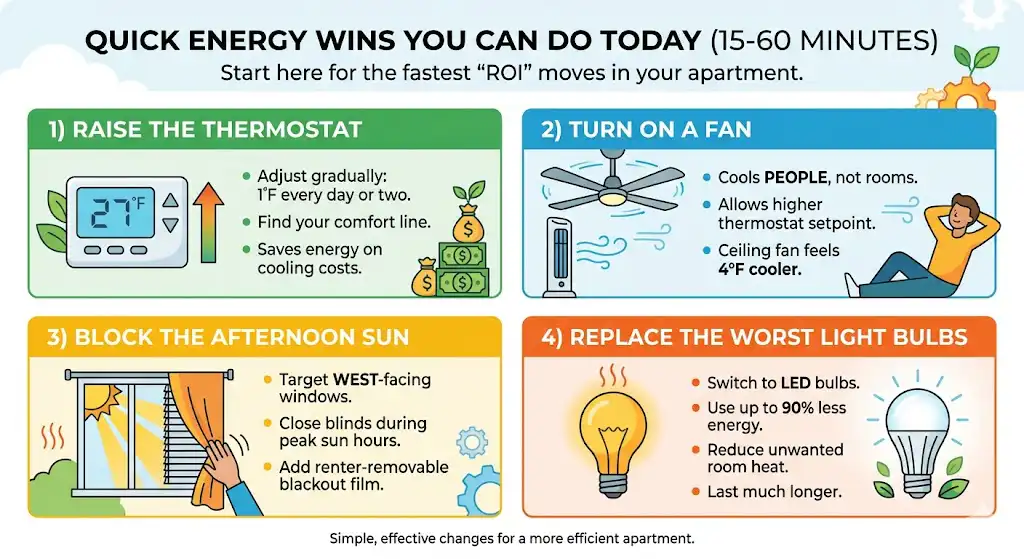
If you do nothing else, do these first. They’re the fastest “ROI” moves in most apartments.
1) Raise the thermostat a little, the right way
The U.S. Department of Energy recommends 78°F when you’re home, and warmer when you’re away. That sounds high for a lot of people, so here’s what I tell my customers:
- Raise your setpoint 1°F every day or two until you find your comfort line.
- Pair that change with a fan (more on that below).
DOE also notes that setting your thermostat about 7°F higher for 8 hours a day can reduce cooling costs by up to around 10% per year.
2) Turn on a fan in the room you’re actually in
Fans cool people, not rooms. But in real life, they let you bump the thermostat up without feeling it.
A ceiling fan can make a room feel about 4°F cooler (common guidance from energy efficiency programs and manufacturers). Box fans and tower fans can do a similar job if they’re positioned well.
3) Block the afternoon sun
If you’ve got west facing windows, that late day sun is expensive.
Close blinds or curtains during peak sun hours. If your blinds are flimsy, add blackout curtains or reflective window film that’s renter removable.
4) Replace the worst light bulbs
Incandescent bulbs waste a lot of energy as heat. The Department of Energy states LEDs use up to 90% less energy and can last much longer than incandescents. In summer, LEDs also reduce unwanted heat in the room.
The renter friendly game plan (what works best in apartments)
The “big 3” that usually move the needle most
- Thermostat strategy
- Air sealing around windows and doors
- Cutting heat gain through windows
Everything else helps, but those three are where I see renters get the biggest improvement without needing landlord approval.
Thermostat settings that balance comfort and cost

Here’s a practical schedule that aligns with DOE guidance but still feels realistic for most people.
Recommended thermostat targets (adjust for your comfort)
| Situation | Target setting | Why it helps |
|---|---|---|
| Home and awake | 76 to 78°F | Cuts runtime without feeling miserable |
| Sleeping | 78 to 82°F | Your body often tolerates warmer temps at night with airflow |
| Away (work, errands) | 82 to 85°F | You’re not paying to cool an empty apartment |
If you have a window unit or portable AC
- Avoid turning it completely off for 10 to 12 hours if your apartment gets brutally hot, because it may take a long time to recover and can run flat out when you get home.
- Instead, set it higher while you’re away, then bring it down 30 to 60 minutes before you return.
Real world tip from my service calls
If your apartment is humid, 78°F can feel sticky. Before you drop to 72°F, try boosting air movement and reducing humidity first. It’s usually cheaper than brute force cooling.
Use fans strategically (so they actually save money)
Best fan setups in an apartment
- Living room: one tower fan aimed across the seating area.
- Bedroom: a quieter fan aimed to move air across the bed, not the ceiling.
- Cross ventilation trick (evening): place one fan blowing out of a window on the warm side of the apartment, and open a window on the cooler side to pull air through.
Fan rule that saves money
Turn the fan off when you leave the room. Fans don’t lower the room temperature, they just help you feel cooler.
Stop cold air from leaking out (renter edition)
I can’t tell you how many times I’ve seen a perfectly good AC lose the battle because the apartment is leaking air like a screen door.
What to check in 10 minutes
- Around the front door (especially the bottom gap)
- Window edges and locks
- Wall penetrations under sinks (pipes)
- The seal around a window AC unit
Easy fixes that usually don’t violate a lease
- Door sweep or draft stopper
- Removable weatherstripping for doors and windows
- Foam panels for window AC side gaps
- Rope caulk (peels off later) for leaky window seams
Quick check
Hold your hand near the edges of a window or door on a hot day while the AC is running. If you feel warm air movement, your AC is paying for it.
Block heat before it enters (your windows matter more than you think)
In apartments, windows are often the weakest link. The U.S. Department of Energy has long recommended window coverings to reduce heat gain, because windows can be a major source of unwanted heat in summer.
Best window options for renters (from cheapest to strongest)
- Close blinds before the sun hits
- Blackout curtains with a tight seal at the sides
- Reflective, static cling window film (usually removable)
- Temporary cellular shades (great insulation value for the cost)
Focus on the right windows
- West facing windows are usually the biggest summer bill culprit.
- South facing windows can be bad too, depending on your building and shade.
Cut indoor heat from appliances (timing is everything)
Every time you dump heat into the apartment, your AC has to remove it. That removal is what you pay for.
Best times to run heat producing appliances
If you’re on time of use billing, peak prices are often late afternoon and early evening. Even if you’re not, running appliances at night helps because your apartment starts cooler.
| Appliance | Better time to run | Apartment friendly alternative |
|---|---|---|
| Oven | Late evening | Air fryer, microwave, no cook meals |
| Dryer | Late evening | Air dry rack (indoors) |
| Dishwasher | Night | Air dry setting if available |
| Laundry (washer) | Night | Cold water wash when possible |
A stat that surprises people
Ovens and stovetops can noticeably raise kitchen temps during cooking. In a small apartment, that heat spreads fast, and the AC pays the price.
Manage humidity (this is a big comfort hack)
Humidity is why 78°F sometimes feels awful.
Apartment humidity moves that actually help
- Run the bath fan during showers and for 15 to 20 minutes after.
- Use the kitchen exhaust when cooking (and make sure it vents out if possible).
- Don’t air dry clothes inside without ventilation if your apartment is already humid.
Should you buy a dehumidifier?
Sometimes, yes. It does use electricity, but in a very humid apartment, a dehumidifier can let you raise the thermostat a couple degrees and still feel comfortable.
My rule of thumb:
- If you’re constantly setting the AC colder just to feel less sticky, try improving humidity control.
- If your AC already keeps humidity reasonable, a dehumidifier can be redundant.
Keep your AC efficient (maintenance that renters can actually do)
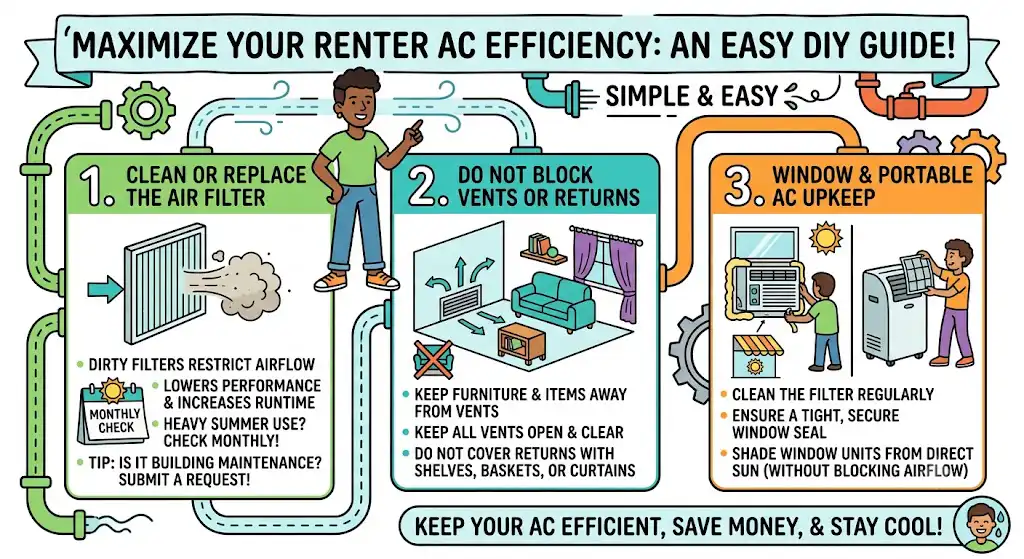
In my experience, this is where a lot of renters lose money without realizing it.
1) Change or clean the air filter
A dirty filter restricts airflow. Restricted airflow lowers performance and can increase runtime.
- During heavy summer use, check it monthly.
- If you have building maintenance, submit a request. It’s often their responsibility.
2) Do not block vents or returns
I see furniture pushed against supply vents constantly. Your system needs airflow.
- Keep vents open and clear.
- Do not cover returns with shelves, baskets, or curtains.
3) Window unit or portable AC upkeep
- Clean the filter.
- Make sure the unit is sealed tightly in the window.
- If the back of a window unit is in direct sun all day, shading it (without blocking airflow) can help.
Hot water: the sneaky part of summer electric bills
Water heating is a year round cost. The U.S. Department of Energy notes water heating can be around 18% of home energy use.
If you control your water heater (some apartments do, many don’t):
- Set it to 120°F. The Consumer Product Safety Commission recommends no higher than 120°F to reduce scald risk, and DOE estimates this can save money annually.
If you do not control it:
- Take slightly shorter showers.
- Wash clothes in cold water when possible.
- Fix dripping hot water faucets fast (maintenance request).
Lighting and plug loads (small changes that stack up)
LEDs
DOE estimates the average home can save significant money annually by switching to LEDs, and they also reduce heat compared to incandescents.
Smart power strips
If you’ve got a TV setup, gaming console, speakers, and streaming device, standby power is real. A smart strip can shut off accessories when the main device turns off.
Laptop instead of desktop (when you can)
Desktops plus monitors can throw noticeable heat into a small room.
Know what’s costing you: a simple way to estimate AC cost
If you want to stop guessing, here’s a quick calculation I use.
Cost per day = (Watts ÷ 1000) × hours used × your electricity rate
Example:
- Portable AC: 1,200 watts
- Runs: 8 hours/day
- Rate: $0.20 per kWh
Daily cost = (1200 ÷ 1000) × 8 × 0.20 = $1.92/day
That’s about $58/month if that pattern stays consistent.
Do this for your AC, then you’ll know exactly why small thermostat adjustments matter.
If you can talk to your landlord, these upgrades are worth requesting
Even if you’re renting, you can often request improvements. I’ve seen plenty of property managers say yes when the request is reasonable and safety focused.
High impact requests
- Install a programmable or smart thermostat (if compatible)
- Service the AC system before peak summer
- Replace damaged window seals or weatherstripping
- Add or repair attic insulation (top floor units suffer most)
- Fix doors that don’t seal properly
When you submit the request, frame it as:
- comfort and humidity control
- preventing equipment strain
- reducing risk of breakdowns during heat waves
Summer savings checklist (quick reference)
| Action | Cost | Landlord needed | Expected impact |
|---|---|---|---|
| Raise thermostat 1 to 3°F + use a fan | $ | No | High |
| Seal window AC gaps and door drafts | $ | No | High |
| Blackout curtains or reflective film | $ to $$ | No | High |
| Replace dirty HVAC filter | $ | Sometimes | Medium to high |
| Shift laundry, dishwasher, cooking to evening | $ | No | Medium |
| Switch to LED bulbs | $ | No | Medium |
| Reduce shower time, cold wash laundry | $ | No | Low to medium |
Common mistakes I see renters make (that cost real money)
- Setting the thermostat super low thinking it cools faster
It doesn’t cool faster. It just runs longer. - Leaving fans on in empty rooms
Comfort benefit goes to nobody, but you still pay. - Running the oven at 6 pm on the hottest day of the week
You’re adding heat right when the grid is stressed and your apartment is already warm. - Ignoring window unit gaps
I’ve seen gaps big enough to fit a finger through. That is basically an open window.
Frequently asked questions
What temperature should I set my AC to in summer to save money in an apartment?
Most people land in the 76 to 78°F range when home if they use fans and block sunlight. DOE’s commonly cited recommendation is 78°F when home, warmer when away.
Is it cheaper to leave the AC on all day or turn it off when I leave?
It depends on how long you’re gone and how hot your apartment gets. In many apartments, the sweet spot is setting it higher while you’re away (like 82 to 85°F) instead of turning it completely off, then bringing it down before you return.
Do blackout curtains really help with electric bills?
Yes, especially on west and south facing windows. Keeping solar heat out reduces how hard and how long your AC runs.
Will a dehumidifier raise my bill?
It can, but in humid apartments it may still save money overall if it lets you raise the thermostat a couple degrees while staying comfortable.
My recommended order of attack (if you want the fastest results)
- Thermostat up 1 to 2°F, add a fan in the rooms you occupy
- Seal door drafts and window AC gaps
- Block afternoon sun with curtains or reflective film
- Shift cooking and laundry to cooler hours
- Filter and airflow check