

Hi, I’m Nathan. I’ve worked as an HVAC technician for over 10 years, and this is one of the most common thermostat questions I hear every winter:
You set your thermostat to Heat, but then you notice another fan option: Auto or On. Which one should you use?
In most homes, for the heating season, I recommend Auto. But there are a few important exceptions where On (or a newer “Circulate” option) can genuinely improve comfort or air quality.
Below is the exact way I explain it to homeowners at the thermostat, in plain language.
- Quick answer (what I recommend for most homes)
- What Auto and On actually control (simple explanation)
- Auto vs On for heat: side-by-side comparison
- The biggest difference in winter: cost and comfort
- Air quality and filtration: when Fan On actually helps
- One winter complaint I hear all the time with Fan On
- Duct leakage: a hidden reason Auto often wins
- Does Auto wear out the fan faster because it starts and stops?
- The best “middle ground”: Circulate mode (if your thermostat has it)
- My recommendations by situation (what I’d tell you at your thermostat)
- What about smart thermostats and savings?
- Simple “try this” strategy (practical and homeowner-friendly)
- FAQ
- Bottom line (my honest HVAC tech take)
Quick answer (what I recommend for most homes)
- Best for most people in winter: Fan = Auto
- Lower energy use
- Less duct leakage loss
- Less wear from constant runtime
- Use Fan = On only if you have a specific reason.
- You need constant air mixing to fix hot and cold rooms.
- You run a high performance filter or air cleaner and want more filtration time.
- You have a variable speed (ECM) blower, and you understand the added runtime cost.
What Auto and On actually control (simple explanation)

Your thermostat has two separate jobs:
- Heat setting tells the system when to heat.
- Fan setting (Auto vs On) tells the blower fan when to run.
Auto (fan runs only during heating calls)
When the furnace (or heat pump) is actively heating, the blower runs. When the thermostat is satisfied, the system shuts off, and the fan stops.
On (fan runs constantly)
The blower runs all the time, even when the system is not heating.
That’s it. Same heat setting, different fan behavior.
Auto vs On for heat: side-by-side comparison
Here’s how it usually plays out in real homes I service.
| Energy use | Lower | Higher (fan runs 24/7) |
| Comfort consistency | Can have slight temperature swings | More even temps room-to-room |
| Air filtration time | Less | More (air passes filter more often) |
| Noise | Quieter | More fan noise (constant) |
| Filter replacement | Normal | More frequent (more airflow hours) |
| Equipment wear | Normal | More runtime on blower motor and controls |
| Drafty feeling from vents | Less | More common between heat cycles |
The biggest difference in winter: cost and comfort

1) Energy cost: An auto is almost always cheaper
Even though a blower fan isn’t as power-hungry as electric heat strips, it still uses electricity every hour it runs.
In the field, I commonly see blower motors drawing something like:
- Older PSC blower motors: often higher power draw
- Newer ECM variable-speed motors: generally lower power draw, especially at low speed
That’s why some homes notice a real bump in the power bill when switching to Fan On.
A competitor example you provided mentions up to about $50/month in some situations for a constant fan. That can be realistic, especially with older blower motors, higher electricity rates, or higher fan speeds.
Simple cost example (easy math)
If your blower averages 400 watts while running:
- 0.4 kW x 24 hours/day x 30 days = 288 kWh/month
Then multiply by your electric rate (for example, $0.15/kWh): - 288 x 0.15 = $43.20/month
Your numbers may be lower or higher, but the point is this: Fan On can add noticeable cost, especially in winter when you might already be paying more for heating.
2) Comfort: One can reduce hot and cold spots
This is the best reason to use Fan On in the heating season.
If you have:
- A two-story home where upstairs runs warmer
- A bonus room over the garage that’s colder
- Long duct runs that struggle to balance.
A constant fan can keep air moving and make temperatures feel more even.
That said, it’s not a magic fix. If a room is consistently 6 to 10 degrees off, I usually find one (or more) of these:
- Duct sizing or balance issues
- Poor insulation or air leaks
- Closed or blocked returns
- Weak airflow due to a dirty filter, a blower issue, or a coil issue
Fan On can mask these problems, but it rarely solves the root cause.
Air quality and filtration: when Fan On actually helps
This part matters if you or someone in your home deals with allergies, asthma, or lots of dust.
When the blower runs, your air passes through your HVAC filter (and any air cleaner you have). So yes, more fan runtime can mean more filtration time.
But here’s what I tell homeowners in person:
- If you’re using a basic 1-inch filter, running the fan nonstop can load it faster.
- If you have a media filter, HEPA bypass, or electronic air cleaner, extra runtime can be more beneficial.
What to expect with filters if you run Fan On
| 1-inch fiberglass or pleated | Clogs faster, may need more frequent changes |
| 4-inch media filter | Handles added runtime better, still check more often |
| Whole-home air cleaner | More runtime can improve results (when installed and maintained correctly) |
My practical advice: if you switch to Fan On, check your filter sooner than usual the first month. Don’t guess. Look at it.
One winter complaint I hear all the time with Fan On
“It feels like cold air is blowing from the vents.”
In heating season, when the furnace isn’t actively heating, the ducts can cool off. If the fan keeps running, it will move air that feels cool compared to your body temperature.
It may not actually be “cold,” it’s just not being heated at that moment. But comfort is comfort, and if it bothers you, Auto is usually the fix.
Duct leakage: a hidden reason Auto often wins
Most duct systems leak at least a little, especially in older homes.
One stat commonly referenced in the industry (including from Energy Vanguard) is roughly:
- about 10 percent supply leakage
- about 12 percent return leakage
If your fan runs constantly, you’re pushing and pulling air through that duct system constantly too. That can mean more:
- wasted heated air
- infiltration from attics, crawlspaces, or wall cavities
- dust pulled into the system (especially on leaky returns)
So if you suspect duct leaks, Fan Auto is usually the safer choice until leakage is sealed and airflow is verified.
Does Auto wear out the fan faster because it starts and stops?
You’ll see this claim online both ways.
Here’s how I explain it based on what I’ve seen in the field:
- In Auto, the motor cycles more often, but it also gets plenty of rest time.
- In On, the motor runs many more total hours.
In real life, I replace plenty of blower motors that ran a lot of hours. So I don’t consider “On is easier on the fan” a universal truth. Total runtime matters.
If you’re worried about wear, the better answer is:
- Keep filters clean
- Keep airflow correct
- Have the blower and capacitor (if applicable) checked during maintenance
The best “middle ground”: Circulate mode (if your thermostat has it)
Many newer thermostats offer a Circulate (or similar) option. This runs the fan at intervals, like:
- a certain number of minutes per hour
- or intermittent mixing cycles
This can help with:
- temperature balancing
- gentle air cleaning
- less cost than a 24/7 fan
If you tell me you want better air mixing, but you don’t want a big bill increase, Circulate is usually my first choice.
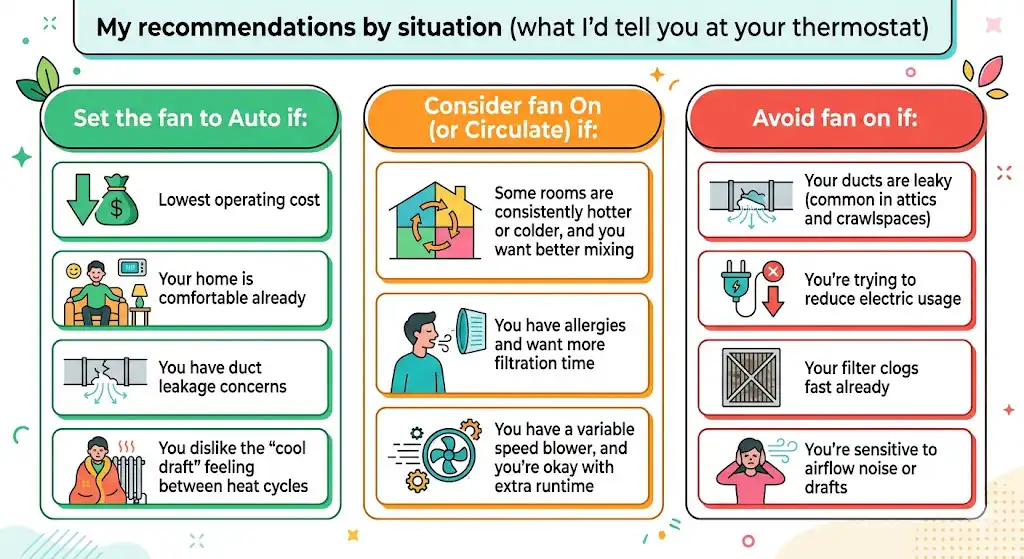
My recommendations by situation (what I’d tell you at your thermostat)
Set the fan to Auto if:
- You want the lowest operating cost.
- Your home is comfortable already.
- You have duct leakage concerns.
- You dislike the “cool draft” feeling between heat cycles.
Consider fan On (or Circulate) if:
- Some rooms are consistently hotter or colder, and you want better mixing.
- You have allergies and want more filtration time.
- You have a variable speed blower, and you’re okay with extra runtime.
Avoid fan on if:
- Your ducts are leaky (common in attics and crawlspaces)
- You’re trying to reduce electric usage.
- Your filter clogs fast already.
- You’re sensitive to airflow noise or drafts.
What about smart thermostats and savings?
Smart thermostats don’t just change Auto vs On. The real benefit is better scheduling and less wasted runtime.
A commonly cited benchmark is that smart or programmable thermostats can reduce heating and cooling costs by up to about 10 percent per year when used correctly.
Those savings usually come from:
- setback temperatures while sleeping or away
- smarter recovery timing
- less “manual fiddling” that keeps systems running longer than needed
If you’re interested, I typically recommend using smart features to optimize runtime first, before relying on Fan On to solve comfort issues.
Simple “try this” strategy (practical and homeowner-friendly)
If you’re not sure what you prefer, here’s a strategy I’ve seen work well:
- Run Fan Auto for one week
Note comfort, temperature differences, and utility usage. - Run Fan On (or Circulate) for 3 to 5 days
Pay attention to:- Does the house feel more even?
- Do you notice drafts from vents?
- Does it get noisier?
- How does the filter look?
- Pick the setting that matches your goal:
- Comfort evenness: On or Circulate
- Lowest cost and quietest: Auto
FAQ
Is Auto or On better for a heat pump?
Most heat pump setups do best on Auto, unless you’re addressing comfort balancing. With heat pumps, airflow and duct balance are especially important, so if you feel uneven temps, I’d rather verify airflow and duct design than just run the fan 24/7.
Will Fan On make my house warmer?
Not directly. It can make temperatures feel more even, but it does not create more heat. Heat comes from the furnace burner, heat exchanger, or heat pump compressor and backup heat.
Does Fan On improve indoor air quality?
It can, but only if:
- You have a decent filter and change it on time
- The duct system is reasonably sealed
- the system is clean and properly maintained
If your ducts are leaky or your filter is low quality, Fan On can sometimes move more dust around.
Bottom line (my honest HVAC tech take)
If you ask me, “Nathan, should my thermostat fan be on Auto or On for heat?” my default answer is:
Use Auto unless you have a specific comfort or air quality reason to run the fan more.


