

I’m John, and I’ve worked as an HVAC technician for over 10 years. If there’s one “small” maintenance item I’ve seen cause the biggest chain reaction of comfort problems, high utility bills, and breakdowns, it’s a neglected air filter.
Most homeowners don’t ignore their filter on purpose. It’s just out of sight, and your system often keeps running even when the filter is getting packed with dust. But “still running” and “running efficiently” are two very different things.
Here’s the honest answer.
The quick answer
- Most homes should change the HVAC air filter every 60 to 90 days.
- Homes with pets, allergies, or heavy HVAC use should change it every 30 to 60 days.
- 1-inch basic fiberglass filters: usually every 30 days
- 4 to 5-inch media filters: often every 6 to 12 months
- During wildfire smoke or construction dust: check weekly and replace as needed.
If you want the most reliable routine, check your filter every month. The calendar is helpful, but the filter’s condition is the truth.
Why changing your HVAC filter matters more than most people think
Your filter has two jobs:
- Protect your HVAC equipment from dust buildup.
- Reduce airborne particles that circulate through your home.
When the filter loads up, airflow drops. Then your system starts compensating by running longer and harder.
What I see in the field when filters are ignored
- Hot or cold rooms, because airflow is restricted
- Noisy returns and whistling grilles (high static pressure)
- Frozen AC coils in summer
- Overheated furnaces or short cycling in winter
- Dust streaking around vents and returns.
The money side (real stats)
- The U.S. Department of Energy estimates that replacing a dirty filter can reduce energy use by 5 to 15 percent in many situations.
- Multiple indoor references, including EPA guidance, commonly note that indoor air can be 2 to 5 times more polluted than outdoor air, depending on the home and activities.
A filter is cheap. Running your system under strain is not.
A simple rule that works: match the schedule to your filter thickness
A lot of “how often” depends on what you installed last time. Thickness matters because thicker filters generally have more surface area and can hold more dust before airflow drops.
HVAC filter change frequency by type and thickness
| 1-inch fiberglass (flat, cheap) | Every 30 days | Clogs fast, weak filtration |
| 1-inch pleated (most common) | Every 30 to 90 days | Most homes land at 45 to 60 days |
| 2-inch pleated | Every 60 to 120 days | Good balance if your system accepts it |
| 4-inch media cabinet filter | Every 6 to 12 months | Great for airflow and dust holding |
| 5-inch media filter | Every 6 to 12 months (sometimes longer) | Often best “set it and remember it” option |
| Washable filter | Clean about every 30 to 90 days | Only works if you actually clean it thoroughly |
Important: The package might say “lasts 90 days” or “lasts 12 months.” That’s under ideal conditions. Your house is real life.
The 6 biggest factors that change your schedule
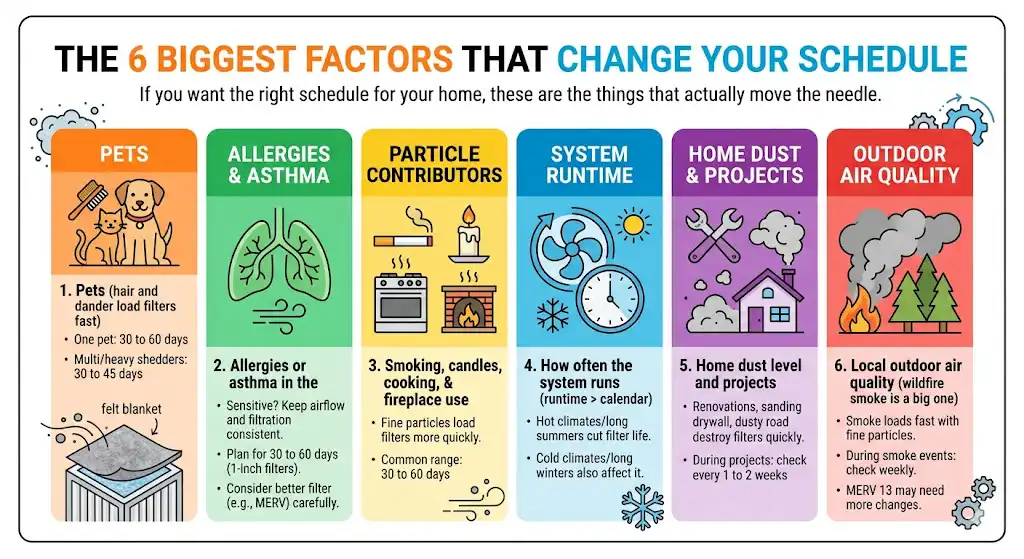
If you want the right schedule for your home, these are the things that actually move the needle.
1. Pets (hair and dander load filters fast)
- One pet: often every 30 to 60 days
- Two or more pets, or heavy shedders: often every 30 to 45 days
I’ve pulled filters that looked like felt blankets after 5 weeks in homes with multiple dogs.
2. Allergies or asthma in the home
If anyone is sensitive, you want consistent airflow and filtration.
- Plan for 30 to 60 days on 1-inch filters.
- Consider a better filter (more on MERV below), but don’t over-restrict airflow.
3. Smoking, candles, cooking, and fireplace use
These add fine particles that load filters more quickly.
- Common range: 30 to 60 days
4. How often the system runs (runtime matters more than the calendar)
- Hot climates and long summers can cut filter life in half.
- Same for cold climates with long heating seasons.
5. Home dust level and projects
Renovations, sanding drywall, cutting wood, or even a dusty road nearby can destroy a filter quickly.
- During projects: check every 1 to 2 weeks
6. Local outdoor air quality (wildfire smoke is a big one)
When smoke is present, the filter can load fast with fine particles.
- During smoke events: check weekly
- If you’re using MERV 13, you may need more frequent changes because it captures more.
My “most homes” recommendation (easy decision table)
Use this table to set your baseline, then adjust if the filter looks dirty sooner.
| No pets, no allergies, average home | Every 60 to 90 days |
| 1 pet | Every 45 to 60 days |
| Multiple pets | Every 30 to 45 days |
| Allergies or asthma in the home | Every 30 to 60 days |
| Smoking indoors or lots of candles | Every 30 to 60 days |
| New baby or high sensitivity household | Every 30 to 45 days |
| Vacation home, very low occupancy | Every 6 to 12 months (still inspect) |
| Wildfire smoke or nearby construction | Inspect weekly, replace as needed |
If you want the simplest habit, check it on the first of every month. Replace it when it’s dirty, even if it “has time left.”
A seasonal filter-change calendar (what I personally follow)
This is a practical rhythm that matches how HVAC systems actually get used.
Spring (pollen season)
- Check at the start of spring.
- Recheck 30 days later.
- Many homes need a swap in this window, especially with allergies.
Summer (heavy AC use)
- Check every 30 to 60 days.
- If your AC runs daily, assume the shorter end.
Fall (ragweed, dust, back-to-school traffic)
- Check at the start of fall.
- Replace if you see buildup or if you’ve had windows open often.
Winter (closed windows, furnace runtime)
- Check at the start of the heating season.
- Recheck mid-winter
Wildfire smoke (any season)
- Check weekly
How to tell your HVAC filter needs changing (not guessing, actual signs)
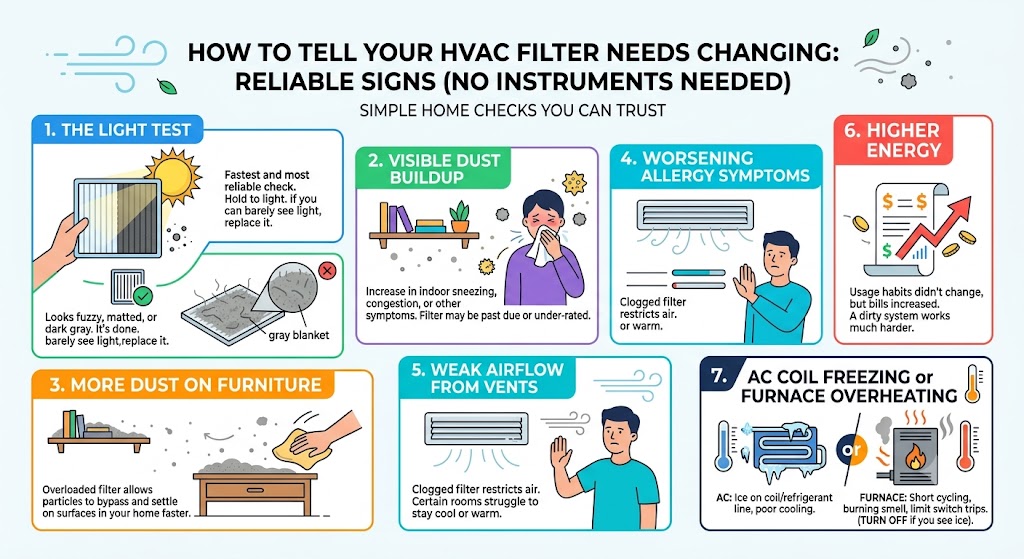
You don’t need instruments to do a solid check at home. Here are the signs I trust.
1. The light test (fastest and most reliable)
Hold the filter up to a bright light.
- If you can barely see light through it, replace it.
2. Visible dust and “gray blanket” buildup
If the filter looks fuzzy, matted, or dark gray, it’s done.
3. More dust on furniture, faster
When the filter is overloaded, more particulate matter ends up back in the home.
4. Allergy symptoms are getting worse indoors
If sneezing and congestion spike at home, your filter may be past due (or under-rated for your needs).
5. Weak airflow from vents
A clogged filter can reduce airflow enough that certain rooms struggle.
6. Higher energy bills with the same habits
If usage patterns didn’t change but the bill did, a dirty filter is one of the first things I check.
7. AC coil freezing or furnace overheating symptoms
- AC: ice on the refrigerant line or indoor coil, poor cooling
- Furnace: short cycling, burning smell, limit switch trips
If you see ice, turn the system off and address airflow first. A filter is often part of that.
What happens if you wait too long (real consequences, I see)
A dirty filter doesn’t just make air “less clean.” It changes how the entire system operates.
1. Lower efficiency and higher bills
Again, DOE commonly cites 5 to 15 percent efficiency improvement after replacing a dirty filter in many systems.
2. More wear on blower motors and components
Restricted airflow increases static pressure. The blower has to work harder to move air, which adds stress over time.
3. Comfort problems and longer run times
You feel it as:
- uneven temperatures
- The system runs “all day.”
- sticky humidity in summer
4. Costly repairs or even early replacement
Repair costs vary wildly by region and system, but it’s not unusual to see:
- smaller repairs in the hundreds
- major repairs are climbing into the thousands
- full system replacements in the many-thousands range
Most of those bills are a lot bigger than a filter.
Choosing the right HVAC filter (MERV ratings without the confusion)
MERV means Minimum Efficiency Reporting Value. Higher MERV captures smaller particles, but it can also restrict airflow if your system isn’t designed for it.
Here’s the balance I aim for when I’m advising homeowners: good filtration without choking the system.
Practical MERV guide for most homes
| 1 to 4 | Large dust, lint | Bare-minimum filtration |
| 5 to 8 | Better dust, some mold spores, pet dander | Many standard homes |
| 9 to 12 | Finer dust, more allergens | Homes wanting better air quality |
| 13 | Smoke particles, many bacteria-sized particles | Wildfire smoke, higher sensitivity households (only if system supports it) |
| HEPA (separate system) | Very high capture (medical-grade levels) | Usually requires dedicated equipment, not a standard 1-inch slot |
My recommendation (most systems)
- MERV 8 to 11 is a strong “sweet spot” for many residential systems.
- MERV 13 can be excellent in the right setup, but I always want to confirm the system can handle the added resistance.
How to change your HVAC air filter the right way (step-by-step)
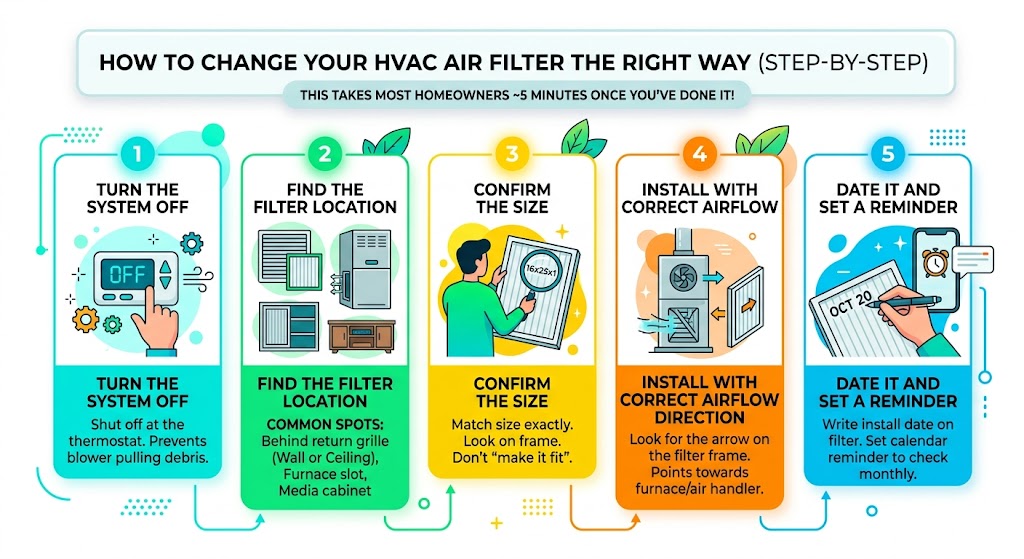
This takes most homeowners 5 minutes once you’ve done it once.
Step 1: Turn the system off
You can shut it off at the thermostat. This prevents the blower from pulling debris around while the slot is open.
Step 2: Find the filter location
Common spots:
- Behind a return grille (wall or ceiling)
- In a slot next to the furnace or air handler
- Inside a media cabinet (usually 4 to 5-inch thick filters)
Step 3: Confirm the size
The size is printed on the frame, like 16x25x1.
- Match the size exactly.
- Don’t “make it fit.” Air will bypass if it’s wrong.
Step 4: Install with airflow direction correct
Look for the arrow on the filter frame.
- The arrow should point toward the furnace or air handler (the direction the air flows).
Step 5: Date it and set a reminder
Write the install date on the filter frame.
Then set a calendar reminder to check it monthly.
Frequently asked questions
How often should I change my HVAC filter if I have pets?
Most pet homes should plan on every 30 to 60 days, and heavy shedding or multiple pets often means 30 to 45 days.
Do air filters really last 3 months?
Sometimes. A typical 1-inch pleated filter can last up to 90 days in a low-dust home with no pets. In many real homes, it’s closer to 45 to 60 days.
Is it okay to run HVAC without a filter?
No. I don’t recommend it. Without a filter, dust can coat the blower wheel and indoor coil fast, hurting performance and potentially leading to expensive cleaning or repairs.
Is a dirty filter better than no filter?
A dirty filter is still not good, but in general, it’s usually better than no filter because it still blocks some debris. The right answer is to replace it.
Do expensive filters last longer?
Often, yes, because thicker and higher-quality filters can have more surface area. But “higher filtration” can also mean it loads faster. The real win is choosing a filter your system can breathe through and then changing it on time.
My bottom-line recommendation (the schedule that prevents most HVAC problems)
If you want the simplest plan that works for almost everyone:
- Check your filter every month.
- Replace it every 60 to 90 days in a typical home.
- Replace it every 30 to 60 days if you have pets, allergies, smoke, or heavy system runtime.
- If the filter fails the light test, replace it immediately.