
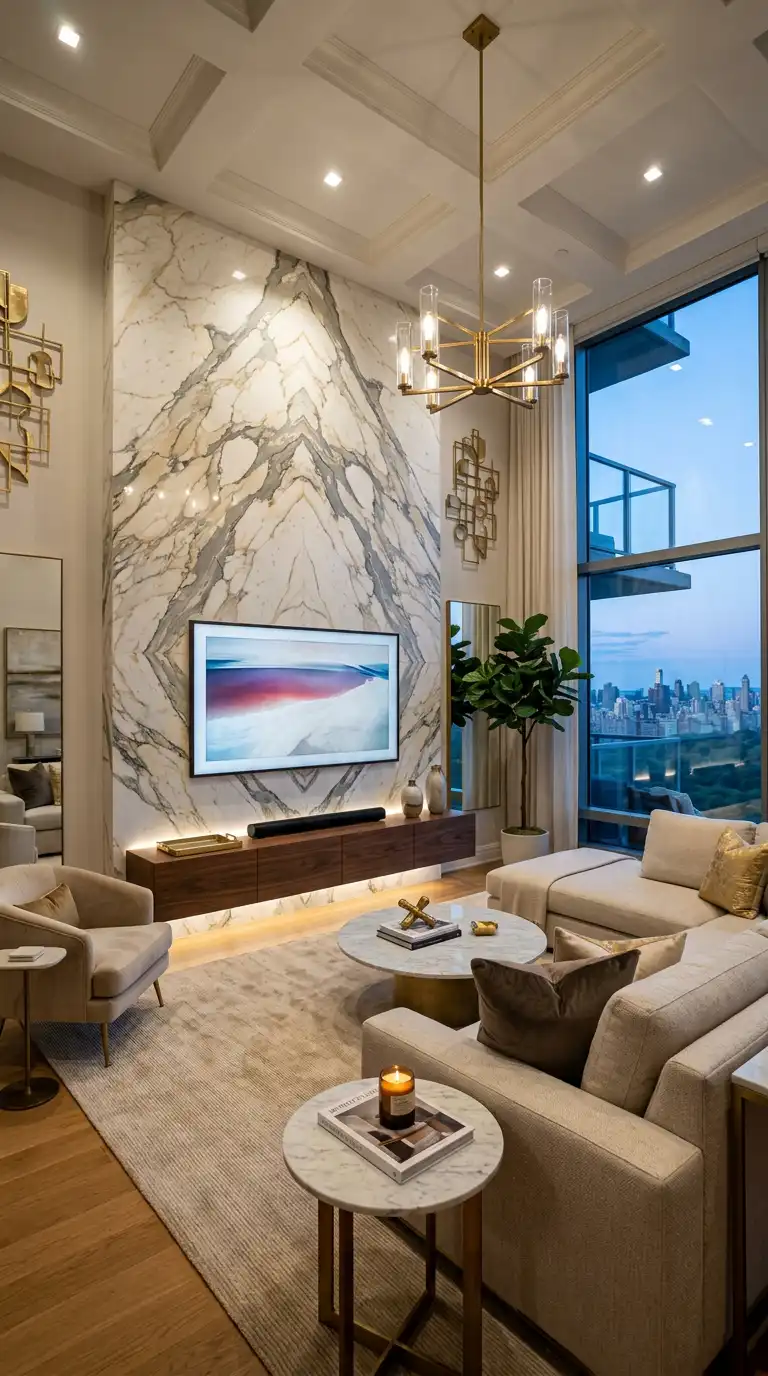
Let me ask you something — have you ever walked into a living room and felt your jaw drop because of one single wall? Not the furniture, not the lighting, not even that fancy rug everyone keeps talking about.
Just one wall that completely transformed the entire space into something magazine-worthy. Yeah, I’ve been there too, and honestly, it’s a feeling that never gets old.
Accent walls have this magical ability to anchor a room, inject personality, and make your living space feel intentional and curated without requiring you to renovate your entire home.
And when we’re talking about contemporary charm, we’re talking about designs that feel fresh, bold, and effortlessly stylish all at once.
I’ve spent way too many weekends (and I mean way too many) scrolling through design boards, visiting showrooms, and experimenting with my own living room walls to figure out what actually works and what’s just Instagram hype.
So today, I’m sharing 10 spectacular accent wall ideas that genuinely deliver that contemporary wow factor you’re probably craving right now.
Buckle up, because we’re about to completely change the way you think about your living room.
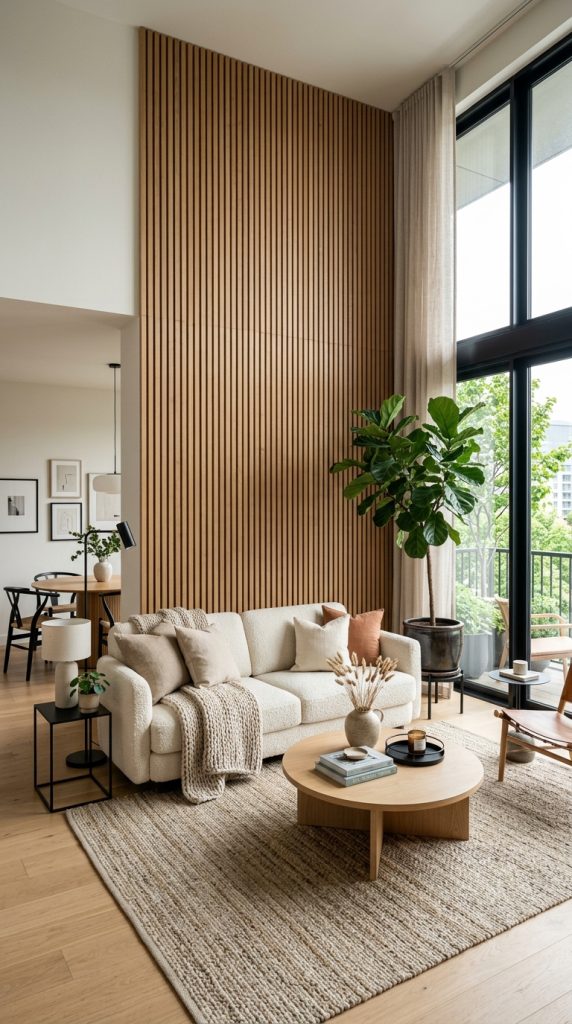
Vertical Wood Slat Accent Wall
Why Vertical Slats Are Having Their Moment
If you’ve been anywhere near a home decor account recently, you’ve seen vertical wood slat walls absolutely everywhere — and honestly? They deserve every bit of attention they’re getting.
This design trend manages to feel both warm and ultra-modern simultaneously, which is a pretty rare combination when you think about it.
Vertical wood slat walls work by creating strong, upward-moving lines that draw your eye toward the ceiling.
This makes your room feel taller without you spending a single dollar on actual construction work. That’s a win I can absolutely get behind.
What Makes This Design Work
The beauty of a vertical wood slat accent wall lies in its versatility. You can go with:
- Natural oak or pine slats for a warm, Scandinavian-inspired look
- Dark walnut or ebony-stained wood for a dramatic, moody contemporary feel
- Painted white or grey slats for a cleaner, more minimalist approach
- Mixed-width slats for added visual texture and depth
The spacing between the slats matters enormously here. Wider gaps create an airy, open feel while tighter spacing delivers a more solid, dramatic impact.
IMO, a gap of about 1.5 to 2 inches tends to hit that perfect sweet spot between modern and cozy.
Personal Take
I tried this in my own living room last year using pre-finished oak slats, and the transformation was genuinely shocking.
My living room ceiling suddenly felt a foot higher. Guests who had visited dozens of times walked in and immediately asked, “Did you move to a new place?” — which is exactly the reaction you want from an accent wall.
Pro tip: Mount your slats over a dark-painted backing wall.
The contrast between the dark paint peeking through the gaps and the natural wood creates incredible depth that photographs beautifully and looks even better in person.
Floor to Ceiling Stone Feature Wall

Go Big or Go Home — Literally
When you commit to a floor-to-ceiling stone feature wall, you’re making a statement that says, “Yes, I absolutely have my life together.”
There’s something undeniably commanding about natural or faux stone stretching from your floor all the way up to your ceiling. It anchors the entire room and immediately establishes a focal point that everything else in the space can work around.
Contemporary stone feature walls work particularly well in living rooms because they introduce natural texture into a space that can sometimes feel too polished or sterile. Stone brings the outdoors in, and in a contemporary setting, that organic quality feels refreshingly human.
Choosing the Right Stone
Not all stone looks the same, and choosing the right type dramatically affects the overall vibe:
- Stacked ledger stone — creates a heavily textured, linear look that feels very modern
- Large format limestone or travertine slabs — delivers a sleek, luxurious contemporary feel
- Slate tiles arranged vertically — adds an architectural quality with natural color variation
- Faux stone panels — perfect for renters or anyone who wants the look without the structural commitment
Real stone is undeniably stunning but requires professional installation and proper wall reinforcement due to its weight. Faux stone panels, on the other hand, have gotten remarkably realistic over the past few years and are significantly easier on your budget and your floor joists.
Styling Around a Stone Wall
A stone wall naturally commands the room, so keep your furniture and decor clean and understated. Think:
- Low-profile sofas in neutral tones
- Simple metallic accents (brushed brass or matte black work brilliantly)
- Minimal throw pillows and minimal clutter
- Strategic lighting that grazes the stone surface and highlights its texture
Warm lighting does particularly beautiful things to stone walls — it creates shadows and highlights that shift throughout the day, making the wall feel almost alive.
3. Moody Charcoal Statement Wall

Dark and Dramatic — But Make It Sophisticated
Let’s talk about the charcoal accent wall, because I know exactly what you’re thinking — “Won’t a dark wall make my room feel smaller and more depressing?” And to that I say: only if you do it wrong.
Done right, a moody charcoal statement wall makes a living room feel deeply sophisticated, cozy, and undeniably contemporary.
The psychological effect of a well-executed charcoal wall is fascinating. It creates a sense of depth that draws your eye into the wall itself, making the room feel layered and intentional rather than flat and boring.
Making Charcoal Work
Here’s what separates a stunning charcoal accent wall from a gloomy mistake:
- Balance it with light-toned furniture — cream, ivory, warm white, or even blush tones create gorgeous contrast
- Use high-sheen paint — a satin or semi-gloss finish on your charcoal wall reflects light and prevents the space from feeling cave-like
- Layer your lighting — floor lamps, table lamps, and sconces on or near the wall all help maintain brightness
- Add metallic accents — gold, brass, or copper accessories absolutely sing against a charcoal background
The specific shade of charcoal matters too. A charcoal with warm undertones (like Farrow & Ball’s Railings) feels cozy and enveloping.
A cooler blue-grey charcoal (like Benjamin Moore’s Wrought Iron) feels more architectural and crisp.
Your choice should depend on whether you want the room to feel warm and intimate or cool and modern.
Why I’m Obsessed With This Look
A friend of mine painted one wall of her living room in a deep charcoal grey and paired it with cream linen sofas and a massive gold-framed mirror.
The result looked like it came straight out of a luxury hotel lobby.
Nobody would guess the paint cost less than $80 total. That’s the power of a confident color choice executed with intentionality.
Also Read: 10 Gorgeous Couches Living Room Aesthetic Decor Ideas – Airlucent
Geometric Painted Accent Wall

Who Said Paint Has to Be Boring?
Here’s where things get really fun. A geometric painted accent wall takes the simplest, most affordable design tool paint and transforms it into a work of art.
We’re talking triangles, hexagons, diamonds, chevrons, or abstract asymmetrical shapes that create a custom mural effect right on your wall.
The contemporary design world absolutely loves geometric patterns because they combine mathematical precision with bold visual energy.
And unlike wallpaper, a painted geometric wall lets you customize every single color, scale, and angle to suit your exact taste.
Planning Your Geometric Design
Before you grab a brush, a little planning goes a long way:
- Sketch your design on graph paper first and determine the scale relative to your wall size
- Use painter’s tape to create crisp, clean lines — this is non-negotiable if you want a professional result
- Choose a cohesive color palette — two to four colors work best; too many colors create visual chaos
- Consider the geometry of your furniture — angular geometric walls pair best with furniture that has clean, contemporary lines
Popular contemporary geometric styles include:
- Large-scale diamond or triangle patterns in two contrasting tones
- Asymmetrical color-blocking that feels artistic rather than rigid
- Herringbone painted patterns using subtle tonal variations
- Half-painted walls with geometric borders for a sophisticated transitional look
The Budget-Friendly Bonus
One of the biggest advantages of a geometric painted accent wall is the cost. You’re looking at paint, tape, and a few hours of your weekend.
The result, however, looks like you paid a professional muralist a significant sum of money. Can’t argue with that kind of value.
Modern Wallpaper Focal Wall
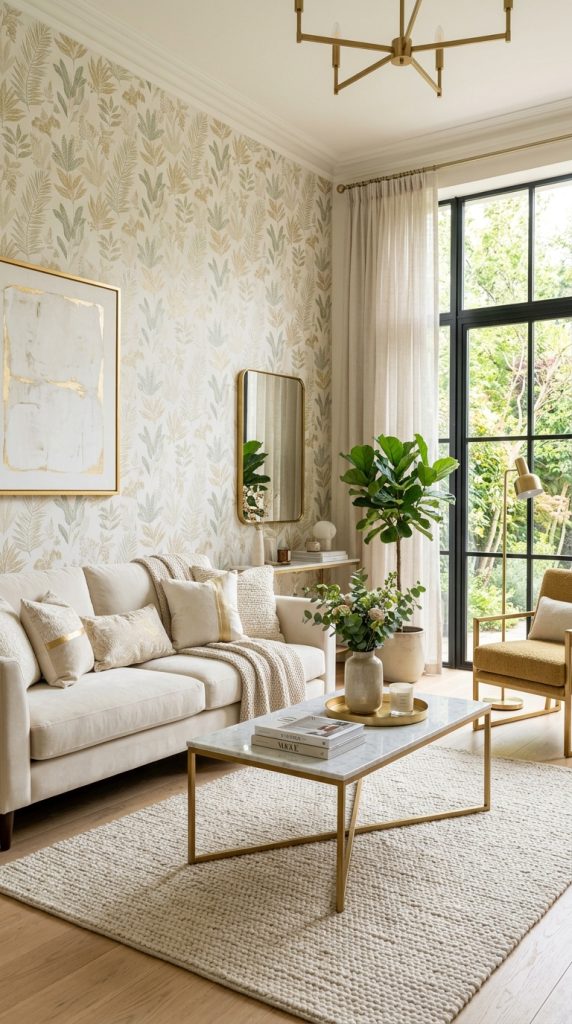
Wallpaper Is Back — and It’s Not Your Grandmother’s Version
FYI — wallpaper has had one of the greatest comebacks in interior design history. The floral, pastel, slightly-terrifying wallpaper of the 1980s is completely gone.
What’s replaced it is absolutely stunning: bold botanical prints, abstract watercolor designs, architectural geometric patterns, and textured grasscloth that adds dimension alongside visual interest.
A modern wallpaper focal wall is arguably the fastest way to add a completely finished, designer-quality look to your living room. One wall, one afternoon, and your room suddenly has a soul.
Choosing Contemporary Wallpaper
The wallpaper market has exploded with contemporary options. Look for:
- Large-scale botanical or jungle prints for an organic, dramatic statement
- Abstract ink or watercolor designs for an artistic, one-of-a-kind feel
- Metallic or textured grasscloth wallpaper for subtle luxury without overwhelming print
- Architectural or trompe-l’oeil designs that mimic real surfaces like concrete, marble, or exposed brick
- Geometric or Art Deco-inspired patterns for a crisp, contemporary edge
Peel-and-stick wallpaper has genuinely improved to the point where it’s now a viable option even for permanent homes — not just rentals.
The installation is dramatically easier, and removal doesn’t damage your walls. For a focal wall where you’re only covering one surface, it’s a completely practical choice.
Built-In Shelving Accent Wall

Function Meets Drop-Dead Beautiful Design
A built-in shelving accent wall is the overachiever of accent wall designs, and I mean that as the highest possible compliment.
It doesn’t just look extraordinary — it actually solves your storage problem at the same time. Two birds, one beautifully designed wall.
Contemporary built-in shelving goes far beyond the basic bookcase. We’re talking floor-to-ceiling architectural installations that frame your television, showcase curated objects, and create a sense of custom craftsmanship that elevates your entire living room aesthetic.
Designing Your Built-In Feature Wall
The most important element of a successful built-in shelving wall is treating it as a cohesive architectural feature rather than just furniture placed against a wall. Here’s how to nail it:
- Paint the shelves and the back wall the same color as your room walls for a seamless, built-in look
- Or paint the back of the shelves a contrasting color or deep accent shade to add depth
- Vary the shelf heights to accommodate books, art objects, and plants at different scales
- Incorporate closed cabinet sections at the bottom to hide the inevitable clutter that accumulates
- Include integrated lighting — LED strip lights inside the shelves create an incredibly polished, gallery-like effect
Styling the Shelves
A built-in shelving wall only looks as good as its styling. Resist the urge to fill every single inch of shelf space. Contemporary styling is about deliberate curation, not maximum capacity. Mix:
- Books (grouped by color or size for visual order)
- Art objects and ceramics
- Small framed photos
- Trailing plants or sculptural dried botanicals
- A few intentional empty spaces for visual breathing room
Also Read: 10 Perfect Earthy Living Room Organic Home Ideas – Airlucent
Luxury Marble TV Accent Wall

Because Your Television Deserves a Better Frame
Let’s be honest — televisions are unavoidable in living rooms, but they’re not exactly beautiful objects when they’re just hanging on a blank white wall.
A luxury marble TV accent wall completely reframes your television as an intentional design element within a stunning backdrop, rather than just a screen mounted awkwardly on paint.
Marble behind a television creates an immediate association with luxury hotel suites and high-end interior design.
And the wonderful thing about contemporary design is that you don’t need real marble to achieve this look.
Real Marble vs. Alternatives
- Real marble slabs — absolutely breathtaking but expensive to source, heavy to install, and requires professional sealing and ongoing maintenance
- Large-format marble-look porcelain tiles — incredibly realistic, highly durable, more affordable, and much easier to install
- Marble-effect wallpaper — an accessible, renter-friendly option that still delivers dramatic visual impact
- Marble vinyl panels — budget-friendly and surprisingly convincing from normal viewing distances
White Carrara marble with its distinctive grey veining delivers a classic, timeless contemporary look. Nero Marquina black marble creates a dramatically moody backdrop. Verde green marble is having a huge moment right now and looks absolutely sensational against natural wood furniture.
Framing the Television
On a marble accent wall, your television essentially becomes an art object within the composition. Enhance this by:
- Mounting the TV flush to the wall with concealed cable management
- Adding floating marble shelves below for your media equipment
- Including sconce lighting on either side that bounces off the marble surface
- Keeping the surrounding furniture low and minimal so the wall breathes
Rustic Reclaimed Wood Feature Wall

Old Wood, New Life, Unbelievable Character
There’s something deeply satisfying about using reclaimed wood in a contemporary space. It’s the design equivalent of telling a great story — every plank of reclaimed timber carries history, imperfection, and character that no new material can replicate.
A rustic reclaimed wood feature wall brings warmth, texture, and a sense of authentic humanity to a living room that might otherwise feel too polished.
The contemporary approach to reclaimed wood is key here. We’re not going full rustic cabin — we’re balancing the raw, organic quality of the wood against clean-lined, modern furniture to create a tension that feels fresh and dynamic.
Sourcing and Installing Reclaimed Wood
You can source reclaimed wood from:
- Architectural salvage yards — often the most affordable and most authentic option
- Specialty reclaimed wood retailers — cleaned, treated, and ready to install
- Old barns, factories, or demolished buildings in your area — if you know someone with connections :/
- Online marketplaces where local sellers offer reclaimed material
When installing, you can create several different effects:
- Horizontal planks in varying widths for a classic shiplap-inspired contemporary look
- Herringbone or chevron pattern for a more geometric, sophisticated arrangement
- Random mixed-length planks that highlight the variation in the wood’s natural character
- Whitewashed reclaimed wood for a coastal contemporary twist
Textured Panel Contemporary Wall

Texture Is the Secret Weapon of Contemporary Design
If you want your living room to feel expensive without necessarily spending a fortune, texture is your best friend.
A textured panel contemporary wall creates visual and tactile depth that makes a space feel curated, layered, and deliberately designed.
And unlike some of the more dramatic accent wall styles, textured panels work beautifully in almost every color scheme.
Types of Textured Panels
The market for wall panels has absolutely exploded in recent years, giving you more options than ever:
- 3D geometric wall panels — typically made from MDF, PVC, or bamboo fiber, these create striking shadow play as light moves across the surface throughout the day
- Fluted or ribbed panels — one of the biggest contemporary design trends right now, these vertical channels create strong linear interest
- Acoustic fabric panels — combine beautiful texture with the practical benefit of sound absorption
- Concrete-look panels — deliver an industrial contemporary vibe with significantly less weight and mess than actual concrete
- Leather or suede-effect panels — for the ultimate in tactile luxury
The real magic of textured panels is how they interact with lighting. A panel that looks interesting in flat, even light becomes absolutely dramatic when you add a directional spotlight or a sconce that grazes the surface at an angle.
The shadows the texture creates shift constantly throughout the day, giving your wall genuine visual dynamism.
Painting Textured Panels
Here’s a trick most people overlook — you can paint over textured panels to create an even more sophisticated result.
Painting 3D panels in a single dark or rich color makes the dimensional effect even more striking because the shadows and highlights become more pronounced. It’s a sleek, contemporary approach that feels very considered.
Also Read: 10 Magnificent Double Height Living Room Showstopping Designs – Airlucent
Arched Accent Wall With Soft Neutrals

The Arch: Ancient Form, Completely Contemporary Feel
You might have noticed that arches have completely taken over contemporary interior design, and honestly, I’m not even a little surprised.
The arched form carries this beautiful tension between classical architecture and modern simplicity that makes it feel simultaneously timeless and incredibly fresh.
An arched accent wall with soft neutrals is perhaps the most elegant entry point into contemporary accent wall design.
This particular approach is also wonderfully accessible. You don’t need expensive materials or professional contractors. A painted arch or a simple built-up arch detail on your wall can achieve extraordinary results with modest effort.
Creating the Arched Accent Wall
There are several approaches to creating an arched accent wall:
- Painted arch — use a pencil, string, and a large level to map out your arch shape, then paint within it using a contrasting or complementary neutral
- Built-up arch detail — use thin MDF strips bent to your arch shape and applied to the wall to create a three-dimensional architectural effect
- Arched alcove creation — frame out a recessed arched space in the wall and treat the interior as your accent feature
- Arched wallpaper panel — apply a panel of wallpaper within an arched shape surrounded by paint for a mixed-media focal point
The Power of Soft Neutrals
The reason this particular combination — arched form plus soft neutrals — works so brilliantly is that soft neutrals let the architectural form be the hero.
You’re not competing with bold color or dramatic pattern. Instead, you’re letting the shape itself do the work.
Beautiful soft neutral choices include:
- Warm terracotta or clay tones
- Dusty sage green
- Soft sand or wheat
- Blush or warm ivory
- Greige (the grey-beige hybrid that contemporary designers absolutely love)
The arch creates focus and drama. The soft neutrals create calm and sophistication. Together, they deliver a result that feels curated, intentional, and deeply contemporary without trying too hard.
Bringing It All Together: How to Choose Your Perfect Accent Wall
Finding Your Style
Now that you’ve seen all ten of these spectacular options, you’re probably wondering how to actually choose the right one for your specific living room. Here’s how I’d approach it:
Start with your existing furniture and flooring:
- Warm wood tones pair beautifully with vertical wood slats, reclaimed wood, and soft arched neutrals
- Cool grey or concrete floors love charcoal statement walls, textured panels, and geometric designs
- Traditional or eclectic furniture mixes work wonderfully with modern wallpaper or marble feature walls
- Minimalist contemporary furniture suits stone feature walls and built-in shelving beautifully
Consider your room’s natural light:
- Dark walls (charcoal, deep marble) work best in rooms with generous natural light
- Textured panels and geometric walls perform brilliantly in any lighting condition
- Soft neutrals and arched walls bring warmth to rooms that lack abundant natural light
Think about your commitment level:
- Painted designs (geometric, charcoal, arched) are the easiest to change if your taste evolves
- Wallpaper is semi-permanent and moderately reversible
- Stone, marble, and built-in shelving represent significant investments in both money and permanence
One Wall, Maximum Impact
The fundamental principle behind all ten of these accent wall ideas is the same: you don’t need to transform your entire room to create a completely different living space. One wall, executed with confidence and intention, can do more for a living room than thousands of dollars spent on new furniture.
The contemporary design world understands this — which is exactly why accent walls continue to dominate interior design conversations, renovation wish lists, and home makeover projects globally.
Final Thoughts: Your Living Room Deserves That Moment
Whether you choose the dramatic presence of a floor-to-ceiling stone wall, the warm sophistication of a vertical wood slat feature, or the elegant restraint of an arched accent wall in soft neutrals — the most important thing is that you actually commit to it.
Half-hearted design decisions produce half-hearted results.
Pick the idea that genuinely excites you, that makes you feel a little nervous because it’s bolder than what you’d normally try.
That’s almost always the right choice. The best accent walls I’ve ever seen — in magazines, in friends’ homes, and yes, in my own living room — came from someone deciding to be genuinely intentional about one single wall.
So go ahead. Choose your wall. Paint it, clad it, panel it, or wallpaper it into something spectacular.
Your living room has been patiently waiting for its moment, and honestly? I think it’s been waiting long enough.
Have you already tackled an accent wall in your living room? Which of these ten ideas speaks to you the most? The best design decisions always start with a conversation — even if that conversation is just you and your paint samples on a Saturday morning.