Let’s be honest — not everyone has the luxury of a sprawling, perfectly designed home with dedicated rooms for everything.
Most of us are working with one big open living space that somehow needs to function as a lounge, a dining area, a workspace, AND occasionally a guest room. Sound familiar? Yeah, I thought so.
The good news? You don’t need to knock down walls or hire an expensive interior designer to create smart, beautiful divisions in your living room.
Budget-friendly partition ideas have come a long way, and some of them look so good that your guests will think you spent a fortune. Spoiler alert: you didn’t.
I’ve personally experimented with a few of these ideas in my own apartment, and let me tell you — the transformation was unreal.
Whether you’re renting, owning, or just desperate to stop seeing your kitchen mess from your couch, this guide is going to be your new best friend. Let’s get into it.
Wooden Slat Living Room Partition Wall

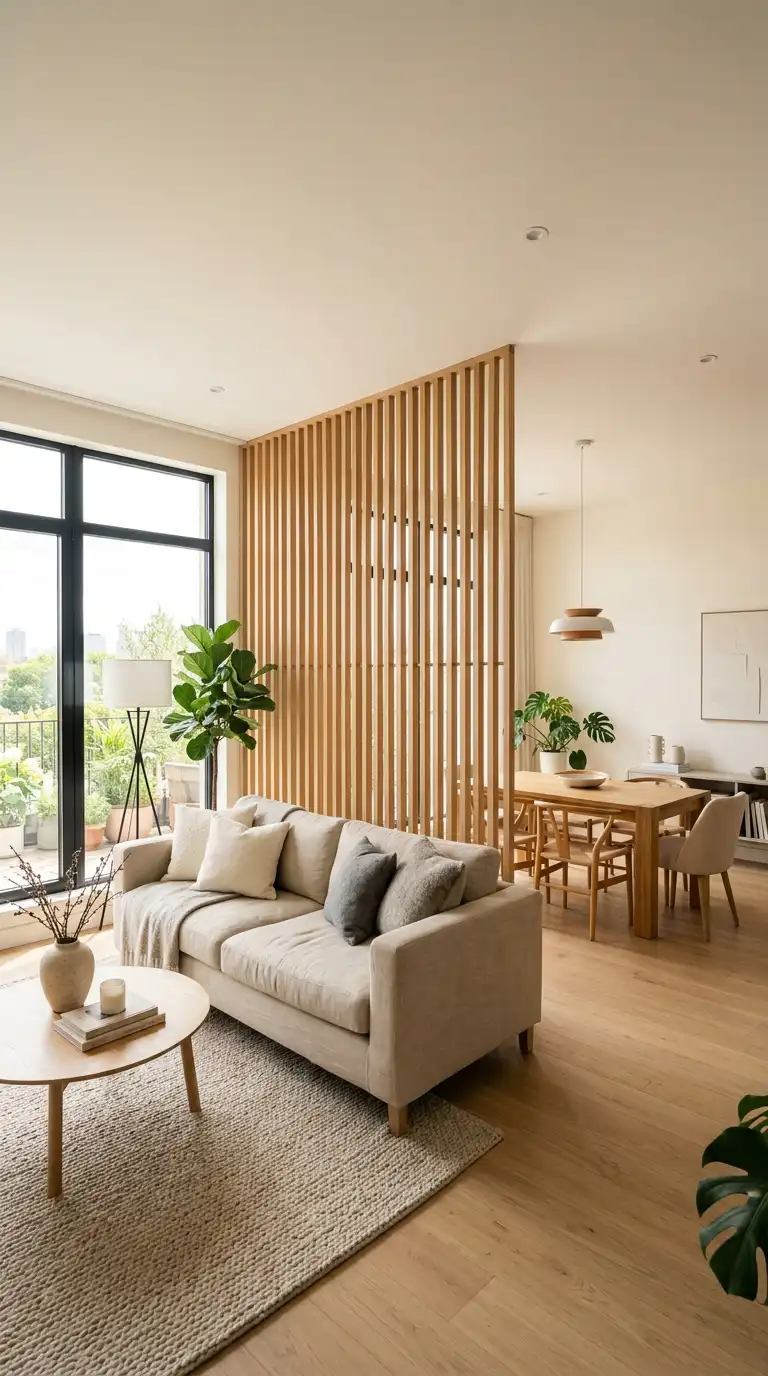
If there’s one partition idea that’s been absolutely everywhere on Pinterest and Instagram lately, it’s the wooden slat partition wall. And honestly? The hype is totally justified.
What Makes It So Popular?
Wooden slat partitions give your living room that warm, textured, organic feel that makes a space look intentionally designed rather than accidentally divided.
They let light pass through the gaps, which means you get the separation without the suffocation. Nobody wants a dark corner of their living room, right?
The best part — you can build a basic version yourself. All you need is:
- Wooden planks or dowels (pick up affordable ones from your local hardware store)
- A floor-to-ceiling frame made from two vertical 2×4 planks
- Wood stain or paint in your chosen color
- Basic tools like a drill and measuring tape
You can space the slats however you like — closer together for more privacy or further apart for a more airy, open look. IMO, spacing them about 2–3 inches apart hits the perfect sweet spot between privacy and openness.
Budget-Friendly Tips
- Buy reclaimed or off-cut wood from lumber yards — it’s cheaper and adds character
- Paint them in a bold color like charcoal or forest green to make a real statement
- If you’re renting, use a free-standing version with a weighted base instead of fixing anything to the ceiling
Wooden slat partitions also double brilliantly as a backdrop for plants, string lights, or even hanging artwork. So you’re getting a partition AND a decorative feature. That’s what I call a two-for-one deal.
Glass Panel Living Room Divider Design
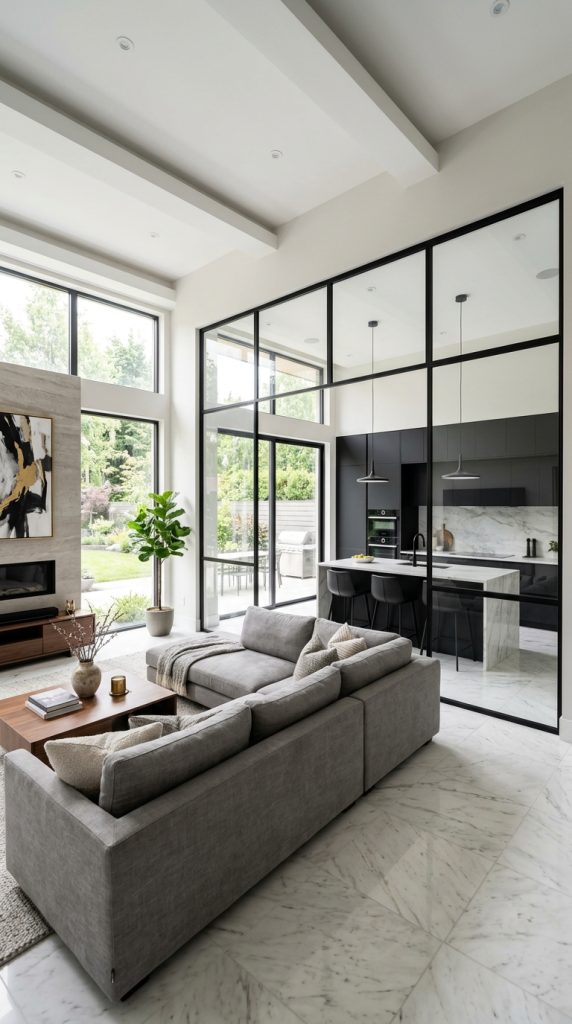
Now, if wood feels too rustic for your taste, let’s talk about the sleek and sophisticated world of glass panel dividers.
These are perfect if you want to define separate zones in your living room without making the space feel smaller or darker.
Why Glass Works So Well
Glass keeps the visual flow of your room completely intact. You can see the entire space, but the psychological and physical separation is still very much there.
It’s like having your cake and eating it too — which, by the way, is my personal philosophy in interior design and in life.
The most budget-friendly approach to glass panel partitions includes:
- Framed glass panels using simple metal or wood frames
- Repurposed old windows — yes, those vintage windows from flea markets or salvage stores make stunning partitions
- Frosted adhesive film applied to cheaper clear panels for privacy without the premium price tag
DIY Glass Panel Ideas
You don’t have to buy custom-made glass panels (unless you want to, of course). Here’s what works great on a budget:
- Pick up pre-made glass door panels from building salvage shops
- Mount them in a simple wooden frame that you build yourself
- Use metal pipe flanges and pipes for an industrial-style frame that looks far more expensive than it is
The industrial metal-and-glass combination, in particular, works beautifully in modern and contemporary living rooms.
It’s sharp, clean, and gives off serious “architect designed this” vibes. Which is exactly what we’re going for.
Open Shelf Living Room Partition Idea
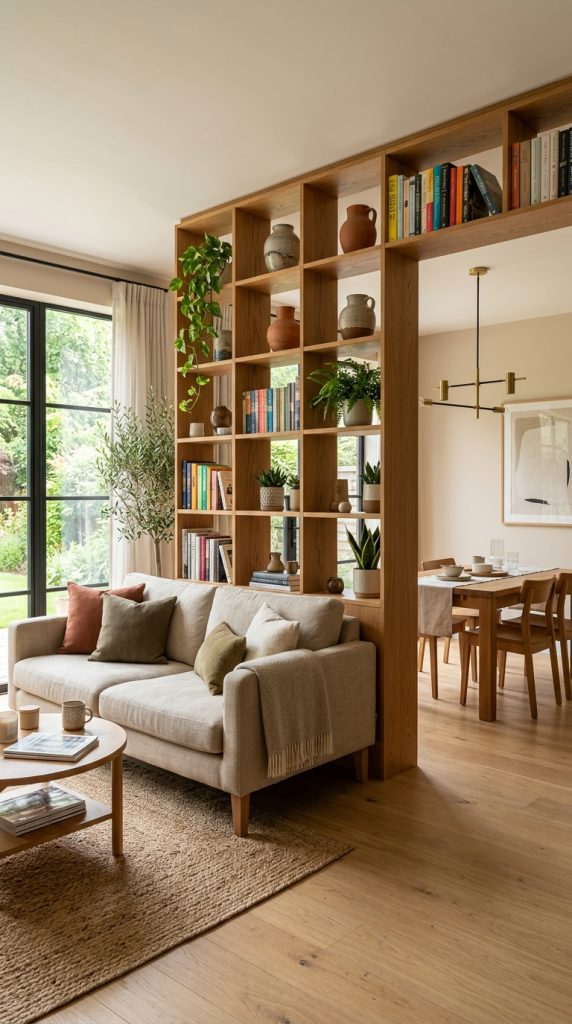
Here’s where things get genuinely exciting — because open shelf partitions don’t just divide your space, they actively make it more functional.
You’re getting storage, display space, AND a room divider all in one. Ever wondered why this idea took so long to become mainstream? Neither have I — it just makes too much sense.
The Genius of Open Shelving as a Partition
A well-placed bookshelf or open shelving unit can transform an awkward open-plan living area into two distinct zones almost instantly.
The key is choosing a unit that’s tall enough to create visual separation but open enough to maintain the flow of light and air.
What you want to think about:
- Height — aim for at least 5–6 feet tall to create a meaningful division
- Depth — standard 12-inch deep shelves work perfectly
- Color — matching the shelf color to your wall color makes it look built-in and intentional
Styling Your Open Shelf Partition
This is where you can really have fun. Style those shelves with a mix of:
- Books (obviously, if you have them)
- Plants — trailing varieties look especially gorgeous
- Decorative objects — think vases, candles, framed photos
- Baskets for hidden storage
The trick is to not overstuff the shelves. Leave some empty space so it feels curated rather than cluttered. A cluttered partition just creates visual chaos, and we’re trying to create calm here, not recreate your college dorm room.
Also Read: 10 Modern Rugs in Living Room: Simple Elegant Touch – Airlucent
Sliding Door Living Room Divider Concept
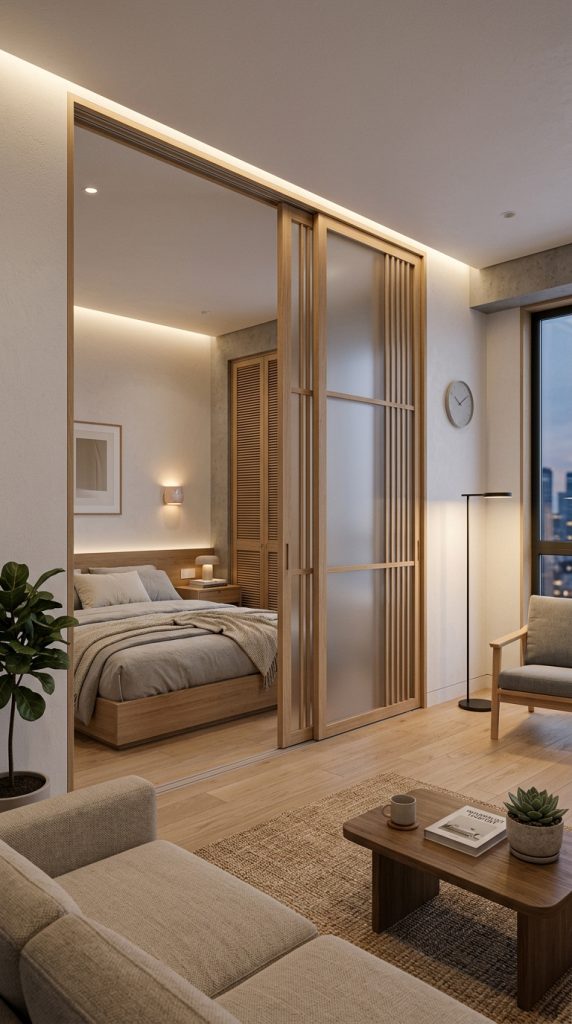
If you want a partition that you can actually close when you need full privacy — like when you’re working from home and someone’s watching TV at maximum volume — then sliding doors are your answer.
Why Sliding Doors Are Brilliant
Sliding doors don’t eat into floor space the way traditional hinged doors do. They glide along a track, which means you can open them fully to create one big unified space or close them completely for total separation. It’s flexible, it’s practical, and it looks incredibly intentional.
Popular sliding door options for living room partitions include:
- Barn doors — rustic, charming, and currently very on-trend
- Shoji-style sliding panels — lightweight rice paper or fabric panels in wooden frames, inspired by Japanese design
- Floor-to-ceiling glass sliding doors — sleek and modern
- Fabric panel sliders — the most budget-friendly option of the lot
Installing on a Budget
You don’t need a contractor for this. A basic barn door hardware kit (widely available online and in home improvement stores) comes with everything you need.
Pair it with a piece of plywood or an old solid door that you paint or stain, and you’ve got yourself a stunning sliding partition for a fraction of the cost of custom work.
FYI: If you’re renting, look for freestanding sliding panel systems that don’t require drilling into walls or ceilings. They exist, they work, and your landlord will never know the difference.
Curtain Style Living Room Partition Setup
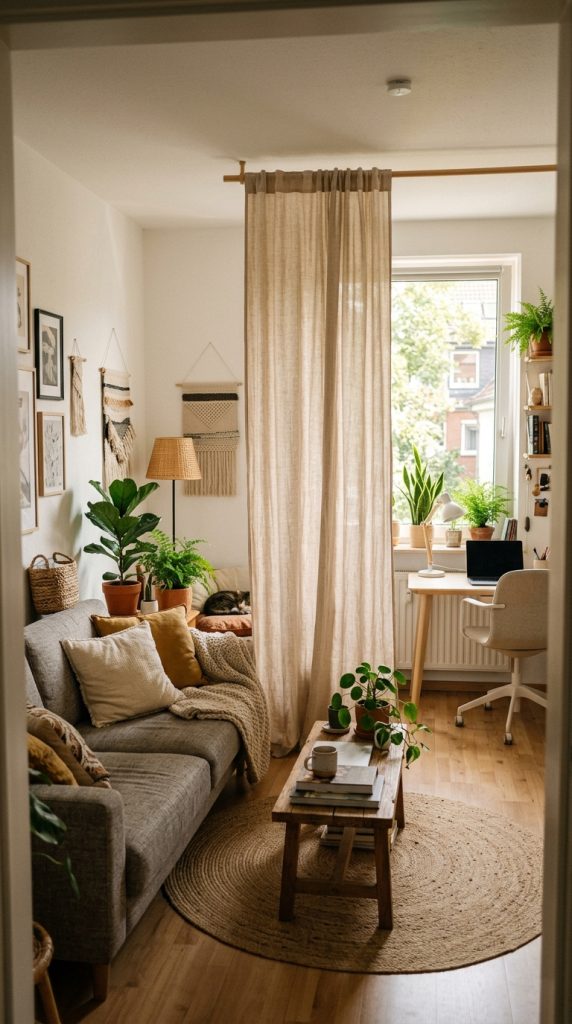
Okay, hear me out before you roll your eyes. Curtains as room dividers have gone way beyond the cheap college apartment look.
When done right, curtain partitions can look absolutely luxurious — and they’re arguably the most budget-friendly option on this entire list.
How to Make Curtain Partitions Look High-End
The secret is all in the execution. Here’s what separates a chic curtain partition from something that looks like a changing room at a department store:
- Hang them HIGH — mount the curtain rod as close to the ceiling as possible
- Choose full-length curtains — they should just graze the floor
- Pick the right fabric — velvet, linen, or heavy cotton drapes look expensive; thin polyester does not
- Use a double rod so you can layer sheer curtains with blackout ones
The Practical Benefits
Beyond aesthetics, curtain partitions offer some genuinely practical advantages:
- Completely adjustable — open them fully or close them as needed
- Sound dampening — thick curtains actually reduce noise between zones
- Easy to change — swap out the fabric with the seasons or when your style evolves
- Rental-friendly — a ceiling-mounted curtain rod does minimal damage
A ceiling-mounted curtain track system (instead of a standard rod) gives the most seamless, architectural look. It’s a small upgrade that makes a massive difference in how polished the finished result looks.
Half Wall Living Room Divider Design
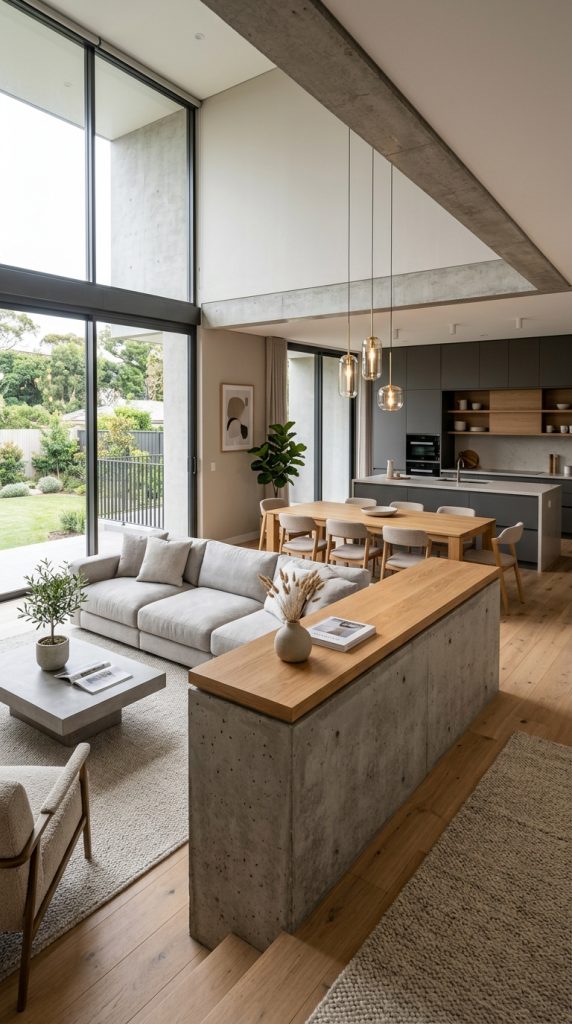
There’s something uniquely satisfying about a half wall partition — it defines your space clearly and permanently, but it doesn’t close anything off. You get the best of both worlds: structure AND openness.
What Exactly Is a Half Wall?
A half wall (sometimes called a pony wall) typically rises to about waist or chest height — usually between 3 and 4 feet tall. It creates a clear visual and physical boundary between two areas without blocking light or making the space feel boxed in.
Half walls work brilliantly between:
- Living room and dining area
- Living room and home office nook
- Living room and entryway
Building One on a Budget
For homeowners comfortable with basic DIY, building a simple half wall is surprisingly achievable. You’ll need:
- 2×4 lumber for the frame
- Drywall for the panels
- Joint compound and paint to finish it off
- A weekend and some patience
Top your half wall with a flat wooden cap to create a natural ledge — perfect for plants, candles, or decorative items.
Or go bold and add a tile or stone cap for a more upscale look. The flexibility in how you finish it means you can make it look completely custom without spending custom money.
Also Read: 10 Captivating Moody Living Room Ideas for Modern Elegance – Airlucent
Vertical Garden Living Room Partition Idea
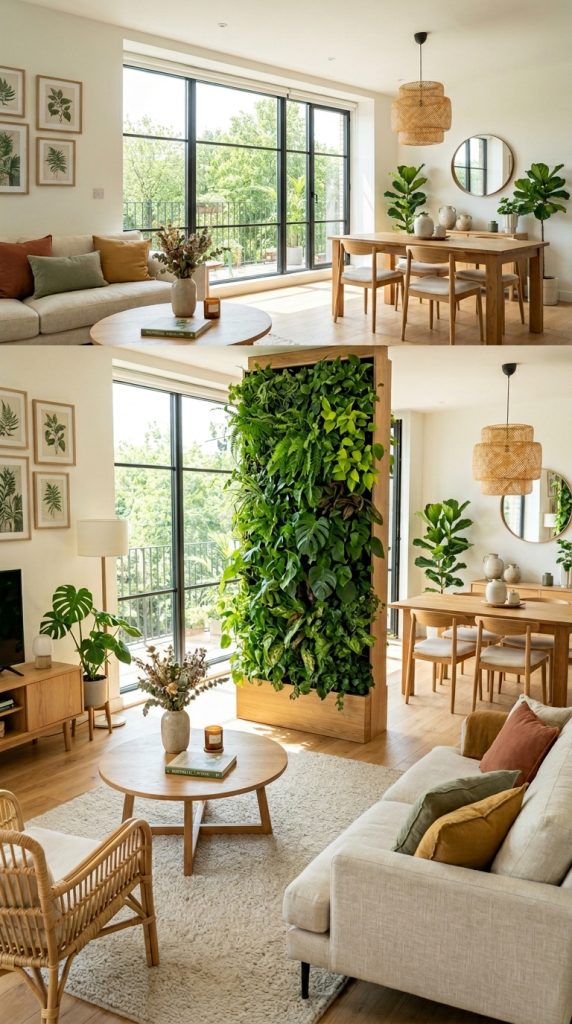
Now THIS is where I personally get a little too excited. A vertical garden partition combines two things I love deeply — beautiful design and the undeniable mood-boosting power of plants.
If you haven’t considered this option yet, let me be the one to change your mind.
How a Vertical Garden Works as a Partition
A vertical garden partition is essentially a freestanding or wall-mounted structure that holds plants — and in doing so, creates a lush, green divider between two zones in your living room.
It’s dramatic. It’s natural. It’s genuinely one of those ideas that stops guests in their tracks.
You can go several routes:
- Freestanding plant stands arranged in a line — affordable and flexible
- Wall-mounted pocket planters on a wooden frame or trellis
- A custom built-in planter frame if you’re feeling ambitious
- Hanging planters on a curtain track for a flowing, organic look
Plants That Work Best
Not every plant thrives indoors, so choose wisely:
- Pothos — practically indestructible and trails beautifully
- Philodendrons — lush, leafy, and low-maintenance
- Boston ferns — dramatic and full
- Snake plants — structural and incredibly hardy
- Peace lilies — beautiful flowers, low light tolerance
The maintenance is the only honest downside here — you will need to water these regularly. But if plants make you happy (and research says they genuinely improve your mental health), that’s a small trade-off for something this beautiful.
Metal Frame Living Room Divider Style
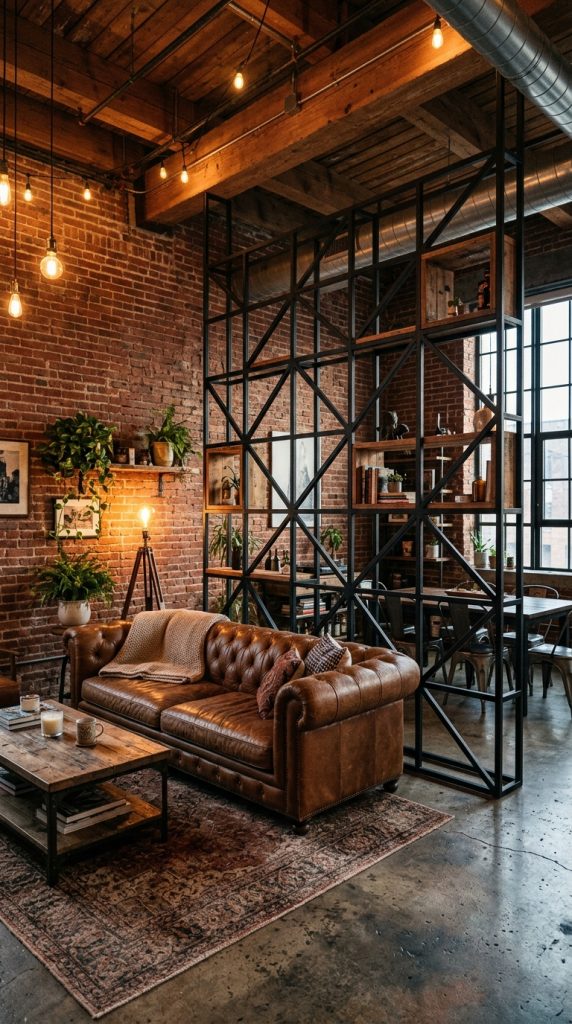
If your design aesthetic leans more industrial, modern, or even a little bit edgy, then a metal frame divider might be exactly what your living room needs. This style has surged in popularity over the last few years, and it’s not hard to see why.
The Appeal of Metal Frame Dividers
Metal frame partitions — particularly those with a black steel or iron frame — have this quality that makes a space feel both structured and sophisticated.
They reference architectural steel windows (think New York loft or converted warehouse) and they pair beautifully with both modern and rustic interiors.
Common styles include:
- Steel frame with glass inserts — the classic industrial look
- Metal frame with fabric or rattan panels — softer and more eclectic
- Decorative laser-cut metal screens — intricate patterns that cast beautiful shadows
- Simple metal grid frames with climbing plants woven through
Affordable Ways to Get This Look
Custom metal fabrication can get expensive quickly, so here’s how to get the same look for less:
- Shop for pre-made metal grid room dividers online — many are surprisingly affordable
- Look for old steel-frame windows at architectural salvage yards
- Use black metal pipe and flanges (plumbing supplies, oddly enough) to create a custom frame — this DIY approach is wildly popular and genuinely looks incredible
The contrast between matte black metal and warm wood tones or soft textiles is honestly one of the best combinations in interior design right now. (As in, it’s almost unfairly good.)
Bookshelf Living Room Partition Concept
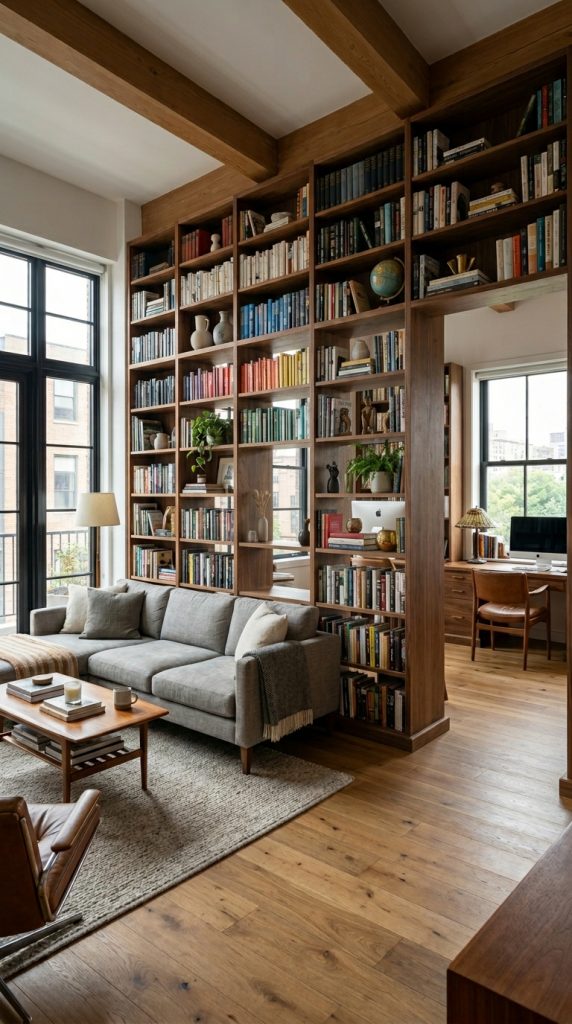
Wait, didn’t we already talk about open shelving? Yes — but a dedicated bookshelf partition is its own thing entirely, and it deserves its own spotlight.
Because there’s something magical about a floor-to-ceiling bookshelf that also happens to divide your room.
Bookshelf vs. Open Shelf — What’s the Difference?
While open shelving partitions focus on displaying a curated mix of items, a bookshelf partition leans specifically into the function of housing books — lots of them.
The effect is cozy, intellectual, and warmly personal. It makes your living room feel like a place where actual interesting people live.
The best bookshelf partition setups:
- Use back-to-back shelving units that face different zones — one side facing the living area, one facing the home office or dining space
- Opt for tall, narrow units for a more dramatic, library-like effect
- Go floor to ceiling by stacking two shorter units and securing them together (always anchor to the wall for safety)
Making It Feel Custom
A great trick is to paint the back panel of the bookshelf a bold contrasting color. When you look through the books, you catch glimpses of that color on both sides. It makes even an IKEA KALLAX look like something you ordered from a custom furniture maker.
You can also use your bookshelf partition to create distinct visual zones by styling each side differently — warmer, cozier on the living room side, and cleaner, more functional on the work or dining side.
Also Read: 10 Creative L Shape Sofa Living Room Arrangements – Airlucent
Folding Screen Living Room Divider Design
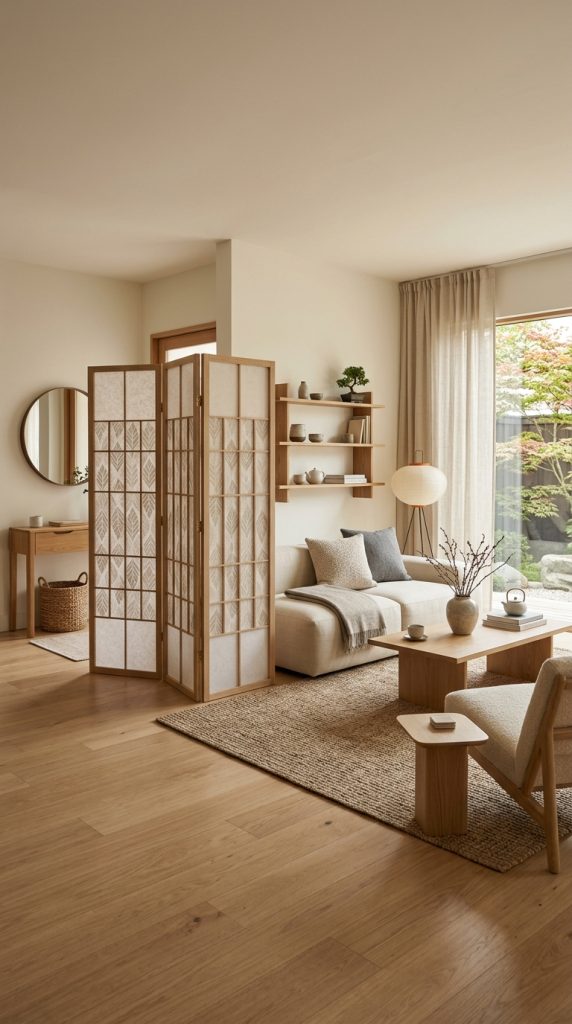
Last but absolutely not least — the folding screen. This is genuinely the most flexible, most budget-friendly, and most versatile option on this entire list. And yet, somehow, people still underestimate it.
Why Folding Screens Deserve More Credit
A folding screen (also called a room divider screen or paravent) can be moved, repositioned, stored, or swapped out entirely at a moment’s notice. No installation, no commitment, no drama. For renters especially, this is basically the holy grail of room partitions.
The range of styles available is genuinely impressive:
- Rattan or bamboo screens — natural, bohemian, beautiful
- Fabric-paneled screens — soft, warm, customizable
- Painted wooden screens — classic, elegant
- Laser-cut metal screens — modern and sculptural
- Mirrored screen panels — space-expanding and glamorous
Getting Creative With Folding Screens
Here’s the thing about folding screens that most people miss — they don’t just divide space, they add personality. You can:
- Lean one against a wall as a decorative backdrop for a sofa or chair
- Use it to hide an ugly corner, a pile of stuff, or a home office setup
- Place plants in front of and behind it for a layered, dimensional look
- Swap it out seasonally to refresh your living room without moving furniture
You can find stunning folding screens at thrift stores, on marketplace apps, or make your own using hinged wooden frames and your choice of fabric, paint, or paper.
A basic DIY folding screen costs very little and can be genuinely beautiful if you put some thought into the finish.
Bringing It All Together
So there you have it — 10 genuinely achievable, budget-friendly living room partition ideas that can completely transform how your space looks and functions.
Whether you go for the warm, organic charm of wooden slats, the sleek sophistication of glass panels, the practical magic of bookshelf dividers, or the effortless flexibility of a folding screen, you have real, actionable options that don’t require a massive budget or a professional contractor.
Here’s a quick recap to help you decide which direction suits you best:
| Partition Idea | Best For | Budget Level |
|---|---|---|
| Wooden Slat Wall | Warm, natural aesthetic | Low–Medium |
| Glass Panel Divider | Modern, light-filled spaces | Medium |
| Open Shelf Partition | Storage + style combo | Low–Medium |
| Sliding Door Divider | Maximum privacy flexibility | Medium |
| Curtain Partition | Renters and budget seekers | Very Low |
| Half Wall Divider | Permanent, structural definition | Medium |
| Vertical Garden | Plant lovers and bold design | Low–Medium |
| Metal Frame Divider | Industrial and modern styles | Low–Medium |
| Bookshelf Partition | Book lovers and cozy vibes | Low–Medium |
| Folding Screen | Flexibility and portability | Very Low |
The best partition idea is ultimately the one that fits your lifestyle, your budget, and your personal taste. Don’t let anyone convince you that you need to spend thousands to make your home feel intentional and well-designed.
A little creativity, a weekend project, and a clear vision are genuinely all you need.
Now — what are you waiting for? Go measure your living room. Your divided, beautifully organized, envy-inducing space isn’t going to create itself.