I’m Nathan. I’ve worked as an HVAC technician for over 10 years, and if there’s one thing I see every single summer, it’s this simple mistake.
People either set the AC too low and get hit with high bills, or they set it too high and wonder why the house feels sticky and uncomfortable.
The truth is, there’s a sweet spot where comfort and efficiency meet. Once you understand how temperature, humidity, and your home’s setup work together, it gets a lot easier to dial things in.
Let me walk you through what actually works in real homes, not just theory.
- The Best AC Temperature in Summer (Quick Answer)
- What I See in Real Homes
- Why 78°F Gets Recommended So Often
- The Real Comfort Factor Most People Miss: Humidity
- Best AC Temperature When You’re Home
- Best AC Temperature When You’re Away
- Best AC Temperature for Sleeping
- Does Outdoor Heat Change the Ideal Setting?
- The Biggest Factors That Change Your Ideal Setting
- Common AC Temperature Myths I See Every Summer
- How to Stay Comfortable Without Lowering the Thermostat
- Simple Summer Thermostat Schedule
- When Your Home Still Feels Hot at Normal Settings
- Final Recommendation From Field Experience
The Best AC Temperature in Summer (Quick Answer)

For most homes I service, the most reliable summer thermostat range is:
- When you’re home: 75°F to 78°F
- When you’re sleeping: 78°F to 82°F
- When you’re away: 80°F to 85°F
If you want the most widely recommended target from energy agencies, it’s 78°F when you’re home. That number shows up again and again because it balances comfort and energy use in typical residential systems.
Here’s the simple breakdown I give homeowners:
| Home daytime | 75°F to 78°F | Comfortable for most families without overworking the system |
| Sleeping | 78°F to 82°F | Reduces energy use while still supporting sleep comfort |
| Away at work or errands | 80°F to 85°F | Prevents wasting energy on an empty house |
| Multi-day vacation | 85°F to 88°F | Saves energy but requires humidity awareness |
One thing I always stress: if you have pets, humidity issues, or older insulation, you may need to stay closer to the lower end of these ranges.
What I See in Real Homes
Here’s something most guides don’t tell you.
A home set to 72°F is not automatically more comfortable than one set to 77°F.
I’ve walked into hundreds of homes where:
- The thermostat says 74°F
- But the air feels sticky and heavy
- And the humidity is over 60%
That’s not a temperature problem. That’s a moisture control problem.
On the other hand, I’ve seen homes at 78°F that feel crisp and comfortable because humidity is controlled properly.
Comfort is not just temperature. It is temperature plus humidity plus airflow.
Why 78°F Gets Recommended So Often
There’s a reason 78°F shows up in Energy Star and utility recommendations.
It works because it:
- Reduces the temperature gap between indoors and outdoors
- Lowers compressor runtime
- Helps control humidity in most systems
- Cuts energy use without making the home unlivable
But here’s the honest part.
In humid climates, 78°F can feel warm if your system is not removing moisture properly. In dry climates, 78°F often feels perfectly fine.
So the number is a starting point, not a rule.
The Real Comfort Factor Most People Miss: Humidity

If there’s one thing I could change in how people use AC systems, it would be this.
Stop chasing lower temperatures before checking humidity.
Ideal indoor humidity in summer:
40% to 55%
When humidity goes above 60%, this happens:
- 75°F feels sticky
- Sleep becomes uncomfortable
- AC runs longer, but comfort does not improve.
What I check first in real homes:
- Dirty air filter restricting airflow
- Oversized AC system short cycling
- Poor duct airflow balance
- Weak moisture removal due to low runtime
A properly working system should make 78°F feel better than 74°F in a humid house.
Best AC Temperature When You’re Home
Recommended range: 75°F to 78°F
Here’s how I break it down in practice:
- 75°F to 76°F: higher comfort, higher cost
- 77°F: balanced middle ground
- 78°F: best efficiency zone for most homes
In real service calls, homes running below 73°F consistently tend to show:
- Higher electricity bills
- More system wear
- Short cycling issues in some units
The difference of a couple of degrees matters less than airflow and humidity control.
Best AC Temperature When You’re Away
Recommended range: 80°F to 85°F
This is where homeowners often waste the most energy.
You do not need to cool an empty home like it is occupied.
Practical away settings I recommend:
| 1 to 2 hours | 78°F to 82°F |
| Workday (8 to 10 hours) | 82°F to 85°F |
| Full day outing | 84°F to 86°F |
| Vacation | 85°F to 88°F |
Turning the AC completely off sounds like it saves more, but in many homes, it causes heat soak.
That means:
- Walls and furniture absorb heat.
- Humidity builds up
- The system works harder later to recover.
A steady setback is usually more efficient.
Best AC Temperature for Sleeping
Recommended range: 78°F to 82°F
Sleep comfort is very personal, but here’s what I consistently see:
- 76°F to 78°F works for most people
- 74°F to 75°F is preferred by people who like cooler sleep
- 80°F to 82°F works well with fans and good airflow
One important detail most people ignore:
Your body naturally cools at night. That means you often do not need the same aggressive cooling as during the day.
Ceiling fan effect:
A properly used ceiling fan can make a room feel about 3°F to 4°F cooler.
That means:
- 80°F with a fan can feel like 76°F
- Without raising your energy bill
Does Outdoor Heat Change the Ideal Setting?
Short answer: not really.
A lot of people think:
“If it’s 100°F outside, I need to set my AC to 68°F.”
That is not how residential systems are designed.
Most home AC systems are built to handle about a 15°F to 25°F drop in outdoor temperature.
So if it’s:
- 100°F outside
- A realistic indoor target is 75°F to 80°F
Trying to force 68°F in extreme heat often leads to:
- Non-stop operation
- Higher electricity bills
- Poor humidity control
- Increased wear on components
The Biggest Factors That Change Your Ideal Setting
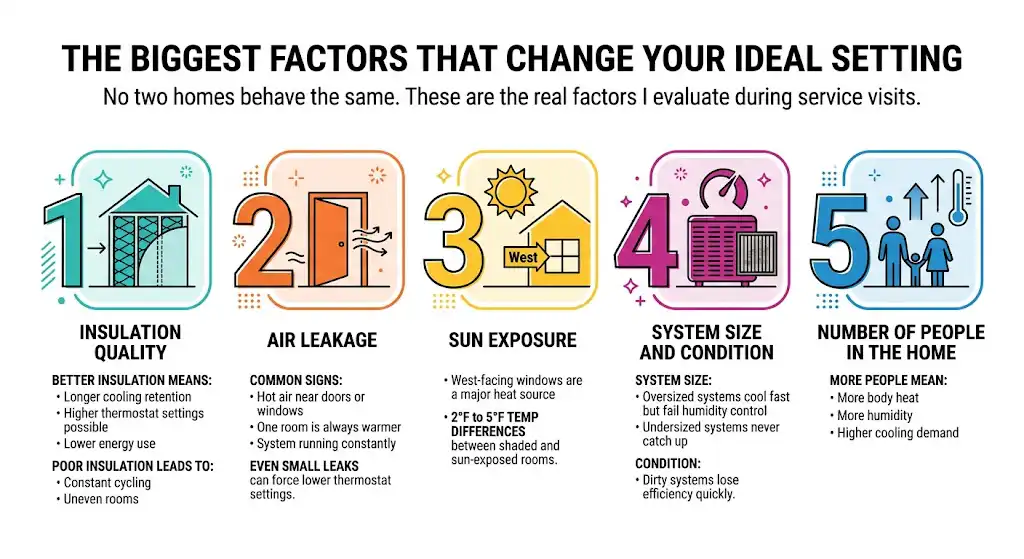
No two homes behave the same. These are the real factors I evaluate during service visits.
1. Insulation quality
Better insulation means:
- Longer cooling retention
- Higher thermostat settings possible
- Lower energy use
Poor insulation leads to constant cycling and uneven rooms.
2. Air leakage
Common signs:
- Hot air near doors or windows
- One room is always warmer than the others
- System running constantly
Even small leaks can force lower thermostat settings.
3. Sun exposure
West-facing windows are a major heat source.
I often see 2°F to 5°F differences between shaded and sun-exposed rooms.
4. System size and condition
This matters more than most people realize.
- Oversized systems cool fast but often fail at humidity control.
- Undersized systems never catch up.
- Dirty systems lose efficiency quickly.
5. Number of people in the home
More people means:
- More body heat
- More humidity
- Higher cooling demand
Common AC Temperature Myths I See Every Summer

Myth 1: Lower temperature cools faster
Your AC cools at a fixed rate. Setting it to 65°F does not make it cool faster. It just makes it run longer.
Myth 2: Turning AC off saves the most money
Not always. Heat-soaked homes often cost more energy to recover than maintain.
Myth 3: Small temperature changes do not matter
Small changes matter less than people think individually, but over a full summer, they add up. Still, comfort should not be sacrificed for tiny savings.
How to Stay Comfortable Without Lowering the Thermostat
These are the real-world steps I recommend after repairs and tune-ups.
Keep airflow strong
- Replace filters every 1 to 3 months.
- Do not block vents
- Make sure returns are open.
Use ceiling fans correctly.
- Counterclockwise in summer
- Only when rooms are occupied
Control sunlight
- Close blinds in the afternoon
- Use blackout curtains on hot-facing windows.
Seal air leaks
- Weatherstrip doors
- Seal window gaps
- Check attic access points.
Schedule maintenance
A basic tune-up often improves:
- Cooling speed
- Humidity control
- Energy efficiency
Simple Summer Thermostat Schedule
Here is a schedule that works well in many homes:
| 6:00 AM to 8:00 AM | 76°F | Morning comfort |
| 8:00 AM to 4:30 PM | 83°F | Away savings |
| 4:30 PM to 10:30 PM | 76°F to 78°F | Evening comfort |
| 10:30 PM to 6:00 AM | 79°F to 82°F | Sleep efficiency |
If your home cools slowly, start pre-cooling earlier before you return.
When Your Home Still Feels Hot at Normal Settings
If your thermostat says 76°F to 78°F but comfort is off, check this first.
If it feels sticky:
- Humidity above 60%
- Dirty filter
- Weak drainage or coil issues
If rooms are uneven:
- Duct leakage
- Poor return airflow
- Insulation gaps
If AC never stops running:
- Dirty outdoor coil
- Low refrigerant
- Undersized system
Final Recommendation From Field Experience
If I had to simplify everything I have learned over 10 years into a practical starting point:
- Set 75°F to 78°F when you are home.
- Use 80°F to 85°F when you are away.
- Keep the sleeping range around 78°F to 82°F
- Control humidity between 40% and 55%
- Use fans, shading, and airflow before lowering temperature.
Most comfort problems I see are not solved by lowering the thermostat further.