
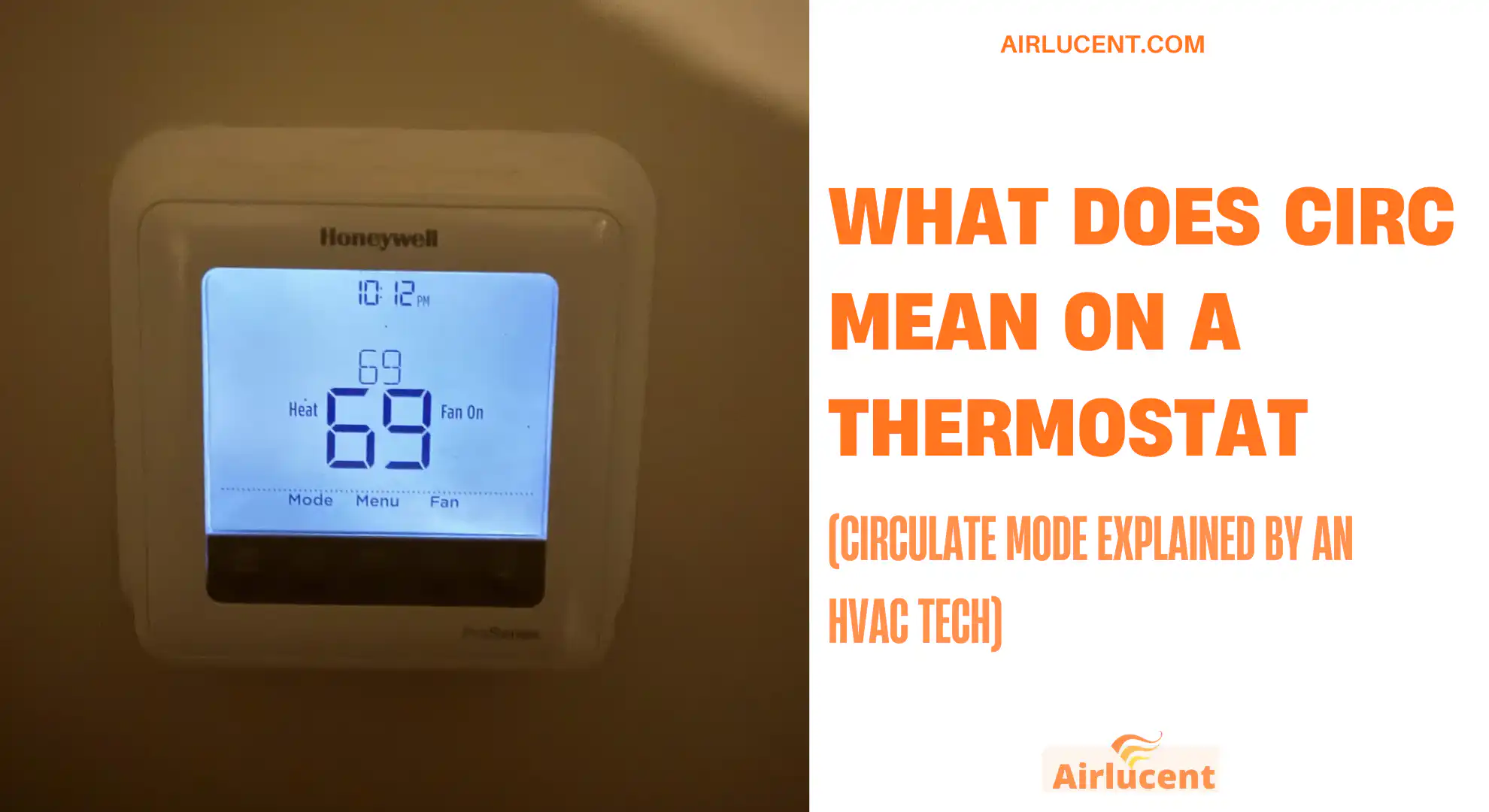
If you’ve ever looked at your thermostat’s fan options and thought, “Auto I get. On I get. But what is CIRC?”, you’re not alone.
In plain English, CIRC means Circulate. It’s a fan setting that runs your HVAC blower intermittently, even when your system is not actively heating or cooling. The goal is to keep air moving through your home without the full energy cost (and noise) of running the fan 24 7.
Most thermostats that offer CIRC run the fan about 35 percent of the time, which works out to roughly 20 minutes per hour, minus any time the fan already ran during heating or cooling.
What CIRC (Circulate) Actually Does
When your thermostat is set to Fan CIRC:
- Your system’s blower fan turns on for short periods throughout the hour
- This happens even if you are not calling for heat or AC
- If the system runs for heating or cooling, that runtime usually counts toward the circulate target
What you’ll notice at home
In real homes I service, CIRC is most useful when:
- One room is always hotter or colder than the others
- Air feels stuffy, even though temperatures look fine
- You want more filtration without running the fan nonstop
- It’s spring or fall and the system barely runs, but you still want airflow
Thermostat Fan Settings Compared (Auto vs CIRC vs On)
Here’s the simplest way to think about it:
- Auto runs the fan only when heating or cooling is running
- On runs the fan all the time
- CIRC runs the fan some of the time, automatically
Quick comparison table
| Auto | Only with heating or cooling | Only during calls | Good, but can leave hot or cold spots | Lowest |
| CIRC (Circulate) | With heating or cooling plus periodic fan cycles | Often about 20 min per hour (varies by thermostat) | Better mixing, fewer hot or cold spots | Medium |
| On | Continuously | 24 7 | Most consistent airflow | Highest |
If you want my technician perspective: CIRC is usually the best “set it and forget it” option when your home needs better air mixing but you do not want to pay for constant fan operation.
Why Thermostats Offer CIRC Mode (Real Benefits)
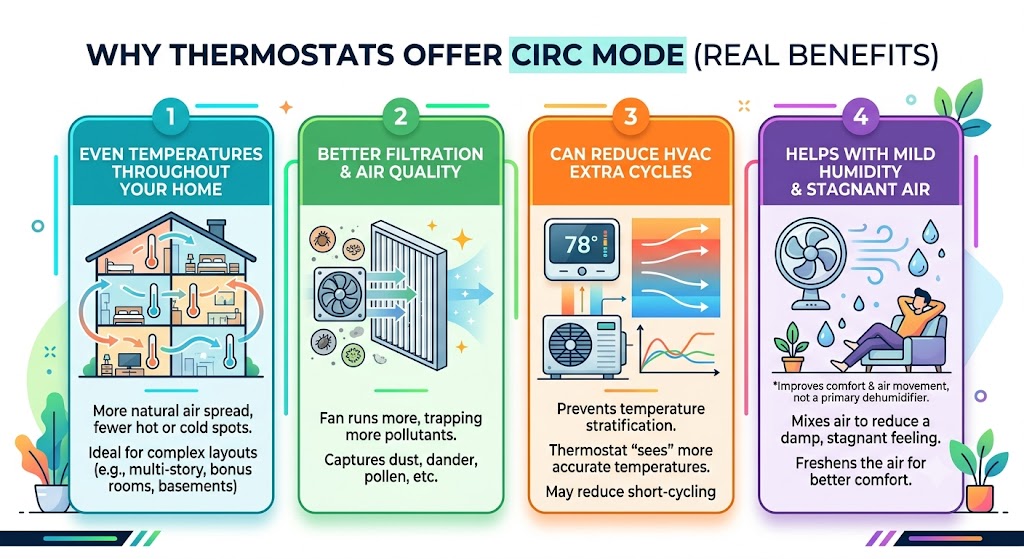
1. More even temperatures and fewer hot or cold spots
Heat and AC do not naturally spread evenly through a house, especially if you have:
- Two stories
- Long duct runs
- Rooms over a garage
- A finished basement
- A bonus room with lots of windows
CIRC helps mix the air so temperatures feel more consistent from room to room.
2. Better filtration and indoor air quality
Every time the fan runs, air passes through your HVAC filter (assuming the ductwork is reasonably sealed and your return air setup is correct).
That means more opportunities to capture:
- Dust
- Pet dander
- Lint
- Pollen (especially during allergy season)
3. Can reduce the need for extra heating and cooling cycles
This one surprises homeowners. When you circulate air, you reduce temperature stratification (warm air stuck upstairs, cool air stuck downstairs). That can help your thermostat “see” a more representative temperature and may reduce short cycling in some homes.
4. Helps with mild humidity and stagnant air
CIRC is not a dehumidifier. But air movement can help with that damp, stagnant feeling in certain areas.
If your home has real humidity issues, I’d look at:
- Bathroom exhaust use
- Crawlspace or basement moisture
- Oversized AC
- Ventilation
- A whole-home dehumidifier
CIRC helps comfort, but it is not the full fix for moisture problems.
Does CIRC Use a Lot of Electricity? (What It Costs in Real Numbers)
The fan motor uses electricity when it runs. How much depends on your system type:
- Older PSC blower motors often draw more power
- Newer ECM blower motors are usually more efficient at low or variable speeds
To give you a realistic idea, here are common ranges I see in the field.
Estimated fan-only electricity use
| Older PSC motor | ~400 to 700 watts | 3.2 to 5.6 kWh per day | ~96 to 168 kWh |
| Newer ECM motor | ~80 to 250 watts | 0.64 to 2.0 kWh per day | ~19 to 60 kWh |
Cost example (you can adjust to your rate)
If electricity is $0.15 per kWh:
- 30 kWh per month costs about $4.50
- 120 kWh per month costs about $18.00
So yes, CIRC costs more than Auto, but it is usually far less than running Fan On all day.
When Should You Use CIRC Mode?
In my experience, CIRC shines in a few specific situations.
Best times to use CIRC
- Spring and fall when heating and cooling barely run
- During sleep if bedrooms get stuffy
- When you are home and want better comfort in multiple rooms
- During allergy season to increase filtration cycles
- If your home has temperature swings between floors
Times I would avoid CIRC (or use it carefully)
- If your ducts pull air from a dusty attic or crawlspace (duct leakage issue)
- If your filter gets dirty quickly and airflow is already borderline
- If your system is noisy and extra fan runtime will be annoying
How to Turn On CIRC on a Thermostat
Most thermostats that support it follow the same basic idea:
- Tap or press Fan
- Cycle through options: Auto, On, Circ
- Select Circ
Some smart thermostats also let you set a target like:
- Fan run time per hour (example 10, 20, or 30 minutes)
- Fan circulation schedule (only afternoons, only when home, etc.)
Which Thermostats Commonly Have CIRC Mode?
Not every thermostat includes CIRC. It’s more common on mid-range and higher-end models.
Honeywell thermostats that often include Fan Circulate
These are commonly seen with CIRC support (model features vary by sub-model):
| T6 Pro and T6 Pro Smart | Yes | Very common in residential installs |
| WiFi 9000 Color Touchscreen | Yes | Strong scheduling and fan control |
| VisionPRO 8000 Series | Yes | Popular for advanced setups |
If your thermostat only shows Auto and On, it likely does not have a CIRC option.
CIRC vs ON: Which One Should You Use?
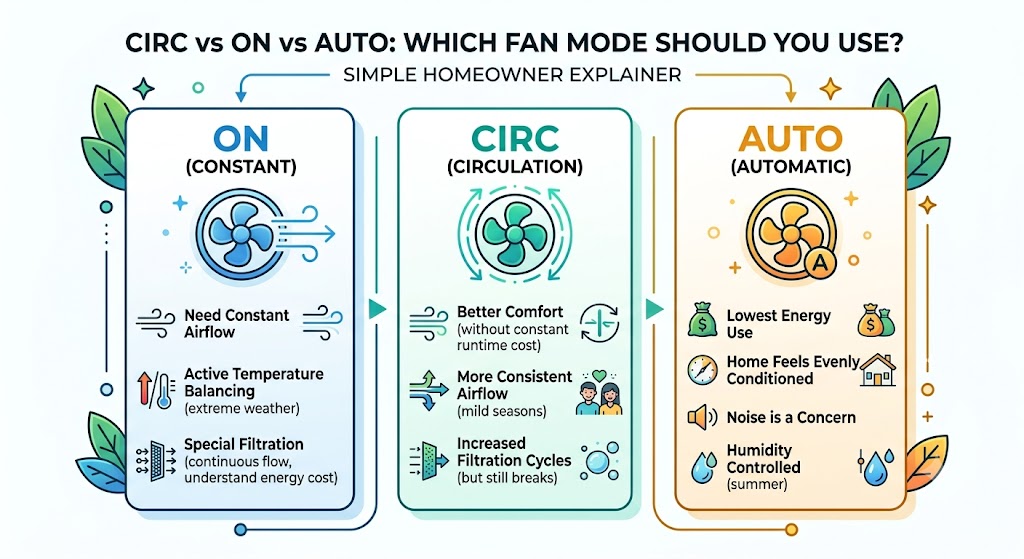
Here’s the easiest way I explain it to homeowners on service calls:
Use Fan ON if:
- You need constant airflow for a specific reason
- You are actively balancing temperatures during extreme weather
- You have special filtration equipment that benefits from continuous flow (and you understand the energy cost)
Use Fan CIRC if:
- You want better comfort without the constant runtime cost
- You want more consistent airflow in mild seasons
- You want increased filtration cycles but still want breaks
Use Fan AUTO if:
- You want the lowest energy use
- Your home already feels evenly conditioned
- Noise is a concern
- You are trying to keep humidity controlled in summer (often Auto is best
Common CIRC Problems (Troubleshooting From the Field)
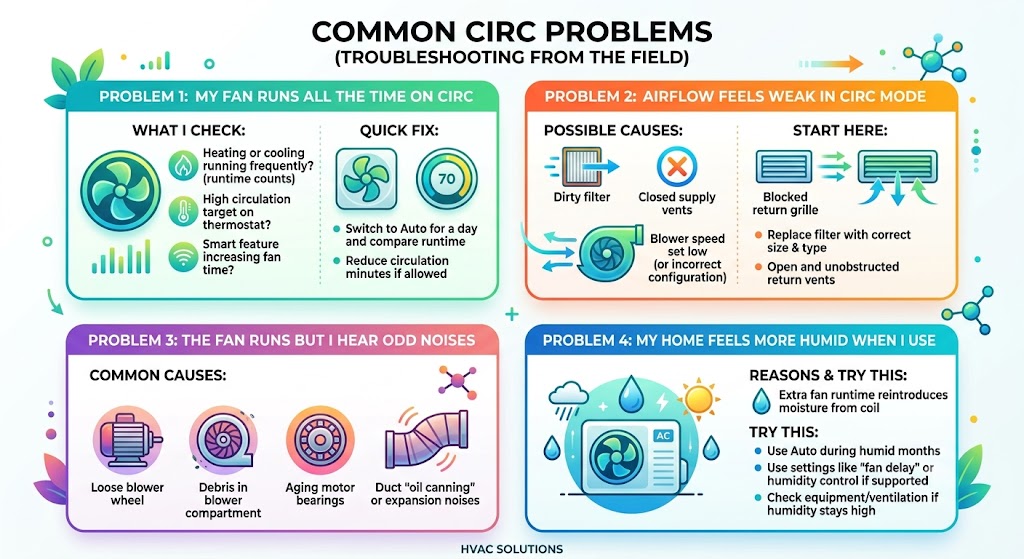
Problem 1: My fan seems like it runs all the time on CIRC
What I check:
- Is the system also heating or cooling frequently? (That runtime counts)
- Is the thermostat set to a high circulation target?
- Do you have a smart circulation feature that increases fan time automatically?
Quick fix:
- Switch to Auto for a day and compare runtime
- Reduce circulation minutes if your thermostat allows it
Problem 2: Airflow feels weak in CIRC mode
Possible causes:
- Dirty filter
- Closed supply vents
- Blocked return grille
- Blower speed set low (or incorrect wiring/configuration on some systems)
Start here:
- Replace the filter with the correct size and type
- Make sure return vents are open and unobstructed
Problem 3: The fan runs but I hear odd noises
Common real causes:
- Loose blower wheel
- Debris in the blower compartment
- Aging motor bearings
- Duct “oil canning” or expansion noises when airflow starts
Problem 4: My home feels more humid when I use CIRC
This can happen, especially in humid climates, because extra fan runtime can reintroduce moisture that was sitting on the evaporator coil after an AC cycle.
Try this:
- Use Auto during the most humid months
- Consider a thermostat setting like “fan delay” or humidity control if your system supports it
- If humidity stays high, you may need equipment or ventilation changes, not just fan settings
My Recommended Settings (Simple Starting Points)
If you want a practical baseline:
- Summer (humid climates): Auto
- Summer (dry climates): CIRC can be fine if comfort is uneven
- Winter: CIRC if you have stratification or cold rooms
- Spring and fall: CIRC is often the sweet spot
FAQ: CIRC on Thermostats
Does CIRC mean my AC is running?
No. CIRC runs the fan, not the compressor or heat. Your outdoor unit usually stays off unless the thermostat is actively calling for cooling.
Is CIRC the same as leaving the fan ON?
No. Fan ON is constant. CIRC is intermittent and typically targets around 35 percent runtime per hour.
Will CIRC lower my energy bill?
It depends. CIRC uses more electricity than Auto because the fan runs more. But it can sometimes reduce heating and cooling cycling in homes with big hot or cold spots. The real value is usually comfort, air mixing, and filtration, not guaranteed savings.
Can CIRC help with allergies?
It can help by moving more air through your HVAC filter. Just make sure you:
Use the right filter (not overly restrictive for your system)
Replace it regularly
Keep returns and supply vents open
Can using CIRC wear out my system faster?
Running the blower more does add runtime to the motor. But in many systems, that is still relatively low stress, especially on ECM motors. The bigger risk I see is homeowners running high-MERV filters and then increasing fan runtime, which can reduce airflow and create other issues. Balance is key.