
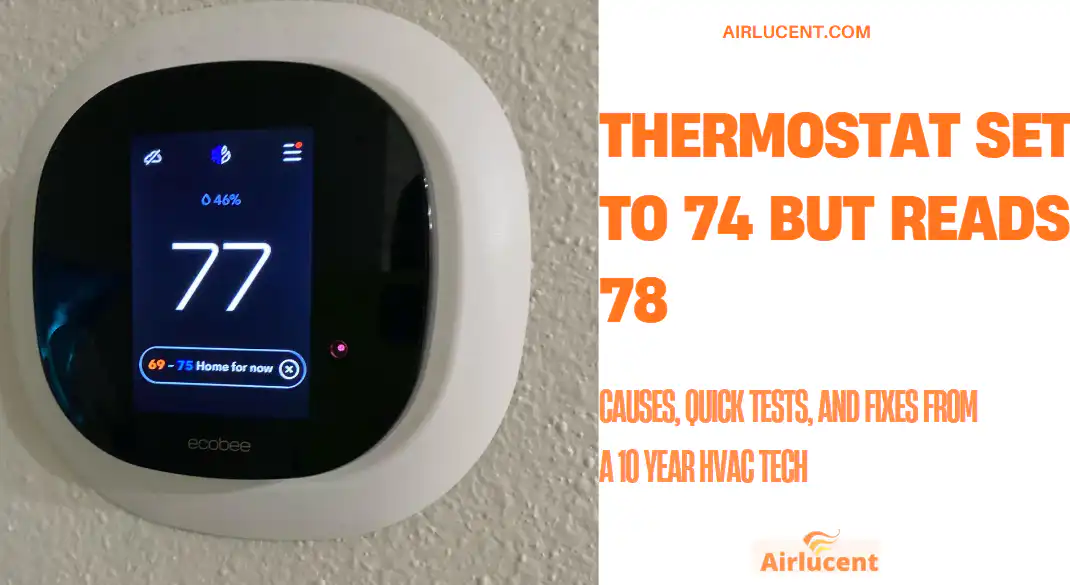
Hi, I’m Nathan. I’ve worked as an HVAC technician for over 10 years, and this exact complaint is one of the most common summer calls I run:
You set the thermostat to 74°F, but the house stalls at 78°F (or higher) and just won’t come down.
Most of the time, the thermostat is doing its job. The real issue is one of these:
- The thermostat is reading the wrong temperature (bad location, wall drafts, calibration)
- Your system is losing cooling capacity (airflow restriction, dirty coils, duct leakage, low refrigerant)
- Your home is gaining heat faster than the AC can remove it (extreme outdoor heat, undersized system, poor insulation)
- A setting or accessory is fighting your cooling (air exchanger, schedules, wrong mode)
Below is exactly how I troubleshoot this in the field, starting with the easiest checks first.
- Quick Diagnosis Table: Why It Won’t Go Below 78°F
- Before You Do Anything: One Fast Test That Tells Me a Lot
- 1) Dirty or Too-Restrictive Air Filter (Most Common Fix)
- 2) Thermostat Reading Wrong Because of Wall Drafts (Common and Overlooked)
- 3) Thermostat Location Problems (Sun, Kitchen Heat, Supply Vents)
- 4) Your ERV, HRV, or Air Exchanger Is Running (And Fighting the AC)
- 5) Outdoor Temperature Is Simply Too High (Heat Load vs AC Capacity)
- 6) Dirty Outdoor Condenser Coil or Condenser in Full Sun
- 7) Leaky Ductwork (You’re Paying to Cool the Attic)
- 8) Undersized AC Unit (Runs All Day, Never Hits Setpoint)
- 9) Low Refrigerant or Dirty Indoor Coil (Needs a Technician)
- 10) Thermostat Schedules or Smart Features Overriding You
- 11) Simple Thermostat Reset (Surprisingly Effective)
- 12) Outdoor Unit Not Running (Breaker, Disconnect, Capacitor)
- 13) Wiring Issue: RC Wire Not Connected (Cooling Power)
- My Recommended Troubleshooting Order (Fastest to Slowest)
- Cost Guide (Typical Ranges You Might See)
- When I’d Stop DIY and Call an HVAC Technician
- FAQ
- Bottom Line
Quick Diagnosis Table: Why It Won’t Go Below 78°F
| Thermostat says 78 but another thermometer says 74 to 75 | Bad thermostat location or calibration | Seal wall drafts, relocate (long term), recalibrate or replace | If relocation requires new wiring |
| AC runs nonstop and air feels weak at vents | Dirty filter, blower issue, blocked return, dirty coil | Replace filter, open returns/supplies | If coil is freezing, blower failing, or static pressure is high |
| Outdoor unit is silent or hums | Breaker, disconnect, capacitor, contactor | Check breakers, confirm disconnect is on | If capacitor/contactor/compressor issue |
| House cools at night but not mid-day | Outdoor heat load, sun gain, undersized AC, dirty condenser | Shade windows, reduce heat sources, clean condenser | If sizing is wrong or condenser fan/compressor struggling |
| Some rooms are hot, others ok | Duct leakage, poor balancing, closed dampers | Open registers, check obvious duct disconnects | For duct testing and sealing |
| System short cycles (on/off a lot) | Thermostat placement, oversized system, sensor issue | Check placement and drafts | If short cycling persists |
Before You Do Anything: One Fast Test That Tells Me a Lot
Check your “temperature split” (vent temperature drop)
This is a simple performance check you can do with a cheap thermometer.
- Set thermostat to Cool and Fan Auto
- Let the system run 10 to 15 minutes continuously
- Measure:
- Return air temperature (at the large return grille or filter area)
- Supply air temperature (closest supply vent to the air handler)
Normal target: about 15°F to 20°F difference in many properly operating systems (there are exceptions, but this is a great baseline).
| 78°F | 58 to 63°F | 15 to 20°F | Cooling system is likely producing cold air нормально |
| 78°F | 68 to 74°F | 4 to 10°F | Often airflow issue, dirty coils, low refrigerant, compressor problem |
| 78°F | 50 to 55°F | 23 to 28°F | Often low airflow (dirty filter, blocked return) and may lead to icing |
If your split is healthy but the house still won’t reach 74°F, your issue is usually heat gain, duct leakage, or thermostat reading accuracy.
1) Dirty or Too-Restrictive Air Filter (Most Common Fix)
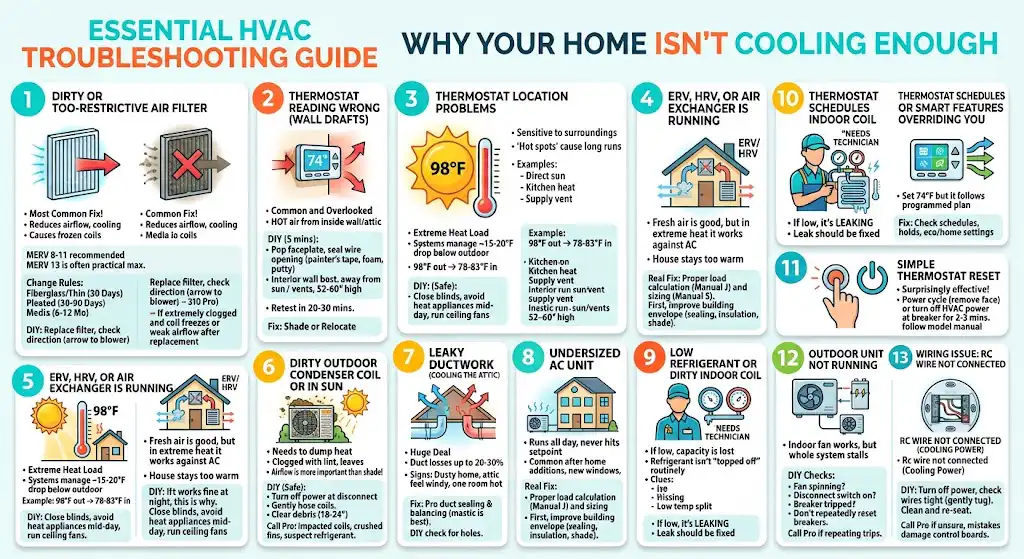
If I could only check one thing first, it’s the filter.
A clogged filter reduces airflow, and low airflow means your system can’t move enough cooled air through the home. It may run constantly, cool slowly, and sometimes even freeze the indoor coil.
What I recommend (real-world guidance)
- For most homes, MERV 8 to MERV 11 is a safe, practical range.
- MERV 13 is often the practical ceiling for many residential blowers unless the system was designed for it. Higher MERV can create enough resistance to act like a “mystery cooling problem.”
Quick filter rules I use on service calls
| 1-inch fiberglass or thin pleated | 30 days | Clogs fast, especially with pets/dust |
| 1-inch pleated (better quality) | 30 to 90 days | Check monthly at first |
| 4 to 5-inch media filter | 6 to 12 months | Longer life, lower pressure drop when sized right |
DIY fix: Replace the filter and make sure it’s installed in the correct direction (arrow toward the blower).
Call a pro if: The filter was extremely clogged and now the coil is freezing, or airflow still feels weak after replacement.
2) Thermostat Reading Wrong Because of Wall Drafts (Common and Overlooked)
I’ve seen plenty of thermostats “think” the house is warmer than it is because hot air is coming from inside the wall.
Why it happens
Behind many thermostats is a hole where wires come through. If that hole opens into a warm wall cavity or attic chase, hot air drafts across the thermostat sensor.
DIY fix in 5 minutes
- Turn off the thermostat (or the HVAC breaker if needed)
- Pop the thermostat faceplate off
- Look for the wire opening in the wall
- Lightly seal around the wire hole using:
- painter’s tape, or
- foam (minimal), or
- putty designed for draft sealing
Put it back on and re-test the reading after 20 to 30 minutes.
3) Thermostat Location Problems (Sun, Kitchen Heat, Supply Vents)
Thermostats are extremely sensitive to their surroundings. If yours is in a “hot spot,” it will read high and run the AC longer, sometimes still never matching your comfort level.
Bad locations I see all the time
- Direct sun from a window or glass door
- Near the kitchen (stove, oven, fridge heat)
- Near a supply vent (it can read too cool and shut off early)
- In a hallway that doesn’t represent the main living space
Best practice: Interior wall, away from sunlight, away from supply registers, roughly 52 to 60 inches from the floor.
Fix: Short term, shade it from sun and reduce nearby heat sources. Long term, relocate the thermostat if it’s truly in the wrong place.
4) Your ERV, HRV, or Air Exchanger Is Running (And Fighting the AC)
If you have an air exchanger (HRV or ERV), it brings in outside air to improve indoor air quality. That’s great for ventilation, but in extreme heat it can absolutely keep the home stuck at 78°F.
What I see in the field
Homeowners often don’t realize it’s running, or it’s set to continuous ventilation.
DIY fix: Temporarily turn it off (or reduce it) and see if the house begins dropping closer to setpoint within 1 to 2 hours.
If you need ventilation for health reasons, consider a reduced schedule instead of full-time operation during the hottest hours.
5) Outdoor Temperature Is Simply Too High (Heat Load vs AC Capacity)
On very hot days, many standard systems struggle. A common rule of thumb is that many systems can manage roughly 15°F to 20°F drop compared to outdoor conditions, depending on insulation, windows, humidity, and system design.
Example
If it’s 98°F outside, it’s not unusual for a home to stall around 78°F to 83°F if the system is running at full capacity.
What you can do right now
- Close doors and windows (even “just a crack” matters)
- Close blinds and curtains on sun-facing windows
- Avoid heat-producing appliances mid-day (oven, dryer, long hot showers)
- Run ceiling fans (they don’t lower temperature, but they improve comfort so you can raise setpoint slightly)
If the system cools fine at night but can’t keep up between 2 pm and 7 pm, this is often the reason.
6) Dirty Outdoor Condenser Coil or Condenser in Full Sun
Your outdoor unit has to dump heat outside. If the coil is clogged with lint, cottonwood, grass clippings, or it’s baking in direct sun, efficiency drops.
DIY cleaning (safe basics)
- Turn off power at the disconnect box near the unit
- Use a garden hose with gentle water pressure to rinse the coil from the outside
- Clear leaves and debris around the unit (give it 18 to 24 inches of breathing room)
About shading the outdoor unit
Shade can help, but airflow matters more than shade. If you build something, keep it well away from the unit and never block discharge air.
Call a pro if: Coil is impacted deep inside, fins are crushed badly, or you suspect refrigerant issues.
7) Leaky Ductwork (You’re Paying to Cool the Attic)
Duct leaks are a huge deal. In many homes, the ductwork runs through attics, crawlspaces, or garages. If ducts leak, cold air never reaches the rooms, and hot air can get pulled into the system.
Useful stat: The U.S. Department of Energy commonly cites duct losses that can be 20 percent to 30 percent in typical homes with ducts outside the conditioned space.
Signs I look for
- One or two rooms always hot
- Weak airflow far from the air handler
- Dusty home, especially after the system runs
- Attic feels “windy” near duct runs when AC is on
DIY checks: Look for disconnected ducts, obvious holes, or loose joints you can access safely.
Best fix: Professional duct sealing and balancing. (Mastic sealing beats “duct tape” almost every time in real conditions.)
8) Undersized AC Unit (Runs All Day, Never Hits Setpoint)
If your unit is too small for the home, it can run constantly and still stall at 78°F.
This happens a lot after:
- home additions
- finishing a basement
- replacing windows with big glass sliders
- changing insulation levels (or lack of them)
Real fix: A proper load calculation (Manual J) and equipment sizing (Manual S). I know it’s not the fun answer, but it’s the correct one.
What you can do first: Improve the building envelope (air sealing, attic insulation, window shading). Sometimes that’s enough to “make” your existing AC feel bigger.
9) Low Refrigerant or Dirty Indoor Coil (Needs a Technician)
If refrigerant is low due to a leak, the system loses capacity. It may still blow “cool-ish” air but not enough to pull the home down to 74°F.
Clues I take seriously
- Ice on the refrigerant line or indoor coil
- Hissing near the indoor coil or outdoor unit
- Very low temperature split (example: only 5°F to 10°F)
- AC runs constantly and humidity feels high
Important: Refrigerant is not something you “top off” as routine maintenance. If it’s low, it’s leaking, and the leak should be found and corrected.
10) Thermostat Schedules or Smart Features Overriding You
Some thermostats have:
- schedules
- eco modes
- geofencing
- utility demand response events
So you set 74, but the thermostat is following a programmed plan and effectively says “no.”
Fix: Check:
- schedule settings
- hold settings (temporary vs permanent hold)
- eco mode
- home away settings
If you want a quick reset, you can disable schedules or do a full restart (see next section).
11) Simple Thermostat Reset (Surprisingly Effective)
I’ve fixed plenty of strange thermostat behaviors with a reset.
General approach:
- Power cycle the thermostat (remove from base if battery-powered)
- Or turn off HVAC power at the breaker for 2 to 3 minutes, then restore
Because each brand is different, follow your model’s manual for a proper reset.
12) Outdoor Unit Not Running (Breaker, Disconnect, Capacitor)
If the indoor fan is running but the outdoor unit is off, your thermostat may stay stuck at 78°F because you’re basically just circulating air.
DIY checks
- Is the outdoor fan spinning?
- Is the disconnect switch near the outdoor unit on?
- Are any breakers tripped?
If the breaker trips repeatedly, stop resetting it and call a pro. Repeated trips can mean a failing capacitor, motor, or compressor.
13) Wiring Issue: RC Wire Not Connected (Cooling Power)
On many thermostat setups, Rc provides power for cooling controls. If it’s loose or not properly connected (or a jumper setting is wrong), cooling can behave unpredictably.
DIY fix (only if you’re comfortable):
- Turn off HVAC power
- Remove thermostat face
- Confirm wires are tight in terminals (gently tug test)
- Clean and re-seat the Rc wire if needed
If you’re unsure, this is a good spot to bring in a tech. A small wiring mistake can blow a fuse on the control board.
My Recommended Troubleshooting Order (Fastest to Slowest)
If you want the quickest path to a solution, do it in this order:
- Replace/check air filter
- Make sure thermostat is in Cool mode, Fan Auto, schedules off
- Compare thermostat temperature to a separate thermometer
- Seal drafts behind thermostat
- Measure temperature split (return vs supply)
- Check outdoor unit is running and coil is clean
- Check for duct leaks or disconnected duct sections
- If split is low or icing is present, call a pro for refrigerant/coil/blower diagnostics
- If it only fails on extreme-heat afternoons, consider heat-load improvements or sizing check.
Cost Guide (Typical Ranges You Might See)
These vary by region, but this is a realistic planning table.
| New air filter | $10 to $40 |
| Basic thermostat replacement | $100 to $400 plus install if needed |
| Professional AC tune-up | $100 to $250 |
| Capacitor replacement | $150 to $400 |
| Refrigerant leak find and repair | $400 to $1,500 plus refrigerant |
| Duct sealing (whole-home typical) | $500 to $2,500 |
| New AC system (installed) | $6,000 to $15,000+ |
When I’d Stop DIY and Call an HVAC Technician
Call for service if you notice:
- Ice on indoor coil or refrigerant lines
- Outdoor unit not running (and breaker trips)
- Burning smell, electrical buzzing, or loud grinding
- Temperature split is consistently under 12°F
- You’ve changed the filter and airflow is still weak
Those situations usually require instruments (refrigerant gauges, static pressure testing, amp draws) and safe handling.
FAQ
Is it normal for my AC to not reach 74°F when it’s really hot outside?
It can be. If the system runs continuously during peak heat and catches up at night, that often points to heat load, sun gain, duct losses, or a system operating at its limit.
What temperature should air be coming out of the vents?
Instead of a single number, I look for a 15°F to 20°F temperature drop between return and supply after the system has been running 10 to 15 minutes.
Could my thermostat be “wrong” even if it’s new?
Yes. New thermostats can still read wrong if they’re installed over a drafty wall opening, in sunlight, near a kitchen, or near supply airflow.
Bottom Line
When your thermostat is set to 74°F but reads 78°F, it’s usually not a mystery. In my experience, the most common culprits are airflow problems (filters), thermostat reading errors (location or drafts), outdoor heat load, dirty coils, duct leakage, or a cooling system that needs professional diagnosis (refrigerant, blower, capacitor).