
I’m Nathan, and I’ve been an HVAC technician for over 10 years. I’ve seen this exact problem hundreds of times after a thermostat swap: you set your brand new Honeywell thermostat to Cool, the fan comes on… and you get warm or hot air.
The good news is this is usually not a major equipment failure. In most homes, it’s one of a few setup or wiring issues, especially if you have a heat pump.
This guide walks you through the fixes in the same order I use in the field, starting with the quickest checks and moving into the deeper diagnostics.
- Quick answer (what causes it most often)
- Before you start (2 safety steps)
- Symptoms checklist (so you diagnose the right problem)
- Step-by-step troubleshooting (in the order I recommend)
- 1) Confirm the thermostat is actually set to Cool (simple but important)
- If you have a Honeywell with installer setup
- 2) Check for compressor delay mode (wait 5 minutes)
- 3) The big one: Heat pump reversing valve setting (O vs B)
- What “O” and “B” mean (plain English)
- How to fix it
- 4) Make sure the O/B wire is connected (and actually making contact)
- What to do
- Important note
- 5) Verify your system type: Heat pump vs conventional
- Quick ways to tell (no tools)
- Why this causes “hot air on cool”
- 6) Fix wiring mistakes (this is the other top cause)
- Common wiring mistakes I see
- Honeywell terminal cheat sheet (typical)
- Rc and Rh jumper note
- 7) Confirm the outdoor unit (condenser/heat pump) is running
- Quick checks you can do safely
- Outdoor unit won’t run: common causes and fixes
- 8) Heat pump reversing valve stuck (less common, but it happens)
- How reversing valves fail
- Reversing valve troubleshooting overview
- 9) Control board issues (rare, but possible)
- Common control board-related issues
- 10) Low refrigerant (Freon) or refrigerant leak
- Signs your system may be low on refrigerant
- A fast diagnostic flow (what I’d do at your house)
- Thermostat wiring tips that prevent this problem
- When you should call a professional (and save time)
- FAQ
Quick answer (what causes it most often)
If your new Honeywell thermostat is blowing hot air on cool, the most common causes are:
- Thermostat is configured for the wrong equipment type (heat pump vs conventional)
- O/B reversing valve setting is wrong (O vs B)
- O/B wire isn’t connected or is on the wrong terminal
- Wiring mix-up (Y and W swapped, missing jumper, loose wire)
- Outdoor unit (condenser/heat pump) isn’t running
- Reversing valve stuck (heat pump issue)
- Control board issue (less common)
- Low refrigerant (less common, but real)
- Normal 5-minute compressor delay (very common right after power loss)
In my own service history, when this happens immediately after installing a new thermostat, it’s usually setup or O/B wiring, not a bad AC.
Before you start (2 safety steps)
- Turn off power to your HVAC at the furnace/air handler switch and the breaker.
- If you open any panels on the outdoor unit, shut off the outdoor disconnect too.
If you’re not comfortable around electrical components, stop at the thermostat-only steps and call a pro.
Symptoms checklist (so you diagnose the right problem)
| Air feels warm/hot and outdoor unit is not running | Thermostat setup, wiring, breaker, float switch, capacitor/contactor |
| Air feels warm/hot but outdoor unit is running | Heat pump reversing valve setting (O/B), stuck valve, low refrigerant |
| Air feels room-temperature and only the fan runs | Compressor delay mode, thermostat not calling Y, outdoor unit not starting |
| Heat works fine, but Cool blows hot | Strong sign of O/B setting or heat pump config issue |
Step-by-step troubleshooting (in the order I recommend)
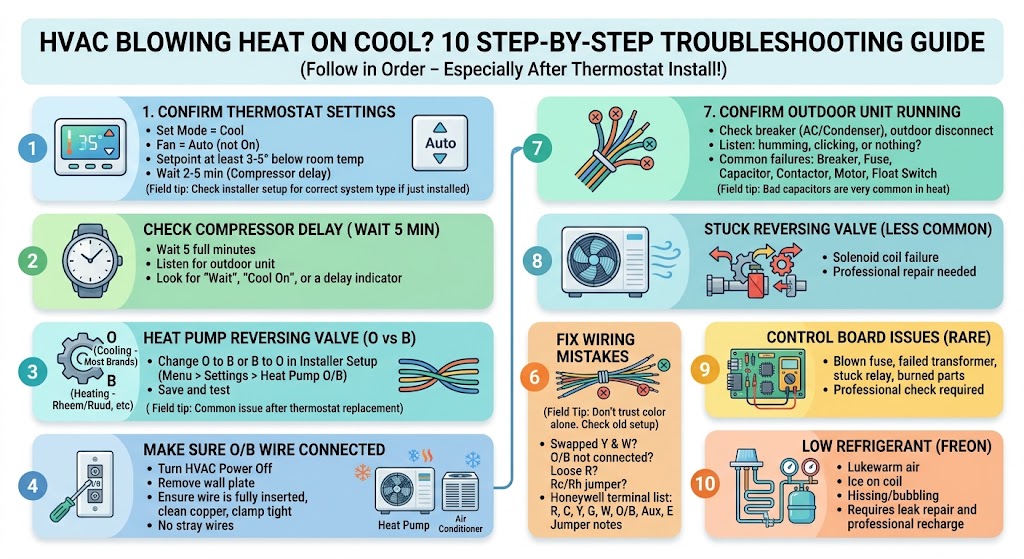
1) Confirm the thermostat is actually set to Cool (simple but important)
It sounds obvious, but I can’t tell you how many calls end here.
- Set Mode = Cool
- Set fan to Auto (not On)
- Drop setpoint at least 3 to 5 degrees below room temp
- Wait 2–5 minutes (many thermostats delay the compressor)
If you have a Honeywell with installer setup
If you accidentally configured it as the wrong system type during installation, you can get “heat on cool” behavior.
What you want to confirm:
- Do you have a heat pump or a conventional furnace + AC?
If you don’t know yet, skip down to the “Do you have a heat pump?” section and come back.
2) Check for compressor delay mode (wait 5 minutes)
Many Honeywell thermostats have a built-in compressor protection delay. After a power outage or quick cycling, it may run the indoor fan while the outdoor unit waits.
What to do:
- Leave it in Cool for 5 full minutes
- Listen for the outdoor unit to start
- Check if the thermostat shows “Wait”, “Cool On”, or a delay indicator (varies by model)
If after 5 minutes the outdoor unit never starts, continue.
3) The big one: Heat pump reversing valve setting (O vs B)
If you have a heat pump, the thermostat controls a reversing valve (O/B) that switches the system between heating and cooling.
If the thermostat is set to the wrong option, your system will behave exactly like you described:
- Cool mode produces heat
- Heat mode may produce cool air (sometimes)
What “O” and “B” mean (plain English)
| O | Cooling | Most brands |
| B | Heating | Some systems (often Rheem/Ruud, but not always) |
How to fix it
On many Honeywell models, you’ll enter Installer Setup (the exact steps depend on model, but generally):
- Menu → Settings/Installer Setup → Equipment → Heat Pump → O/B
- Change O to B or B to O
- Save, then test Cool again
Field tip from my experience:
If the thermostat was replaced and nothing else changed, and you suddenly have heat on cool, the O/B setting is one of the first things I check. It’s extremely common.
4) Make sure the O/B wire is connected (and actually making contact)
Even if your installer settings are correct, cooling can still fail if:
- The O/B wire is loose
- The copper isn’t fully clamped
- The conductor is corroded
- The wire is landed on the wrong terminal
What to do
- Turn HVAC power off
- Remove thermostat from the wall plate
- Find the O/B terminal
- Confirm the wire is:
- fully inserted
- copper is clean and not nicked
- clamp is tight
If the copper looks short or damaged, strip it back a little and re-seat it.
Important note
If you have a conventional system (not a heat pump) you typically do not use O/B at all. Having a stray wire on O/B in a conventional setup can create weird behavior.
5) Verify your system type: Heat pump vs conventional
This matters because a thermostat configured for the wrong equipment can energize the wrong terminals.
Quick ways to tell (no tools)
Look at your outdoor unit label:
- If it says Heat Pump, you have one.
- If it says Air Conditioner, it’s cooling-only (paired with furnace/air handler).
Watch what runs in Heat mode:
- Heat pump heating usually runs the outdoor unit in Heat mode (unless it’s using emergency heat).
- A conventional furnace heating call usually does not require the outdoor unit.
Why this causes “hot air on cool”
If the thermostat thinks it’s controlling conventional equipment when it’s actually a heat pump (or vice versa), it may:
- fail to energize O/B
- call W heat when it should call Y cooling (or the other way around)
6) Fix wiring mistakes (this is the other top cause)
Thermostat swaps are where wiring errors happen most. Even if the wire colors look “standard”, don’t trust color alone. Always trust where it landed on the old thermostat and how it matches your equipment.
Common wiring mistakes I see
- Y and W swapped (cooling and heat calls reversed)
- O/B not connected on a heat pump
- Loose R wire causing weird behavior
- Missing jumper between Rc and Rh (on systems that require it)
Honeywell terminal cheat sheet (typical)
These are common functions (your system may vary):
| R / Rc / Rh | 24V power |
| C | Common wire (power return) |
| Y / Y1 | Compressor (cooling) |
| G | Indoor fan |
| W / W1 | Heat (furnace/aux heat) |
| O/B | Heat pump reversing valve |
| Aux / W2 | Auxiliary heat (heat pump backup) |
| E | Emergency heat |
Rc and Rh jumper note
Some Honeywell wall plates have an internal jumper or require one depending on model and system.
- If you have one R wire, most modern thermostats handle it without a jumper.
- If you have separate Rc and Rh wires, they go to their matching terminals.
- If your Honeywell model requires a jumper and you don’t have it, you can get partial operation.
If you’re unsure, check your thermostat manual for Rc/Rh configuration for your exact model.
7) Confirm the outdoor unit (condenser/heat pump) is running
If the thermostat is calling for cool but the outdoor unit never starts, you won’t get real cooling.
Quick checks you can do safely
- Check the breaker labeled AC / Condenser / Heat Pump
- Check the outdoor disconnect (some have a pull-out handle)
- Listen: do you hear humming, clicking, or nothing at all?
Outdoor unit won’t run: common causes and fixes
| Tripped breaker | Reset once | If it trips again, stop |
| Blown disconnect fuses | Replace fuses | If you’re not trained, call |
| Bad capacitor | Usually needs replacement | Yes (common repair) |
| Bad contactor | Replace contactor | Yes |
| Condenser fan motor failed | Replace motor | Yes |
| Float switch open (some systems) | Clear drain clog | If drain keeps backing up |
8) Heat pump reversing valve stuck (less common, but it happens)
If the reversing valve sticks in the heat position, the system may blow hot air even when cooling is selected.
How reversing valves fail
- Mechanical sticking inside the valve body
- Weak/broken solenoid coil
- Electrical issue preventing valve energizing
Reversing valve troubleshooting overview
| Stuck/failed reversing valve | Replace valve (major repair) |
| Failed solenoid coil | Replace coil (sometimes easier) |
| No 24V call to O/B | Wiring/setup issue (thermostat side) |
This is not usually a DIY repair. It involves refrigerant work and should be done by a licensed technician.
9) Control board issues (rare, but possible)
On modern systems, the furnace/air handler control board is basically the traffic controller. If it fails, it may ignore thermostat calls or energize the wrong outputs.
Common control board-related issues
| Blown 3A/5A low-voltage fuse | Thermostat may go blank or act erratically |
| Transformer failure | No 24V power |
| Relay stuck | Fan/heat runs when it shouldn’t |
| Burned traces / component failure | Random system behavior |
If you suspect this, a pro can confirm with a meter quickly (checking 24V, board outputs, and safety circuits).
10) Low refrigerant (Freon) or refrigerant leak
Low refrigerant doesn’t always mean “hot air.” Often it’s “not cold enough,” but on heat pumps it can create confusing symptoms depending on conditions.
Signs your system may be low on refrigerant
- Air is lukewarm, never reaches set temp
- Ice on the refrigerant line or indoor coil
- Hissing/bubbling near the coil or line set
- Higher electric bills with poor performance
Refrigerant handling is not DIY. A proper repair means:
- Find and repair the leak
- Evacuate and recharge to manufacturer specs
A fast diagnostic flow (what I’d do at your house)
| 1 | Mode = Cool, Fan = Auto | Go to step 2 | Fix settings |
| 2 | Wait 5 minutes | Go to step 3 | If it starts cooling, done |
| 3 | Do you have a heat pump? | Go to step 4 | Go to step 6 |
| 4 | O/B setting correct (O vs B)? | Go to step 5 | Flip O/B, test |
| 5 | O/B wire connected and tight? | Go to step 6 | Fix connection |
| 6 | Outdoor unit runs on Cool? | Go to step 8 | Step 7 (power/parts) |
| 7 | Breaker/disconnect/capacitor/contactor | Repair as needed | Call a pro |
| 8 | Still heating on Cool with outdoor running | Suspect stuck reversing valve | Call a pro |
Thermostat wiring tips that prevent this problem
Here are the best practices I teach homeowners after thermostat installs:
- Take a clear photo of the old thermostat wiring before removing it
- Label wires by terminal, not by color
- Push copper in fully and tighten terminals firmly
- Don’t let exposed copper touch other terminals
- If you don’t have a C wire, make sure your thermostat model supports your setup (some need a C-wire adapter)
When you should call a professional (and save time)
Call an HVAC tech if:
- Breaker trips repeatedly
- Outdoor unit hums but won’t start (often capacitor)
- You suspect a reversing valve is stuck
- You see ice on the lines or coil
- You suspect refrigerant issues
- You have 24V control issues and aren’t comfortable testing safely
A good tech can confirm thermostat call signals (R to Y, R to O/B, etc.) and pinpoint whether the issue is control-side or equipment-side in one visit.
FAQ
Why would a new thermostat cause heat on cool?
Because the thermostat is the “translator” between you and the system. If it’s set up for the wrong equipment type or the O/B setting is wrong, it can energize the reversing valve incorrectly or call the wrong terminal.
Will flipping O/B hurt anything?
Flipping O/B in installer setup won’t physically damage the system. It just changes when the reversing valve is energized. If cooling becomes correct after switching, you found the issue.
My fan is blowing but the air isn’t cold. Is the thermostat bad?
Not usually. If the indoor fan runs but the outdoor unit doesn’t, it’s often:
delay mode
no Y call due to wiring/setup
outdoor power issue
capacitor/contactor problem
Could it be because I don’t have a heat pump?
Yes. If you only have a furnace and no AC/heat pump installed, setting “Cool” won’t magically create cooling. You need an air conditioner or heat pump to produce cold air.