I’m Nathan. I’ve worked as an HVAC technician for over a decade, and while I’m not an electrician, I’ve spent thousands of hours in and around homes where lighting, security, energy bills, and outdoor equipment all overlap. Homeowners ask me this exact question all the time because it feels like a simple safety choice, but it’s actually a tradeoff between security, cost, neighbor comfort, and light pollution.
In this guide, I will tell you if you should or should not leave the lights on.
- Why People Leave Outdoor Lights On All Night
- Pros of Leaving Outdoor Lights On Overnight
- Cons of Leaving Outdoor Lights On All Night
- Floodlights: Why People Leave Them On and Why I Usually Wouldn’t
- What I Recommend Instead: A Balanced Lighting Plan That Actually Works
- LED, Timers, Motion Sensors, Smart Controls: What Actually Saves Money
- Color Temperature and Brightness: The Part Most People Get Wrong
- When It Makes Sense to Leave Some Outdoor Lights On All Night
- When You Should Turn Outdoor Lights Off (or Change Your Setup)
- My Quick Decision Guide: Should You Leave Outdoor Lights On All Night?
- Simple Checklist: A Better Outdoor Lighting Setup in One Weekend
- FAQ
- Bottom Line
Why People Leave Outdoor Lights On All Night
In my experience, homeowners leave exterior lights on overnight for four main reasons:
- Security (deterring break ins, seeing movement outside)
- Safety (avoiding trips and falls on steps, walkways, driveways)
- Convenience (late arrivals, dog walks, taking trash out)
- Curb appeal (landscape and architectural lighting looks great at night)
Pros of Leaving Outdoor Lights On Overnight
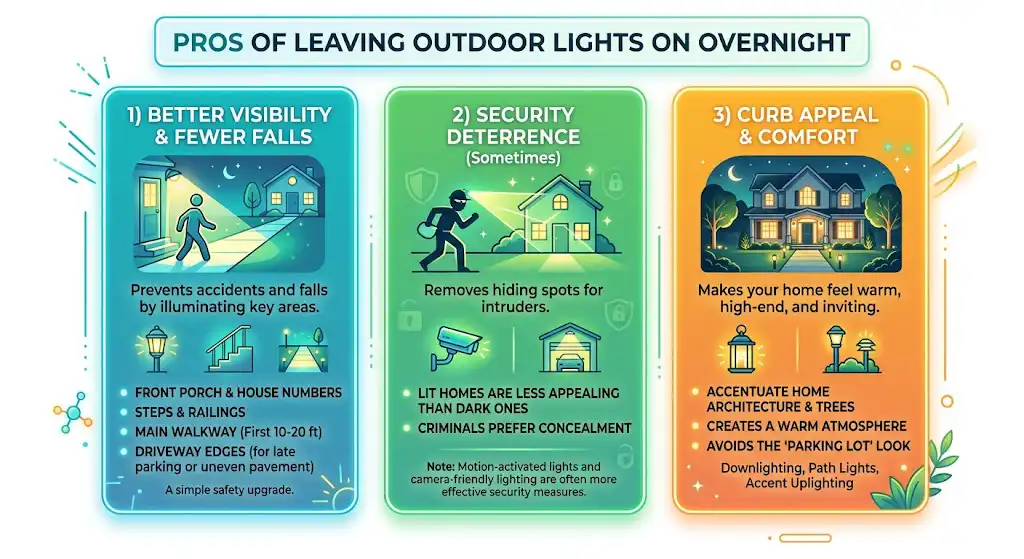
1) Better visibility and fewer falls
Pathway lights and porch lights can prevent accidents. I’ve been on plenty of calls where someone mentions they slipped on steps, missed a curb, or didn’t see ice near the entry. Good lighting is a simple safety upgrade.
Where constant light helps most
- Front porch and house numbers
- Steps and railings
- The first 10 to 20 feet of the main walkway
- Driveway edges if you park late or have uneven pavement
2) Security deterrence (sometimes)
A lit home can be less appealing than a dark home because it removes hiding spots. Security pros often say criminals prefer concealment. That said, lighting alone is not a complete security plan, and some thieves are bold enough to ignore it.
What works better than always on lighting is light that reacts (motion activation) and lighting that supports cameras (good angles, no glare, correct brightness).
3) Curb appeal and comfort
Landscape lighting can make your home feel warm and high end. Well placed downlighting, path lights, and accent uplighting can look incredible without making your yard look like a parking lot.
Cons of Leaving Outdoor Lights On All Night
1) Higher energy use and cost
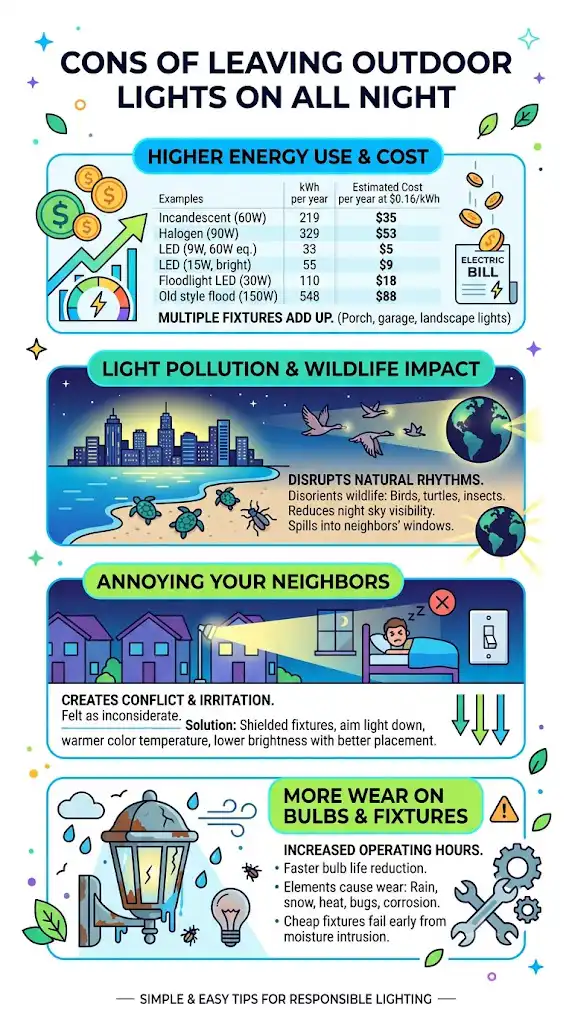
Leaving lights on for 8 to 12 hours a night adds up, especially if you have multiple fixtures or older bulbs.
To keep this practical, here’s a simple way to estimate cost:
Cost per year = (Watts ÷ 1000) x Hours per night x 365 x Electric rate
The average residential electric rate in the US often lands around the mid teens per kWh, but it varies a lot by state. I’ll use 0.16 per kWh as a realistic example rate.
Estimated annual cost of leaving one light on every night
| Bulb type and wattage | Hours per night | kWh per year | Estimated cost per year at 0.16 per kWh |
|---|---|---|---|
| Incandescent 60W | 10 | 219 | 35 |
| Halogen 90W | 10 | 329 | 53 |
| LED 9W (60W equivalent) | 10 | 33 | 5 |
| LED 15W (bright outdoor) | 10 | 55 | 9 |
| Floodlight LED 30W | 10 | 110 | 18 |
| Old style flood 150W | 10 | 548 | 88 |
Now multiply that by 3 to 8 fixtures and you can see why some homeowners notice their bill creeping up.
What I see in real homes
People often think they are running one porch light, but they are actually running a porch light, two garage sconces, a backyard flood, and landscape lights. That’s how the cost becomes noticeable.
2) Light pollution and wildlife impact
Excessive outdoor lighting contributes to light pollution. DarkSky International has long documented how poorly designed night lighting can disrupt wildlife, including disorienting migrating birds and sea turtle hatchlings and contributing to declines in nighttime insects.
Even if you don’t live near sensitive habitat, light pollution still matters because it:
- reduces night sky visibility
- spills into neighbors windows
- can disrupt natural day night rhythms for people and animals
3) Annoying your neighbors (and sometimes creating conflict)
This is a big one. A bright, unshielded floodlight aimed too high can light up someone else’s bedroom. Even if your intention is security, it can feel inconsiderate to the people around you.
If you want to keep the peace, focus on:
- shielded fixtures
- aiming light downward
- warmer color temperature
- lower brightness with better placement
4) More wear on bulbs and fixtures
Outdoor fixtures live a rough life: rain, snow, heat, bugs, wind, corrosion. Running them all night increases operating hours and usually reduces bulb life faster, especially with older technologies.
LEDs help a lot here, but cheap fixtures still fail early from moisture intrusion, poor seals, or corrosion.
Floodlights: Why People Leave Them On and Why I Usually Wouldn’t
Why homeowners like floodlights
Floodlights are popular because they create instant visibility over wide areas like:
- driveways
- backyards
- side yards
- sheds and gates
They also help cameras capture clearer color footage compared to a pitch dark yard.
The downside: harsh light and poor aesthetics
In my opinion, constant on floodlights often make a home look stark and overlit. They can wash out landscaping and create glare, which ironically can reduce visibility because your eyes constantly adjust to the brightness.
Better approach
- Put floodlights on motion sensors
- Use two zones if possible: low level accent lighting always on, bright flood only when triggered
What I Recommend Instead: A Balanced Lighting Plan That Actually Works
The best setup for most homes
Here’s the system I recommend most often because it checks the security box without wasting power.
My practical outdoor lighting layers
| Area | Goal | Best light type | Best control |
|---|---|---|---|
| Front porch and house numbers | Safe entry, deliveries | Sconce or porch LED | Dusk to dawn or timer |
| Walkway and steps | Trip prevention | Low glare path lights | Timer, dimmer, or dusk to dawn |
| Driveway and side yard | Security visibility | Floodlight | Motion sensor plus timer cutoff |
| Backyard patio | Comfort, entertaining | String lights, downlights | Smart dimmer or schedule |
| Gates, sheds, dark corners | Security | Flood or spot | Motion sensor |
This approach gives you light where you need it, when you need it.
LED, Timers, Motion Sensors, Smart Controls: What Actually Saves Money
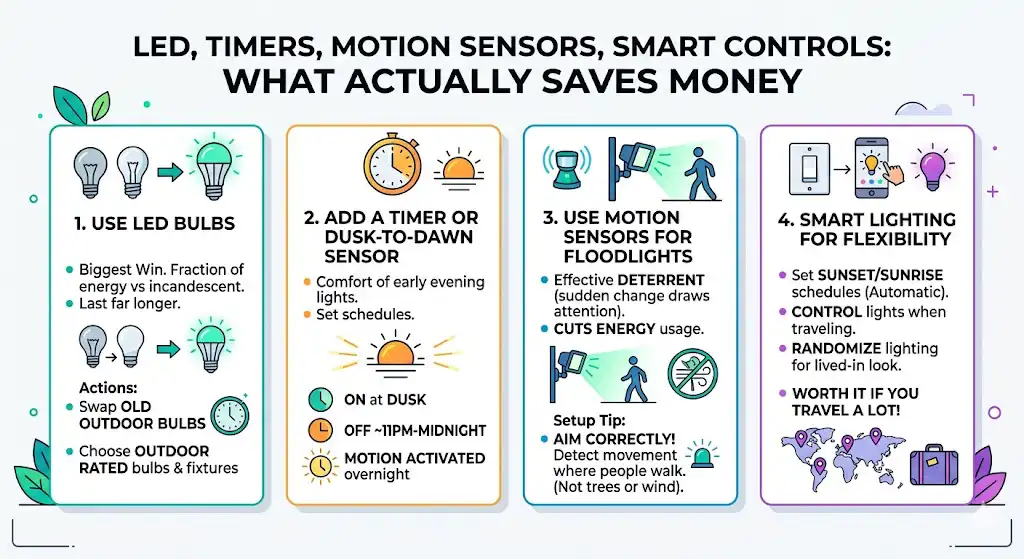
Use LED bulbs
LEDs are the biggest win. They use a fraction of the energy of incandescent or halogen for the same brightness and usually last far longer.
If you do nothing else, do this:
- Swap any older outdoor bulbs for LED
- Choose outdoor rated bulbs and fixtures
Add a timer or dusk to dawn sensor
If you like the comfort of lights being on early in the evening, schedule them.
A simple schedule that works for many homes:
- On at dusk
- Off around 11 pm or midnight
- Motion activated lighting stays active overnight
Use motion sensors for floodlights
Motion lights are one of the most effective deterrents because they create a sudden change that draws attention. They also cut energy usage because the light is off most of the night.
My setup tip
Aim them to detect movement where a person would actually walk, not where trees move in the wind. Poor aiming causes false triggers and annoys everyone.
Smart lighting for flexibility
Smart switches and smart bulbs let you:
- set sunset sunrise schedules automatically
- control lights when you are traveling
- randomize lighting patterns so your home looks lived in
If you travel a lot, this is worth it.
Color Temperature and Brightness: The Part Most People Get Wrong
If you want outdoor lighting that feels welcoming and is less disruptive, focus on two specs:
Choose warm light, not harsh blue white
- Warm white is typically around 2700K to 3000K
- Cooler light like 4000K to 5000K can feel harsh outdoors and contributes more to glare
Avoid overlighting
More light is not always more security. Glare can reduce your ability to see into darker areas, and it can also make your cameras struggle with overexposed hotspots.
If you want a cleaner look:
- use multiple smaller lights
- aim them down
- avoid bare bulbs and unshielded fixtures
When It Makes Sense to Leave Some Outdoor Lights On All Night
I’m not against overnight lighting. I just think it should be intentional.
You should consider leaving certain lights on if:
- Your entry path is genuinely hazardous (steps, uneven pavers, poor railings)
- You have frequent late night activity (shift work, caregivers, deliveries)
- Your neighborhood has low street lighting and you rely on your own light for safe entry
- You use low glare, shielded, warm LED fixtures that are not bothering neighbors
In those cases, I would still avoid leaving high powered floodlights on all night. I would keep it to porch and path lighting.
When You Should Turn Outdoor Lights Off (or Change Your Setup)
You should not run outdoor lighting all night if:
- the light shines into a neighbors windows
- you are using bright, unshielded floodlights
- your lights create glare that makes it harder to see
- your goal is security but you have no camera coverage, no sensors, and no alarm
If security is your main concern, lighting is only one layer. A basic camera system or monitored alarm does more than a constant on bulb.
My Quick Decision Guide: Should You Leave Outdoor Lights On All Night?
Answer these honestly:
- Are you lighting a walking path or just lighting the yard
- Are your fixtures shielded and aimed downward
- Are the bulbs LED and warm white
- Is the light bothering anyone else
- Would motion activation do the job better
My rule of thumb
- Porch and key pathways can stay on if they are low glare LED
- Floodlights should almost always be motion activated
- Landscape accent lighting is fine on a schedule, but you rarely need it until sunrise
Simple Checklist: A Better Outdoor Lighting Setup in One Weekend
If you want a straightforward upgrade path, do this in order:
- Replace bulbs with outdoor rated LEDs
- Set porch lights to dusk to dawn or a timer
- Put floodlights on motion sensors
- Adjust angles to prevent light trespass
- Choose 2700K to 3000K bulbs for comfort
- Consider a smart switch if you travel or keep irregular hours
FAQ
Does leaving outdoor lights on all night prevent burglars?
It can help, but it’s not foolproof. Some criminals avoid well lit areas, others don’t care. In real world security, motion lighting plus cameras plus good locks is more reliable than always on lighting alone.
Is it cheaper to leave LED outdoor lights on all night?
Cheaper than incandescent or halogen, yes. But it still costs money and can still contribute to light pollution. LEDs make overnight lighting more affordable, not automatically ideal.
What time should I turn my outdoor lights off?
A common balance is:
keep porch and walkway lights on until 11 pm or midnight
rely on motion lighting after that
If you’re coming home late often, keep the entry lights on longer but keep them warm and shielded.
Will outdoor lights affect my HVAC bill?
Not directly in a meaningful way. Outdoor lights do not change your heating or cooling load much. The main cost is the electricity the lights use themselves.
Bottom Line
If you ask me as someone who’s spent 10 plus years helping homeowners solve comfort, safety, and energy cost problems, the best answer is this:
Don’t leave bright outdoor lights on all night by default.
Instead, keep a few key, low glare LED lights on for safety, and let motion sensors handle the rest. You get the security effect, you protect your sleep and your neighbors, and you stop paying for light you don’t actually need.