
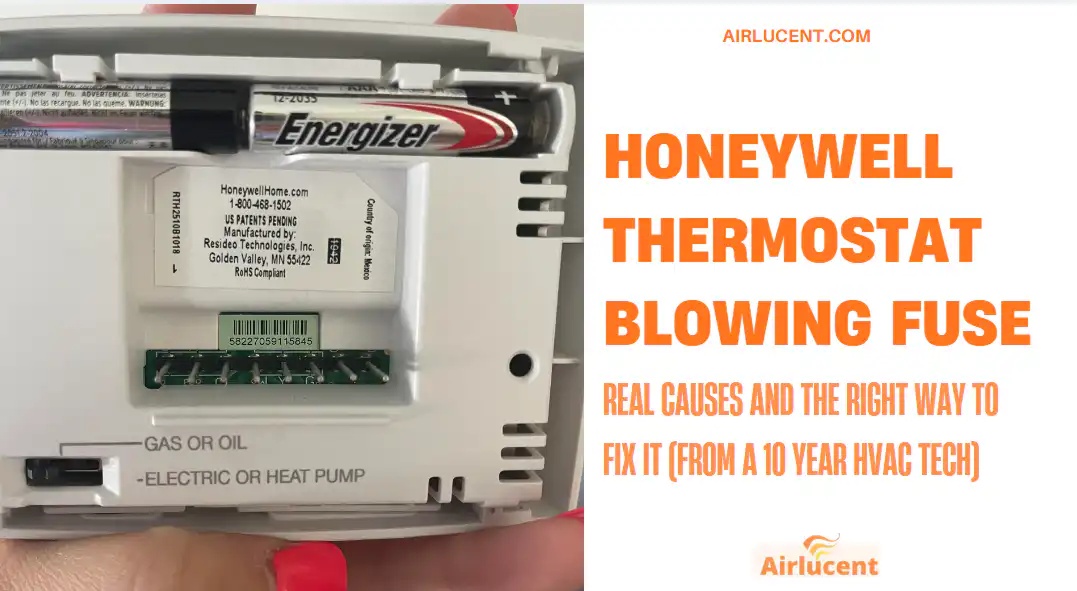
I’m Nathan. I’ve worked as an HVAC technician for over 10 years, and I’ve lost count of how many “my Honeywell thermostat keeps blowing the fuse” calls I’ve been on.
Here’s the truth: the fuse is almost never the real problem. A low voltage fuse (usually 3 amp or 5 amp) blows because there’s an active short circuit or an overcurrent draw somewhere in the 24V control circuit. If you keep tossing fuses at it, you’re not fixing anything, and you risk damaging the transformer or control board.
This guide walks you through the exact diagnostic process I use in the field, written like I’m talking you through it at your furnace.
- Quick answer (TLDR)
- First, where the fuse actually is (and what it protects)
- Immediate safety steps (do this first)
- How to confirm the fuse is actually blown
- What usually causes a Honeywell thermostat fuse to blow
- Thermostat terminals explained (so you don’t wire by color)
- The only diagnosis that matters: isolate the thermostat wiring
- How to find which wire or terminal is blowing the fuse
- Common Honeywell thermostat wiring mistakes that pop fuses
- If it only blows the fuse when cooling turns on
- If it only blows when heat turns on
- What fuse should you replace it with (exact match)
- Real world numbers: what I find most often
- When you should call a pro (and not keep testing)
- Prevention: how to stop this from happening again
- FAQ: Honeywell thermostat blowing fuse
Quick answer (TLDR)
- A blown 3A or 5A fuse on the furnace control board means there’s a short or overcurrent on the 24V wiring.
- The correct test is to shut power off, disconnect the thermostat wires from the control board, replace the fuse with the same rating, restore power.
- If the fuse holds: the short is in the thermostat, wall wiring, or something connected downstream.
- If the fuse blows with thermostat wires removed: the problem is inside the unit (control board, transformer, contactor coil, accessories). That’s usually time to call a pro.
First, where the fuse actually is (and what it protects)
When people say “Honeywell thermostat blowing fuse,” what’s really happening is:
- Your Honeywell thermostat is connected to the furnace or air handler by low voltage thermostat wiring.
- The furnace or air handler control board has a small blade style fuse that protects the 24VAC transformer and control board.
- If the thermostat wiring shorts, the board fuse sacrifices itself to prevent bigger damage.
In most systems, that fuse is an automotive style blade fuse located on the control board.
Typical fuse ratings you’ll see
| 3 amp | Many furnaces and air handlers | Most common. Must replace with same rating |
| 5 amp | Some air handlers, older boards, some brands | Still common. Must match exactly |
Important: Never install a higher amp fuse to “stop it from blowing.” That’s how control boards get cooked.
Immediate safety steps (do this first)
Before you remove panels or touch thermostat wiring:
- Turn off power at the breaker (or the furnace service switch).
- Confirm the blower is off and the board has no lights (or is clearly not powered).
- If you open the blower door, know many units have a door safety switch that cuts power, but do not rely on it. Kill power at the breaker anyway.
A fuse that keeps blowing is an active electrical fault. Treat it like one.
How to confirm the fuse is actually blown
Most board fuses are easy to check:
- Pull the fuse and look through the plastic. If the metal link is broken or burned, it’s blown.
- Better: use a multimeter on continuity mode.
- Good fuse: continuity.
- Blown fuse: no continuity.
Before you blame the fuse, also check these common “no heat / no cool” issues that are not fuse related:
- Breaker tripped
- Furnace switch off
- Furnace door not fully seated (door interlock switch open)
- Drain float switch tripped (common on AC systems, usually shuts off cooling but does not always blow a fuse)
What usually causes a Honeywell thermostat fuse to blow
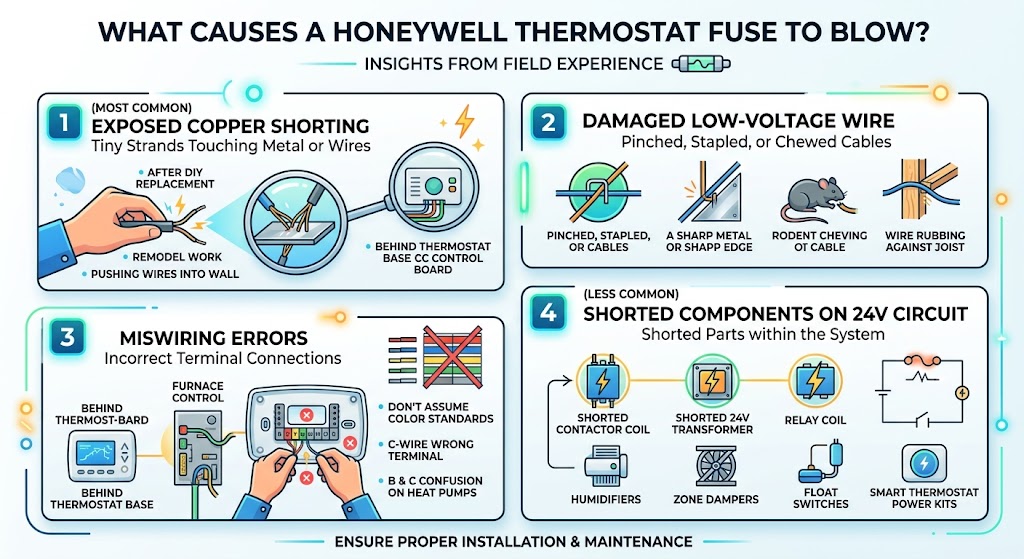
In my day to day field experience, most repeat fuse blowouts come down to damaged thermostat wiring or a wiring mistake at the thermostat base.
Here are the most common causes, in the order I tend to find them.
1. Exposed copper touching metal or another wire (most common)
This happens a lot after:
- DIY thermostat replacement
- Remodel work
- Someone pulling the thermostat off and pushing wires back into the wall
A tiny strand of copper touching the metal wall plate or another terminal is enough to short 24V and pop the fuse.
Where I find it:
- Behind the Honeywell thermostat sub base
- At the furnace control board where wires enter the cabinet
- At a wire splice (attic, basement, near a humidifier)
2. Pinched, stapled, or chewed thermostat wire
Low voltage wire gets damaged by:
- Staples through the cable
- Sharp sheet metal edges at the furnace cabinet entry
- Rodents in attics and crawlspaces
- Wire rubbing on a joist or metal strap over time
3. Miswiring, especially around C and heat pump terminals
This is a big one with thermostat swaps. People assume wire colors are standardized. They are not.
Two common examples:
- C wire accidentally landed on the wrong terminal
- B and C confusion on heat pump systems (depending on equipment and thermostat setup, B is not the same thing as C)
If a common wire gets grounded or landed incorrectly, you can pop the fuse immediately.
4. A shorted component on the 24V circuit (less common, but real)
These can include:
- Shorted contactor coil (outside AC condenser)
- Shorted 24V transformer
- Shorted relay coil
- Add ons like humidifiers, zone dampers, float switches, smart thermostat power kits
If any of these are wired into the same 24V circuit and fail, the fuse can blow.
Thermostat terminals explained (so you don’t wire by color)
Here’s a quick table I use when explaining wiring to homeowners.
| R | 24V power from transformer | Feeds the thermostat |
| C | Common side of transformer | Completes circuit for power stealing or smart stats |
| G | Fan | Indoor blower relay |
| Y | Cooling | Outdoor unit contactor (cool call) |
| W | Heat | Heat call (gas valve or heat relay) |
| O or B | Heat pump reversing valve | Depends on brand and setup |
Tip from the field: Match terminal letters, not wire colors. Always look at the furnace control board terminals and confirm they match what you’re doing at the Honeywell base.
The only diagnosis that matters: isolate the thermostat wiring
This is the exact method I use because it quickly tells you whether the short is in the wall wiring or inside the equipment.
Tools that help
- Correct replacement fuses (same amp rating)
- Flashlight
- Small screwdriver
- Phone camera (take pictures before touching anything)
- Multimeter (optional but very helpful)
Step by step: isolate and test (my go to process)
Step 1: Turn off power
Turn off the breaker to the furnace or air handler.
Step 2: Find the control board fuse and note the rating
Look for a small blade fuse on the board. Confirm if it’s 3A or 5A.
Step 3: Photograph the thermostat wiring at the board
Take a clear picture so you can put everything back exactly.
Step 4: Disconnect thermostat wires from the control board
Remove the small thermostat wires from terminals like R, C, Y, G, W, O, etc.
Important: You are removing the thermostat cable from the control board so the board is no longer connected to the thermostat or the wire run.
Step 5: Install a new fuse with the exact same rating
Do not change the fuse size.
Step 6: Restore power with thermostat wires still disconnected
Now watch what happens.
Interpret the result
If the fuse holds
Good news. That means the board and transformer can survive with no thermostat wiring attached.
So the short is likely in:
- The Honeywell thermostat base wiring
- The thermostat cable in the wall
- Something connected to those thermostat terminals (like an outdoor unit control wire on Y and C)
Next step is finding which circuit is the culprit.
If the fuse blows immediately even with thermostat wires disconnected
That points to an internal issue such as:
- Shorted control board
- Transformer short
- Internal low voltage wiring short inside the cabinet
- Accessory wired directly to the board
This is usually the line where I tell homeowners to stop and schedule service, because you’re now into deeper electrical diagnostics and sometimes live testing.
How to find which wire or terminal is blowing the fuse
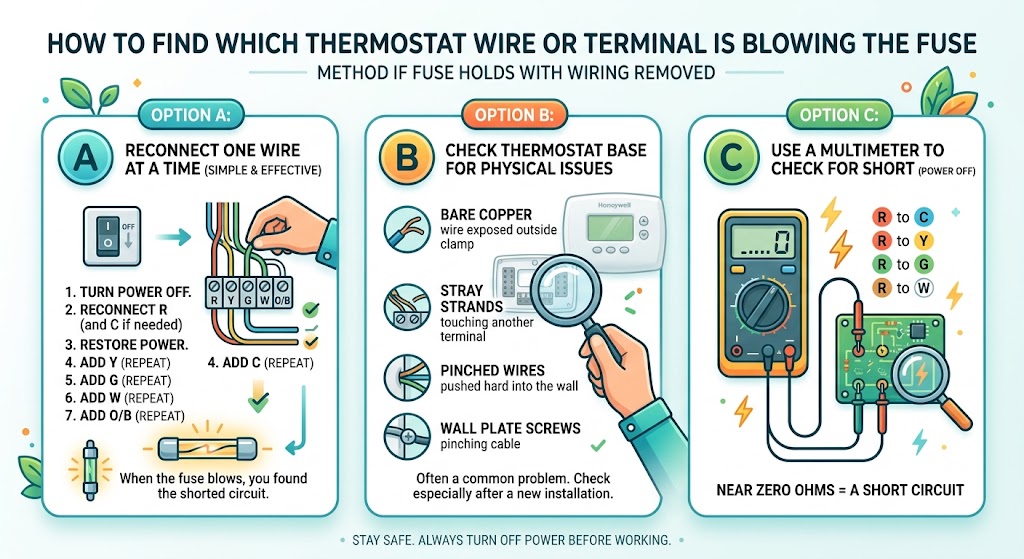
If the fuse holds with thermostat wiring removed, here’s the method that works.
Option A: Reconnect one wire at a time (simple and effective)
- Turn power off again.
- Reconnect only R (and C if needed for your thermostat, but start minimal).
- Restore power and see if fuse holds.
- Add one more wire (Y, then G, then W, then O/B) and repeat.
When the fuse blows right after adding a specific wire, you just narrowed down the circuit that’s shorted.
Option B: Check the thermostat base for bare copper and pinched wires
I always check behind the thermostat first because it’s fast and common.
What I look for:
- Copper showing outside the terminal clamp
- Stray strands touching another terminal
- Wires pushed so hard into the wall they rub metal
- Wall plate screws pinching the cable
If you just installed the Honeywell thermostat, this is the first place I’d expect to find the issue.
Option C: Use a multimeter to check for a short (power off)
With thermostat wires disconnected at both ends (best), check resistance between pairs:
- R to C
- R to Y
- R to G
- R to W
If you see near zero ohms, that’s a short.
Common Honeywell thermostat wiring mistakes that pop fuses
Here are mistakes I see in real homes, not just in manuals.
Mistake 1: Confusing C with something else
If your old thermostat didn’t use a C wire and you add one, it must land on C at the control board and C at the thermostat.
Landing it on the wrong terminal can short the 24V circuit.
Mistake 2: Heat pump O/B wiring errors
If you have a heat pump, O/B wiring can be confusing. Wrong wiring here may not always blow a fuse, but if it causes a dead short due to mislanding or damaged wire, it can.
If you’re not 100 percent sure you have a heat pump, check:
- Do you have an outdoor unit that runs in both heating and cooling
- Do you have an O or B wire connected at the thermostat
Mistake 3: Wiring by color instead of terminal letters
I’ve seen:
- Blue used as Y
- Yellow used as C
- White used as G
That’s why I keep repeating: letters matter, colors don’t.
If it only blows the fuse when cooling turns on
That usually points to the Y circuit.
Common causes:
- The Y wire is shorted to C somewhere in the run
- The outdoor condenser contactor coil is shorted
- The thermostat cable going outside is rubbed through at the wall penetration
- A float switch or safety wired into Y is miswired or failed
A quick clue from the field:
- If the fuse holds until the thermostat calls for cooling, I immediately suspect the Y circuit or anything tied into Y.
If it only blows when heat turns on
That often points to W.
Possible causes:
- W wire short to C or ground
- Short inside the furnace around gas valve control wiring (less common)
- Miswire at thermostat base after replacement
What fuse should you replace it with (exact match)
Replace with the same:
- Amp rating (3A or 5A)
- Same style (blade fuse, typically mini or standard depending on board)
Blade fuse colors are often:
- 3A violet or purple
- 5A tan or orange depending on the fuse type and brand
Do not rely on color alone. Read the number on the fuse.
Real world numbers: what I find most often
I can’t speak for every contractor in every region, but based on what I’ve personally seen over 10 years:
| Exposed copper or wiring mistake at thermostat base | Very common |
| Damaged thermostat cable in wall or attic (staple, rub, rodent) | Common |
| Shorted outdoor contactor coil or Y circuit issue | Sometimes |
| Failed transformer or control board issue | Less common, but serious when it happens |
The main takeaway is this: most cases are wiring related, not “bad fuses.”
When you should call a pro (and not keep testing)
I’m all for homeowners doing safe troubleshooting, but I also know where DIY turns into expensive damage.
Call a licensed HVAC tech if:
- The fuse blows with thermostat wires removed from the board
- You suspect a transformer issue
- You suspect control board damage
- You have accessories tied into the 24V circuit and you’re not sure how they’re wired
- You’re not comfortable working inside the furnace cabinet
Also, if you ever feel tempted to upsize the fuse, stop and call. That fuse is protecting equipment that can cost hundreds to thousands to replace.
Prevention: how to stop this from happening again
If you’re installing or re installing a Honeywell thermostat:
- Strip only a small amount of insulation (just enough to clamp)
- No copper should be exposed outside the terminal
- Tug each wire lightly to confirm it’s secured
- Keep wires separated and not mashed into the wall cavity
- Use labels or take photos before moving anything
- If the wire passes through sheet metal, it should have a grommet or be protected from sharp edges
FAQ: Honeywell thermostat blowing fuse
Why does my thermostat keep blowing the fuse right after I replace it?
Because the fuse isn’t the root problem. You still have a short circuit or overcurrent draw on the 24V wiring. Do the isolation test by disconnecting thermostat wires at the control board and retesting.
Is it safe to keep replacing the fuse until it stops blowing?
No. A repeatedly blown fuse means an active fault. Continuing can damage the transformer, control board, or wiring insulation. Diagnose the short instead.
Can I use a higher amp fuse so it stops blowing?
No. A higher rated fuse can allow the board or transformer to take damage before the fuse opens. You can turn a simple wiring short into a control board replacement.
Is this a Honeywell problem specifically?
Not really. Honeywell, Nest, ecobee, and basic thermostats all connect to the same 24V control circuit. A short in wiring will blow the furnace fuse no matter what thermostat brand is on the wall.
Can a bad thermostat cause the fuse to blow?
It can, but it’s not the first thing I suspect. More often, the issue is exposed copper at the thermostat base or a damaged cable. If you isolate the wiring and the fuse only blows when the thermostat is connected, then yes, the thermostat sub base or thermostat could be shorted.