
BTU Calculator
Quick BTU conversions, capacity estimates, and reference tools
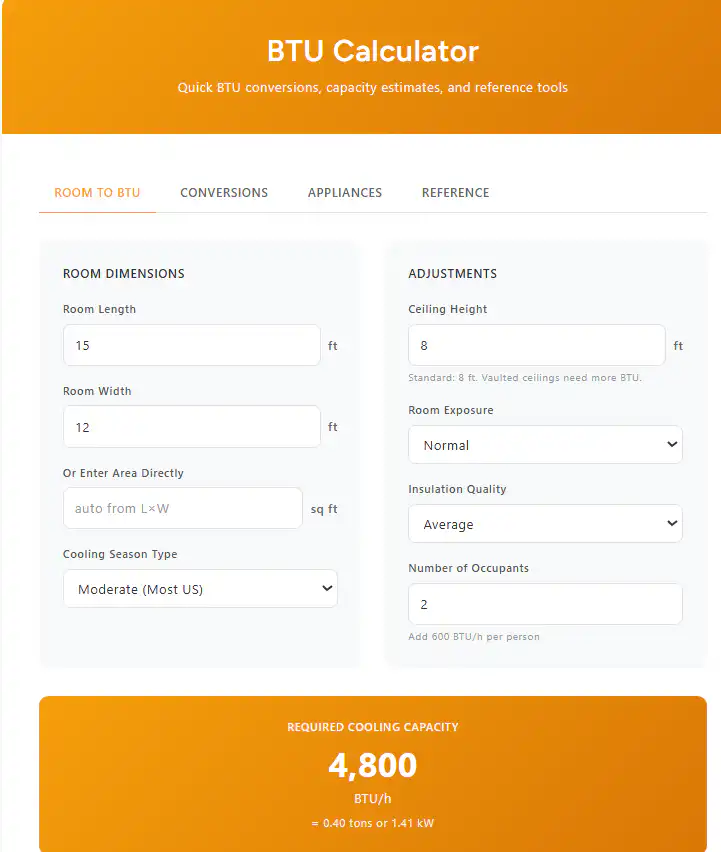
Room Dimensions
ft
ft
sq ft
Adjustments
ft
Standard: 8 ft. Vaulted ceilings need more BTU.
Add 600 BTU/h per person
Required Cooling Capacity
36,000
BTU/h
= 3.0 tons or 10.5 kW
Tons
3.0
Kilowatts
10.5
BTU/sq ft
20
Power (est.)
2.4 kW
💡 Pro Tips
- Rule of Thumb: 20 BTU per square foot is the baseline for average conditions.
- Occupancy: Each person adds ~600 BTU/h; adjust for offices/living spaces.
- Ceiling Height: Vaulted or high ceilings require 10–20% more capacity.
- Oversizing Risk: Undersizing causes discomfort; oversizing wastes energy and causes short-cycling.
- Climate Matters: Hot/humid regions need 15–25% more capacity than temperate zones.
Convert BTU/h to Other Units
Tons
3.0
Kilowatts
10.55
Watts
10,546
kJ/s
10.55
Convert Tons to BTU/h
1 ton = 12,000 BTU/h
BTU per Hour
36,000
BTU/h
Convert Watts to BTU/h
W
BTU per Hour
8,188
BTU/h
= 0.68 tons
Energy Consumption to BTU
For 1 hour of operation
Heat Output / Energy Gained
34,120
BTU
🔢 Conversion Quick Reference
- 1 ton AC = 12,000 BTU/h (fundamental for HVAC sizing)
- 1 kW = 3,412 BTU/h (electrical to thermal)
- 1 watt = 3.412 BTU/h (power to heat)
- SEER rating: BTU/h ÷ watts = efficiency ratio (higher is better)
- 1 kWh = 3,412 BTU (energy equivalence for billing)
Common Appliance Heat Output
📊 How to Use
- Click any appliance to add its heat output to your room load.
- Cumulative effect: Multiple appliances or a busy kitchen can add 2,000–5,000 BTU/h.
- Operating time matters: A 5,000 BTU oven adds full heat for 1–2 hours during use, not all day.
- Ventilation: Range hoods and exhaust fans remove ~70–80% of cooking heat when properly sized.
Room Size to BTU Reference Chart
| Room Size | Mild Climate | Moderate Climate | Hot Climate | Hot & Humid |
|---|---|---|---|---|
| 100 sq ft | 2,000 | 2,500 | 3,000 | 3,500 |
| 200 sq ft | 4,000 | 5,000 | 6,000 | 7,000 |
| 300 sq ft | 6,000 | 7,500 | 9,000 | 10,500 |
| 400 sq ft | 8,000 | 10,000 | 12,000 | 14,000 |
| 500 sq ft | 10,000 | 12,500 | 15,000 | 17,500 |
| 600 sq ft | 12,000 | 15,000 | 18,000 | 21,000 |
| 800 sq ft | 16,000 | 20,000 | 24,000 | 28,000 |
| 1,000 sq ft | 20,000 | 25,000 | 30,000 | 35,000 |
| 1,500 sq ft | 30,000 | 37,500 | 45,000 | 52,500 |
| 2,000 sq ft | 40,000 | 50,000 | 60,000 | 70,000 |
Equipment Sizing Reference
| Equipment Size | BTU/h | Watts | Typical Use |
|---|---|---|---|
| 0.5 ton | 6,000 | 1,759 | Small bedroom, office |
| 1 ton | 12,000 | 3,517 | Master bedroom, small apartment |
| 1.5 tons | 18,000 | 5,276 | Large bedroom, small house |
| 2 tons | 24,000 | 7,034 | Small house, large apartment |
| 2.5 tons | 30,000 | 8,793 | Medium house |
| 3 tons | 36,000 | 10,551 | Medium-large house |
| 4 tons | 48,000 | 14,068 | Large house, small commercial |
| 5 tons | 60,000 | 17,585 | Very large house, commercial |
📌 Key Facts
- Baseline Rule: 20 BTU/h per square foot for average 8-ft ceilings.
- Climate Adjustment: Multiply by 0.75 (cool) to 1.5 (very hot) based on your region.
- Never Undersizing: Too small = discomfort and won't reach setpoint on hot days.
- Beware Oversizing: Too large = short cycles, poor humidity control, and wasted energy.
- 1% vs 99%: Peak design assumes worst-case outdoor temp (1% of the time).
💡 DID YOU KNOW? ✨
Loading interesting facts...
🔄 Rotates every 6 seconds