If your AC won’t go below 74°F, it usually means one of three things is happening:
- The system is hitting its real-world cooling limit because it’s extremely hot outside
- Airflow is restricted
- The system can’t move heat correctly
I’m Nathan. I’ve worked as an HVAC technician for over 10 years, and this “stuck at 74” complaint is one of the most common calls I get during heat waves. The good news is that you can safely check several things yourself before you spend money on a service call. And if it does need a pro, I’ll tell you exactly what to ask for so you don’t get vague answers.
- Why 74°F Becomes the “Sticking Point” for So Many Homes
- Start Here: The 10-Minute Troubleshooting Checklist (Safe DIY)
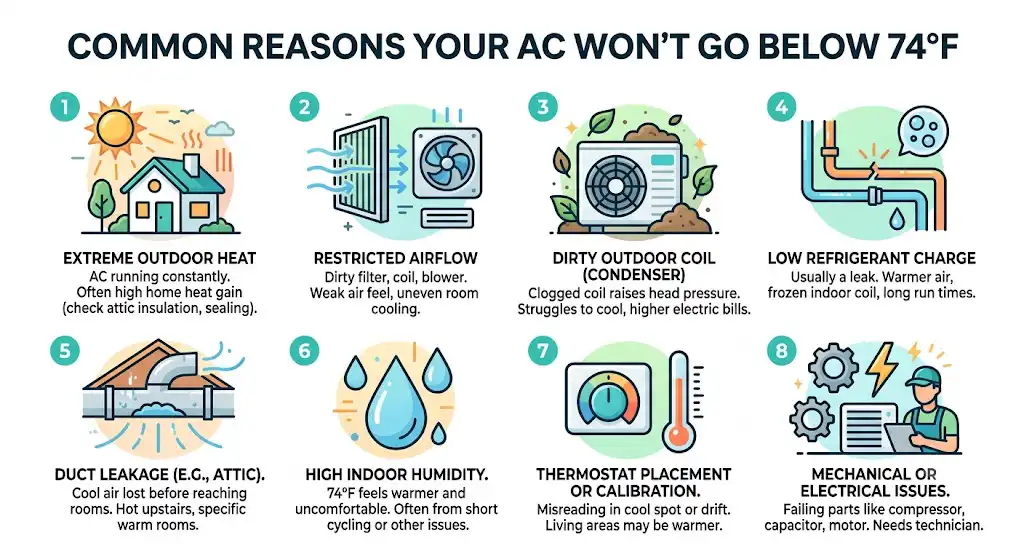
- The Most Common Reasons Your AC Won’t Go Below 74°F
- 1) Outdoor heat is overwhelming the system (sometimes normal)
- 2) Restricted airflow (my number one “stuck at 74” culprit)
- 3) Dirty outdoor coil (condenser can’t reject heat)
- 4) Low refrigerant charge (usually from a leak)
- 5) Duct leakage (cool air never reaches you)
- 6) High indoor humidity making 74°F feel warmer
- 7) Thermostat placement or calibration issues
- 8) Mechanical or electrical issues (needs a technician)
- Symptom-to-Cause Table (What Your AC Is Telling You)
- A Simple Performance Check You Can Do: The “Temperature Split”
- What I Recommend If It’s 95°F+ Outside (Quick Comfort Wins)
- When to Call a Professional (And What to Tell Them)
- FAQ: AC Won’t Go Below 74°F
- Bottom Line (What I’d Do in Your House)
Why 74°F Becomes the “Sticking Point” for So Many Homes
Most residential air conditioners are designed to maintain a temperature difference (often called the “design delta”) of about 20°F to 25°F below the outdoor temperature under typical conditions.
So if it’s 98°F outside, many homes will struggle to get lower than the mid 70s, especially if you have:
- High humidity
- Lots of sun exposure through windows
- Poor attic insulation
- Leaky ductwork
- An aging system or dirty coils
This isn’t just opinion. Common HVAC design guidance (including ACCA residential design practices) aims for a reasonable indoor setpoint around 75°F during peak outdoor design conditions. That means your system may be doing “about all it can” even if it’s running properly.
Quick reality check table (outdoor temp vs realistic indoor target)
| 85°F | 70°F to 74°F | Many systems can hit low 70s |
| 90°F | 72°F to 76°F | Depends heavily on humidity and insulation |
| 95°F | 74°F to 78°F | Low 70s becomes difficult in many homes |
| 100°F | 76°F to 80°F | AC may run nonstop and still stall |
If you used to hit 70–72°F easily and now you can’t get below 74°F, that’s when I start suspecting maintenance issues, airflow problems, or refrigerant trouble.
Start Here: The 10-Minute Troubleshooting Checklist (Safe DIY)
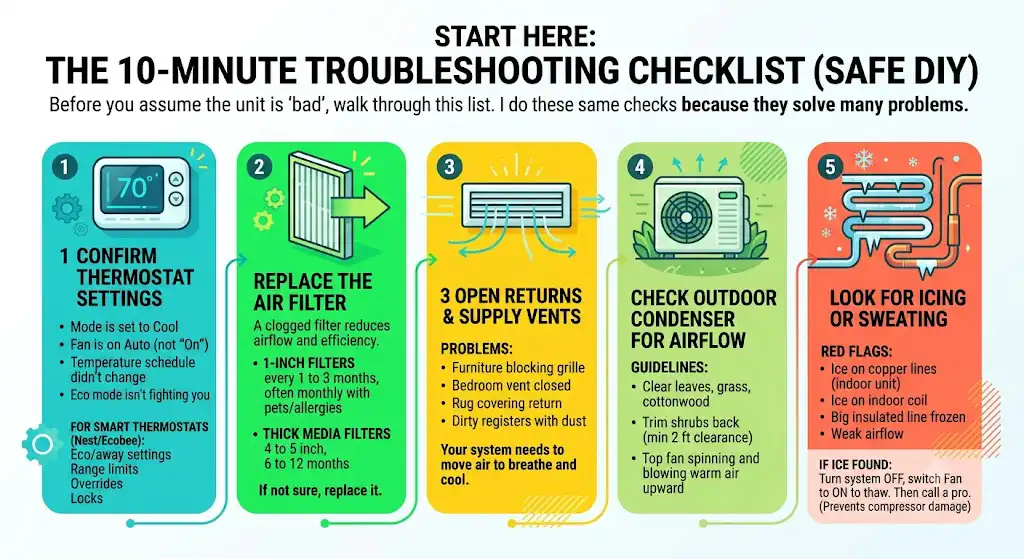
Before you assume the unit is “bad,” walk through this list. I do these same checks on calls because they solve a surprising number of problems.
1) Confirm thermostat settings (and hidden limits)
Check:
- Mode is set to Cool
- Fan is on Auto (not “On,” which can feel warmer and more humid)
- Temperature schedule didn’t change
- Eco mode isn’t fighting you (common on smart thermostats)
- Temperature isn’t capped (landlord settings or thermostat lock)
If you have a Nest/Ecobee or similar, look for:
- Eco/away settings
- Temperature range limits
- Schedule overrides
- “Lock” features
2) Replace the air filter (don’t just look at it)
A partially clogged filter can reduce airflow enough that your system can’t move heat out of the house efficiently.
General filter guidelines I share with homeowners:
- 1-inch filters: every 1 to 3 months
- Homes with pets, allergies, renovations: often monthly
- Thick media filters (4 to 5 inch): 6 to 12 months (varies)
If you’re not sure, replace it. It’s the cheapest “repair” you can do.
3) Make sure returns and supply vents are open
I can’t tell you how often a stuck-at-74 problem is simply:
- Furniture blocking a return grille
- A bedroom vent closed “for comfort”
- A rug covering a return
- Dirty supply registers packed with dust
Your system needs to move a lot of air. If it can’t breathe, it can’t cool.
4) Check the outdoor condenser for airflow
Go outside and look at the unit:
- Clear leaves, grass clippings, cottonwood fluff
- Trim shrubs back (I recommend at least 2 feet of clearance)
- Make sure the top fan is spinning and blowing warm air upward
5) Look for icing or sweating where it shouldn’t
Red flags:
- Ice on the copper lines near the indoor unit
- Ice on the indoor coil (often visible if you remove the panel)
- The big insulated line is frozen solid
- Weak airflow from vents
If you see ice: turn the system off and switch the fan to On to thaw it, then call a pro. Running it frozen can damage the compressor.
The Most Common Reasons Your AC Won’t Go Below 74°F
1) Outdoor heat is overwhelming the system (sometimes normal)
During extreme heat, your AC may run continuously. That’s not automatically a failure.
But here’s what I tell people: if your system runs all day and holds steady (not climbing), that often means it’s working but the home’s heat gain is high.
Common hidden heat gain sources:
- Attic insulation is thin or missing
- Leaky attic hatch
- West-facing windows with no shading
- Dryer/oven use during hottest hours
- Gaps around doors/windows
- Ducts in a hot attic leaking cool air
If you want a huge comfort improvement without replacing equipment, air sealing and attic insulation are often the best bang for your buck. The U.S. Department of Energy consistently highlights air sealing and insulation as top ways to reduce cooling load and improve comfort.
2) Restricted airflow (my number one “stuck at 74” culprit)
Air conditioners don’t “make cold.” They move heat. If airflow is low, heat transfer drops.
Restricted airflow causes include:
- Dirty filter
- Dirty evaporator coil
- Blower wheel clogged with dust
- Closed/blocked vents
- Collapsed or kinked flex duct
- Undersized return ducting
What it feels like in the house
- AC runs constantly
- Bedrooms far from the air handler are warmer
- Air feels weak at vents
- Humidity feels high even when temperature is “okay”
3) Dirty outdoor coil (condenser can’t reject heat)
When the outdoor coil is clogged, the system’s head pressure rises and capacity drops. Translation: it struggles to cool and your electric bill goes up.
You can clear debris around the unit yourself. But deep cleaning should be done carefully to avoid bending fins or damaging components.
4) Low refrigerant charge (usually from a leak)
Refrigerant doesn’t get “used up.” If it’s low, there’s typically a leak.
Common signs I see on low-charge systems:
- Takes forever to cool
- Warmer air from vents
- Indoor coil freezing
- Hissing/bubbling near the coil or lines
- Higher energy use for less comfort
Important: Refrigerant work is regulated and requires proper tools and licensing. “Topping it off” without fixing the leak is usually a temporary (and expensive) cycle.
5) Duct leakage (cool air never reaches you)
If your ducts run through a hot attic and they’re leaking, you can lose a lot of cooling before it ever gets to the rooms.
Typical clues:
- Upstairs is hot, downstairs is okay
- Certain rooms never cool
- Dusty attic smell when AC runs
- Visible disconnected ducts in attic (it happens more than you’d think)
ENERGY STAR and many utility programs regularly point out duct sealing as a major efficiency and comfort upgrade, especially for attic duct systems.
6) High indoor humidity making 74°F feel warmer
Comfort isn’t just temperature. Humidity matters a lot.
ASHRAE comfort guidance generally places many people’s comfort zone around 30 to 60 percent relative humidity (with typical indoor temps). When humidity climbs, 74°F can feel sticky and uncomfortable, like the AC “isn’t working.”
Humidity gets worse when:
- The system short cycles (often oversized equipment)
- Airflow is wrong
- Ducts leak
- Outdoor air infiltration is high
- The evaporator coil is dirty
7) Thermostat placement or calibration issues
If the thermostat is in a cool hallway, it may read 74°F while the west-facing living room is 78°F.
Also, some thermostats drift out of calibration. A simple test: place a reliable thermometer near the thermostat for 15 to 20 minutes and compare readings.
8) Mechanical or electrical issues (needs a technician)
These are issues I don’t recommend DIY-ing:
- Weak capacitor (fan/compressor not running properly)
- Failing compressor
- Contactor issues
- Blower motor problems
- Metering device restrictions (TXV/piston)
- Drain problems causing safety shutoffs on some systems
Symptom-to-Cause Table (What Your AC Is Telling You)
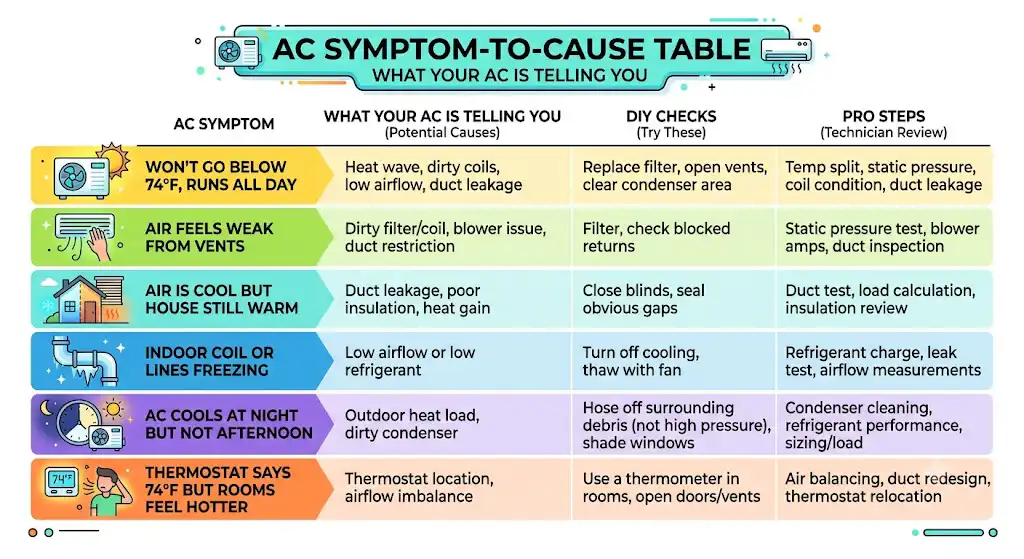
| Won’t go below 74°F, runs all day | Heat wave, dirty coils, low airflow, duct leakage | Replace filter, open vents, clear condenser area | Temp split, static pressure, coil condition, duct leakage |
| Air feels weak from vents | Dirty filter/coil, blower issue, duct restriction | Filter, check blocked returns | Static pressure test, blower amps, duct inspection |
| Air is cool but house still warm | Duct leakage, poor insulation, heat gain | Close blinds, seal obvious gaps | Duct test, load calculation, insulation review |
| Indoor coil or lines freezing | Low airflow or low refrigerant | Turn off cooling, thaw with fan | Refrigerant charge, leak test, airflow measurements |
| AC cools at night but not afternoon | Outdoor heat load, dirty condenser | Hose off surrounding debris (not high pressure), shade windows | Condenser cleaning, refrigerant performance, sizing/load |
| Thermostat says 74°F but rooms feel hotter | Thermostat location, airflow imbalance | Use a thermometer in rooms, open doors/vents | Air balancing, duct redesign, thermostat relocation |
A Simple Performance Check You Can Do: The “Temperature Split”
If you have a basic thermometer, you can do a quick sanity check.
- Let the AC run for 10 to 15 minutes
- Measure temperature at the return (where air is sucked in)
- Measure at a supply vent closest to the indoor unit
A typical system often shows about 16°F to 22°F difference in many normal conditions.
Example:
- Return air: 78°F
- Supply air: 58°F to 62°F
That’s generally a decent sign.
If your split is very low (like 8°F to 12°F), it can indicate low capacity from airflow, refrigerant, or outdoor coil issues. If it’s extremely high and airflow is weak, you might be headed toward icing.
This is not a perfect diagnosis, but it helps you decide whether you’re dealing with “home heat load” versus “system performance.”
What I Recommend If It’s 95°F+ Outside (Quick Comfort Wins)
If you’re in a heat wave and you just need relief today, here’s what actually helps:
- Set thermostat to a realistic target (even 74–76°F) and keep it steady
- Close blinds on sun-facing windows (especially west-facing)
- Avoid oven, long showers, and heat-producing appliances from 2–7 pm
- Replace filter and confirm vents are open
- Run ceiling fans to improve comfort (fans don’t lower temperature, but they help you feel cooler)
When to Call a Professional (And What to Tell Them)
Call for service if:
- It used to cool below 74°F and suddenly can’t
- The system runs constantly and indoor temp still rises
- You see ice, hear hissing, or airflow is very weak
- The outdoor unit is loud, not running, or cycling oddly
- Breaker trips or you smell electrical odor
What I’d ask the technician to measure (this matters)
A good diagnostic is not guesswork. I’d want numbers, including:
- Temperature split (return vs supply)
- Static pressure (tells you airflow health)
- Refrigerant superheat/subcooling (not just “added Freon”)
- Indoor and outdoor coil condition
- Delta across filter and coil if needed
- Duct leakage or airflow balance if certain rooms are hot
If a tech only offers to “top it off” without leak testing or checking airflow, that’s a red flag in my book.
FAQ: AC Won’t Go Below 74°F
Can a dirty air filter really cause my AC to stall at 74°F?
Absolutely. I’ve seen a cheap clogged filter knock a system down enough that it can’t keep up. It also increases the risk of coil freezing and blower strain.
Should I set the thermostat to 65°F to force it to cool faster?
No. Most systems cool at roughly the same rate regardless of setpoint. Dropping it to 65°F just makes it run longer and can make icing more likely if there’s an airflow issue.
Does “stuck at 74” mean I need a new AC?
Not automatically. Many cases are solved with:
Filter and coil cleaning
Airflow repairs
Refrigerant leak repair
Duct sealing
Replacement becomes a bigger conversation when the system is old, inefficient, and needs frequent repairs or can’t meet demand even after issues are corrected.
Bottom Line (What I’d Do in Your House)
If your AC won’t go below 74°F, I’d start with the fast, safe stuff: thermostat settings, a new filter, open vents and returns, and a clear outdoor unit. If the problem continues, the most common “real fixes” I see are airflow corrections, coil cleaning, refrigerant leak repair, and duct sealing.
![Honeywell Hz311 Zone 2 And 3 Red Light: [Solved]](https://airlucent.com/wp-content/uploads/2022/08/Honeywell-Hz311-Zone-2-And-3-Red-Light-Solved-150x150.jpg)