

If a room feels sticky, heavy, or musty even when the temperature looks fine, you’re usually dealing with high relative humidity. I’ve been an HVAC technician for over a decade, and this is one of the most common “summer comfort” complaints I get. The good news is you can often bring humidity down naturally by doing two things:
- Stop adding moisture to the air
- Get that moisture out faster than it’s being added
This guide is the exact approach I walk homeowners through. I’ll give you quick wins you can do today, plus deeper fixes for basements and “it keeps coming back” rooms.
- Quick answer: What humidity should you aim for?
- Ideal indoor humidity by room (practical targets)
- Step 1: Measure first (so you don’t guess wrong)
- A key concept most people miss: RH vs dew point (why windows can “make it worse”)
- Natural ways to reduce humidity in a room (what actually works)
- 1) Ventilate the right way (timing matters)
- My field rule
- Best setup for natural airflow
- 2) Run bathroom exhaust fans longer than you think
- What I recommend
- 3) Take shorter, slightly cooler showers
- Simple routine that works
- 4) Vent moisture at the source when cooking
- Do this every time you cook
- 5) Stop drying clothes indoors (or change how you do it)
- Better options
- 6) Use sunlight strategically
- Practical changes
- 7) Increase air movement (fans don’t remove moisture, but they help)
- What I do in problem rooms
- 8) Fix leaks and hidden moisture fast
- Quick home check
- Pro tip: stop pipe sweating
- 9) Be smart with houseplants (more is not always better)
- What I recommend
- 10) Use natural moisture absorbers (best for closets and small spaces)
- The biggest hidden moisture sources (what to target first)
- Room-by-room playbook (what I’d do in your home)
- Mistakes I see homeowners make (avoid these)
- Quick 3-day action plan (start here)
- When natural fixes aren’t enough (and what it usually means)
- FAQ
- Sources I trust for humidity guidance
Quick answer: What humidity should you aim for?
Most homes feel best and stay healthiest when indoor relative humidity (RH) is around:
- 35% to 50% RH for most living spaces
- Try to keep it under 50% in summer if possible
- Consistently above 60% RH greatly increases the risk of mold and dust-mite issues
This general target aligns with widely used building and health guidance (for example, Health Canada and ASHRAE comfort recommendations commonly land in this range).
Ideal indoor humidity by room (practical targets)
| Bedroom | 40% to 50% | Better sleep comfort, less “heavy air” overnight |
| Living room | 35% to 50% | Best all-around comfort band |
| Bathroom | Under 50% after drying | Shower spikes are normal, but it should recover quickly |
| Kitchen | Under 50% after cooking | Venting and lids make a huge difference |
| Basement | 35% to 50% | Basements often read higher due to cooler temps and concrete moisture |
Step 1: Measure first (so you don’t guess wrong)
Before you change habits or start buying moisture absorbers, spend a few dollars on a digital hygrometer. I’ve seen people chase humidity fixes when the real issue was stale airflow, a mild odor source, or an HVAC fan setting problem.
How to measure correctly
- Place the hygrometer in the problem room, away from direct sunlight and not right beside a vent.
- Check it morning, afternoon, and night for 2 to 3 days.
- Write down the highs and lows.
What the numbers usually mean
| Under 35% | Dry, itchy, static | Overcooling, winter heating, very low ventilation |
| 35% to 50% | Comfortable | Normal |
| 50% to 60% | Sticky, stuffy | Weak exhaust, indoor laundry drying, cooking moisture, too many plants, minor leaks |
| Over 60% | Musty, damp, condensation | Basement moisture, leaks, poor ventilation, HVAC not removing moisture well |
A key concept most people miss: RH vs dew point (why windows can “make it worse”)
Relative humidity depends on temperature. Warm air can hold more moisture than cool air. That’s why a basement can show high RH even when it feels cool.
If you want the simplest “pro” check: look at outdoor dew point on your weather app.
- Lower outdoor dew point than indoors usually means airing out can help
- High outdoor dew point (common in humid summers) means opening windows may bring in more moisture even if there’s a breeze
Natural ways to reduce humidity in a room (what actually works)

1) Ventilate the right way (timing matters)
Ventilation is your most natural tool, but it only helps when outdoor air is actually drier.
My field rule
- Open windows early morning or late evening (often drier)
- Avoid wide-open windows during hot, muggy afternoons in humid climates
Best setup for natural airflow
- Open two windows on opposite sides (cross-ventilation)
- Put a fan facing outward in one window to push humid air out
- Keep interior doors open so the room isn’t a dead-air box
2) Run bathroom exhaust fans longer than you think
This is one of the biggest humidity “leaks” in most homes.
What I recommend
- Run the fan during the shower
- Keep it running 15 to 20 minutes after
- If the fan is loud but weak, dusty, or not vented outdoors, humidity lingers and spreads
If your bathroom mirror stays fogged long after you’re done, that’s a clue the fan setup is underperforming.
3) Take shorter, slightly cooler showers
You don’t need ice-cold showers. Small changes reduce steam massively.
Simple routine that works
- Shorten the shower a bit
- Drop the water temp slightly
- Afterward:
- Squeegee or wipe wet walls if humidity is chronic
- Hang towels so they dry fast (don’t pile them)
The goal is to stop water from slowly evaporating into the air for the next hour or two.
4) Vent moisture at the source when cooking
Boiling, simmering, and running multiple burners adds a lot of water vapor.
Do this every time you cook
- Use the range hood (best if vented outdoors)
- Put lids on pots
- If you don’t have a real vent hood:
- Crack a window
- Use a fan to push air out
A recirculating microwave fan helps with odors, but it usually doesn’t remove moisture well because it’s not exhausting air outdoors.
5) Stop drying clothes indoors (or change how you do it)
Indoor drying racks are a hidden humidity generator. That water doesn’t vanish. It becomes indoor humidity.
Better options
- Dry outdoors when possible
- If you must dry inside:
- Use the most ventilated room
- Crack a window (only if outdoor air is drier)
- Point a fan outward to move moisture out
If you’re battling humidity, don’t dry laundry in a bedroom. Bedrooms are smaller, doors are often closed, and humidity builds overnight from breathing.
6) Use sunlight strategically
This one is underrated. Sunlight warms surfaces and helps moisture leave fabrics and corners before it settles.
Practical changes
- Open blinds/curtains for a few hours daily
- Use lighter window treatments in humid seasons
- Don’t block windows with furniture
I’ve walked into “damp rooms” that were dark all day with heavy curtains and almost no airflow.
7) Increase air movement (fans don’t remove moisture, but they help)
Fans don’t dehumidify like a machine, but they reduce that clammy feeling by preventing humid air from pooling on cool surfaces.
What I do in problem rooms
- Ceiling fan on medium
- Standing fan moving air across the room toward an open door or exhaust path
If a room feels humid mainly at night, it’s often stagnant air plus normal overnight moisture from breathing in a closed space.
8) Fix leaks and hidden moisture fast
A “small” leak is not small if it runs for weeks.
Quick home check
- Under sinks: damp wood, staining, warped cabinet base
- Around toilets: soft flooring, discoloration
- Walls/ceilings: bubbling paint, peeling, water marks
- Closets/corners: musty odors
Pro tip: stop pipe sweating
If cold water pipes “sweat,” add foam pipe insulation. Condensation feeds mold and keeps the air damp.
9) Be smart with houseplants (more is not always better)
Plants release moisture through transpiration, and wet soil evaporates too. A few plants usually aren’t a problem, but a lot in a small room can push RH up.
What I recommend
- Reduce plant count in the most humid room
- Avoid overwatering
- Group plants in a bright, well-ventilated space
- Don’t let water sit in drip trays
10) Use natural moisture absorbers (best for closets and small spaces)
These won’t fix a whole room that’s sitting at 60% RH, but they help in enclosed areas.
| Rock salt | Closets, cabinets | Bowl in a corner, replace when clumpy |
| Activated charcoal | Musty odor spots | Breathable bag or container, refresh periodically |
| Baking soda | Small enclosed spaces | Shallow bowl, replace monthly |
Think of these as support tools, not the main solution.
The biggest hidden moisture sources (what to target first)
Here’s the quick troubleshooting checklist I use.
| Long hot showers | Steam saturates air fast | Shorter, cooler, run fan 15–20 min after |
| Cooking without venting | Boiling adds vapor | Hood, lids, window plus fan if needed |
| Indoor laundry drying | Evaporation adds moisture for hours | Dry outdoors or ventilate aggressively |
| Closed, stagnant rooms | Humidity builds and lingers | Cross ventilation, fans, open doors |
| Small plumbing leaks | Constant moisture addition | Repair quickly, dry materials |
| Overwatering plants | Soil evaporates moisture | Water less, move plants, add light |
Room-by-room playbook (what I’d do in your home)

Bathroom
- Exhaust fan during shower and 20 minutes after
- Keep door closed during shower, then open after to dry faster
- Squeegee walls if humidity is persistent
Bedroom
- Put the hygrometer here first
- Don’t dry laundry in the bedroom
- Crack the door at night if the room traps humidity
- Use gentle fan movement
Kitchen
- Use range hood every time you boil or simmer
- Cover pots
- Ventilate 10 to 15 minutes after cooking
Basement
Basements are their own category. They often read higher RH because the air is cooler and concrete can wick moisture.
- Check for damp concrete, foundation seepage, wet storage items
- Keep furniture a few inches off exterior walls for airflow
- Make sure gutters and downspouts move water away from the foundation
- If there’s visible water entry, humidity is a symptom, not the root problem
Mistakes I see homeowners make (avoid these)
Opening windows at the wrong time
If outdoor air is very humid, opening windows often brings more moisture in.
Running the HVAC fan on ON instead of AUTO
If you have central air, use AUTO. Continuous fan operation can re-evaporate moisture off the coil and blow it back into the house.
Treating symptoms instead of sources
A bowl of salt won’t overcome daily indoor laundry drying, poor bathroom venting, and a slow leak.
Quick 3-day action plan (start here)
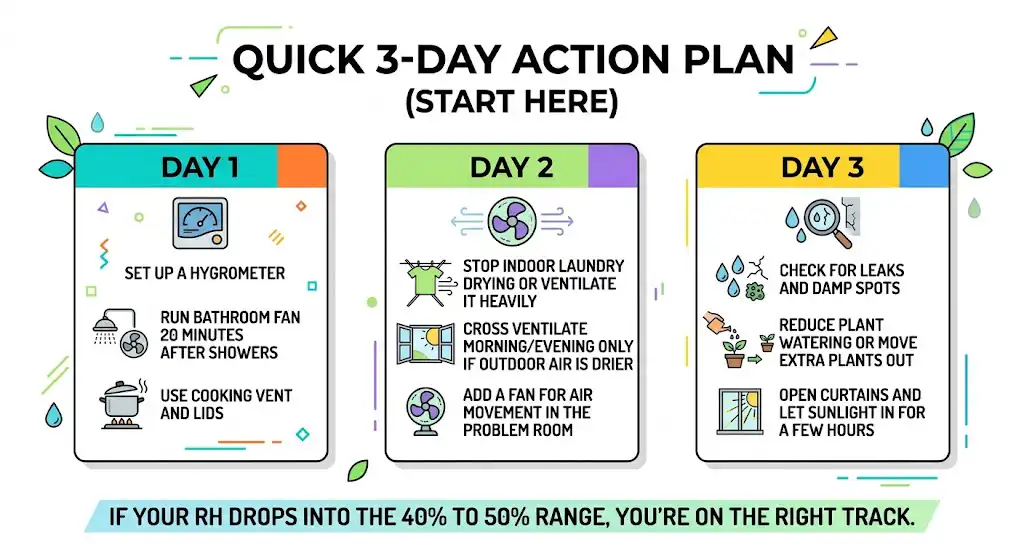
Day 1
- Set up a hygrometer
- Run bathroom fan 20 minutes after showers
- Use cooking vent and lids
Day 2
- Stop indoor laundry drying or ventilate it heavily
- Cross ventilate morning/evening only if outdoor air is drier
- Add a fan for air movement in the problem room
Day 3
- Check for leaks and damp spots
- Reduce plant watering or move extra plants out
- Open curtains and let sunlight in for a few hours
If your RH drops into the 40% to 50% range, you’re on the right track.
When natural fixes aren’t enough (and what it usually means)
If you’ve done the basics for a week and you’re still consistently above 55% to 60% RH, something bigger is likely going on. In my field experience, common culprits are:
- Bathroom fans not vented outdoors or not moving enough air
- Basement moisture coming through concrete or crawl spaces
- HVAC issues where the system cools but doesn’t dehumidify well
- Oversized AC short-cycling (cools fast, removes little moisture)
- Clogged condensate drain, dirty filter, or airflow problems
I know this article is about natural methods, but I’d rather be straight with you. Some homes need ventilation upgrades, repairs, or HVAC adjustments to solve chronic humidity.
FAQ
What is the fastest natural way to reduce humidity in a room?
Fastest improvement usually comes from source control and exhaust: run bathroom fan longer, use the kitchen hood, and ventilate only when outdoor air is drier.
Does opening windows always reduce humidity?
No. It only helps when outdoor air is drier than indoor air. In hot, muggy weather, it can make humidity worse.
Can plants reduce humidity in a room?
Most houseplants add moisture overall due to transpiration and damp soil. A few plants are rarely a problem, but many plants in a small room can raise RH.
Why does my room feel humid even with AC running?
AC should remove moisture, but issues like dirty filters, low airflow, low refrigerant, clogged drains, oversized equipment, or the fan being set to ON can reduce dehumidification.
What humidity level causes mold?
Risk rises when materials stay damp. Many building and public health resources warn that persistent RH above about 60% plus poor ventilation increases mold risk, and mold can begin growing on damp materials within 24 to 48 hours under the right conditions.
Sources I trust for humidity guidance
- Health Canada indoor humidity guidance
- ASHRAE thermal comfort guidance
- U.S. EPA and CDC mold and moisture resources