
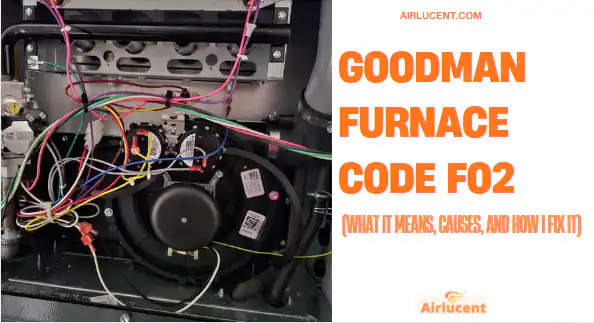
Hi, I’m Nathan. I’ve been an HVAC technician for over 10 years, and I’ve worked on a lot of Goodman gas furnaces in real homes just like yours. When you see Goodman furnace code F02, it usually feels urgent because the furnace often won’t run at all. The good news is that F02 is commonly tied to a very specific safety system, so troubleshooting can be straightforward if you take it step by step.
In this guide, I’ll explain exactly what F02 means, the most common causes, and the same checks I do in the field to get heat back safely.
What Does Goodman Furnace Code F02 Mean?
On most Goodman furnaces, F02 points to a pressure switch problem, specifically:
- The furnace is not proving enough draft (vacuum) for the pressure switch to close
- Or the control board is not seeing the pressure switch close when it expects it to
The pressure switch is a safety device. It verifies that the inducer motor is moving combustion air properly and that flue gases can vent out. If the furnace cannot prove safe venting, it will shut down instead of risking flue gas spillage.
What you’ll usually notice
- Furnace tries to start, then shuts off
- Inducer may run briefly or run continuously with no ignition
- No flame, no heat
- You may hear repeated attempts (a “cycling” start sequence)
Why This Code Matters (Safety First)
A pressure switch failure isn’t just “a bad sensor.” Sometimes it’s doing its job because there’s a blocked vent, condensate backup, or weak inducer. Those conditions can lead to improper venting.
If you notice any of the following, stop and call a pro immediately:
- Gas smell
- Sooting around the furnace or vent
- Headaches, nausea, or CO alarm going off
- Signs of melted plastic or scorch marks
Quick Reference: Most Common Causes and Fixes
Here’s the fast “cheat sheet” I use when training newer techs.
| Possible cause behind F02 | What I check first | Typical fix |
|---|---|---|
| Blocked exhaust vent (flue) or intake pipe | Outside terminations, elbows, sagging pipe, debris, ice | Clear obstruction, correct venting issues |
| Condensate drain or trap blocked (high-efficiency models) | Water in hoses, clogged trap, backed-up drain | Clean trap, clear drain, re-route/repair drain |
| Pressure switch hose pinched, cracked, loose, or blocked | Hose condition and routing | Reconnect, replace hose, clear port |
| Inducer motor weak or failing | Inducer amp draw, noise, wheel condition, draft strength | Repair wiring, clean wheel, replace inducer assembly if weak |
| Pressure switch failing or wrong rating | Switch label rating, continuity test | Replace with correct OEM-rated switch |
| Wiring/connection issue | Spade terminals, harness fit, board connection | Tighten, repair connectors, fix broken wire |
How the Furnace Decides to Throw F02 (Simple Sequence)
When you call for heat:
- Control board powers the inducer motor
- Inducer should create negative pressure (vacuum)
- That vacuum pulls the pressure switch closed
- Only then will the furnace move on to ignition
If steps 2 or 3 don’t happen correctly, F02 shows up.
Step-by-Step Troubleshooting (The Same Order I Use on Service Calls)
1) Confirm the inducer motor is actually running
When the thermostat calls for heat, you should hear the inducer come on first.
What I look for:
- Is it running at all?
- Is it unusually loud (grinding, squealing)?
- Does it start and then stop?
If it’s not running:
- Check power to the furnace
- Check the wiring harness to the inducer
- This may become an electrical diagnosis (best for a tech if you’re not comfortable)
2) Inspect the vent (exhaust) and intake for blockages
This is one of the most common real-world causes, especially after storms or freezing weather.
Check outside first:
- Leaves, nests, debris
- Snow drift covering termination
- Ice buildup (common on certain vent setups)
Then check the pipe run (as much as you can access):
- Sagging sections holding water
- Too many elbows or improper termination
- Disconnected joints (rare but important)
If your furnace is a high-efficiency condensing model, a sag can collect water and restrict airflow, causing low draft and an F02.
3) Check the condensate drain and trap (high-efficiency furnaces)
If your Goodman has PVC venting, it likely produces condensate. A backed-up drain can prevent proper draft and trip the pressure switch.
What you can do:
- Look for water pooling near the furnace
- Check for kinked hoses
- If you see gunk in the clear tubing, the trap may be clogged
Typical fix:
- Clean the trap and drain line
- Make sure the drain flows freely
If you’re not used to taking traps apart, take pictures first so everything goes back the same way.
4) Inspect the pressure switch hose and ports
This is a simple check that solves a surprising number of F02 calls.
Remove and inspect the rubber/silicone hose:
- Cracks
- Splits
- Loose fit
- Pinched spots
- Water in the hose
Also check the little port on the inducer housing where the hose connects. That port can plug up with moisture, rust dust, or debris.
Fix:
- Replace the hose if questionable (cheap and fast)
- Clear the port carefully (don’t enlarge it)
5) Check wiring connections (don’t skip this)
I can’t tell you how many times the “problem” was a loose spade connector.
Check:
- Pressure switch terminals seated tightly
- No corrosion
- Wires not rubbing on sharp metal
A poor connection can make the board think the switch never closed.
6) Test the pressure switch (basic method)
If you’re comfortable and safe doing so, you can do a basic functional check.
Simple click test concept:
- The pressure switch should “click” when it closes under vacuum
- If it never closes, the furnace will not proceed to ignition
That said, a click doesn’t guarantee it’s closing electrically, and lack of a click doesn’t always mean it’s bad. It’s just an indicator.
Advanced Diagnosis (How I Prove the Real Cause)
If you want to diagnose this the professional way, you use a manometer (or Magnehelic gauge) to measure inducer draft.
Measure inducer vacuum against the switch rating
Most pressure switches have the required vacuum printed on the label (commonly in inches of water column, shown as in. w.c.).
What I do:
- Connect the manometer in-line between the inducer and pressure switch
- Start a heat call
- Compare measured draft to the switch rating
Important: The required vacuum varies by model. Don’t guess. Read the label.
If the inducer is only producing weak draft, replacing the pressure switch won’t help (it’s doing its job). The real issue is usually venting, condensate, or a failing inducer.
About Bypassing the Pressure Switch (Read This Before You Try Anything)
You’ll see advice online about jumping the pressure switch.
Here’s my professional take after 10 years in the field:
- A bypass can be a momentary diagnostic step
- It should never be left bypassed
- It can be unsafe because it defeats a venting safety
If you’re not trained and you don’t have combustion safety tools, I recommend you do not do this test. A furnace that “runs” with the switch bypassed may be venting improperly.
When the Fix Is Replacement (Pressure Switch or Inducer)
Pressure switch replacement
Pressure switches aren’t usually expensive, but they must match the furnace specifications.
Typical part-only range: often around 25 to 80 dollars (varies by model and supplier)
Labor: depends heavily on access and diagnostics time
A pressure switch can wear out over time. In the field, I commonly see switch issues show up as systems age, especially in humid basements where moisture affects hoses and ports.
Inducer motor or inducer assembly replacement
If the inducer is weak, noisy, or not producing enough draft, replacement becomes likely.
Signs I trust more than guesses:
- Measured draft is below spec
- Inducer wheel damaged or packed with debris
- Motor struggles, overheats, or pulls abnormal amperage
Useful Homeowner Stats (So You Know What’s Normal)
| Item | Typical industry expectation |
|---|---|
| Average furnace lifespan | About 15 to 20 years (maintenance and install quality matter a lot) |
| Pressure switch lifespan | Often around 8 to 12 years in real-world conditions (varies widely) |
| How often to service a furnace | Ideally once a year; twice a year if you want top reliability |
| Share of home energy used by space heating | Roughly 29 percent in many U.S. homes (commonly cited by U.S. energy data sources) |
My Recommended “Do This First” Checklist (Fast and Safe)
If you want the highest chance of fixing F02 without tools, do these in order:
- Replace/confirm clean furnace filter (restricted airflow doesn’t directly cause F02, but it can worsen overall operation)
- Check vent and intake terminations outside for blockage
- Look for sagging PVC that could trap water
- Check condensate drain and trap for clogs
- Inspect pressure switch hose for cracks, water, pinches, or loose connections
- Confirm wiring is snug on the pressure switch and inducer
If none of that changes anything, you’re likely into manometer testing, inducer diagnostics, or a switch replacement.
Preventing F02 From Coming Back
Here’s what I tell homeowners I work with:
- Keep vent terminations clear year-round (especially after storms)
- Flush or maintain condensate drain lines if your system is high-efficiency
- During annual maintenance, have the tech verify draft and inspect the pressure switch tubing and ports
- Address inducer noise early. A loud inducer often fails later at the worst time
FAQ
Can I reset the furnace to clear F02?
You can power-cycle the furnace at the switch or breaker, but if the underlying problem is still there, the code will return. Resetting is not a fix.
Is F02 always a bad pressure switch?
No. In my experience, many F02 calls are caused by venting issues or condensate drainage problems. The switch is often just reporting the real problem.
Do I need a technician for F02?
If you’ve checked venting and drains and the error persists, yes. Proper draft testing requires the right tools and experience.
Final Thoughts From Me (Nathan)
Goodman furnace code F02 is usually the furnace telling you: I can’t prove safe venting, so I’m shutting down. Most fixes come down to venting, condensate drainage, inducer performance, or the pressure switch circuit.