I’m Nathan. I’ve worked as an HVAC technician for over 10 years, and this question comes up constantly, especially during heat waves:
You’ve got one or two rooms that feel like an oven, and you’re tempted to close vents in unused rooms to “push” more cool air where you actually need it.
Here’s the truth from the field.
Closing air vents usually does not help cool other rooms. In many homes it can actually make comfort worse, increase system strain, and lead to expensive problems like duct leaks, frozen AC coils, or even furnace safety issues in winter.
Let me explain what’s really happening inside your ductwork, why the “redirect the air” idea doesn’t work the way people think, and what I recommend instead.
- Key takeaways (what I tell homeowners on service calls)
- The myth behind closing vents
- Does closing air vents in unused rooms save energy?
- Does closing vents redirect air to other rooms?
- What’s actually happening: static pressure (in plain English)
- Cooling season risks (AC mode): frozen coil and poor dehumidification
- Heating season risks (furnace mode): overheating and potential safety issues
- What about closing vents just a little?
- Should you close basement vents?
- Why that hot bedroom stays hot (and it’s usually not “not enough vents”)
- What to do instead of closing vents (what I actually recommend)
- 1. Change your filter on schedule
- 2. Make sure vents and returns are not blocked
- 3. Seal duct leaks (this is one of the biggest wins)
- 4. Get a real system balance, not guesswork
- 5. Improve attic insulation and air sealing (especially for upstairs comfort)
- 6. Use thermostat strategy that matches your home
- 7. Consider zoning or ductless for true room-by-room control
- Quick checklist: what you can do today
- FAQ (questions I hear all the time)
- Bottom line: Does closing air vents help cool other rooms?
Key takeaways (what I tell homeowners on service calls)
- Your HVAC system still tries to move roughly the same amount of air, even if you close multiple supply vents.
- Closing vents increases static pressure, which can reduce overall airflow and efficiency.
- The “extra air” often does not go to the rooms you want. It commonly gets lost through duct leakage or causes airflow problems.
- If you want certain rooms cooler, there are safer, proven fixes like duct sealing, balancing dampers, return air improvements, or zoning.
The myth behind closing vents
The myth sounds logical:
If I close vents in rooms I’m not using, I’ll stop “wasting” air and force more cool air into the rooms I care about.
But most residential HVAC systems are not designed to work like a water pipe where you close one valve and everything cleanly reroutes. Air is compressible, ducts leak, and your blower has a performance curve it can fall off of when pressure rises.
So instead of cleanly redirecting air, you often get:
- higher duct pressure
- more duct leakage
- less total airflow through the system
- hotter rooms staying hot
Does closing air vents in unused rooms save energy?
In most homes, no
Your AC or furnace doesn’t “know” you closed vents. The thermostat still calls for cooling, and your equipment still runs until it satisfies that thermostat.
What changes is how hard it is for the blower to move air.
When you close vents, you increase resistance in the duct system. That higher resistance can:
- reduce airflow across the evaporator coil (AC mode)
- reduce airflow across the heat exchanger (heating mode)
- increase blower workload and noise
- increase leakage at weak duct connections
A real-world stat that matters
According to ENERGY STAR, the average home loses about 20 to 30 percent of the air moving through ductwork due to leaks, holes, and poorly connected ducts. That matters because when you raise duct pressure by closing vents, you can push even more conditioned air out through those leaks into attics, crawlspaces, or wall cavities.
If your ducts are already leaky (many are), closing vents can be like squeezing a balloon that has pinholes.
Does closing vents redirect air to other rooms?
It redirects pressure, not comfort
Yes, air will try to find paths of least resistance. But the “path” is not always the room you want cooler.
In my experience, when homeowners close a bunch of registers, the most common outcomes are:
- the system gets louder
- airflow at several vents drops overall
- one room might improve slightly but others get worse
- the equipment runs longer, especially on hot days
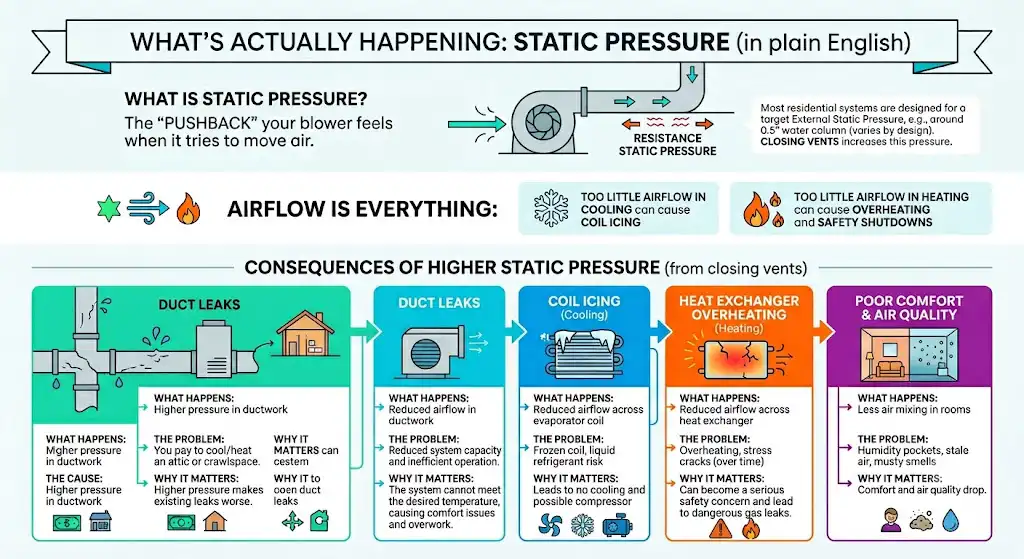
What’s actually happening: static pressure (in plain English)
What is static pressure?
Static pressure is basically the “pushback” your blower feels when it tries to move air through your system.
Most residential systems are designed for a target external static pressure, often around 0.5 inches of water column (this varies by equipment and duct design). When you close vents, static pressure rises. When pressure rises enough, airflow drops.
And airflow is everything:
- Too little airflow in cooling can cause coil icing
- Too little airflow in heating can cause overheating and safety shutdowns
Common problems caused by higher static pressure
Here’s what I see most often when vents are closed aggressively.
| What you do | What it can cause | Why it matters |
|---|---|---|
| Close several supply vents | Higher static pressure | Less airflow where you need it |
| Higher pressure in ductwork | More air lost through duct leaks | You pay to cool an attic or crawlspace |
| Reduced airflow across evaporator coil | Frozen coil, liquid refrigerant risk | Leads to no cooling and possible compressor damage |
| Reduced airflow across heat exchanger | Overheating, stress cracks (over time) | Can become a serious safety concern |
| Less air mixing in rooms | Humidity pockets, stale air, musty smells | Comfort and air quality drop |
Cooling season risks (AC mode): frozen coil and poor dehumidification
When your AC runs, warm indoor air needs to flow across the evaporator coil to:
- remove heat
- remove moisture
If airflow drops too low, the coil can get colder than it should and may fall below freezing. Ice forms, airflow drops even more, and suddenly the system can’t cool at all.
Signs you may have restricted airflow
- weak air coming out of vents
- rooms getting clammy instead of comfortably cool
- ice on the refrigerant line (outside or at the indoor unit)
- the AC runs nonstop but barely changes the temperature
Closing vents is not the only cause, but it’s a common trigger that stacks on top of other issues like dirty filters or undersized returns.
Heating season risks (furnace mode): overheating and potential safety issues
In heating mode, furnaces need adequate airflow to carry heat away from the heat exchanger. Restricting supply airflow can contribute to higher internal temperatures and more frequent limit trips.
Also, any discussion of furnace operation needs to be taken seriously:
- If a heat exchanger is compromised, it can become a carbon monoxide risk
- Carbon monoxide is dangerous and requires immediate professional attention
To be clear: closing vents does not automatically crack a heat exchanger, but it can be one factor that increases stress on an already aging system or on a duct system with serious airflow problems.
What about closing vents just a little?
Homeowners ask me this all the time:
If fully closing vents is bad, can I partially close one or two?
Sometimes, yes, with caution
If you’re making a small adjustment, like partially closing one or two registers that blast air in a low-priority area, that can be part of basic comfort balancing.
But I do not recommend closing:
- multiple rooms worth of vents
- any vents needed for system balance (especially near returns)
- vents in spaces with plumbing that can freeze in winter
If you do partially close a vent, watch for:
- increased system noise
- reduced airflow elsewhere
- longer run times
- icing in cooling season
If any of those show up, undo the change.
Should you close basement vents?
If the basement is finished and part of your conditioned space, closing vents usually creates the same problems as upstairs.
If the basement is unfinished, it depends on how your home and ducts are laid out. Many basements contain:
- duct trunks
- mechanical equipment
- return air pathways
- leakage points
In a lot of homes, basements act like a buffer zone that influences upstairs comfort. Closing basement supplies can sometimes make upstairs feel worse, not better.
Why that hot bedroom stays hot (and it’s usually not “not enough vents”)
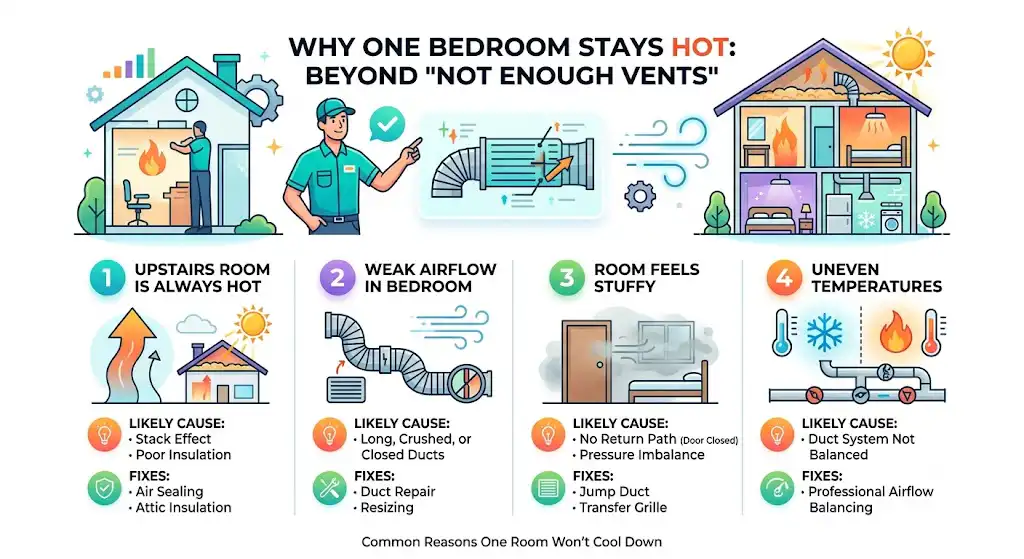
When I diagnose uneven cooling, I usually find one or more of these root causes.
Common reasons one room won’t cool down
| Symptom | Likely cause | What fixes it |
|---|---|---|
| One upstairs room is always hotter | Stack effect, poor attic insulation, sun exposure | Air sealing, attic insulation, shading, balancing |
| Bedroom has weak airflow | Duct run too long, crushed flex duct, closed damper, undersized branch | Duct repair, resizing, balancing damper |
| Room feels stuffy even with air blowing | No return path, door closed, pressure imbalance | Jump duct, transfer grille, dedicated return |
| Some rooms too cold, others too hot | Duct system not balanced | Professional airflow balancing |
| Hot in summer, cold in winter | Envelope issues | Insulation, air sealing, window improvements |
This is why closing vents is such a frustrating strategy. It treats a symptom without fixing the real cause.
What to do instead of closing vents (what I actually recommend)
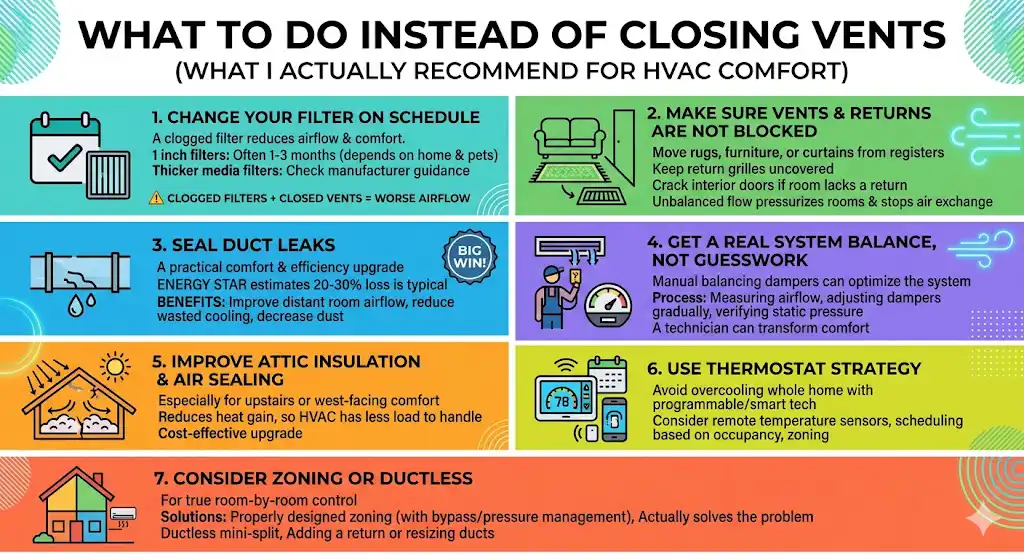
1. Change your filter on schedule
A clogged filter is one of the fastest ways to reduce airflow and create comfort issues.
- 1 inch filters: often every 1 to 3 months (depends on home and pets)
- thicker media filters: sometimes longer, but check manufacturer guidance
If your system already struggles for airflow, closing vents makes it worse.
2. Make sure vents and returns are not blocked
This is simple but huge.
- Move rugs, furniture, or curtains away from registers
- Make sure return grilles are not covered
- Keep interior doors cracked if a room doesn’t have a return
A room with supply air but no good return path often becomes pressurized and stops exchanging air properly.
3. Seal duct leaks (this is one of the biggest wins)
Duct sealing is one of the most practical upgrades for comfort and efficiency.
As mentioned earlier, ENERGY STAR notes typical duct losses of 20 to 30 percent in many homes. Sealing ducts can:
- improve airflow to distant rooms
- reduce wasted cooling into unconditioned spaces
- reduce dust infiltration in some setups
If you want more air to reach the hot room, you need the ducts delivering that air to actually hold pressure without leaking.
4. Get a real system balance, not guesswork
Many duct systems have manual balancing dampers (often near the trunk line). A proper balance involves:
- measuring airflow
- adjusting dampers gradually
- verifying static pressure is still safe
This is one of those areas where a good technician can make a home feel completely different without changing equipment.
5. Improve attic insulation and air sealing (especially for upstairs comfort)
If the problem room is upstairs or west-facing, your HVAC may be fighting heat gain more than airflow.
Air sealing and insulation are often the most cost-effective comfort upgrades because they reduce the load your AC has to handle.
6. Use thermostat strategy that matches your home
A programmable or smart thermostat can help you avoid overcooling the whole home just to make one room tolerable.
If one area always runs hotter, consider:
- remote temperature sensors
- scheduling based on occupancy
- zoning solutions (next section)
7. Consider zoning or ductless for true room-by-room control
If you want different temperatures in different parts of the house, the cleanest solutions are:
- a properly designed zoning system (with bypass and static pressure managed correctly)
- a ductless mini split for problem rooms
- adding a return or resizing duct runs where needed
These cost more than “closing vents,” but they actually do what you want without risking equipment damage.
Quick checklist: what you can do today
| Goal | Do this first |
|---|---|
| Cool a hot bedroom | Confirm register is open, confirm strong airflow, confirm door return path |
| Lower bills | Seal duct leaks, insulate attic, use smart scheduling |
| Improve airflow | Replace filter, clean return grille, inspect flex ducts for kinks |
| Avoid system damage | Do not fully close multiple vents, avoid blocking returns |
FAQ (questions I hear all the time)
Will closing vents make my AC last longer?
Usually no. In many cases it can increase strain because the blower is working against higher pressure, and airflow problems can lead to coil icing or longer run times.
What if my system is variable-speed?
Variable-speed blowers can adapt better than single-speed PSC blowers, but they still operate within static pressure limits. You can still create comfort and efficiency issues by closing too many vents.
Is it ever OK to close vents in a room you never use?
If it’s truly one room and you are only partially closing the register, sometimes it’s fine. But fully closing multiple vents is where trouble starts. If you want to reduce conditioning to a space, a proper zoning approach is safer.
Bottom line: Does closing air vents help cool other rooms?
In most homes, no. Closing vents rarely sends meaningful extra cooling to the rooms you care about, and it can create:
- higher static pressure
- more duct leakage
- lower total airflow
- equipment stress and potential breakdowns
If you’re trying to fix hot rooms, I’d focus on the real drivers: airflow delivery, return air paths, duct leakage, insulation, and balancing.