

Hi, I’m Nathan. I’ve worked as an HVAC technician for over 10 years, and I’ve been inside a lot of homes right before they hit the market and again after inspections. I can tell you this straight: trying to “fix everything” before you sell is one of the fastest ways to burn profit and still end up negotiating repairs anyway.
When you’re selling, the goal isn’t to create your dream house. The goal is to sell a home that feels clean, cared for, and financeable without dumping money into upgrades a buyer will rip out the minute they move in.
This guide breaks down what not to fix when selling a house, what you should fix, and how I’d personally triage it if you were my neighbor getting ready to list.
The mindset that saves you the most money
Here’s the simplest rule I use:
Fix what affects lending, safety, leaks, and function.
Skip what’s cosmetic, personal taste, or likely to be replaced.
A lot of sellers assume every dollar spent raises the home value by a dollar or more. In real life, many projects don’t come close to paying you back.
One data point I like to show homeowners: industry cost vs value reports regularly show that some projects can return a strong percentage, while many “big” remodels return a weak one. And if you’re selling soon, time and risk matter just as much as ROI.
Quick decision table: Fix or skip?
| Roof | Active leak, missing shingles, obvious damage | Fix | Can kill financing and trigger big buyer fear |
| HVAC | Not heating or cooling reliably | Fix or replace (or offer strong credit) | Appraisal and inspections flag nonfunctional systems |
| Windows | Old but working | Skip replacement | Buyers rarely pay you back for full window cost |
| Kitchen | Dated but functional | Skip full remodel | Buyers often want their own finishes |
| Electrical | Safety hazards (burning smell, exposed wiring) | Fix | Safety and insurability issue |
| Electrical | A couple dead outlets | Usually skip | Inspector notes it; credit is easier |
| Basement | Unfinished | Usually skip finishing | Expensive and buyers want customization |
| Cosmetics | Scratches, small nail pops | Mostly skip | Clean and touch up only if very visible |
What not to fix when selling a house (the big money traps)
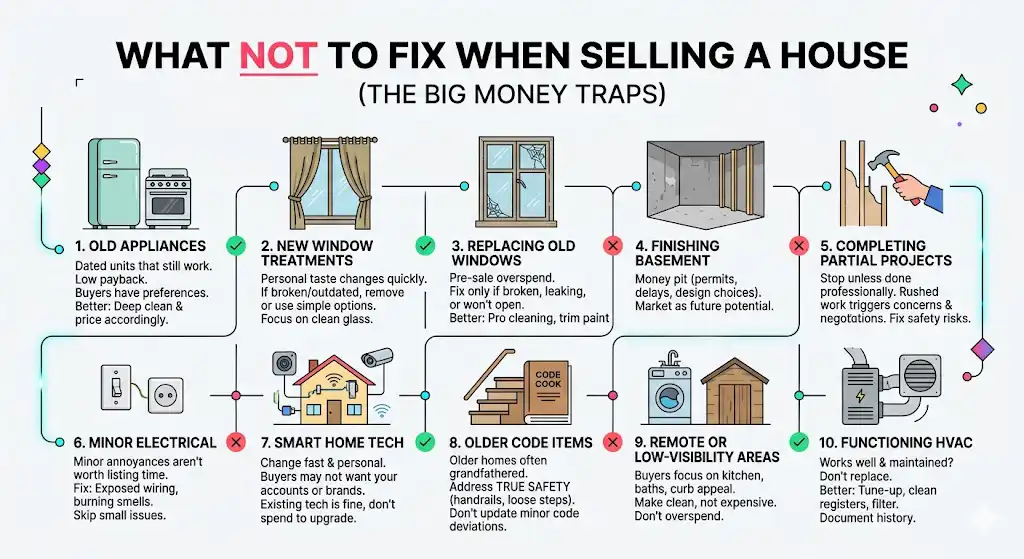
1. Don’t replace old but working appliances
If your range, dishwasher, or fridge is dated but still works, replacing it is often a low-payback move. Buyers may prefer stainless, panel-ready, or different brands and sizes.
My practical rule:
If an appliance is fully functional and not disgusting, I’d rather see you deep clean it and price accordingly.
Better option: offer a repair credit if a buyer complains during inspection, instead of guessing what they want.
2. Don’t install new window treatments just to sell
New blinds and curtains feel like an easy “refresh,” but most buyers treat window coverings as personal taste.
If your treatments are:
- broken
- heavily stained
- screamingly outdated
Then the best move is often to remove them or replace with something simple and inexpensive only if the room looks unfinished without them.
What I’ve seen work well: clean windows, neutral walls, and no “visual clutter” at the glass.
3. Don’t replace windows just because they’re old
Window replacement is a classic pre-sale overspend.
Typical pricing varies by area and window type, but many homeowners see quotes in the ballpark of 700 to 1,000 dollars per window, and that adds up fast.
Unless you have:
- broken glass
- windows that won’t open (egress issues in bedrooms can matter)
- active leaks or rot around the frame
You’re usually better off doing this instead:
- professional window cleaning inside and out
- touch-up paint at trim
- address obvious drafts with inexpensive weatherstripping
Buyers notice cleanliness and light more than they notice the model year of a window.
4. Don’t finish an unfinished basement just to “add value”
Finishing a basement can look tempting on paper, but right before a sale it can become a money pit:
- permits
- surprises behind walls
- timeline delays
- design choices buyers may not like
If your basement is dry, clean, and bright, you can market it as future potential. That’s often more valuable than a rushed finish that looks like a flip.
5. Don’t “complete” partially finished projects if you can’t do them right
This one is huge. I walk into homes all the time where the seller says, “We’ll just wrap up the bathroom quickly.”
If you can’t do it cleanly and professionally, a last-minute renovation can:
- look mismatched
- raise permit questions
- trigger inspection concerns
- create negotiation leverage for the buyer
Sometimes it’s better to stop, clean, and disclose than to rush.
Exception: If the project creates a safety risk (exposed wiring, missing plumbing traps, no handrail), fix the safety part.
6. Don’t chase minor electrical annoyances (unless they’re safety issues)
A wobbly switch plate, one dead outlet, or a finicky switch is usually not worth your pre-listing time unless it screams “danger.”
Fix these:
- exposed wiring
- burning smells
- warm outlets
- DIY splices
- missing covers near live wiring
Usually skip these (and credit later if needed):
- one or two non-working outlets
- a switch that controls “nothing” (common in older homes)
- minor cosmetic issues at devices
Home inspectors will note small stuff no matter what. Your goal is to avoid anything that feels unsafe.
7. Don’t upgrade smart home tech right before listing
Smart thermostats, cameras, doorbells, and hubs are personal preference and change fast.
Also, buyers may not want your accounts, wiring, subscriptions, or system brands.
If you already have smart tech installed, it can be a nice bonus. But I wouldn’t spend big money upgrading it for a sale.
8. Don’t “correct” older code items that were allowed when your home was built
A lot of homeowners panic when they learn something doesn’t meet today’s codes. In many cases, older homes are effectively grandfathered if it was legal at the time and you’re not doing new work that triggers an update.
That said, safety is different than code preference.
Address true safety hazards like missing handrails, loose steps, or exposed wiring. But don’t start tearing your house apart because outlet spacing or stair geometry isn’t what a 2026 code book would want.
If you’re unsure, ask your agent and a local contractor who pulls permits in your city.
9. Don’t overspend on remote or low-visibility areas
Buyers focus on:
- kitchen
- main bathrooms
- living areas
- primary bedroom
- curb appeal at first glance
They’re less emotionally driven by:
- laundry room sinks
- sheds
- carports
- utility closets
- back-corner fencing
Make these areas clean and functional. But don’t replace a shed roof just because it’s ugly if it’s not leaking and the shed isn’t a key value driver.
10. Don’t replace a functioning HVAC system just to “impress buyers” (my HVAC perspective)
This one is personal for me. I’ve inspected plenty of systems that are older, a little noisy, and still doing their job.
If your HVAC:
- heats and cools properly
- maintains temperature
- doesn’t have dangerous venting issues
- has a clean filter and reasonable service history
Then a full replacement right before listing often isn’t the best use of money.
What I recommend instead (high impact, lower cost):
- professional tune-up and cleaning
- new filter
- clean supply registers and returns
- fix obvious condensate drain issues
- document maintenance
If the buyer asks for a new system, you can negotiate:
- a closing credit
- a home warranty
- or a price adjustment
That’s usually less stressful than rushing an install with contractors booked out and parts delays.
The projects that usually don’t pay you back (with ROI context)
ROI varies by market, but the trend is consistent: some small-to-mid projects outperform big “dream remodels.”
Here are commonly cited returns from national cost vs value style reporting and real estate data summaries:
| Upscale kitchen remodel | “Buyers will pay more” | Often low percentage return compared to cost |
| Primary suite addition | “More square footage equals profit” | Expensive, slow, and rarely recoups fully |
| High-end finishes everywhere | “Make it luxury” | Risk of over-improving for the neighborhood |
| Premium windows “for efficiency” | “Buyers will love it” | Buyers like it, but they don’t always pay for it |
On the flip side, some projects can show surprisingly strong recovery in certain reports. For example, widely discussed cost vs value summaries have shown garage door replacement and minor kitchen refreshes performing well in many markets. Treat those numbers as directional, not guaranteed, because your neighborhood and price band matter.
What you should fix or disclose (don’t skip these)

Even though this guide is about what not to fix, I don’t want you to get burned. Some issues can:
- block financing
- trigger insurance problems
- create legal disclosure risk
- scare off traditional buyers
Fix or professionally address these before listing
- Active roof leaks or obvious water intrusion
- Plumbing leaks, recurring backups, or water heater issues
- Mold or persistent moisture problems
- Termite or major pest damage
- Structural movement that’s more than cosmetic cracking
- Unsafe electrical conditions
- HVAC that does not heat or cool (especially in extreme climates)
Lending reality check
Many traditional loans and government-backed loans (like FHA and VA) can require repairs for:
- peeling paint in pre-1978 homes (lead-based paint concern)
- safety hazards
- nonfunctional major systems
- significant roof problems
If a buyer can’t get a loan, your buyer pool shrinks to cash buyers and investors, and that usually means a lower net.
Selling as-is: the real trade-off
Selling as-is can be smart when:
- you need speed
- the home needs too much work
- you don’t have cash for repairs
But understand the math. Many market summaries and investor rules of thumb commonly estimate that selling as-is can require a price discount in the range of 15 to 30 percent, depending on condition, financing limitations, and buyer risk.
Sometimes it’s cheaper to fix one or two “finance killers” than to take a broad as-is discount.
My simple pre-listing plan (that I’d follow in my own home)
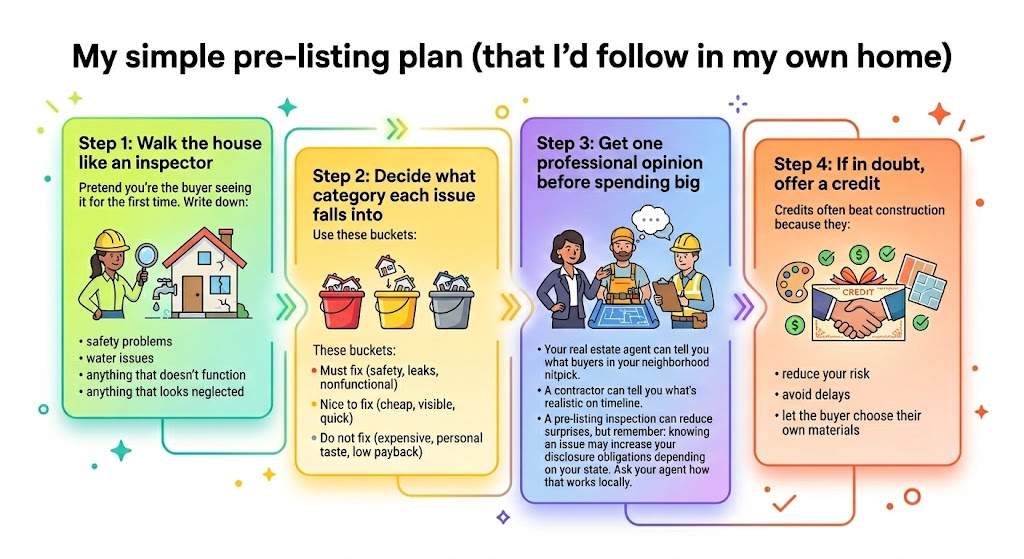
Step 1: Walk the house like an inspector
Pretend you’re the buyer seeing it for the first time. Write down:
- safety problems
- water issues
- anything that doesn’t function
- anything that looks neglected
Step 2: Decide what category each issue falls into
Use these buckets:
- Must fix (safety, leaks, nonfunctional)
- Nice to fix (cheap, visible, quick)
- Do not fix (expensive, personal taste, low payback)
Step 3: Get one professional opinion before spending big
Your real estate agent can tell you what buyers in your neighborhood nitpick.
A contractor can tell you what’s realistic on timeline.
A pre-listing inspection can reduce surprises, but remember: knowing an issue may increase your disclosure obligations depending on your state. Ask your agent how that works locally.
Step 4: If in doubt, offer a credit
Credits often beat construction because they:
- reduce your risk
- avoid delays
- let the buyer choose their own materials
Quick checklist: The “skip it” items most sellers regret paying for
- full kitchen remodel right before selling
- replacing all appliances that still work
- new blinds and curtains to match your taste
- whole-house window replacement without functional problems
- finishing basements just to add a listing bullet point
- last-minute custom landscaping that needs constant upkeep
- expensive smart home system upgrades
- luxury HVAC upgrades when the current system is functional
Final advice from Nathan
If you remember only one thing, make it this:
Buyers pay for a home that feels clean, maintained, and low-risk. They don’t pay full price for your expensive personal upgrades.
So before you sink money into big projects, ask yourself:
- Will this help the house appraise and qualify for financing?
- Will this remove a safety risk or active damage?
- Or am I trying to guess what a buyer would design?