
Okay, real talk — small apartments are basically the universe’s way of testing your creativity. You’ve got one room that needs to be a living room AND a dining room, and somehow it’s supposed to look like it belongs on a Pinterest board instead of a storage unit. Sound familiar? 🙂
I’ve been obsessed with small-space design for years, and I can tell you from experience — the right layout can completely transform how a room feels. We’re not talking magic, just smart choices. Here are 10 ideas that actually work.
Floating Sofa Divider Layout
What it is
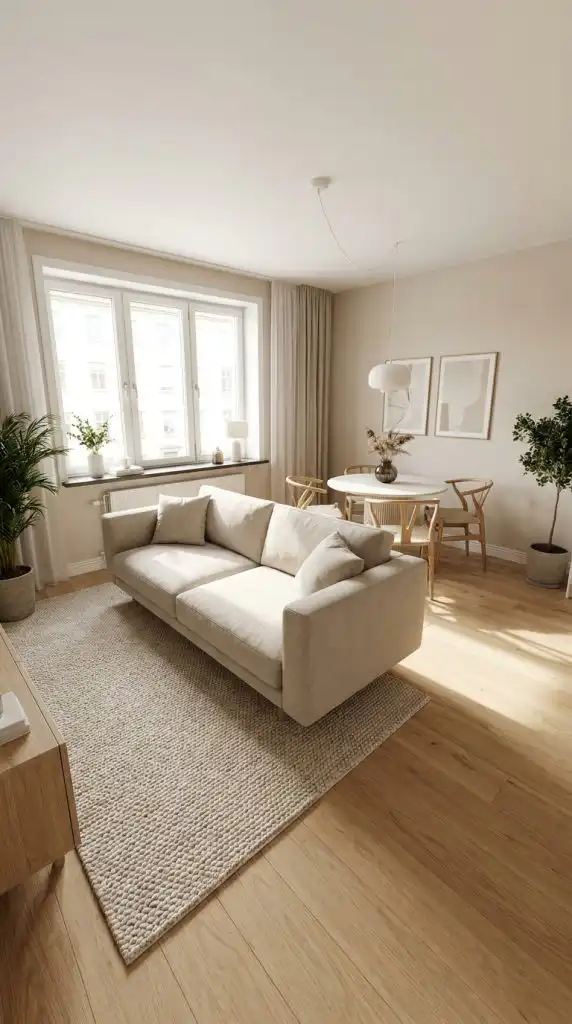
Most people push their sofa against the wall. Don’t. Float your sofa away from the wall and use its back as a natural divider between the living and dining zones. It’s one of the oldest tricks in the interior design book — and it still works brilliantly.
Why it works
- Defines two distinct zones without building a wall
- Creates a natural “entrance” feel when you walk in
- Keeps the space visually open while still feeling organized
Pro tip: pick a sofa with a low, clean backline — a bulky, high-back sofa will chop the room visually. A mid-century modern silhouette works perfectly here.
Ever noticed how hotel lobbies feel spacious even when they’re not huge? Floating furniture is a big part of that trick.
Glass Dining Table Space Saver Concept
What makes it a game changer
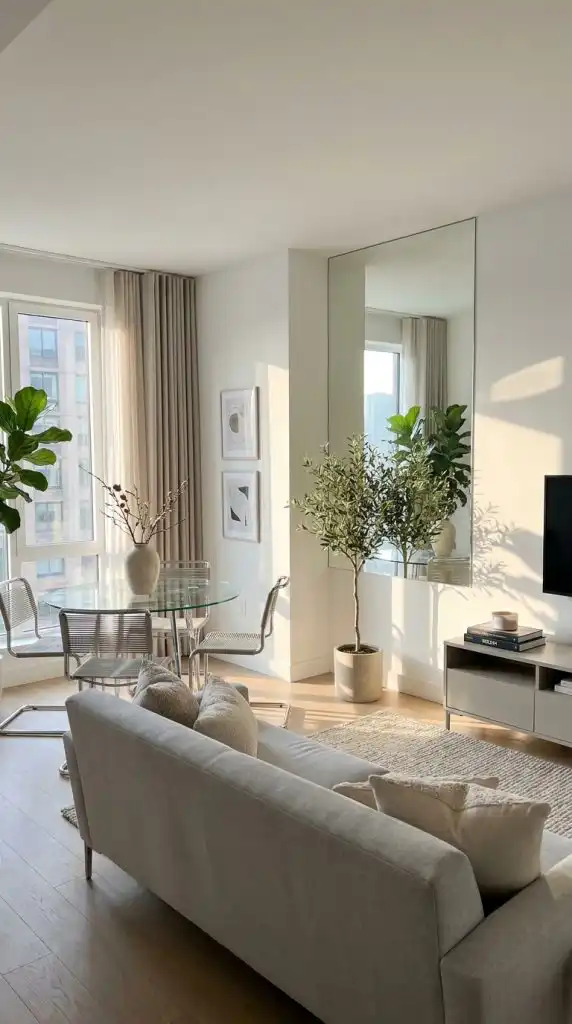
A glass dining table is genuinely one of the best investments you can make in a small combo room. The transparency means your eyes don’t “stop” at the table — they travel right through it, making the whole space feel bigger.
How to style it right
- Pair with light-colored or metallic chairs to keep the airy feel going
- Use a round glass table if space is really tight — no sharp corners catching your hips at 2am
- Add a textured rug underneath to ground it, otherwise it floats a little too literally
IMO, a round glass table with slim hairpin legs is one of the most universally flattering things you can put in a small room. Just saying.
L-Shaped Sofa Zoning Setup

Using the sofa as an architectural element
An L-shaped sofa does double duty in a combo room. One side faces the TV for your living area, while the end of the “L” naturally creates a boundary pointing toward the dining space. It’s geometry doing the work for you.
The key here is proportion. An oversized L-sofa will swallow a small room whole — go for a compact modular sectional with slim arms and legs. Chesterfields and pillow-back sofas are gorgeous, just… not here.
What to pair it with
- A narrow console table tucked behind the sofa’s shorter arm acts as a subtle boundary
- Keep dining chairs low-profile to avoid competing with the sofa’s visual weight
- Neutral upholstery lets the layout speak instead of the color
Also Read: 10 Simple Small Living Room Ideas for Stylish Comfort
Minimalist Open Plan Warm Neutral Design

When less is genuinely more
This one is for the people who look at their cluttered combo room and think “I just want it to breathe.” A warm neutral palette — think sand, warm white, terracotta, and muted sage — tied across both the living and dining zones makes the whole room read as one cohesive space instead of two cramped ones.
The minimalist approach works because your eye doesn’t catch on competing colors or styles. Everything flows. And no, this doesn’t mean boring — the texture does the talking here. Linen curtains, a jute rug, a bouclé throw — all neutral, all interesting.
The fastest way to make a small room feel bigger? Stop adding things. Seriously — remove three items and see what happens.
Key moves
- Use the same wood tone throughout (table, shelves, chair legs)
- Stick to two neutrals max — one warm, one cooler to create contrast without chaos
- Add life with plants, not objects
Wall Mounted Dining Bench Solution

Stealing back your floor space
Here’s one that surprises people: a wall-mounted bench on one side of your dining table instantly frees up floor space that chairs would have occupied. You get the same seating capacity with a significantly smaller footprint.
Wall-mounted benches also give the dining zone a built-in, intentional look — like it was designed for the space rather than shoved into it. Pair it with two or three lightweight moveable chairs on the other side and you’ve got flexible seating that doesn’t feel rigid.
Practical notes
- Add a cushion with removable covers — comfort plus practicality
- Use the space under a floating bench for slim storage baskets
- Keep the bench depth around 40–45cm for comfortable seated dining
Rug Defined Living Dining Separation
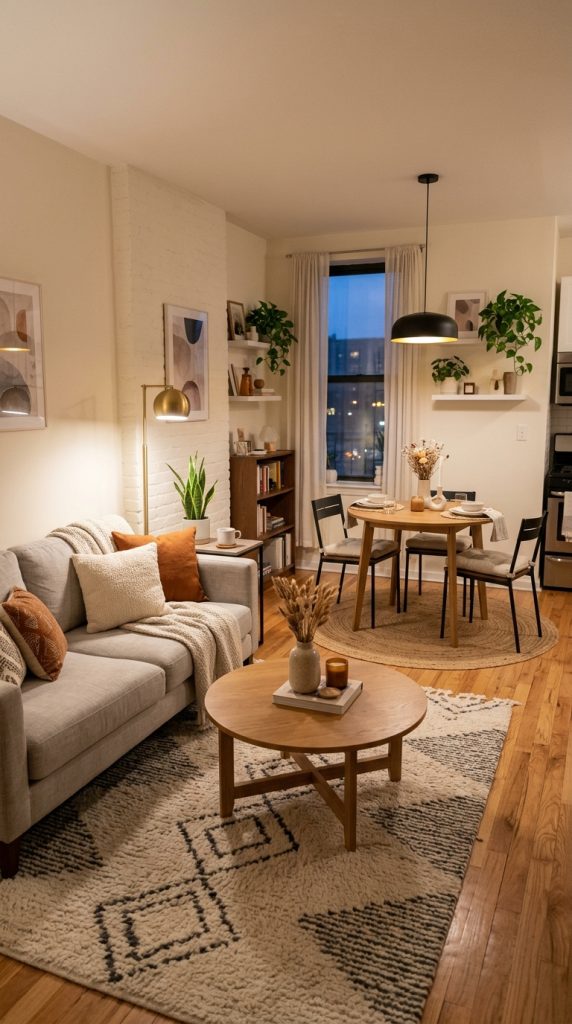
The power of a rug (and most people underestimate it)
You don’t need walls or furniture to define zones. A well-placed rug creates a psychological boundary that your brain registers as a distinct space. Place a large area rug under the sofa and coffee table — that’s your living zone. Leave the dining area on bare floor or a smaller, contrasting rug.
The trick is sizing. Most people buy rugs that are too small, which makes the room look like the furniture is floating on a postage stamp. Go bigger than you think you need. Front legs of the sofa on the rug at minimum; ideally all four legs.
Rug pairings that work in small spaces
- Living zone: textured, warm-toned rug (wool, jute, shaggy)
- Dining zone: flat-weave or no rug (easier to clean, less visual bulk)
- If using two rugs, keep them in the same color family
Also Read: 10 Space-Saving Very Small Living Room Ideas to Try
Corner Dining Nook Compact Idea
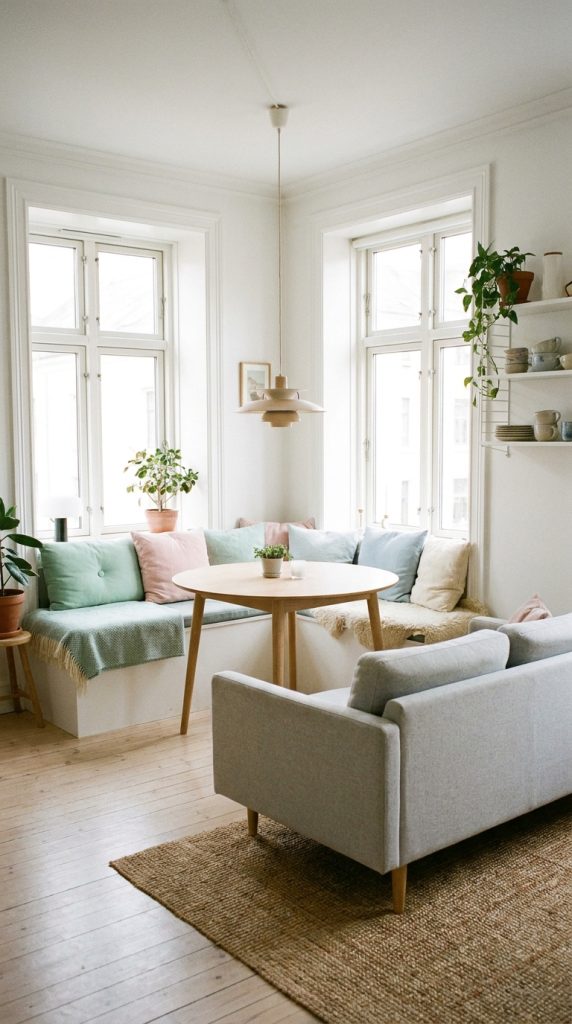
Tucking the dining zone into a corner — genius or desperate?
Both, actually — and it works beautifully. A corner dining nook uses the two walls as built-in structure, meaning you only need to furnish two sides instead of four. It feels intentional, cozy, and surprisingly spacious when done right.
Think of a small square or rectangular table pushed into a corner with a bench along two walls and one or two chairs completing the set. This setup is wildly popular in Scandinavian and Japanese small-space design for good reason.
What makes it work
- Wall-mounted shelving above the nook adds storage without floor footprint
- A pendant light directly above anchors the dining zone visually
- Built-in bench storage underneath is peak efficiency :/
FYI — corner nooks don’t have to be permanent. A few cushions and a small folding table can achieve the same effect without a single drill hole.
Mirror Wall Illusion Space Expander
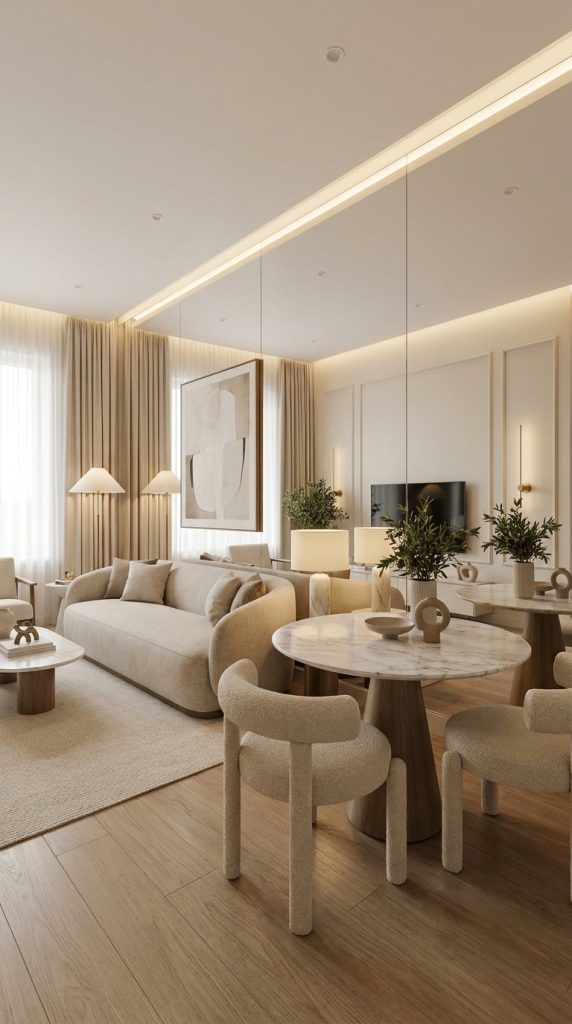
The oldest trick in the small-space playbook
Mirrors are almost comically effective in small rooms. A large mirror on one wall literally doubles the visual depth of a room — your eye reads it as another room beyond the reflection. Place it strategically opposite a window to bounce light around and the effect multiplies.
In a combo room, a tall leaning mirror or a gallery-style arrangement of smaller mirrors works beautifully on the dining side — it makes the dining area feel like it has more dimension without stealing any floor space.
Mirror styling tips
- Choose a frame that ties into your existing furniture tones (brass, black, natural wood)
- Arch-shaped mirrors are trending and add a softness small rooms benefit from
- Avoid placing mirrors where they reflect clutter — they amplify whatever they’re facing
Multi Functional Storage Coffee Table Setup

Your coffee table needs to work harder
In a small combo room, a coffee table that just holds your remote is a wasted opportunity. Opt for a storage ottoman, a lift-top table, or a coffee table with drawers and shelves. You reclaim valuable storage without adding a single extra piece of furniture.
A lift-top coffee table is especially clever — it rises to dining height and essentially becomes a casual dining surface. Movie night dinner? Done. Work-from-home lunch? Sorted. It’s basically a dining table that pretends to be a coffee table. Brilliant, honestly.
Best options for small spaces
- Storage ottoman: soft, doubles as extra seating, hides blankets and remotes
- Lift-top table: casual dining at coffee table height
- Nested tables: one main table with smaller ones tucked underneath — expand when needed, tuck away when not
Also Read: 10 Must-Try Small Space Living Room Ideas — Apartment Goals
Half Wall Room Divider Modern Style

A partial wall — commitment-phobe’s dream
If you want clear zone separation but can’t bear to close off the space entirely, a half wall (or pony wall) is the ideal middle ground. It sits about waist to chest height, defines both sides clearly, and still keeps the room visually connected and airy.
Modern takes on this include open shelving units used as room dividers, thin steel-framed partitions, and slatted wood panels. They define the zones without building a wall and add texture and personality to the space.
Modern half-wall options
- Open bookshelf divider: practical, accessible from both sides, adds character
- Slatted wood panel: warm, architectural, filters light beautifully
- Steel + glass partition: modern industrial vibe, maximum light flow
The bookshelf divider is a personal favorite — it does three jobs at once (divider, storage, display) and looks great doing all three.
Putting It All Together
Here’s the thing about small living and dining combos — the limitation is the invitation. When you can’t throw more space at a problem, you get creative. And creative solutions almost always look better than big, empty rooms anyway.
Whether you float your sofa, go transparent with a glass table, or carve out a cozy corner nook, the principles are the same: define zones clearly, choose furniture that earns its place, and let the room breathe.
You don’t need to implement all ten ideas — honestly, pick two or three that fit your space and your style. Mix a rug boundary with a storage coffee table and a mirror wall and you’ve already transformed your room. That’s not an exaggeration.