
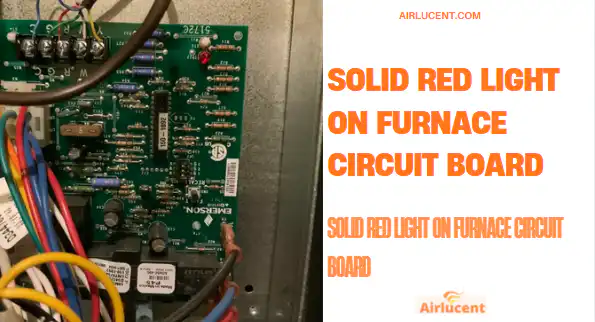
Hi, I’m Nathan. I’ve worked as an HVAC technician for over 10 years, and I’ve been on a lot of “no heat” calls where the homeowner opens the blower door, sees a solid red LED on the furnace control board, and assumes the board is bad.
Most of the time, that solid red light is actually good news.
In this guide I’ll show you:
- What a solid red light usually means (and when it’s normal)
- Why your furnace can still not heat even though the board looks “fine”
- A safe, homeowner-friendly troubleshooting path (including the R to W jump test)
- How to tell the difference between solid vs flashing diagnostic lights
- A useful Carrier error code table and what those codes point to
If you follow this in order, you’ll either get heat back or you’ll know exactly what to tell a technician.
Quick answer: What does a solid red light mean on a furnace control board?
On many furnaces (including a lot of Carrier and Goodman models), a solid red LED on the circuit board typically means:
- The control board has power (24V control power is present)
- The furnace is in standby
- It’s waiting for a call for heat from the thermostat
So in normal operation, a steady red light often means the board is alive and ready.
Solid vs flashing LED (the big difference)
- Solid red usually indicates normal standby (not always, but often)
- Flashing red typically indicates a fault code (diagnostic code)
The exact meaning depends on brand and model, so always check the furnace’s diagnostic label (usually on the inside of the blower door).
Before you touch anything: 3 safety notes I give every homeowner
- If you smell gas, leave the home and contact your gas utility or emergency services.
- If you suspect carbon monoxide (headaches, nausea, alarms going off), shut the system down and ventilate, then call a pro.
- Power off at the furnace switch or breaker before removing panels or moving wires. Some steps below require power on for observation, but do those carefully.
Where to find the red light (and why the door switch matters)
The LED is on the furnace control board, typically behind the lower front panel (blower compartment). Most furnaces have a door safety switch—when the panel is off, the switch pops out and cuts power to the furnace.
So if you remove the door to look at the board, you may need to hold the door switch in to restore power for testing/observing LED behavior.
Why your furnace can have a solid red light but still not work
If the LED is solid and the furnace isn’t responding, in my experience it usually comes down to one of these:
- Thermostat isn’t actually calling for heat
- Thermostat wiring issue (R and W circuit not closing)
- Power issue upstream (less common if LED is on, but still possible)
- Safety/limit condition (sometimes you’ll still see a steady LED depending on model)
- Control board is powered but not receiving the heat request
My real-world service note (10+ years in the field)
A big chunk of “no heat” calls end up being thermostat-related or simple control wiring problems (loose wire at W, broken thermostat cable, mis-set thermostat, dead batteries). It’s not glamorous, but it’s common.
Step-by-step troubleshooting (solid red light, no heat)
Step 1: Confirm the thermostat is calling for heat
At your thermostat:
- Set mode to HEAT
- Raise the set temperature 3–5°F above room temp
- If it’s battery-powered, replace batteries (even if it “looks on”)
What you’re looking for: a clear call for heat.
If your thermostat has a “heat on” indicator, it should appear. If it doesn’t, the problem may be thermostat setup, power, or thermostat failure.
Step 2: Make sure the furnace has proper power (even if the LED is on)
A solid LED suggests the board has 24V, but still check:
- Furnace switch is ON
- Breaker is ON
- If you have a condensate pump (90+), verify it’s not tripped
- Ensure the blower door is seated (or hold the door switch in during testing)
Step 3: Watch what the furnace does when there’s a call for heat
With thermostat calling:
- Does the inducer motor start?
- Do you hear a click (gas valve relay)?
- Does the igniter glow?
- Any change from solid to flashing?
If nothing at all happens and LED stays solid, the furnace may not be receiving the call for heat (thermostat circuit issue).
The fastest diagnostic test: Jump R to W at the furnace board
This is one of the most useful tests I do in the field because it separates thermostat/wiring problems from furnace problems.
What “R” and “W” mean
- R = 24V power (hot) from furnace transformer
- W = heat call signal back to the board
When the thermostat calls for heat, it essentially connects R to W.
How to do the R to W jump test (basic method)
Tools: a small insulated jumper wire is best. In a pinch, a paperclip can work, but be careful.
- Turn furnace power OFF
- Remove blower door
- Locate the low-voltage terminal strip (R, W, C, G, Y)
- Restore power (and hold the door switch in if needed)
- Briefly connect R to W
- Watch what happens
Results (what they mean)
| Result when you jump R to W | What it usually means | Next move |
|---|---|---|
| Furnace starts sequence (inducer, ignition, etc.) | Furnace is capable of heating; issue is thermostat or thermostat wiring | Move to thermostat wiring checks |
| Nothing happens at all | Could be bad board, blown low-voltage fuse, transformer issue, or safety circuit issue | Check fuse, 24V power, diagnostics |
| LED changes to a flashing fault code | The furnace is seeing a problem and is telling you which system is stopping it | Read the fault code chart |
If the furnace runs when you jump R to W: your issue is thermostat or wiring
At that point, the furnace is basically telling you: “I’m fine. I just wasn’t being asked to run.”
Step 4: Check thermostat wiring (common failure points)
- Loose wire at thermostat terminal W
- Loose wire at furnace terminal W
- Thermostat cable nicked/stapled too hard somewhere
- Corroded splice (especially near humidifiers, basements, or condensate areas)
Quick thermostat-side jump test
If you’re comfortable:
- Remove thermostat faceplate
- Identify R and W
- With power on, briefly connect R to W at the thermostat
If it runs at the thermostat jump: thermostat is bad or misconfigured.
If it only runs when jumped at the furnace: wiring between thermostat and furnace is likely broken.
Bad thermostat symptoms (what I see most)
A thermostat can fail in subtle ways. Common signs:
- Screen works, but it never sends a heat call
- Heat works sometimes, then stops
- Thermostat is set to “heat” but system doesn’t respond
- Smart thermostat wiring errors (especially missing C-wire issues)
If your furnace works with the R-W jump at the board, replacing the thermostat or fixing wiring usually solves it.
If you have a flashing red light instead: it’s giving you an error code
Most furnaces communicate faults through an LED:
- Count the flashes (for example, 3 flashes, pause, repeat)
- Or some boards show two-digit sequences (like 31, 32)
Always check the diagnostic chart on the panel first. If it’s missing, the manufacturer manual for your model will have it.
Carrier furnace error codes (common LED flash meanings)
Below is a practical reference list for many Carrier-style integrated furnace controls. This can vary by model, so treat it as a guide and verify against your unit’s label/manual.
| LED Code | Status / Meaning | What to check |
|---|---|---|
| 12 | No previous code (memory cleared) | Normal after power loss |
| 12 | Blower on after power up (if powered during a call for heat) | Blower runs ~90 seconds |
| 13 | Limit or flame rollout switch lockout | Overheat causes: dirty filter, blocked vents, weak blower, closed registers; rollout needs immediate attention |
| 14 | Ignition lockout | Gas supply, igniter, flame sensor, grounding, venting |
| 21 | Gas heating lockout (will not auto-reset) | Gas valve wiring, gas valve, board relay |
| 22 | Abnormal flame-proving signal | Leaky/stuck gas valve, flame sensor circuit issues |
| 23 | Pressure switch did not open | Pressure switch stuck closed, tubing issues |
| 24 | Secondary voltage fuse open (24V fuse) | Short in thermostat wiring, contactor short, humidifier wiring, etc. |
| 31 | High-heat pressure switch / relay did not close or reopened | Vent restriction, pressure switch, inducer/relay |
| 32 | Low heat pressure / draft safeguard / aux-limit issues (often downflow) | Venting, inducer voltage, pressure tubing, combustion air, wind, blocked intake/exhaust |
If you want, tell me your exact Carrier model number and what the LED is doing (solid or number of flashes), and I can help you interpret it more precisely.
Common “no heat” causes that look like a board problem (but aren’t)
Here’s a quick diagnostic table I’ve built from the patterns I see in the field.
| What you observe | Likely cause | Why it happens |
|---|---|---|
| Solid red LED, no response to thermostat | Thermostat not calling, broken W wire, miswired thermostat | Board is powered but never receives R-W closure |
| Solid red LED, furnace starts only when R-W jumped | Bad thermostat or open thermostat wire | Jump proves furnace side is OK |
| Blown 3A/5A fuse on board | Short in thermostat wires, humidifier, outdoor unit wiring (if shared), pinched cable | Fuse protects transformer/board from shorts |
| Furnace starts then shuts off quickly | Dirty flame sensor, airflow/limit issue | Safety trips end the cycle |
| Inducer runs but no ignition | Pressure switch/venting, igniter, gas supply | Sequence stops before flame |
A few useful numbers (homeowner context)
These aren’t scare tactics. They help you prioritize what matters:
- Space heating is one of the largest energy uses in U.S. homes. According to the U.S. Energy Information Administration (EIA), space heating accounts for a major share of residential energy consumption (often the biggest single category). That’s why small issues like a misconfigured thermostat or airflow restriction can have a noticeable comfort and cost impact.
- In my day-to-day service work, thermostat settings, batteries, or low-voltage wiring are among the most common “simple fixes” for a furnace that won’t start even though it has power.
(If you’d like, I can tailor this section to your furnace type: 80 percent vs 90+ condensing, single-stage vs two-stage.)
When I recommend calling a professional (don’t push past these)
Call a licensed HVAC tech if:
- You get a flame rollout or limit lockout repeatedly (Carrier code 13 can be serious)
- You see signs of overheating (burnt smell, discoloration, repeated shutdowns)
- You suspect a venting/pressure switch issue and you’re not comfortable inspecting intake/exhaust
- You’re getting ignition lockouts and you’re not trained to work around gas systems
- You’re unsure about jumping terminals or using a meter safely
A good technician won’t just “swap the board.” They’ll verify the call for heat, safeties, ignition sequence, and airflow.
Final thoughts (from me to you)
A solid red light on your furnace circuit board usually means the control board has power and is waiting for a heat request. If the furnace isn’t running, the most productive path is to test whether the board is actually receiving the call for heat.