
I’m Nathan. I’ve worked as an HVAC technician for over 10 years, and when a homeowner tells me, “My AC isn’t cooling and I don’t see any water coming out,” I take that as a very specific clue.
In a normal central air conditioner, cooling and condensation usually happen together. If you’re getting neither, it often means the evaporator coil isn’t getting cold enough, air isn’t moving across it, or the system isn’t running a true cooling cycle at all.
Below is the exact, practical way I troubleshoot this in the field, starting with the simple checks you can do safely and moving toward the issues that require a professional.
- Quick reality check: should your AC always produce condensation?
- The most common causes (summary table)
- Step-by-step troubleshooting (the same order I’d do it at your house)
- Step 1: Make sure the thermostat is actually calling for cooling
- Step 2: Check the air filter (this is the #1 homeowner fix)
- Step 3: Check for a frozen indoor coil (very common when there’s “no water”)
- Step 4: Go outside and confirm the compressor is actually running
- Step 5: Check the condensate drain line (especially if you suspect “no water” is the symptom)
- The “big” cause: low refrigerant (and why it stops both cooling and condensation)
- A simple diagnostic you can do: temperature split
- Cost guide (realistic homeowner expectations)
- What I’d do first (fast checklist)
- When you should stop and call a professional
- FAQ
Quick reality check: should your AC always produce condensation?
Not always.
Your AC only makes noticeable condensate when:
- The system is actually running cooling (compressor operating)
- Indoor air has enough humidity to drop moisture on the cold coil
- Condensate has a place to go that you can actually see (some drains tie into plumbing)
The most common causes (summary table)
Here’s the “big picture” table I use mentally on service calls:
| Thermostat set wrong (Fan ON / not in Cool) | Fan runs, air feels room temp, outside unit may not run | No true cooling cycle = coil not cold = no water | Set to Cool, Fan to Auto, lower setpoint |
| Dirty or wrong air filter (airflow restriction) | Weak airflow, rooms not cooling, sometimes ice | Not enough warm air hitting coil; coil can freeze or performance drops | Replace filter (most homes use MERV 8–13) |
| Frozen evaporator coil | Little airflow, indoor unit may hiss, lines may ice | Ice blocks airflow; coil can’t absorb heat; water becomes ice | Turn system OFF to thaw, then address airflow/refrigerant |
| Low refrigerant (often from a leak) | Poor cooling, coil may freeze, outdoor unit runs long | Coil doesn’t get to proper operating temps; heat transfer fails | Needs leak test and recharge by a pro |
| Compressor not running (even if fan is) | Outdoor fan spins but air is not cold | No compression = no cooling = no condensation | Requires professional diagnosis/repair |
| Clogged condensate drain line | Water around indoor unit, musty smell, shutoffs | Condensate can’t drain; some systems shut down via float switch | Clear drain line (safe methods below) |
Step-by-step troubleshooting (the same order I’d do it at your house)
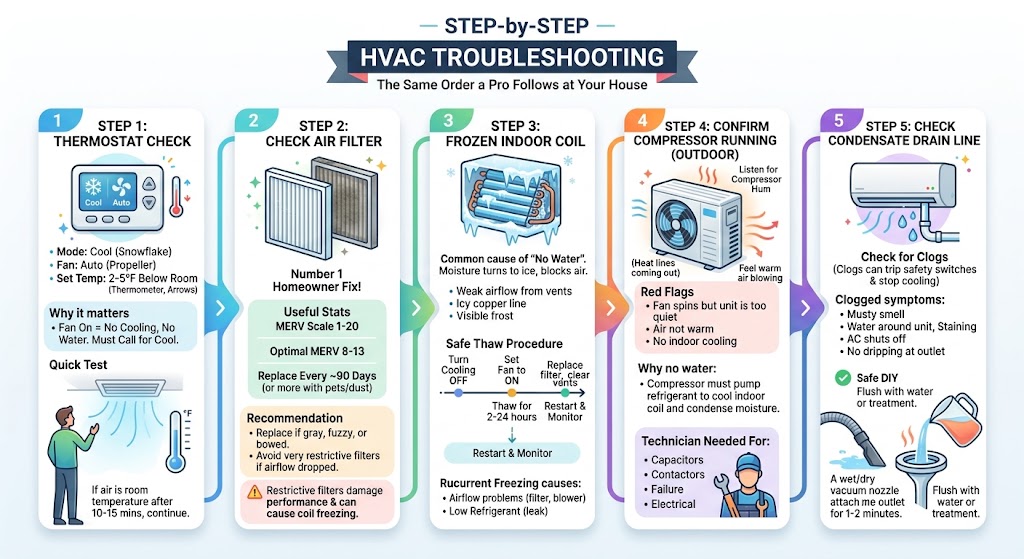
Step 1: Make sure the thermostat is actually calling for cooling
This sounds basic, but I see it constantly.
Check these settings:
- Mode: Cool
- Fan: Auto (not “On”)
- Set temperature: at least 2–5°F below the room temperature
Why it matters:
Condensation forms when the compressor is running and the indoor coil is cold. If you’re set to “Fan On” or a circulation mode, you can get airflow with no cooling and no water.
Quick test:
Stand at a supply vent. If the system has been running 10–15 minutes and the air feels basically room temperature, continue to Step 2.
Step 2: Check the air filter (this is the #1 homeowner fix)
A clogged filter can absolutely cause no cooling, and it often leads to coil icing, which can also reduce visible drainage.
Useful filter stats (practical, not theory)
- MERV scale range: 1–20
- Most homes do best with: MERV 8–13 (good filtration without choking airflow)
- A widely used baseline reminder is every ~90 days for replacement, but homes with pets, dust, or allergies often need it more frequently.
What I recommend
- If the filter looks gray, fuzzy, or bowed inward, replace it now
- If you recently installed a very “high filtration” filter and airflow dropped, step down to a more appropriate MERV
Important: Running a system with a severely restricted filter can damage performance and may contribute to coil freezing.
Step 3: Check for a frozen indoor coil (very common when there’s “no water”)
A frozen evaporator coil can trick you:
- You won’t see normal dripping because the moisture is turning into ice
- Cooling drops because airflow is blocked by frost/ice
Signs your coil may be frozen
- Airflow from vents is weak
- The larger copper line near the indoor unit (or outside) is icy
- You see frost on the refrigerant lines or near the indoor coil cabinet
What to do (safe thaw procedure)
- Turn Cooling OFF
- Set the fan to ON (to move warm air across the coil)
- Let it thaw for 2–24 hours depending on how solidly it’s frozen
- Replace the filter (if dirty) and make sure vents aren’t blocked
- Restart and monitor
If it freezes again, that usually points to:
- Airflow problems (filter, blower, closed registers, dirty coil)
- Low refrigerant (often from a leak)
Step 4: Go outside and confirm the compressor is actually running
This is a big one: sometimes the outdoor fan runs but the compressor does not.
What you should see/hear
- Outdoor unit running with a steady “compressor hum”
- Air blowing out the top/sides that feels warm (because it’s rejecting heat)
Red flags
- Outdoor fan spinning but the unit sounds “too quiet”
- Air coming out feels not warm at all
- The system never cools inside
Why it causes no condensation:
If the compressor isn’t pumping refrigerant properly, the indoor coil won’t get cold enough to condense moisture.
This usually requires a technician because it can involve:
- Capacitor issues
- Contactor issues
- Compressor failure
- Electrical problems
Step 5: Check the condensate drain line (especially if you suspect “no water” is the symptom)
Sometimes there is condensate, but it’s not draining where you expect. Other times, a clog causes backups that trigger a safety switch and stop cooling.
Common clogged drain line symptoms
- Musty or moldy smell near the indoor unit
- Water around the furnace/air handler
- Water staining
- AC shuts off randomly (float switch trip)
- You don’t see water at the usual drain termination point
Safe DIY drain clearing (what I do first)
- Turn system off
- If you have access to the drain outlet outside, use a wet/dry vacuum for 1–2 minutes
- Flush the drain with warm water (or a manufacturer-approved condensate treatment)
If you keep getting clogs, it’s worth having a tech inspect the drain routing, trap, and slope.
The “big” cause: low refrigerant (and why it stops both cooling and condensation)
If your system is low on refrigerant, it’s usually because of a leak. Refrigerant doesn’t get “used up” in a sealed system.
What low refrigerant often looks like
- AC runs долго (long cycles) but can’t reach set temperature
- Little or no condensate
- Coil may freeze
- Air coming from vents isn’t cold
Why it kills condensation
The indoor coil must reach the right operating temperature and pressure to pull heat and moisture from the air. With low charge, the coil can end up operating abnormally, heat transfer drops, and dehumidification suffers.
This is not a DIY fix. Correct repair means:
- Finding and fixing the leak
- Evacuating and weighing in the correct charge per manufacturer specs
A simple diagnostic you can do: temperature split
If you have a basic thermometer, you can get a useful clue.
How to check
- Measure return air temperature (air going into the system)
- Measure supply air temperature (air coming out of a nearby vent)
- Do this after the AC has been running 10–15 minutes
| Split is small (example: only 5–10°F) | Not really cooling: possible refrigerant issue, compressor issue, airflow issue, or thermostat/control problem |
| Split is moderate to strong (often around the mid-teens to low-20s°F range in many normal situations) | Cooling is happening; lack of visible condensate may be humidity/drain routing related |
This test doesn’t replace gauges and proper diagnosis, but it helps you avoid guessing.
Cost guide (realistic homeowner expectations)
Prices vary by region and system type, but here are practical “ballpark” ranges I see homeowners encounter.
| Air filter | $5–35 | Depends on size and MERV rating |
| Basic drain line clearing | Often service call minimum | DIY vacuuming is sometimes enough |
| Capacitor/contactor | Moderate repair | Common cause when outdoor unit won’t properly start |
| Refrigerant leak search + repair + recharge | Higher cost | Requires certified handling and correct charging |
| Compressor replacement | High cost | Sometimes leads to recommending full system replacement depending on age |
If your system is older and the compressor is failing, it’s worth asking about total system health rather than throwing money at one part.
What I’d do first (fast checklist)
If you want the quickest path without overthinking:
- Thermostat on Cool, Fan Auto, set 3–5°F lower
- Replace the filter (don’t “see if it helps,” just replace it if it’s dirty)
- Check airflow at vents
- Check outside unit: is the compressor actually running or just the fan
- Look for ice on the refrigerant line or signs of a frozen coil
- If ice is present, thaw completely, then restart
- If it still won’t cool and there’s still no condensate, call a tech for refrigerant/compressor diagnostics
When you should stop and call a professional
Call for service sooner (and shut it off) if:
- You see ice repeatedly after changing the filter
- The outdoor unit fan runs but cooling never starts (possible compressor/electrical issue)
- You suspect a refrigerant leak (hissing, oil spots, persistent poor cooling)
- Water is overflowing near the indoor unit (drain blockage, float switch, pan issues)
As a technician, I’ll tell you plainly: refrigerant and compressor issues are where DIY guessing gets expensive fast.
FAQ
Is it normal for my AC to have no condensation?
Yes, if it’s cooling properly and indoor humidity is low, or the drain is routed somewhere you don’t see. But no cooling plus no condensate is usually a real fault.
Can a dirty filter cause no condensation?
Absolutely. With low airflow, the system can’t exchange heat correctly. It may also freeze the coil, turning “water” into ice.
If my drain line is clogged, would cooling stop?
It can. Many systems have a float safety switch that shuts the system down to prevent water damage. Others will keep running and overflow into a pan.