Look, I get it. You open your front door and immediately want to cry a little because your entryway is basically the width of a yoga mat.
Maybe less. I’ve been there, staring at that sad, skinny hallway wondering how anyone expects me to create a welcoming first impression when I can barely fit a doormat without causing a fire hazard.
But here’s the thing—narrow entryways don’t have to suck. Actually, they’re kind of a fun challenge once you stop fighting against the space and start working with it. I’ve tried pretty much every trick in the book (and made plenty of mistakes along the way), and I’m here to share what actually works.
These aren’t just Pinterest-pretty ideas that look good in photos but fail in real life. These are legit, functional solutions that’ll make your narrow entryway look intentional and stylish instead of cramped and sad.
Ready to transform that skinny strip of doom into something you’re actually proud of? Let’s do this.
Slim Console Table with Round Mirror

The Classic Combo That Never Fails
You know what? Sometimes the classics become classics for a reason. A slim console table paired with a round mirror is basically the little black dress of entryway design—it just works.
I’m talking about those super skinny console tables that measure maybe 8-12 inches deep. They hug the wall like they’re afraid to take up space (which is exactly what you want). The beauty here is functionality without the bulk. You get a surface for your keys, wallet, and that random mail you’ll definitely look at later (spoiler: you won’t), without turning your hallway into an obstacle course.
Now, why a round mirror specifically? Here’s my take: Round mirrors soften the whole look. Narrow entryways already have so many straight lines and angles working against you—the walls, the doorframes, the general rectangular sadness of it all. A round mirror breaks that up and actually makes the space feel less claustrophobic. Plus, circles are visually interesting without being aggressive about it.
My personal setup trick:
- Choose a console table no deeper than 10 inches for truly narrow spaces
- Hang the mirror so its center sits about 57-60 inches from the floor (eye level for most people)
- Add a small tray on the console to corral your everyday items
- One sculptural piece or small plant is enough decor—don’t go crazy
The mirror does double duty by reflecting light and making your entryway feel bigger. It’s basically a magic trick, but make it interior design. I hung an oversized round mirror (about 30 inches in diameter) above my 9-inch console table, and honestly, guests think my entryway is way bigger than it actually is. Smoke and mirrors, my friend. Literally.
Floating Shelf and Wall Hooks Entryway

When Floor Space Is a Myth
Ever looked at your narrow entryway and thought, “What floor space?” Yeah, me too. This is when you need to get vertical and aggressive about it.
Floating shelves paired with wall hooks are the ultimate space-saving dream team. You’re using wall space that was just sitting there doing nothing, and you’re creating actual storage without sacrificing precious floor real estate. This setup is especially clutch for those entryways that are more “hallway” than “room.”
Here’s what I love about this approach: flexibility. You can install floating shelves at whatever height makes sense for your life. Got kids? Lower shelf. Just adults? Higher shelf for a cleaner look. The wall hooks can go underneath, beside, or in a totally different configuration depending on your needs.
Smart placement tips:
- Install the floating shelf about 60-65 inches high
- Place 3-5 sturdy wall hooks underneath or beside the shelf
- Use decorative hooks—they’re functional AND they look good
- Keep the shelf depth around 6-8 inches max
I installed this setup in my own narrow hallway, and it’s been a game-changer. The shelf holds a small basket for sunglasses and dog leashes, while the hooks below manage our everyday jackets and bags. Nothing touches the floor, which makes the whole space feel more open and less cluttered.
One word of warning though: Don’t cheap out on the hooks. I made that mistake once, used those flimsy adhesive hooks, and came home to my winter coat on the floor. Not cute. Invest in proper wall-mounted hooks that can actually handle weight. Your jackets will thank you.
Minimalist Narrow Hallway Entry Design

Less Is Actually More (I Know, Shocking)
I used to think minimalism was just a fancy word for “boring,” but then I tried it in my narrow entryway and had a full revelation moment. Sometimes the best thing you can do for a small space is to chill out with the decorating.
A minimalist approach for narrow entryways means being ruthless about what you include. Every single item needs to earn its place by either being functional or seriously beautiful. Preferably both. This isn’t about having nothing—it’s about having exactly enough and making it count.
The minimalist entryway formula:
- One statement piece (maybe a unique coat rack or a single piece of art)
- One functional element (a small bench or wall-mounted organizer)
- Neutral color palette (whites, grays, blacks, natural wood tones)
- Clear floors whenever possible
- Quality over quantity always
The trick here is choosing pieces with clean lines and simple silhouettes. Forget the ornate, curvy furniture—go for straight edges and streamlined designs. A simple wooden bench with metal legs. A basic wall-mounted mail organizer. A single piece of abstract art in a thin frame.
I redesigned my friend’s narrow apartment entryway using this approach, and the transformation was wild. We removed about 70% of what she had there (turns out she didn’t need three decorative vases and a ceramic elephant), kept her small bench, added a simple coat rack, and painted the walls a crisp white. The space literally looked twice as wide. The minimalist approach creates breathing room, and in narrow spaces, breathing room is everything.
FYI, minimalism doesn’t mean cold or uninviting. You can totally make it feel warm by choosing natural materials like wood, rattan, or linen. It’s minimalist, not miserable
Also Read: 10 Delightful Church Entryway Decor Ideas with Seasonal Beauty – Airlucent
Vertical Gallery Wall Entryway Decor

Because Blank Walls Are Boring
Okay, controversial opinion time: Gallery walls in narrow entryways can absolutely work if you do them vertically instead of horizontally. Everyone assumes gallery walls need tons of space, but they’re actually perfect for narrow areas when you build them upward instead of outward.
Think about it—your narrow entryway already lacks width, so why would you emphasize that by spreading frames horizontally? Going vertical draws the eye up, makes your ceilings feel higher, and creates visual interest without taking up physical space. It’s architecture psychology or whatever.
How to nail the vertical gallery wall:
- Start with 3-5 frames in varying sizes
- Arrange them in a vertical column or slightly staggered pattern
- Keep the total width under 20 inches so it doesn’t overwhelm the narrow wall
- Use a consistent color scheme for the frames (all black, all white, all wood)
- Mix family photos with art prints for personality
I created a vertical gallery wall in my entryway that goes from about 40 inches off the floor all the way up to 7 feet. It includes four frames—two larger ones and two smaller ones—arranged in a slightly offset column. The whole thing is maybe 18 inches wide, but it makes the ceiling look a mile high and gives guests something interesting to look at while they’re taking off their shoes.
Here’s a pro tip I learned the hard way: Plan the layout on the floor first. Seriously. Lay out all your frames on the ground, take a photo from above, and reference that photo when you’re hanging. I didn’t do this the first time and ended up with seventeen nail holes I had to patch. Learn from my mistakes, people.
The beauty of a vertical gallery wall is that it adds personality without adding bulk. It’s decoration that lives entirely on the wall plane, which is exactly what narrow entryways need. Plus, you can easily swap out photos or prints whenever you want to refresh the look without buying new furniture.
Cozy Farmhouse Narrow Entry Nook

Rustic Charm Meets Tiny Spaces
Listen, I’m not usually a “farmhouse everything” person (the trend got a bit out of hand there for a minute), but I’ll admit that farmhouse style actually works beautifully in narrow entryways. Something about the cozy, practical vibe just fits.
The farmhouse approach is all about combining functionality with warmth. You’re looking at natural materials, vintage-inspired pieces, and that lived-in feel that makes a space instantly welcoming. Even in a narrow space, you can capture this aesthetic without making it feel cluttered or overly themed.
Essential farmhouse entryway elements:
- Shiplap or beadboard accent wall (if you’re feeling ambitious)
- Wooden bench or stool with a weathered finish
- Metal hooks or a vintage coat rack
- Woven basket for storage
- Neutral textiles (a simple runner or cushion)
- Small farmhouse sign or rustic mirror
The key here is restraint. You want farmhouse vibes, not a Cracker Barrel explosion. I helped my sister create a farmhouse-style narrow entryway, and we focused on just a few key pieces: a small wooden bench with a worn white finish, three black metal hooks mounted on the wall above it, and a woven basket tucked underneath for shoe storage. That’s it. The wall got a fresh coat of soft gray paint, and she added a simple “Welcome” doormat. The whole thing feels cozy and intentional without being over the top.
One element I personally love for farmhouse entryways is the sliding barn door aesthetic, but here’s the thing—actual sliding barn doors take up space when they’re open. However, you can fake the look with barn door-style wall decor or even just rustic wood panel art. You get the style without the spatial sacrifice.
The farmhouse approach works well in narrow entryways because it embraces practical, space-saving solutions while making them look intentional and stylish. That wooden bench isn’t just pretty—it gives you a place to sit while putting on shoes. Those metal hooks aren’t just decorative—they’re holding your coats. Function and form, baby.
Built-In Bench with Hidden Storage
The Ultimate Space-Saving Power Move
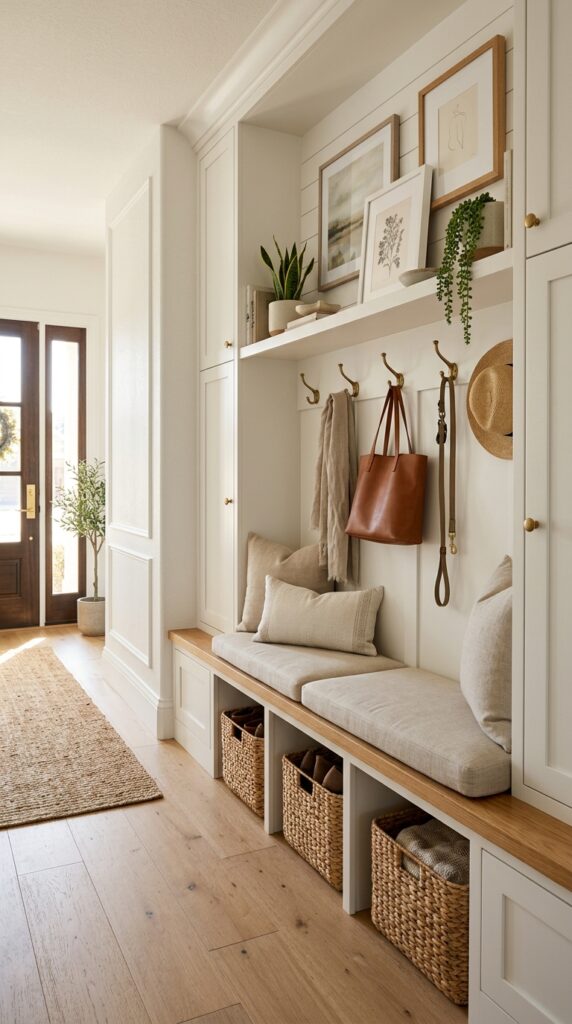
Alright, this one requires either some DIY skills or a decent budget for a carpenter, but hear me out—a built-in bench with hidden storage is hands-down the most efficient use of space in a narrow entryway. It’s like the Swiss Army knife of entryway furniture.
I’ll be honest: I lusted after this setup for years before finally pulling the trigger, and now I’m insufferable about it. Every person who visits gets a tour of my bench storage situation whether they want it or not. Why? Because it’s just that good.
Why built-in benches dominate:
- They’re custom-sized to fit your exact space (no awkward gaps or overhang)
- Hidden storage keeps clutter out of sight
- They provide seating without occupying separate floor space
- They look expensive and intentional
- They add architectural interest to boring hallways
The beauty of a built-in is that it uses the full width of your entryway without making it feel crowded because it becomes part of the wall structure. A regular bench or furniture piece creates a visual break, but a built-in just flows with the architecture.
For narrow entryways, I recommend keeping the bench depth around 15-18 inches. Deep enough to sit comfortably, but not so deep that it juts out obnoxiously. The storage underneath can be accessed via a lift-up seat or pull-out drawers—both work great. I went with the lift-up seat design because it’s sleeker (no drawer pulls to catch on), and I store seasonal items in there: winter hats, gloves, beach bags, dog walking supplies, whatever.
Design considerations:
- Paint it the same color as your walls for a seamless look
- Or use a contrasting wood tone for visual interest
- Add cushions for comfort and style
- Install hooks or a coat rack above for a complete entryway solution
- Consider adding cubbies underneath instead of closed storage for frequently-used shoes
IMO, this is the best long-term investment for a narrow entryway, especially if you own your place. It adds actual value to your home while solving multiple problems at once. Yeah, it costs more upfront than buying a random bench from Target, but it’s custom, it’s permanent, and it works exactly the way you need it to.
Also Read: 10 Fabulous Outdoor Entryway Decor Ideas for Front Porch Magic – Airlucent
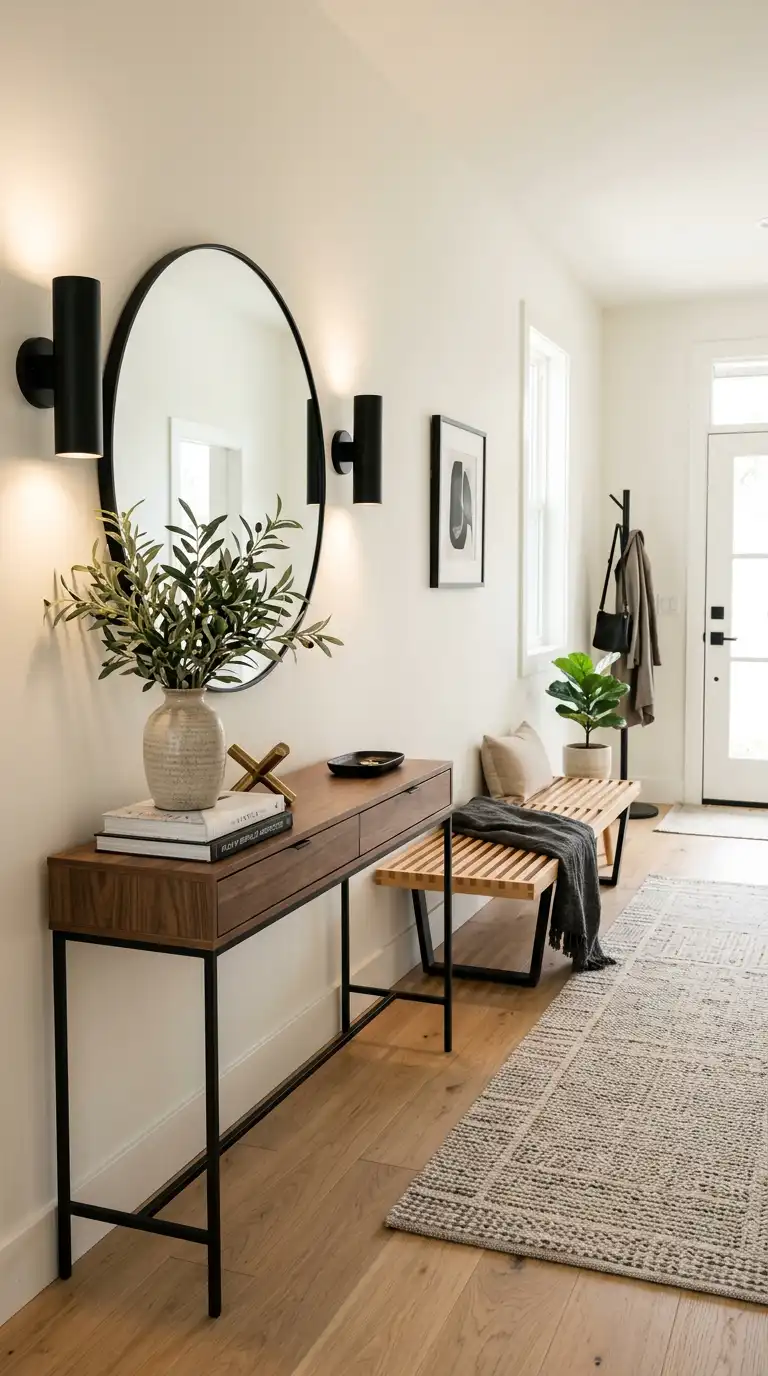
Modern Black and Wood Entryway Setup

Sleek, Sophisticated, and Surprisingly Versatile
There’s something about the combination of black metal and natural wood that just screams sophisticated without trying too hard. This color combo works in basically any design style—modern, industrial, Scandinavian, even transitional—which makes it a safe bet for narrow entryways.
The modern black and wood approach gives you a clean, polished look that doesn’t feel heavy or dark despite the black elements. The trick is balance. You’re pairing the weight and drama of black with the warmth and texture of wood, creating a contrast that’s visually interesting without being chaotic.
How to execute this look:
- Black metal coat hooks or a black metal coat rack
- Natural wood floating shelf or slim console
- Black-framed mirror or artwork
- Wood bench with black metal legs
- Small black accent pieces (bowl for keys, picture frames, etc.)
I recently redid my own entryway using this exact scheme, and the compliments have been genuinely surprising. It’s such a simple concept, but it looks designer-level when you commit to it. I installed a light oak floating shelf (10 inches deep) with matte black metal brackets. Below it, I mounted four black metal hooks in a row. The floor has a small wooden bench with sleek black hairpin legs. Above the shelf hangs a round mirror in a thin black metal frame.
The whole setup cost maybe $200, took an afternoon to install, and completely transformed the space. The black elements create definition and structure, while the wood keeps everything from feeling cold or stark. In a narrow entryway, this kind of visual clarity actually makes the space feel more open because there’s no visual clutter—just clean lines and intentional design.
One bonus of this color scheme: It hides dirt and wear really well. Black metal doesn’t show scuffs, and natural wood ages beautifully instead of looking worn out. Practical AND pretty—that’s the dream, right?
Apartment Entryway with Floating Shoe Storage
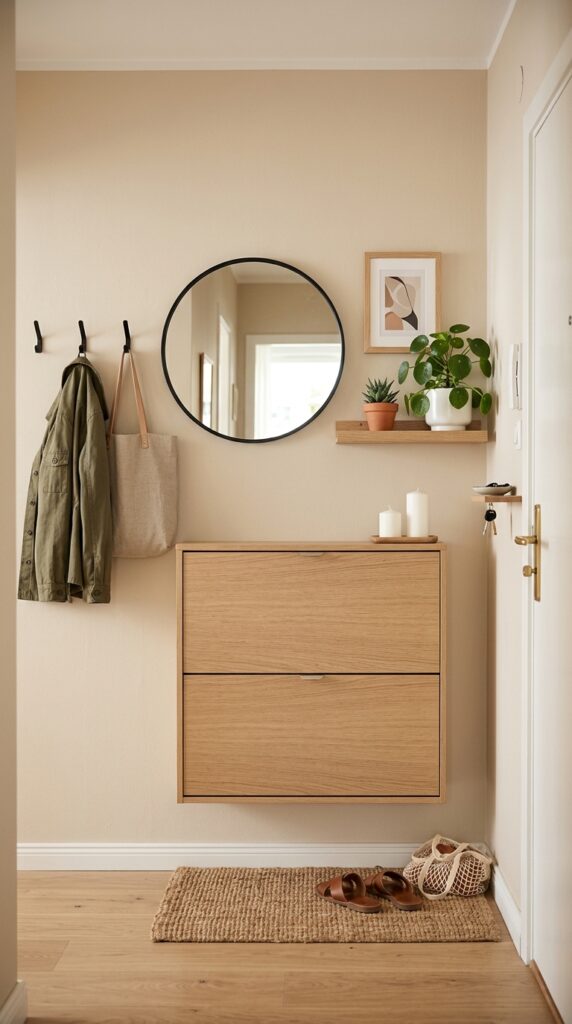
For Renters Who Can’t Mount Heavy Stuff
Apartment dwellers, this one’s for you. Most landlords get twitchy about major installations, and let’s be real—you probably don’t want to invest in expensive built-ins when you’re renting anyway. But your narrow entryway still needs to function, and shoe chaos is real.
Floating shoe storage (the kind that mounts to walls with minimal damage) is your new best friend. I’m talking about those sleek, slim shoe racks that hang on the wall and hold shoes at an angle or in slim cubbies. They keep your shoes off the floor, they’re easy to install, and most importantly, they’re easy to remove when you move out.
Apartment-friendly entryway essentials:
- Wall-mounted floating shoe rack (look for ones that hold 6-12 pairs)
- Command hooks for lightweight coats and bags (yes, they actually work)
- Removable wallpaper accent wall for personality without permanent commitment
- Slim tension rod storage solutions
- Freestanding narrow coat rack that doesn’t require mounting
I lived in a narrow apartment entryway situation for three years, and floating shoe storage literally saved my sanity. I installed a white metal floating shoe rack that held 9 pairs of shoes in slim cubbies. The whole thing was maybe 30 inches wide and 6 inches deep. It mounted to the wall with four screws (easy to patch when I moved), and suddenly my shoe pile situation was under control.
The key with apartment entryways is choosing solutions that are reversible and removable. You want impact without commitment. Floating shoe storage gives you that because it’s functional storage that doesn’t take up floor space, it looks intentional and designed (not like random furniture you shoved in there), and when you move, you can take it with you or patch four small holes. Easy.
Here’s something I learned the hard way: Measure your shoes first. Some floating shoe racks are designed for women’s shoes and can’t accommodate larger men’s shoes or boots. Check the dimensions before buying, or you’ll end up with a shoe rack that holds exactly three pairs of your actual shoes. Ask me how I know.
Bright Neutral Entryway with Oversized Mirror
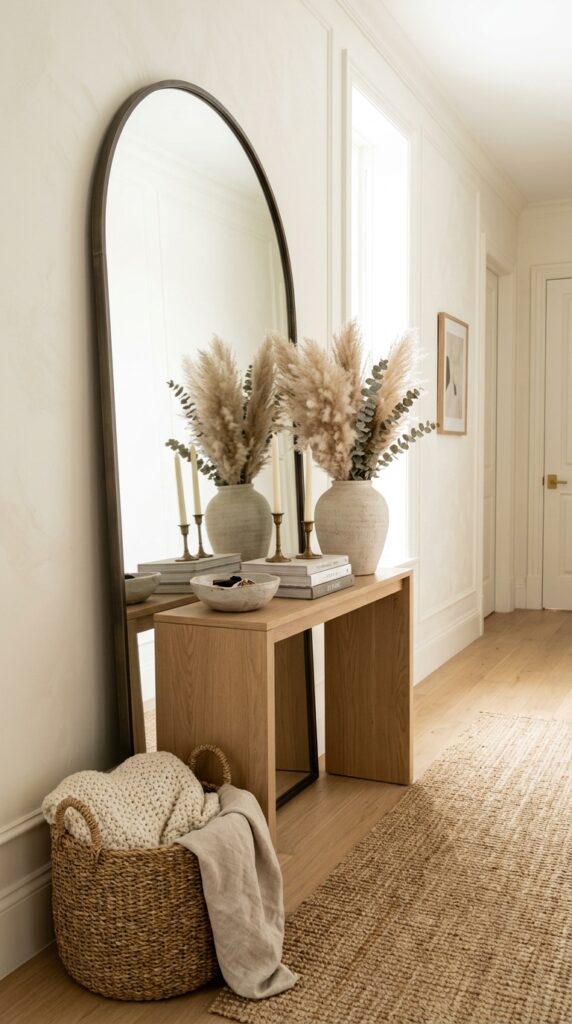
Fake Space Like a Professional
Want to know the biggest trick designers use to make narrow spaces feel bigger? Mirrors. Big ones. And I’m not talking about a tasteful 18-inch circle—I mean an oversized, dramatic, “is this a mirror or a portal to another dimension” sized mirror.
Pairing a huge mirror with a bright neutral color palette is basically cheating at the space-perception game, and I’m here for it. The mirror reflects light and visually doubles your space, while the neutral palette keeps everything feeling open and airy instead of cramped and dark.
The bright neutral palette includes:
- Soft whites and off-whites
- Warm beiges and tans
- Soft grays
- Natural wood tones
- Occasional black or charcoal for contrast
For my own narrow entryway (yes, I’ve redesigned it multiple times—don’t judge me), I went all-in on this approach and the results were kind of ridiculous. I painted the walls Benjamin Moore White Dove, installed a massive 36×48-inch mirror with a thin gold frame, and kept everything else neutral: a light wood console table, a beige textured basket, white ceramic tray for keys. The only darker element is a small black metal table lamp.
The difference is shocking. The mirror reflects light from the window near my front door and basically makes the whole space glow. The neutral palette means there’s no visual competition or clutter. Your eye just glides through the space instead of catching on different colors or busy patterns. In a narrow entryway, that smooth visual flow makes everything feel more spacious.
Oversized mirror tips:
- Lean it against the wall instead of hanging it for a casual, modern look
- Or mount it securely if you have kids or pets (safety first)
- Choose a frame style that matches your overall aesthetic
- Position it to reflect something attractive (a window, artwork, etc.)
- Clean it regularly because a dirty mirror defeats the purpose
One warning: This approach can feel a bit bland if you’re not careful. The key is adding texture within your neutral palette. A jute rug, a woven basket, a chunky knit throw on your bench, wood grain variations—these textural elements keep a neutral space from feeling flat or boring. You want bright and neutral, not boring and hospital-like.
Also Read: 10 Lovely Entryway Bench Decor Ideas to Make Guests Feel Welcome – Airlucent
Boho Narrow Entryway with Baskets and Greenery

Organized Chaos That Actually Works
Okay, last one, and it’s for all my maximalist friends who’ve been suffering through these minimal, sleek ideas. You can absolutely create a boho-style narrow entryway without making it look like a cluttered mess. The secret? Strategic baskets and intentional plant placement.
Boho style is all about layered textures, natural materials, and that collected-over-time vibe. In a narrow entryway, you accomplish this through smart use of baskets for storage and greenery for life and color. Instead of fighting against the boho instinct to add more, you just channel it into functional, space-saving solutions.
Boho entryway must-haves:
- Woven baskets in various sizes for storage
- Macramé wall hanging or plant hanger
- Potted plants or hanging plants
- Natural fiber rug or runner
- Rattan or bamboo furniture pieces
- Warm, earthy color palette (terracotta, sage, cream, natural wood)
I helped my best friend create a boho narrow entryway in her rental, and it turned out so good that I was genuinely jealous. We started with a slim rattan console table (seriously, rattan is magic for boho spaces). Underneath, we placed two large woven baskets for shoe storage—practical and pretty. Above the console, we hung a macramé wall hanging with a pothos plant cascading down from a small shelf. On the console itself: a small terracotta pot with a snake plant, a woven tray for keys, and a vintage brass bowl.
The whole setup was maybe 14 inches deep, but it had so much visual interest and personality. The baskets kept clutter hidden, the plants added life and color, and the layered textures created that cozy boho vibe without actually taking up space.
Making boho work in narrow spaces:
- Use baskets with lids to keep things tidy
- Choose trailing plants that grow vertically or hang down (not bushy plants that spread wide)
- Stick to a cohesive color palette (boho doesn’t mean rainbow explosion)
- Every decorative item should also be functional
- Layer rugs if you have the floor space, or just use one statement runner
The magic of the boho approach is that it feels personal and collected, which makes your narrow entryway seem intentional rather than unfortunate. Yeah, it’s a narrow space, but you’ve filled it with things you love and made it work. That’s peak boho energy right there.
One plant tip: Don’t go crazy. In narrow entryways, 2-3 well-placed plants are way better than 10 small ones. I learned this after creating a plant situation that made my entryway look like a jungle obstacle course. Cute in theory, annoying in practice when you’re trying to get out the door with groceries.
Final Thoughts: Your Narrow Entryway Doesn’t Have to Suck
Look, I’ve thrown a lot of ideas at you, and I get that it might feel overwhelming. But here’s the truth: Your narrow entryway isn’t a problem that needs solving—it’s just a design challenge that needs the right approach.
The biggest lesson I’ve learned through all my entryway experiments (and trust me, there have been many) is that working with your space instead of fighting against it always produces better results. Stop wishing your entryway was wider and start making it work at its actual width. Choose space-saving solutions that don’t sacrifice style. Embrace vertical space. Use mirrors strategically. Pick furniture and decor that earns its place by being functional AND beautiful.
Whether you go with the classic slim console and mirror, get vertical with floating shelves and hooks, commit to a built-in bench situation, or embrace the boho basket life, the key is choosing an approach that matches both your space limitations and your personal style. Don’t force a farmhouse vibe if you’re actually a minimalist at heart. Don’t go minimalist if you need baskets and plants to feel at home.
And hey, it’s okay if your first attempt isn’t perfect. I’ve redesigned my entryway at least five times, and I’m sure I’ll do it again. That’s the fun part—these spaces are small enough that you can experiment without it being a massive undertaking or investment.
Your narrow entryway can absolutely be functional, welcoming, and stylish. It just takes the right strategy and maybe a few oversized mirrors. You’ve got this.
Now stop reading and go measure your space—you’ve got an entryway to transform