
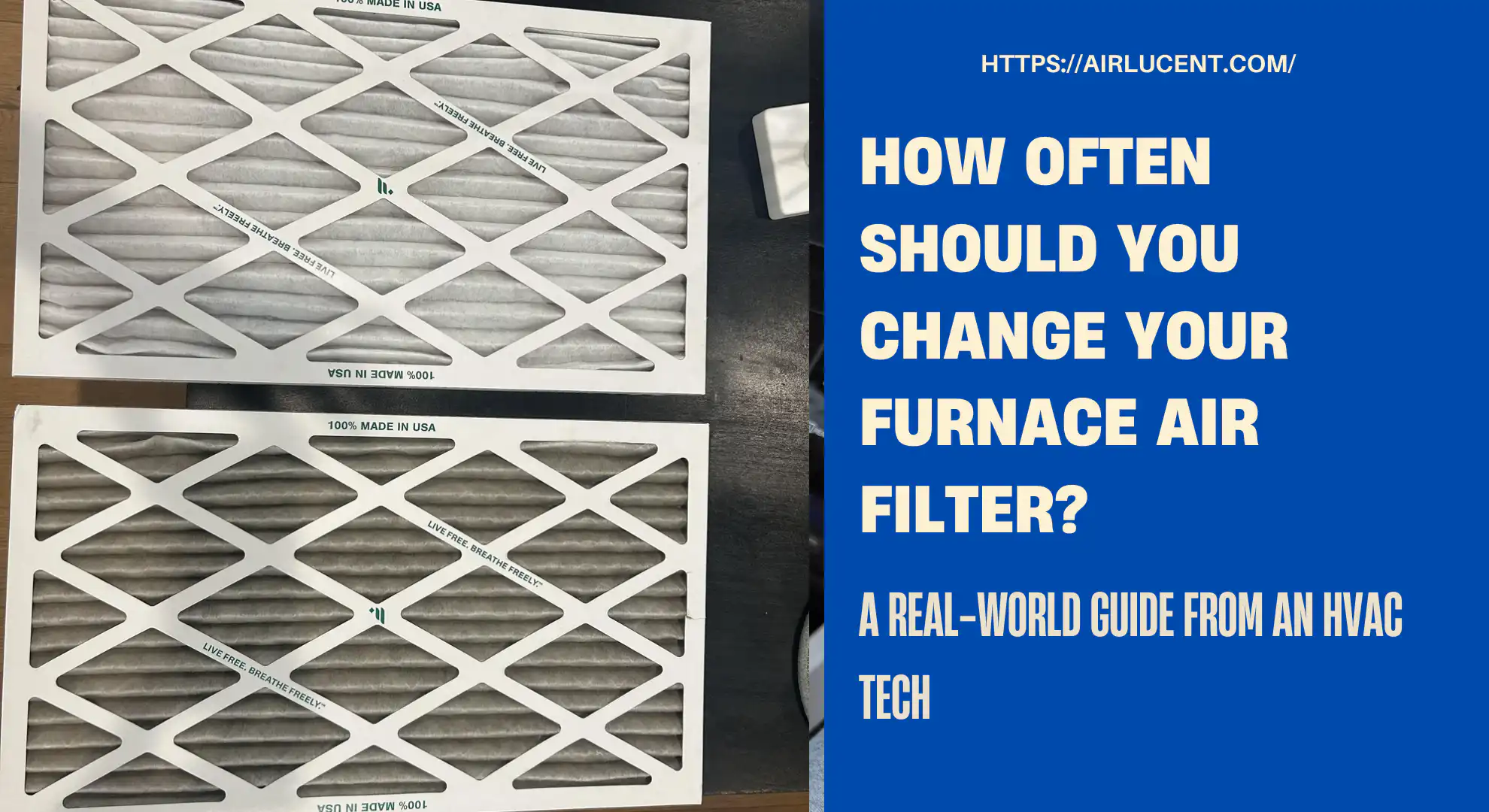
Hi, I’m Nathan. I’ve worked as an HVAC technician for over 10 years, and if there’s one small maintenance task that prevents more problems than anything else, it’s not changing the furnace air filter on time.
Most homeowners don’t ignore it on purpose. It’s just easy to forget because it’s out of sight. But your filter affects three big things you care about every day:
- Your indoor air quality
- Your comfort and airflow from room to room
- Your heating and cooling costs, and how hard your system has to work
In this guide, I will tell you how often to change your furnace filter and how to do it.
- Quick Answer: How Often to Change a Furnace Filter
- Why Changing Your Furnace Filter Matters More Than People Think
- Furnace Filter Change Frequency by Filter Thickness (Best Starting Point)
- The “Real Life” Factors That Change How Often You Should Replace It
- Seasonal Rule: Winter and Summer Usually Need More Attention
- Signs Your Furnace Filter Needs to Be Changed (Even If It Hasn’t Been Long)
- What Happens If You Don’t Change Your Furnace Filter?
- What Filter Should You Use? (MERV Rating Explained Simply)
- Where Is the Furnace Filter Located?
- How to Change a Furnace Filter (Step by Step)
- My Recommended Filter Routine (Simple and Hard to Mess Up)
- Furnace Filter FAQ
- Can a dirty filter cause the furnace to stop working?
- Is it OK to run the furnace without a filter for a day?
- What if I replace the filter, and the airflow is still weak?
- Bottom Line: The Best Change Schedule for Most Homes
Quick Answer: How Often to Change a Furnace Filter
If you want the simple rule:
- Most homes: change the filter every 1 to 3 months
- During heavy heating or AC seasons, check it monthly.
- Thicker media filters (4–5 inch): often last 6–12 months (but still inspect monthly)
That’s the “calendar” answer. The better answer is based on your filter type and your home conditions, which I’ll break down next.
Why Changing Your Furnace Filter Matters More Than People Think
Your furnace filter does two jobs:
- Helps protect your HVAC equipment by catching dust and debris before it ends up coating the blower wheel, the secondary heat exchanger, the evaporator coil, and other important parts.
- Also boosts indoor air quality because it traps floating particles such as dust, pollen, lint, and pet dander.
When a filter loads up with debris, it restricts airflow. Restricted airflow can lead to:
- Uneven heating or cooling
- Longer run times
- Higher energy bills
- Overheating in heating mode (which can trip safety switches)
- Frozen coils in cooling mode (yes, even in summer, a dirty “furnace” filter can cause this)
A stat that’s worth knowing
The EPA has said indoor air can be 2 to 5 times more polluted than outdoor air in certain situations. Your HVAC system keeps re-circulating that indoor air over and over, so filtration and filter upkeep matter a lot.
Furnace Filter Change Frequency by Filter Thickness (Best Starting Point)

Here’s a straightforward schedule I use in the field. This assumes “average” conditions and a properly sized filter.
Replacement intervals by thickness
| 1 inch | Basic fiberglass or 1-inch pleated | Every 30 to 90 days |
| 2 inch | Pleated media | Every 60 to 90 days |
| 3 inch | Deeper media | Every 90 to 180 days |
| 4 inch | Media cabinet filter | Every 6 to 9 months |
| 5 inch | Media cabinet filter | Every 9 to 12 months |
My honest advice: don’t blindly trust the longest number on the box. I’ve seen 5-inch filters clog early in dusty homes, and I’ve seen 1-inch pleated filters last close to 90 days in very clean homes. Your house decides the schedule.
The “Real Life” Factors That Change How Often You Should Replace It
This is where most online guides stop short. In my experience, your replacement schedule depends more on lifestyle and air conditions than the calendar.
Use this table to pick your filter schedule.
| No pets, no smoking, low dust | Slower loading | Every 60–90 days |
| One dog or cat | More hair and dander | Every 30–60 days |
| Multiple pets | Fast clogging, more airborne debris | Every 30 days |
| Allergies/asthma in the home | You want consistent filtration performance | Every 30–45 days |
| Smoking or frequent candles/incense | Sticky particles coat the filter faster | Every 30 days |
| Renovations, drywall, sanding | Filter can plug very quickly | Check weekly, change as needed |
| High HVAC run time (extreme hot/cold) | More air moves through filter | Check monthly, often 30–60 days |
| Older, drafty home or dusty area | More dust infiltration | Every 30–60 days |
If you tell me, “Nathan, I have two dogs, and my system runs nonstop in winter,” I’m not going to recommend a 90-day schedule. I’m going to tell you to check monthly and expect a 30–45 day change.
Seasonal Rule: Winter and Summer Usually Need More Attention
Even if your home is clean, the filter loads faster when airflow is constant.
My seasonal guideline
- Peak winter heating: inspect monthly, usually replace every 30–60 days
- Peak summer AC: inspect monthly, usually replace every 30–60 days
- Mild shoulder seasons (spring/fall): you may stretch to 60–90 days if the filter looks clean
Important detail: in most homes, the same filter is used for both heating and cooling because the furnace blower moves air for the air conditioner, too.
Signs Your Furnace Filter Needs to Be Changed (Even If It Hasn’t Been Long)

I always tell homeowners: the filter doesn’t care what your calendar says.
Replace it if you notice:
1) It looks gray and packed with dust
Pull it out and look at the pleats. If you can’t see much of the material, it’s loaded.
2) More dust around the house than usual
If dust returns quickly after cleaning, the filter may be clogged or not fit properly.
3) Uneven temperatures
Some rooms are too warm, others are too cold, and can be airflow-related. A dirty filter is the easiest thing to rule out first.
4) Higher energy bills without a clear reason
A clogged filter can increase run time. The U.S. Department of Energy has noted that proper filter maintenance can reduce HVAC energy use (commonly cited in the 5–15 percent range for certain systems and conditions).
5) The furnace is short-cycling or shutting off
Restricted airflow can contribute to overheating and safety shutdowns in heating mode.
6) Whistling at the return grille
Sometimes you’ll hear a “sucking” or whistling sound if airflow is being choked down.
What Happens If You Don’t Change Your Furnace Filter?
Here’s what I see on service calls when filters are neglected:
Your system works harder than it should
Less airflow means your blower runs under strain and your heat exchanger can run hotter than intended.
You can shorten equipment life.
It’s not usually one dramatic failure. It’s years of extra stress that add up.
You may trigger expensive problems
A dirty filter can contribute to:
- Dirty blower wheels
- Overheating and repeated limit switch trips
- Poor AC performance or coil icing
- More dust buildup in the ducts and inside the air handler
If you want the simplest “cheap insurance” for your HVAC system, it’s the filter.
What Filter Should You Use? (MERV Rating Explained Simply)
A lot of homeowners buy the highest MERV rating they can find, thinking it’s automatically best. Not always.
- Higher MERV = catches smaller particles.
- But a higher MERV can also restrict airflow if your system wasn’t designed for it or if you use a 1-inch high-MERV filter that loads quickly.
Practical MERV guidance I give homeowners
| Basic dust protection | MERV 5–8 | Usually safe for most systems |
| Better allergy support | MERV 9–11 | Good balance in many homes |
| Maximum fine particle capture | MERV 12–13 | Can be too restrictive in some setups, especially 1-inch filters |
Where Is the Furnace Filter Located?
Most filters are in one of these spots:
- Return grille filter (in a hallway wall or ceiling)
- Filter slot near the furnace (side or bottom of the unit)
- Media cabinet (common with 4–5 inch filters)
If you have return grille filters, make sure you know how many returns you have. I’ve walked into homes where one return had a filter and another didn’t, which can pull unfiltered air straight into the system.
How to Change a Furnace Filter (Step by Step)

This is safe and DIY-friendly for most homeowners.
Step 1: Turn the system off
Use the thermostat to turn off heating or cooling. If you want to be extra safe, flip the furnace switch (it looks like a light switch) near the unit.
Step 2: Remove the old filter carefully
Slide it out slowly so you don’t dump dust into the blower compartment or hallway.
Step 3: Confirm the size
The size is usually printed on the filter frame (example: 16x25x1). Match it exactly.
Step 4: Check the airflow arrow
There’s an arrow on the filter frame. It must point toward the furnace/air handler in the direction the air flows.
Step 5: Install the new filter
Make sure it sits snugly and isn’t bowed or crooked.
Step 6: Turn the system back on
Listen for normal operation.
Pro tip from my service calls
Write the install date on the filter frame with a marker. It’s simple, and it ends the “I can’t remember when I changed it” problem.
My Recommended Filter Routine (Simple and Hard to Mess Up)
If you want a routine that works for almost every homeowner:
- Check your filter on the first weekend of every month.
- Replace it if it:
- Looks loaded, or
- you can’t see light through much of it (for pleated filters), or
- It’s been longer than your target interval.
This method beats strict calendar scheduling because it adapts to pets, weather, and dust.
Furnace Filter FAQ
Can a dirty filter cause the furnace to stop working?
Yes. I’ve personally seen furnaces shut down due to overheating caused by low airflow from a clogged filter.
Is it OK to run the furnace without a filter for a day?
I don’t recommend it. Even a short time can pull dust into the blower and coil surfaces. If you’re waiting on a replacement, buy a temporary one locally.
What if I replace the filter, and the airflow is still weak?
Then we’re likely dealing with something else, such as:
- a dirty blower wheel
- closed dampers
- duct restrictions
- an undersized return
- a clogged evaporator coil (if you also have AC)
If basic filter replacement doesn’t improve anything, that’s when it makes sense to call a pro.
Bottom Line: The Best Change Schedule for Most Homes
If you want one reliable recommendation from me after 10+ years in the field:
- 1 inch filters: plan on every 30 to 60 days or 90 days max in very clean homes
- 4 to 5 inch filters: plan on every 6 to 12 months, but still inspect monthly
- If you have pets, allergies, smoke, or lots of dust, assume monthly changes for 1-inch filters.