
Hi, I’m Nathan. I’ve worked as an HVAC technician for over 10 years, and “Goodman furnace flashing 4 times” is one of the most common cold-weather calls I run. The good news is that this code is usually caused by an airflow problem you can spot quickly. The bad news is that if you ignore it, you can shorten the life of the furnace and potentially create a safety issue.
In this guide I’ll walk you through what 4 flashes means, the most likely causes, and the same troubleshooting steps I use in the field to get homeowners safely back up and running.
- What 4 Flashes Means on a Goodman Furnace
- Fast “Before You Call a Tech” Checks (5 Minutes)
- Common Causes and Fixes (Quick Reference Table)
- Step-by-Step Troubleshooting: Goodman Furnace 4 Flash Code
- Safety first
- Step 1: Check and replace the air filter (most common fix)
- Step 2: Check return air grilles and supply registers
- Step 3: Confirm the blower is actually moving air
- Step 4: Check the evaporator coil (if you have central AC)
- Step 5: Inspect intake and exhaust venting (high efficiency Goodman furnaces)
- Step 6: Measure temperature rise (a very telling test)
- Step 7: Test the limit switch (when airflow checks don’t solve it)
- Resetting the Code: Will It Just Go Away?
- When 4 Flashes Might Indicate a Bigger Safety Issue
- My “Most Likely Fix” Ranking (Based on Real Service Calls)
- Prevent This from Coming Back (Simple Maintenance That Works)
- Goodman Furnace 4 Flashes FAQ
- Final Thoughts (What I Want You to Remember)
What 4 Flashes Means on a Goodman Furnace
On most Goodman furnaces, 4 flashes indicates the primary limit circuit is open, often described as:
- High limit switch open
- Auxiliary limit switch open
- Furnace is overheating and shutting down for safety
Reference: Goodman service literature for models like GMV9 and GCV9 describes 4 flashes as an open limit circuit and points to airflow, blower, and venting causes. (Example training/service document: Questargas Goodman GMV9 GCV9 PDF)
Fast “Before You Call a Tech” Checks (5 Minutes)
If you want the fastest path to a fix, do these first:
- Replace the furnace filter (even if it “doesn’t look that bad”)
- Make sure all supply registers are open and not blocked by rugs or furniture
- Make sure return grilles are not blocked (this one is huge)
- Check the furnace intake and exhaust pipes outside for snow, leaves, lint, or nests
In my experience, airflow restriction is the number one reason Goodman furnaces hit a 4-flash limit code.
Common Causes and Fixes (Quick Reference Table)
| Dirty or restrictive air filter (often high MERV in a system not designed for it) | Starves airflow across the heat exchanger, heat builds too fast | Install a clean filter, consider a less restrictive MERV if needed |
| Blocked return air grille or closed registers | Reduces total airflow volume, causing high temperature rise | Open vents, clear furniture, check all returns |
| Dirty blower wheel or failing blower motor/capacitor | Blower can’t move enough air even with a clean filter | Inspect blower, listen for struggling startup, schedule repair if needed |
| Dirty evaporator coil (if you have AC on top of furnace) | Coil becomes an airflow “plug,” furnace overheats | Coil cleaning typically requires a pro |
| Blocked flue/exhaust or intake (high efficiency units) | Bad combustion airflow or heat not venting properly | Clear outdoor terminations, check for sagging pipes |
| Incorrect blower speed setting or ductwork restrictions | Furnace runs outside designed temperature rise | Speed adjustments and duct evaluation usually require a tech |
| Weak or failing limit switch | Switch opens too early even when airflow is okay | Professional diagnosis and replacement |
| Cracked heat exchanger (less common, but serious) | Can create abnormal heat patterns and trip limits | Stop running the unit and call a professional immediately |
Step-by-Step Troubleshooting: Goodman Furnace 4 Flash Code
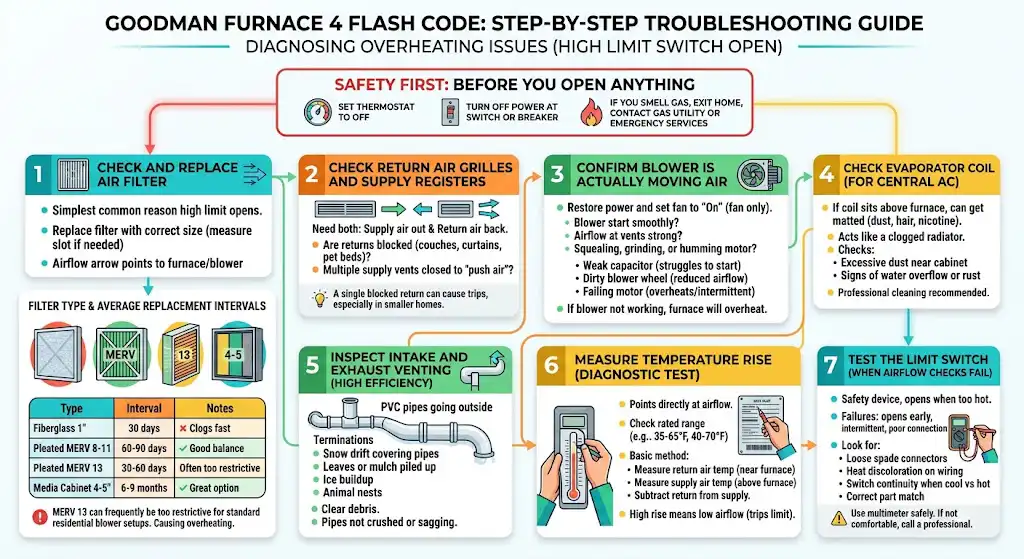
Safety first
Before you open anything:
- Set thermostat to off
- Turn off power to the furnace at the switch or breaker
- If you smell gas, leave the home and contact your gas utility or emergency services
Step 1: Check and replace the air filter (most common fix)
A clogged filter is the simplest and most common reason the high limit opens.
What I recommend:
- Replace the filter with the correct size (don’t trust the box only, measure the slot if needed)
- Make sure airflow arrow points toward the furnace/blower
Filter change intervals (realistic expectations)
These are practical averages I see in homes:
| Fiberglass 1 inch | About 30 days | Clogs fast, low resistance when clean |
| Pleated 1 inch (MERV 8 to 11) | 60 to 90 days | Good balance for many systems |
| Pleated high MERV (MERV 13) | 30 to 60 days | Often too restrictive for older duct systems |
| Media cabinet 4 to 5 inch | 6 to 9 months | Great option if your system supports it |
Important note from the field: MERV 13 is frequently too restrictive for many standard residential blower setups unless the ductwork and filter rack are designed for it. A too-restrictive filter can absolutely mimic bigger problems by causing overheating.
Step 2: Check return air grilles and supply registers
You need both:
- Supply air out
- Return air back
Check:
- Are any returns blocked by couches, curtains, beds, or pet beds?
- Did someone close multiple supply vents to “push air to another room”?
I’ve seen a single blocked return cause repeated limit trips, especially in smaller homes.
Step 3: Confirm the blower is actually moving air
Restore power and set the thermostat fan to “On” (fan only). Then check:
- Do you hear the blower start smoothly?
- Is airflow at vents strong?
- Any squealing, grinding, or a humming motor that struggles to start?
Common blower-related causes:
- Weak capacitor (motor struggles, runs slow)
- Dirty blower wheel (airflow reduced even though motor runs)
- Failing motor (overheats, shuts off, or runs intermittently)
If the blower is not working correctly, the furnace will overheat quickly and trip the limit.
Step 4: Check the evaporator coil (if you have central AC)
If your AC coil sits above the furnace, it can get matted with dust, pet hair, or nicotine residue. When that happens, the furnace is trying to blow through a clogged radiator.
Homeowner-friendly checks:
- Look for excessive dust buildup near the coil cabinet
- Check for signs of past water overflow or heavy rust staining
In most cases, proper coil cleaning is a professional job because of access, delicate fins, and risk of refrigerant line damage.
Step 5: Inspect intake and exhaust venting (high efficiency Goodman furnaces)
If you have PVC pipes (usually two pipes) going outside, check the terminations:
- Snow drift covering pipes
- Leaves or mulch piled up
- Ice buildup
- Animal nests
Blocked venting can cause abnormal operation and safety trips. Clear any debris and make sure the pipes are not crushed or sagging.
Step 6: Measure temperature rise (a very telling test)
This is one of my favorite diagnostics because it points directly at airflow.
Most furnaces have a rated temperature rise range on the data plate, such as:
- 35 to 65 degrees F
- 40 to 70 degrees F
How it’s checked (basic method):
- Measure return air temperature near the furnace
- Measure supply air temperature a few feet above the furnace
- Subtract return from supply
If the temperature rise is above the rated range, airflow is usually too low. That will trigger the limit switch.
If you don’t have a thermometer, you can still proceed with the airflow checks, but temperature rise is how a tech confirms it.
Step 7: Test the limit switch (when airflow checks don’t solve it)
The limit switch is a safety device that opens when it senses too much heat.
A limit switch can fail by:
- Opening too early (nuisance trips)
- Intermittent operation
- Poor electrical connection
What I look for professionally:
- Loose spade connectors
- Heat discoloration on wiring
- Switch continuity when cool vs. when hot
- Correct part match and mounting position
If you are not comfortable using a multimeter safely, this is the point where I recommend calling a technician.
Resetting the Code: Will It Just Go Away?
Often, yes. Many Goodman limit switches are automatic reset. That means after the furnace cools down, it resets and tries again.
But here’s what I tell homeowners:
If it reset itself once, it will probably do it again until the root cause is fixed.
Repeated overheating can lead to:
- Premature blower motor failure
- Cracked heat exchanger risk over time
- Annoying no-heat situations during the coldest nights
When 4 Flashes Might Indicate a Bigger Safety Issue
Cracked heat exchanger (serious)
A cracked heat exchanger is not the most common cause of a 4-flash code, but it is important to mention because it’s high risk.
Potential warning signs:
- Furnace cycles on and off rapidly
- Unusual smells or irritation
- Sooting around burners
- Visible corrosion or cracks during inspection
- Carbon monoxide alarm activity
If you suspect this, stop running the furnace and schedule a professional inspection. A qualified tech may perform a combustion analysis and visual inspection.
My “Most Likely Fix” Ranking (Based on Real Service Calls)
If your Goodman furnace is flashing 4 times, these are the issues I see most often, in order:
- Dirty or overly restrictive air filter
- Closed or blocked vents or returns
- Dirty blower wheel
- Weak blower capacitor or failing motor
- Dirty evaporator coil
- Venting restriction (intake or exhaust)
- Limit switch starting to fail
- Duct design issues or wrong blower speed setup
- Heat exchanger concerns
Prevent This from Coming Back (Simple Maintenance That Works)
Here’s what I recommend you do to avoid future limit trips:
Monthly during heavy heating season
- Check the filter every 30 days
- Walk the house and confirm vents and returns are open
Each season
- Make sure exhaust and intake terminations are clear outside
- Listen for changes in blower sound (early warning of motor/capacitor problems)
Yearly
- Professional furnace maintenance with:
- Temperature rise check
- Blower inspection/cleaning if needed
- Burner inspection and combustion safety checks
- Confirmation of proper venting
Goodman Furnace 4 Flashes FAQ
Can I keep running my furnace if it’s flashing 4 times?
If it’s actively tripping the limit, I don’t recommend forcing it to run. Replace the filter and correct airflow issues first. If it continues, get it serviced. Repeated overheating is hard on the furnace.
Why does it work sometimes and fail other times?
Because the limit switch can reset after cooling. Also, airflow can change (filter loads up, more registers get closed, outdoor vent gets iced over at night).
Is this something I can fix without tools?
Yes, very often. Filter replacement and clearing blocked vents/returns solve a large portion of these calls.
Final Thoughts (What I Want You to Remember)
If your Goodman furnace shows 4 flashes, you’re dealing with an open limit circuit. In plain language, the furnace is overheating or the limit circuit is telling the board it’s overheating.