You know that feeling when you pull up to someone’s house and their front porch just speaks to you? Like, before you even knock on the door, you already know whether they’re a cozy farmhouse person or a sleek minimalist type? Yeah, your outdoor entryway does way more talking than you think.
I’ll be honest—I used to think my front porch was just a place to stack Amazon boxes (don’t judge me). But then I realized this little slice of real estate is basically your home’s handshake.
It sets the vibe, welcomes your guests, and honestly, makes you smile every time you come home. So let’s talk about turning your outdoor entryway from “meh” to “wow” with ten seriously fabulous ideas that’ll give you major front porch magic.
Modern Black and Wood Outdoor Entryway
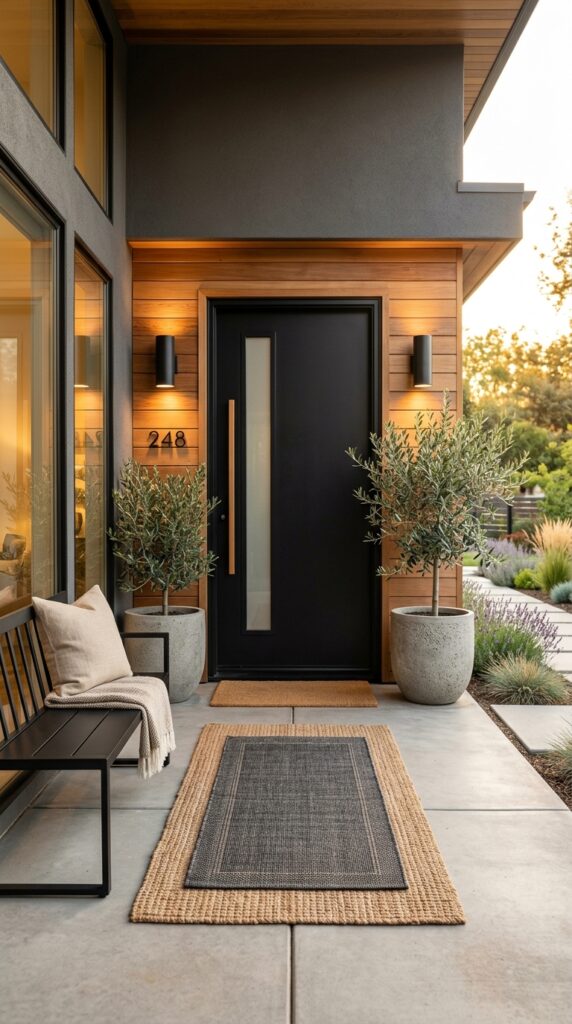
Listen, I’m kind of obsessed with the whole modern black-and-wood combo right now. There’s something about that contrast that screams sophistication without trying too hard. You know what I mean?
The Color Combo That Never Fails
Black and wood create this gorgeous visual tension that catches your eye immediately. I painted my front door matte black last summer (after three years of debating it), and pairing it with natural wood elements completely transformed my entryway. The dark, moody tones against warm wood grain create depth that photographs beautifully—and trust me, you’ll want to Instagram this setup.
Here’s what makes this look work:
- Matte black front door as your anchor piece
- Wooden welcome mat or slatted doormat
- Black metal house numbers in a modern font
- Natural wood bench or stool for functionality
- Black geometric planters with greenery
- Wood-framed outdoor mirror or art piece
Why This Style Works for Real Life
The beauty of modern black and wood? It hides dirt like a champ. My dark elements don’t show every speck of dust, and the wood ages gracefully instead of looking worn out. Plus, this combo works year-round—you can switch up your plants and accessories seasonally while keeping the core aesthetic intact.
I added a simple wooden bench from a local craftsman (okay, fine, I found it at a yard sale and refinished it), and suddenly my entryway became functional and stylish. Guests have a spot to set down gifts or bags, and I have a place to sit while wrestling with my shoes. Win-win.
Cozy Farmhouse Porch Entryway Decor

Can we talk about farmhouse style for a second? Everyone and their mother jumped on this trend, but you know what? It endures for a reason—it just feels like home.
The Elements That Create Farmhouse Charm
Farmhouse style is all about creating that “welcome to my warm, slightly imperfect, totally lived-in space” vibe. I’m talking shiplap (if you’ve got it), vintage finds, and layers upon layers of texture. This isn’t about perfection—it’s about personality.
Your farmhouse entryway should include:
- Oversized wooden sign with a welcoming message
- Galvanized metal accents (buckets, watering cans, or planters)
- Cotton or linen textiles in neutral tones
- Vintage ladder for displaying blankets or seasonal decor
- Rocking chair or wooden bench
- Mason jar lights or Edison bulb fixtures
Making Farmhouse Feel Fresh
Here’s my hot take: farmhouse style gets a bad rap because people go overboard with the “Live, Laugh, Love” signs. IMO, you can totally do farmhouse without looking like a catalog threw up on your porch.
I keep my farmhouse elements subtle—a weathered wooden crate filled with pumpkins in fall, a simple wreath made from eucalyptus, and a vintage milk jug holding fresh flowers. The key is mixing old and new so it doesn’t feel like a time capsule from 1890. Pair that antique watering can with modern succulents, you know?
Small Space Outdoor Entryway Makeover
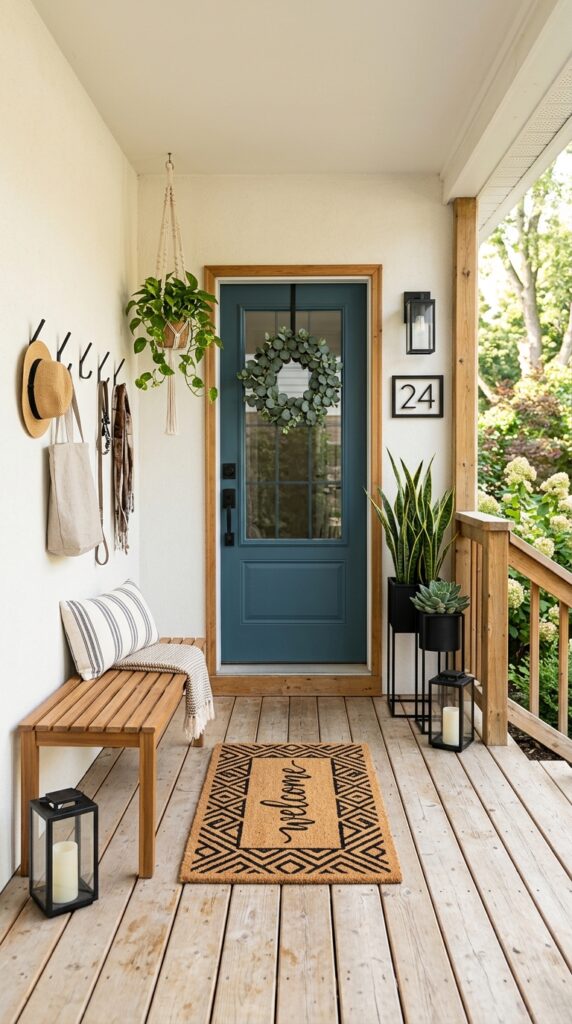
Okay, real talk—not everyone has a sprawling front porch. Some of us are working with a tiny stoop that barely fits a doormat. But guess what? Small spaces can pack just as much punch.
Maximizing Every Single Inch
I learned this the hard way at my first apartment, where my “entryway” was literally a 3×3 foot concrete slab. The trick is vertical thinking and multi-functional pieces. You can’t spread out, so you go up!
Small space essentials:
- Narrow console table or wall-mounted shelf
- Vertical planter or hanging baskets
- Over-the-door wreath as your main focal point
- Wall-mounted lanterns to save floor space
- Slim doormat that fits your dimensions
- One statement plant instead of multiple small ones
The Magic of Smart Styling
Ever wondered why some tiny entryways feel spacious while others feel cluttered? It’s all about restraint (which pains me to say because I love all the decor). But I’ve learned that in small spaces, less really is more.
Choose one or two statement pieces rather than filling every inch. I use a tall, dramatic fiddle leaf fig in a sleek planter on one side of my door. That single plant draws the eye upward, creates presence, and doesn’t crowd my limited space. On the other side? Just a simple wall-mounted mailbox that doubles as decor. Done.
Also Read: 10 Lovely Entryway Bench Decor Ideas to Make Guests Feel Welcome – Airlucent
Elegant Symmetrical Front Door Styling

Can I confess something? I’m a total sucker for symmetry. There’s something deeply satisfying about perfectly balanced design—it’s like visual meditation.
The Power of Perfect Balance
Symmetrical design instantly elevates your entryway from casual to sophisticated. It creates this sense of intentional design that makes your home look pulled together and, dare I say, expensive. You don’t need an actual mansion to achieve this look.
Create symmetry with:
- Matching planters on either side of the door (this is non-negotiable)
- Identical topiary trees or boxwoods
- Two matching lanterns or sconces
- Balanced house numbers centered above the door
- Twin outdoor chairs or benches
- Mirror-image seasonal decor
Keeping It Interesting Without Breaking the Balance
Here’s the thing about symmetry—it can veer into “hotel lobby” territory if you’re not careful. You want elegant, not sterile. I keep my symmetrical elements as the bones of my design, then add slight variations in the organic elements to keep things interesting.
My twin planters hold the same type of plant (dwarf Alberta spruce, FYI), but I let them grow naturally without obsessively trimming them to identical heights. The symmetry provides structure, but the natural growth keeps it from looking too rigid. Between them, my centered door wreath changes with the seasons, giving me a chance to play while maintaining that balanced foundation.
Boho Outdoor Entryway with Layered Textures
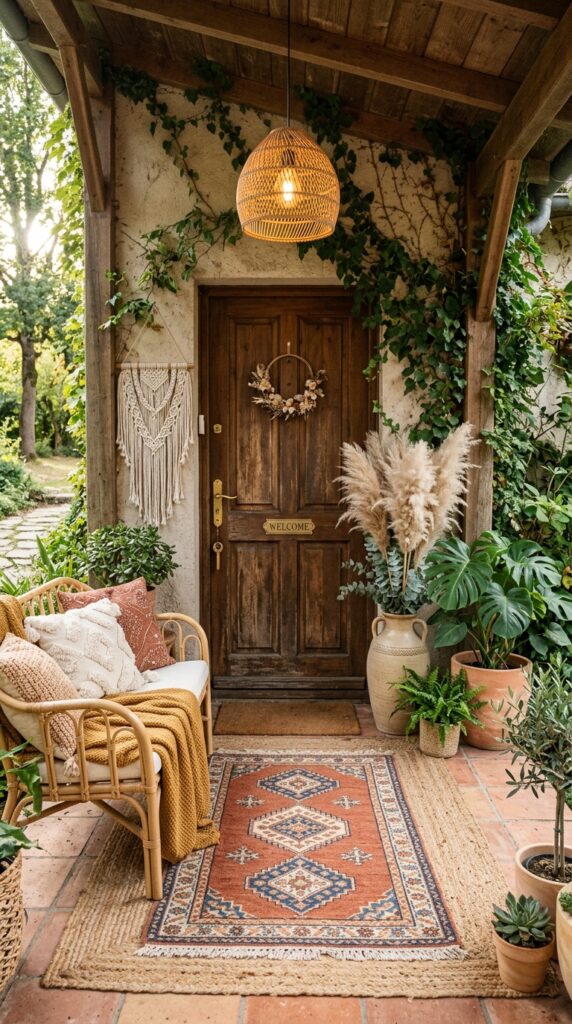
Alright, my free-spirited friends, this one’s for you. Boho style is basically “organized chaos meets worldly traveler,” and I am here for it.
Embracing the Mix-and-Match Aesthetic
Boho breaks all the rules we just talked about (bye-bye, symmetry!), and that’s exactly why it works. This style celebrates eclecticism, natural materials, and that perfectly imperfect vibe.
Your entryway should look like you collected treasures from around the world, even if you actually found them at HomeGoods.
Layer these boho elements:
- Macramé wall hanging or plant hanger
- Rattan or wicker furniture
- Colorful patterned textiles (think Moroccan or tribal prints)
- Lots of plants—the more, the merrier
- Natural fiber rugs layered together
- Vintage or hand-painted pottery
- String lights or beaded chandeliers
The Art of Textural Layering
What makes boho work is the texture overload in the best possible way. I’m talking woven, carved, painted, glazed—all the tactile elements that make you want to reach out and touch everything.
Start with a jute rug as your base layer, then add a smaller patterned rug on top. Hang a macramé piece on the wall, place a rattan chair with a chunky knit throw, and cluster terracotta pots in varying sizes. The key is mixing textures while keeping a cohesive color story—I stick to warm, earthy tones with pops of terracotta, sage, and cream to keep it from looking chaotic.
Luxury Entryway with Oversized Planters

Want to know the easiest way to make your entryway look like a million bucks? Go big. Like, really big.
The Impact of Scale
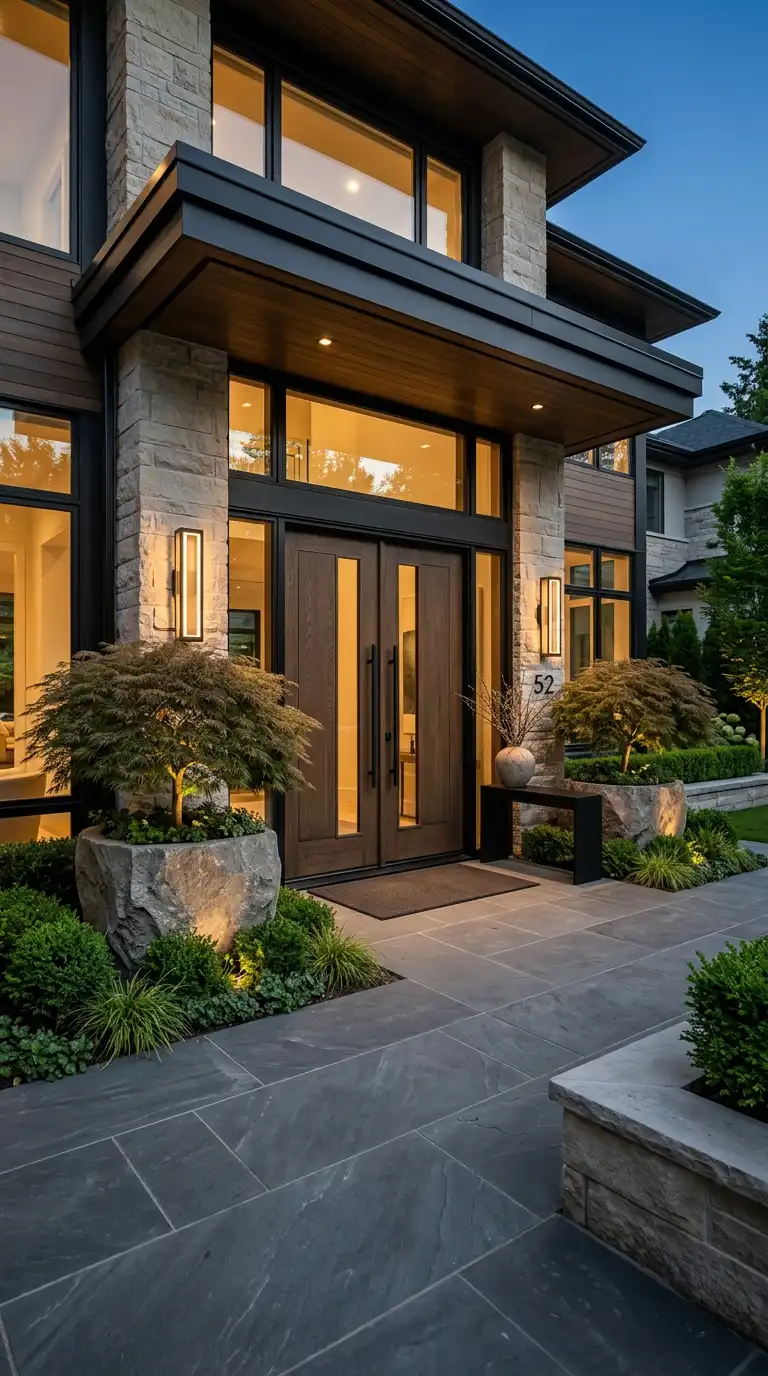
Oversized planters are the secret weapon of luxury design. They create instant drama and make a bold statement that screams “I have my life together” (even if you’re just faking it like the rest of us). There’s something about grand-scale elements that tricks the eye into perceiving higher value.
Luxury entryway must-haves:
- Massive planters (think 24+ inches in diameter)
- Sculptural plants like agave, ornamental grasses, or palms
- High-end materials: ceramic, concrete, or glazed pottery
- Matching or complementary oversized urns
- Statement door hardware in brass or bronze
- Clean, uncluttered lines
- Professional-looking address plaque
Investing in the Right Pieces
I’m not saying you need to drop thousands on planters (though you certainly can). But investing in one or two really substantial, quality pieces makes a bigger impact than a bunch of small, cheap items. I saved up and bought two massive concrete planters—they’re neutral enough to work with any style, they’re built to last, and they instantly upgraded my entryway’s perceived value.
Pro tip: Fill the bottom third of oversized planters with packing peanuts or empty plastic bottles before adding soil. You’ll save money on potting mix, and the planters won’t be impossibly heavy. You’re welcome.
Also Read: 10 Stunning Entryway Wall Decor Ideas to Transform Your Space – Airlucent
Minimalist Neutral Outdoor Entrance Design
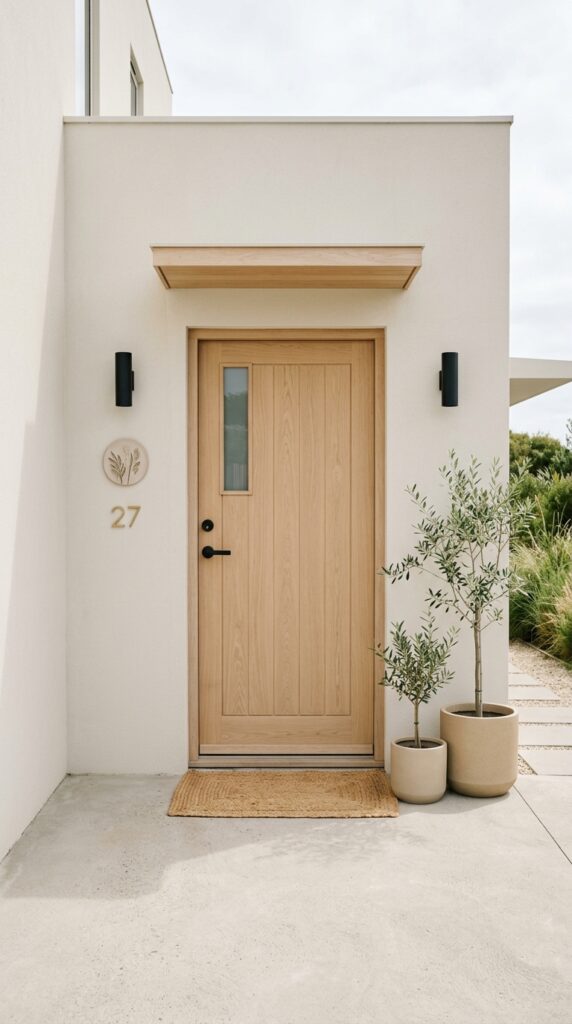
Sometimes, the most powerful statement is no statement at all. Minimalism strips everything back to the essentials, and there’s something incredibly calming about that approach.
The Philosophy of Less
Minimalist design isn’t about deprivation—it’s about intention. Every single element in your entryway should earn its place. No clutter, no excess, just carefully curated pieces that serve a purpose and look beautiful doing it.
Your minimalist entryway includes:
- Neutral color palette (whites, grays, beiges, blacks)
- Simple, modern door hardware
- One or two statement plants in sleek containers
- Clean-lined doormat in solid color
- Unadorned wreath or no wreath at all
- Hidden storage solutions
- Streamlined lighting fixtures
Creating Warmth in Minimal Spaces
The challenge with minimalism? Making it feel welcoming instead of cold. I learned this after my first attempt at a minimal entryway made my porch look like a dentist’s waiting room. Not cute.
The secret is texture within your neutral palette. I use a chunky knit throw over my modern bench, a natural fiber doormat with dimensional weave, and matte ceramic planters that catch the light beautifully. Everything stays neutral and simple, but the varied textures create visual interest and warmth. It’s minimal, not boring—there’s a difference.
Cottage-Inspired Floral Entryway Decor

If your aesthetic is “English countryside meets charming grandma,” cottage style will make your heart sing. This is garden party vibes all day, every day.
Bringing the Garden to Your Door
Cottage style is essentially an excuse to use ALL the flowers, and I support this fully. This romantic, soft approach creates an entryway that feels like stepping into a storybook. You want abundance, color, and that “I just gathered these from my garden” look (even if you bought them at the grocery store—I won’t tell).
Fill your cottage entryway with:
- Overflowing flower baskets and window boxes
- Pastel color scheme or vibrant garden colors
- Vintage watering cans as planters
- Painted wooden furniture in soft colors
- Climbing roses or flowering vines
- White picket fence elements
- Shabby chic painted signs
Managing the Floral Abundance
Real talk: cottage style requires maintenance. Dead flowers aren’t charming—they’re just sad. I rotate between fresh-cut flowers, high-quality faux florals (don’t come for me—the good ones are indistinguishable), and hearty perennials that actually survive my sporadic watering schedule.
My cottage entryway features two massive hanging baskets of petunias that I deadhead religiously (okay, semi-regularly), plus a vintage bicycle basket filled with whatever’s blooming. When I’m feeling lazy, I swap in realistic faux hydrangeas, and honestly? Nobody notices. The layered, abundant aesthetic is more important than whether every single bloom is real.
Rustic Outdoor Entryway with Lantern Accents
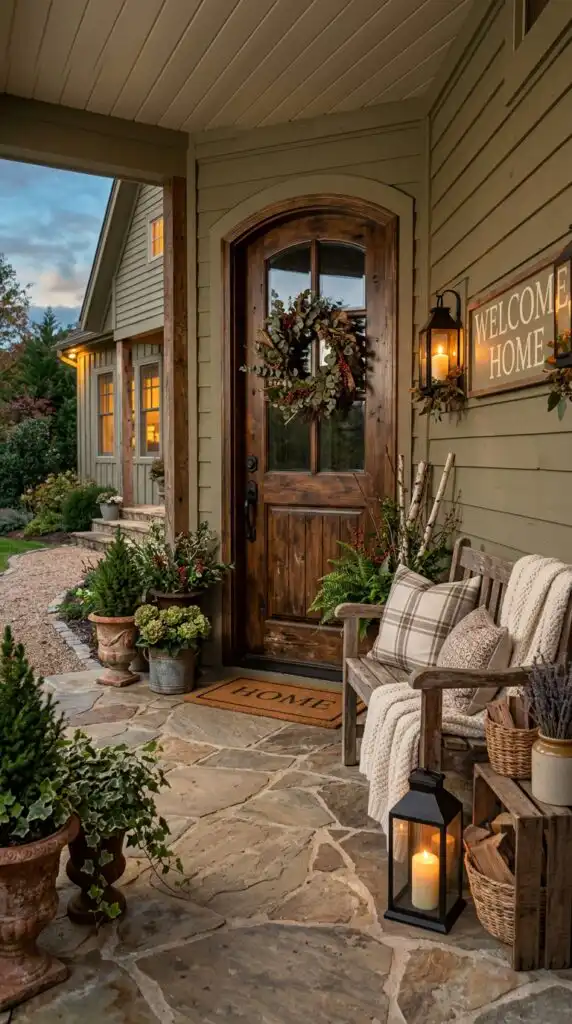
Rustic style is like farmhouse’s edgier cousin—more weathered wood, more metal, more “I could survive in a cabin in the woods” energy.
Creating Rustic Warmth
Lanterns are absolutely crucial to rustic style. There’s something about lantern light (real or faux) that creates instant coziness and warmth. I’m obsessed with how they look grouped together at varying heights—it’s like they’re having a little lantern party on your porch.
Rustic entryway essentials:
- Multiple lanterns in different sizes
- Weathered or reclaimed wood elements
- Metal accents with a patina or rust finish
- Plaid or buffalo check textiles
- Antlers, pinecones, or natural found objects
- Chunky wooden furniture
- Wrought iron hardware and fixtures
Balancing Rustic and Refined
The line between “rustic charm” and “literal junkyard” can be surprisingly thin. How do you keep it on the right side? Intentional placement and editing.
I group my lanterns in odd numbers (three or five looks more natural than even numbers) and keep them clean—rustic doesn’t mean dirty. My weathered wood bench shows its age beautifully, but I don’t just throw any old junk on my porch and call it rustic. Each piece should look like a treasure you discovered, not trash you forgot to throw away. Subtle difference, huge impact.
Also Read: 10 Simple Black Entryway Table Decor Ideas That Feel Premium – Airlucent
Seasonal Outdoor Entryway with Festive Touches

Last but definitely not least, let’s talk about embracing the seasons. Why commit to one look when you can have four different entryways throughout the year?
The Joy of Seasonal Rotation
I’ll admit it—I’m that person who starts decorating for fall on September 1st (fight me). Seasonal decorating keeps your entryway fresh, gives you an excuse to shop for new decor (oops), and marks the passage of time in a really lovely way. Plus, your neighbors will lowkey watch to see what you do next.
Build your seasonal rotation around:
- Fall: Pumpkins, mums, corn stalks, warm-toned wreaths
- Winter: Evergreen boughs, pinecones, lanterns with candles, festive ribbon
- Spring: Tulips, daffodils, pastel colors, bird nests, fresh wreaths
- Summer: Bright flowers, patriotic elements, fresh greenery, tropical vibes
Creating a Seasonal Base
Here’s what I’ve learned after years of seasonal decorating: you need a neutral foundation that works year-round. I keep my core furniture, planters, and structural elements neutral so I’m not constantly moving heavy stuff around.
My base includes two large neutral planters and a wooden bench. These stay put. Then I swap out the plants, pillows, wreaths, and accessories with each season. For fall, I fill the planters with ornamental kale and mums, drape the bench with a plaid blanket, and hang a grapevine wreath. Come spring, those same planters hold bright tulips and pansies, the bench gets pastel pillows, and I swap in a fresh eucalyptus wreath. Same bones, completely different vibe.
Making Seasonal Decor Budget-Friendly
Look, I love seasonal decor, but I’m not made of money. I shop clearance sales right after each season ends (70% off Halloween stuff on November 1st? Yes, please), I reuse elements in creative ways, and I hit up dollar stores for budget-friendly seasonal finds.
You don’t need to buy all new decor for every season. Mix high and low, reuse what you can, and focus on one or two statement seasonal pieces while keeping everything else neutral. My expensive evergreen garland lasts for years, but I pick up fresh florals and cheap pumpkins each season to keep things current.
Pulling It All Together
So there you have it—ten completely different ways to transform your outdoor entryway from forgotten space to fabulous first impression. Whether you’re team modern minimalist or cottage maximalist, there’s a style here that’ll speak to you.
The truth is, your entryway should reflect your personality. Don’t force a style just because it’s trending on Pinterest. If you love it, it’ll show. And if you hate maintaining flowers, maybe skip the cottage look (or embrace those realistic faux blooms—I support your choices).
Start with one or two elements that excite you. Maybe it’s those oversized planters you’ve been eyeing, or finally painting your front door that moody black you’ve been fantasizing about. You don’t have to transform everything overnight. Small changes create big impact when they’re thoughtful and intentional.
And remember—your outdoor entryway isn’t just for guests. You come home to this space every single day. Make it something that brings you joy, makes you smile, and sets the tone for what’s inside. Because at the end of the day, that front porch magic? It’s really about creating a space that feels like you.
Now if you’ll excuse me, I need to go rearrange my lanterns for the fifteenth time this week. It’s a process, okay?